
A honing rod doesn’t sharpen your knife, and that’s the most useful thing to understand before buying one. As you cut, the thin edge of a knife bends over a tiny bit, so it feels dull while the steel is still there. A few strokes on a rod push that edge back in line. Do it every few uses and you’ll need a real sharpener far less often.
The rod you need depends on your knives. Classic grooved steels suit softer German knives; ceramic rods suit almost everything, including harder Japanese blades. The rod I’d hand most home cooks is the Work Sharp Kitchen Ceramic Honing Rod, because its angle guide takes the guesswork out of the stroke. If your block is all German, the WÜSTHOF 9-Inch Honing Steel is the classic choice.
My Top 5 Honing Rod Picks

Ceramic, with angle guidance built in, so beginners hold the knife at a steady angle instead of guessing. Ceramic is gentle enough for Japanese knives and works on serrated ones too.

The traditional steel rod for German knives: forged from high carbon stainless and hardened to 58 HRC, magnetic so the tiny metal bits stick to it. A natural partner for WÜSTHOF, ZWILLING and Victorinox blades.
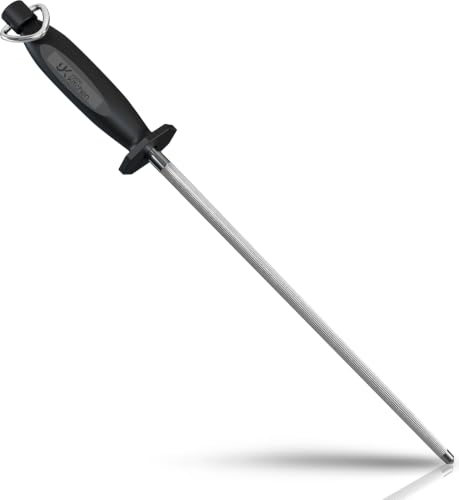
A plain carbon steel rod with a nickel-chrome finish, a non-slip handle and a hanging loop. It costs very little and does the daily job on soft, inexpensive kitchen knives.
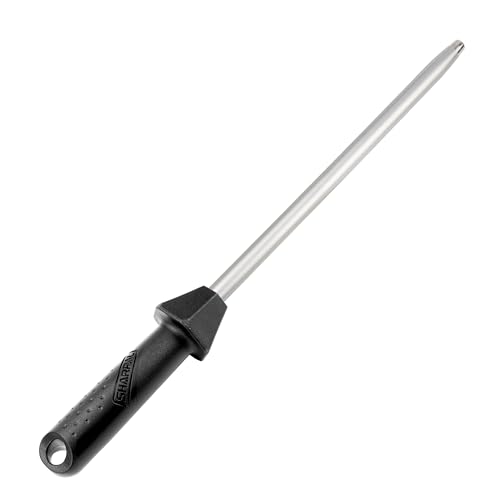
Fine 1200 grit diamond with angle guides on the handle. Unlike a honing steel, it removes a little metal, so it can bring back an edge that honing alone no longer fixes.

Built for Shun’s 16 degree edges, with a guide to set the angle. A smooth side for weekly honing and a micro-ribbed side for monthly touch-ups, on a Pakkawood handle.
Honing Rods Compared
| Rod | Material | Length | Angle help | Best for |
|---|---|---|---|---|
| Work Sharp Ceramic | Ceramic | Not stated | Built-in angle guide | Mixed knife collections, beginners |
| WÜSTHOF 9-Inch | High carbon stainless steel, 58 HRC | 9″ | None | German knives |
| Utopia Kitchen | Nickel-chrome plated carbon steel | 10″ | None | Budget and everyday knives |
| SHARPAL 119N | 1200 grit diamond | Not stated | Angle guides | Hard steels, quick touch-ups |
| Shun Combination | Stainless steel, smooth and micro-ribbed | 9″ | 16 degree guide | Shun and other Japanese knives |
1. Work Sharp Kitchen Ceramic Honing Rod: Best Overall
Who it’s for: home cooks with a mix of knives, and anyone who has never used a rod and worries about getting the angle wrong.
The hardest part of honing isn’t the motion, it’s holding the same angle on every stroke. Most people start steep, drift flatter, and end up rounding the edge instead of straightening it. Work Sharp builds angle guidance into this rod, so the knife has something to rest against at the start of each pass. That turns honing from a knack into a routine.
I like ceramic as the default material because it suits more knives than steel does. A ceramic rod is harder than any kitchen steel, so it straightens the edge and polishes it very slightly, without the coarse grooves that can tear at a thin Japanese edge. Work Sharp lists it for every knife in a normal block, serrated ones included. I already suggest a Work Sharp ceramic rod in my Miyabi sharpening guide for exactly this reason.
Ceramic has one weakness: it’s brittle. Drop the rod on a tile floor and it can chip or snap. Hang it up or keep it in a drawer where it can’t roll off the counter. And because ceramic removes a tiny amount of metal, it’s more than a pure realigner; that’s a benefit for most cooks, but you don’t need to use it every single day.
Key specs
- Material: ceramic
- Built-in angle guidance
- Suits plain and serrated kitchen blades (maker)
- Brand: Work Sharp (sharpening specialist)
Pros
- Angle guide helps beginners get it right
- Safe for both German and Japanese knives
- Also refines serrated edges
Cons
- Ceramic can break if dropped
- Length not stated on the listing
My verdict: the rod I’d recommend first, especially in a kitchen with both German and Japanese knives. If you only own soft German knives and like the classic steel feel, the WÜSTHOF is just as good.
2. WÜSTHOF 9-Inch Honing Steel: Best Classic Steel
Who it’s for: owners of German knives (WÜSTHOF, ZWILLING, HENCKELS, Victorinox) who want the traditional tool.
This is the rod you see in butcher shops and restaurant kitchens: a long steel with fine lengthwise grooves. WÜSTHOF forges it from high carbon stainless steel and tempers it to 58 HRC, the same hardness as its Classic knives. That’s important. A steel rod has to be at least as hard as the knife it’s straightening, and German knives at 56 to 58 HRC are exactly what this rod was made for.
The rod is magnetic, so the tiny particles of metal that come off during honing stick to it instead of to your food. Nine inches is enough for chef’s knives up to about 8 inches, and the shorter length is easier to control than the 12-inch steels in pro kitchens. My guide to sharpening WÜSTHOF knives explains how honing fits between sharpenings: German knives are soft and tough, so they bend rather than chip, and a quick steel brings them back.
The catch is hard Japanese steel. A grooved steel can scratch or chip a thin edge at 60 HRC or more, so don’t use this one on your gyuto. And WÜSTHOF’s listing loosely says it sharpens dull knives. It doesn’t: it realigns. Once honing stops helping, you need a real sharpener.
Key specs
- Length: 9 inches
- Material: high carbon stainless, forged, hardened to 58 HRC
- Magnetic rod collects metal particles
- Brand: WÜSTHOF, Solingen, Germany
Pros
- Matched to German knife hardness
- Manageable 9-inch length
- Magnetic, cleaner honing
Cons
- Not for hard Japanese knives
- No angle guide for beginners
My verdict: the right steel for a German knife block, and a lifetime tool if you hang it up. Mixed collections are better served by the Work Sharp ceramic rod.
3. Utopia Kitchen 10-Inch Honing Rod: Best Budget
Who it’s for: first kitchens, budget knife sets that came without a steel, and anyone who wants to try honing before spending more.
Utopia’s rod is about as simple as honing tools get: a carbon steel rod plated with nickel-chrome, a non-slip handle, a guard and a loop to hang it by. The fine surface is meant to straighten the edge without biting into it. For the soft steel in most inexpensive knife sets, that’s all you need.
I’d happily put this rod in a first kitchen. Cheap knives are the ones that need honing most, because soft steel rolls quickly. A rod that costs very little and lives on a hook by the stove gets used, and a used rod beats a fancy one in a drawer.
Two cautions. The plating is a coating over carbon steel, so dry the rod after washing, as Utopia itself instructs, or it can rust. And I wouldn’t use it on hard Japanese knives. The listing says it handles serrated knives too, but a round rod only touches the tops of the teeth. For serrated bread or steak knives, a narrow ceramic rod or a sharpening service does a better job.
Key specs
- Length: 10 inches
- Material: carbon steel, nickel-chrome plated
- Non-slip ergonomic handle for left or right hand
- Hanging loop
Pros
- Costs very little
- Fine for soft, everyday knives
- Easy to store on a hook
Cons
- Must be dried to avoid rust
- Not for hard Japanese steel
My verdict: the cheapest way to keep a budget knife set cutting. If you own one good German knife, the WÜSTHOF steel is worth the step up.
4. SHARPAL 119N Diamond Sharpening Steel: Best Diamond Rod
Who it’s for: cooks whose knives have gone past what honing can fix, and owners of very hard steels who want a fast touch-up without a stone.
A diamond rod is an in-between tool. It looks like a honing steel, but the surface is coated with diamond particles, so it actually grinds a little metal away. SHARPAL uses fine 1200 grit diamond, which it describes as suited to routine maintenance. In practice, that means a few strokes put a fresh, slightly toothy edge on a knife that a smooth steel no longer helps.
The handle has angle guides and a protective ring to keep your hand away from the blade. SHARPAL is a California sharpening brand with branches in Germany and Australia, and the listing promises three years of after-sale support. Diamond is also one of the few things harder than ceramic, so SHARPAL says it works on very hard materials; for ceramic knives specifically, my ceramic knife sharpening guide explains why diamond is the right tool.
Because it removes steel, a diamond rod shouldn’t be your every-day honing tool. Used daily, it wears your knives faster than they need. Keep a ceramic or steel rod for routine honing and reach for this one when the knife stops responding. Light pressure only: diamond cuts quickly.
Key specs
- Surface: 1200 grit diamond coating
- Built-in angle guides
- Protective ring on the handle
- Brand: SHARPAL, California, USA
Pros
- Restores edges that honing can’t
- Works on very hard steels
- Angle guides help consistency
Cons
- Removes metal, so not for daily use
- Too aggressive in heavy hands
My verdict: a smart second rod for touch-ups between full sharpenings. As your only rod, it’s more than most kitchens need.
5. Shun Premier 9-Inch Combination Honing Steel: Best for Japanese Knives
Who it’s for: Shun owners, and cooks with other Western-handled Japanese knives sharpened around 15 to 16 degrees.
Shun designed this steel around its own knives. The built-in angle guide sets the knife at 16 degrees, the angle Shun sharpens its double-bevel blades to, so you don’t have to estimate it. The rod has two faces: a smooth side for weekly honing and a micro-ribbed side for a slightly stronger monthly touch-up. That’s the routine I describe in my guide to sharpening Shun knives.
The smooth face is the reason it’s safe on hard Japanese steel. A coarse grooved steel can chip a thin, hard edge; a smooth one just nudges it straight. The contoured Pakkawood handle matches Shun’s knife handles and suits both left and right hands.
It’s a specialist rod. The 16 degree guide is wrong for German knives at around 20 degrees, and for very hard or very thin Japanese knives (Miyabi’s SG2 knives, for example) I’d still choose ceramic. It also costs more than the other steels here. But if your block says Shun, this is the steel made for it.
Key specs
- Length: 9 inches
- Two faces: smooth for weekly use, micro-ribbed for monthly use
- Built-in 16 degree angle guide
- Contoured Pakkawood handle, ambidextrous
Pros
- Angle set for Shun knives
- Smooth face is kind to hard steel
- Two surfaces for two jobs
Cons
- Angle guide doesn’t suit German knives
- Pricier than a ceramic rod
My verdict: the steel to buy alongside a Shun knife. For a mixed collection, the Work Sharp ceramic rod is more flexible.
Steel, Ceramic or Diamond: Choosing a Rod
Match the rod to your hardest knife
Choose the rod for the hardest knife you own, because a rod that’s softer than the blade does nothing and a coarse one can damage thin edges. German knives (around 56 to 58 HRC) work with steel, ceramic or diamond. Japanese knives (around 60 HRC and up) want ceramic or a smooth steel. My German vs Japanese knives guide explains the difference in steel.
Grooved steel realigns, ceramic polishes, diamond sharpens
A grooved steel only straightens the edge. Ceramic straightens it and also shaves off a trace of metal, so a knife stays keen longer between sharpenings. Diamond removes noticeably more, so it works as a quick sharpener rather than a daily hone. Most home cooks get the best balance from ceramic.
Length: longer than your longest knife
Pick a rod at least as long as your longest knife’s blade, so you can hone heel to tip in one smooth stroke. A 9 to 10 inch rod handles chef’s knives up to 8 inches; buy 12 inches if you use a long slicer or brisket knife.
Angle guides are worth having
Angle guides help beginners more than any other feature. Holding a steady angle is the whole skill of honing, and a guide sets it for you at the start of each stroke. Once the motion feels natural, you’ll hold the angle without looking.
How to Use a Honing Rod
Stand the rod vertically, its point resting on a folded towel on the counter. Set the heel of the knife near the rod’s upper end at about 15 degrees for Japanese knives or 20 degrees for German knives. Pull the blade downward and back toward your body, so the whole edge from heel to tip touches the rod in one pass.
Alternate sides, five to eight light strokes each. Pressure should be no more than the weight of the knife; pressing hard bends the edge instead of straightening it. Then test on a sheet of paper or a tomato, as I describe in my guide on how to tell if a knife is sharp enough. If it still drags after honing, the edge is worn away and it’s time for a sharpener.
FAQ
What is the difference between honing and sharpening?
Honing straightens an edge that has bent over; sharpening grinds new metal to make a new edge. A honing rod does the first job in seconds and can be used every few days. Sharpening on a stone or sharpener is needed only a few times a year if you hone regularly.
How often should I hone my knives?
Hone soft German knives every few uses, or before any big prep session. Hard Japanese knives need it less often, about once a week, because their steel bends less. If a knife feels dull, hone it first before you reach for a sharpener.
Can I use a honing steel on Japanese knives?
Use a ceramic rod or a smooth steel, not a coarse grooved one. Hard Japanese steel can chip on the ridges of a butcher’s steel. Shun’s combination steel and the Work Sharp ceramic rod are both safe choices.
Can you hone a serrated knife?
Only partly. A regular round rod touches the tips of the teeth, not the scallops between them. A narrow ceramic rod worked into each serration, or a professional sharpening service, is the proper fix for serrated knives.
Does a honing rod wear out?
Yes, slowly. The ridges on a grooved steel smooth out after years of use, and a ceramic rod can glaze with metal particles or chip if dropped. Clean a ceramic rod with a mild abrasive cleaner and replace any rod whose surface feels slick or damaged.
Is a honing steel the same as a sharpening steel?
Mostly, yes. “Sharpening steel” is a common name for a honing rod, but a plain steel rod doesn’t sharpen. Only a diamond-coated steel removes enough metal to count as sharpening.
Final Verdict
For most kitchens, the Work Sharp Kitchen Ceramic Honing Rod is the best place to start: the angle guide teaches good technique, and ceramic is safe on both German and Japanese knives. If you only own German knives, the WÜSTHOF 9-Inch Honing Steel is the classic tool matched to their hardness. And for a budget set that never came with a rod, the Utopia Kitchen rod costs very little and keeps soft knives cutting.
When a few strokes on the rod stop helping, it’s time for a proper sharpener: start with my best knife sharpener picks.

Gary Portman founded knivesadvice.com in 2019. He learned to cook in his family’s kitchen as a kid and has used kitchen, pocket and outdoor knives ever since, from paring and fillet knives to survival blades he carries camping and hiking. He writes the site’s buying guides, brand reviews and sharpening how-tos to help readers find the right knife for the job. More about Gary.