
Cuisinart knives come out of the box sharp, and then, within a few weeks of daily cooking, they don’t. That isn’t a fault so much as the trade-off of the steel: Cuisinart uses a fairly soft high-carbon stainless (it doesn’t publish the grade or hardness), which is tough, rarely chips and sharpens in minutes, but loses its bite quickly.
The fix is a habit, not a fancy tool. Hone the knives every few uses, and sharpen them a few times a year on a simple pull-through, an electric sharpener or a whetstone. Any of the three works on Classic Triple Rivet, Graphix and the colorful ceramic-coated Advantage knives alike, because those are all steel underneath.
For most Cuisinart owners, I’d start with Cuisinart’s own 3-Slot Foldable Knife Sharpener: coarse, medium and fine slots, a cover over the abrasives and a non-slip base. Anyone who wants the best possible edge should learn a whetstone, and because Cuisinart steel is soft and forgiving, it’s one of the easiest knives to learn on.
What Angle Should You Sharpen Cuisinart Knives?
About 20 degrees per side is the safe choice for Cuisinart knives. Cuisinart doesn’t publish an edge angle, and its sharpeners use preset guides, so you don’t need to know the number to use them. If you sharpen on a whetstone, 20 degrees gives soft steel a sturdy edge; you can go down toward 15 for a keener edge on a slicing knife, but it will need honing more often.
Consistency matters more than the exact number. An edge sharpened at a steady 18 degrees cuts better than one that wanders between 15 and 25.
How to Use a Cuisinart Manual Knife Sharpener
Use the coarse slot only for a dull knife, then work through the finer slots with light pressure, always drawing the blade from heel to tip. These steps work for both Cuisinart pull-through sharpeners on this page:
- Set it on a flat counter. Unfold the handle (or slide it open on the knife and shears model) and hold it firmly with your free hand.
- Decide where to start. A truly dull or nicked knife starts in the coarse slot; one that has only lost its bite starts in the fine one.
- Coarse slot: 3 to 6 pulls. Place the heel in the slot, keep the blade straight up and down, and draw it toward you to the tip with even, light pressure. Always pull in one direction.
- Middle slot (3-slot model): 4 to 6 pulls the same way, to sharpen the new edge.
- Fine slot: 6 to 10 pulls with lighter pressure to hone and smooth it.
- Wipe and test. Wipe off any metal dust and slice a sheet of paper. Snags mean a few more pulls in the fine slot.
For shears, open them fully and draw one blade at a time through the shears slot, from the pivot to the tip.
How to Use an Electric Knife Sharpener on Cuisinart Knives
Pull the knife slowly through each slot of the coarse stage, alternating sides, then repeat in the fine stage. Let the motor do the work.
- Switch the sharpener on and let the wheels reach full speed.
- Place the heel of the blade in the left slot of the first stage, resting against the blade guide.
- Draw the knife through to the tip at a slow, even speed, about 3 to 4 seconds for an 8″ knife. Don’t press down.
- Repeat in the right slot, so both sides are sharpened equally. Do 3 to 6 alternating pulls, more only if the knife is very dull.
- Move to the fine stage and repeat with the same alternating pulls.
- Turn it off, wipe the blade clean and empty the filings as the manual describes.
Electric sharpeners remove more steel than a hand tool, so use the coarse stage only when the knife is dull. For routine touch-ups, the fine stage alone or a honing steel is enough. If you don’t own one yet, my best electric knife sharpeners compares the models worth buying.
How to Sharpen a Cuisinart Knife on a Whetstone
Soak the stone, sharpen on the coarse side until you raise a burr, then finish on the fine side. A whetstone gives soft Cuisinart steel its best edge and removes the least metal.
- Soak the stone in water for 10 to 15 minutes and set it on its rubber base, 400 side up for a dull knife, 1000 side up if it only needs refreshing.
- Hold about 20 degrees. A good guide: halve a right angle to 45, halve again to about 22, then drop the spine slightly.
- Stroke the edge across the stone as if cutting a thin slice off it, heel to tip, keeping the angle steady. Keep the surface wet.
- Raise a burr. When you can feel a thin lip of metal along the whole opposite side, turn the knife over and repeat.
- Finish on 1000 grit with lighter, alternating strokes until the burr is gone, then rinse and dry the knife.
Soft steel raises a burr quickly, so it takes fewer strokes than a Japanese knife. The flip side is that the burr is floppy; a few final strokes on the honing steel straighten it out.
How to Hone Cuisinart Knives
Hone every few uses with 4 to 5 light strokes per side on a steel. It takes 20 seconds and does more for a Cuisinart’s edge than any sharpener, because soft steel bends out of line long before it truly wears down.
Hold the steel upright with its tip on a towel, set the blade at roughly 20 degrees, and draw it down and toward you from heel to tip, alternating sides. Many Cuisinart block sets, including the Classic Triple Rivet 15-piece, already include a steel; use it. Sets with self-sharpening slots do this for you, which is the real difference in my Calphalon vs Cuisinart comparison. My Cuisinart knives review lists which sets come with one.
Tools I’d Use
One sharpener, one steel, and a stone if you want to go further.
1. Cuisinart 3-Slot Foldable Knife Sharpener: The Easy Pull-Through

Coarse tungsten carbide to restore a dull edge, a diamond slot to sharpen and alumina ceramic to hone, with a folding handle, a cover over the abrasives and a silicone base. It folds flat into a drawer and carries Cuisinart’s limited lifetime warranty. The carbide slot removes steel quickly, so save it for truly dull knives.
2. HENCKELS Sharpening Steel: For Honing Every Few Uses

Soft Cuisinart edges drift out of line fast, and a few strokes per side on a plain steel bring the bite back between sharpenings. HENCKELS suggests honing every other use and backs it with a lifetime guarantee. It won’t fix a truly dull edge; that’s the sharpener’s job.
3. KEENBEST 400/1000 Whetstone: For the Best Edge
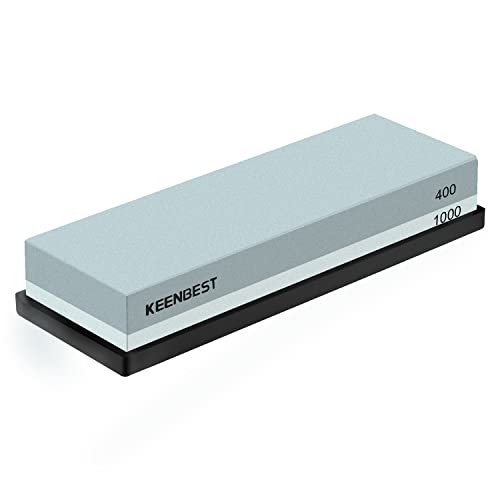
Two water stones on rubber bases: 400 grit silicon carbide for neglected edges and 1000 grit to finish, which is as fine as soft Cuisinart steel really needs. Soak them 10 to 15 minutes first. It takes practice to hold the angle, and budget stones like these wear and need flattening over time.
FAQ
Can you sharpen Cuisinart knives?
Yes. Cuisinart knives use soft stainless steel that sharpens quickly on a pull-through, electric sharpener or whetstone. Hone them every few uses and sharpen a few times a year.
How do you sharpen Cuisinart ceramic knives?
Most Cuisinart “ceramic” knives, like the Advantage color sets, are stainless steel with a ceramic coating, so sharpen them like any steel knife. The coating will wear off right at the edge, which is normal. Solid ceramic knives are different and need diamond abrasives; see how to sharpen a ceramic knife.
Can Cuisinart Classic Triple Rivet steak knives be sharpened?
Yes. Straight-edge steak knives sharpen like any other Cuisinart knife. Serrated ones need a tapered rod worked into each scallop, never the coarse slot of a pull-through, which flattens the teeth.
Can you sharpen Cuisinart Advantage knives?
Yes, in a pull-through, an electric or on a stone, exactly like the steel knives. Expect the colored coating to rub off along the edge, which doesn’t affect how they cut.
What angle are Cuisinart knives sharpened to?
Cuisinart doesn’t publish one. Its sharpeners use preset guides, and about 20 degrees per side is a safe angle if you sharpen on a whetstone.
How often should you sharpen Cuisinart knives?
A few times a year for most home cooks, with honing every few uses in between. If honing no longer brings the edge back, it’s time to sharpen.
Final Verdict
Cuisinart knives are some of the easiest kitchen knives to keep sharp: soft steel, about 20 degrees, a pull-through or a stone, and frequent honing. Sharpen when honing stops bringing the edge back, and keep the coarse stage for knives that are truly dull.
Deciding whether to keep your Cuisinart set or move up? Read are Cuisinart knives worth it. For a pull-through you can also take camping, see my Smith’s knife sharpener guide, and to compare every type side by side, my best knife sharpener picks.

Gary Portman founded knivesadvice.com in 2019. He learned to cook in his family’s kitchen as a kid and has used kitchen, pocket and outdoor knives ever since, from paring and fillet knives to survival blades he carries camping and hiking. He writes the site’s buying guides, brand reviews and sharpening how-tos to help readers find the right knife for the job. More about Gary.