
Work Sharp is the sharpening brand I’d point most people to first, with one condition: buy the right model, because the range runs from a simple kitchen pull-through to belt grinders that will reshape an axe. The guided and field sharpeners are the strongest part of the lineup. They give beginners a repeatable angle without the learning curve of a whetstone, and they suit people with a mix of kitchen, pocket and hunting knives.
Skip Work Sharp if you own only expensive Japanese knives and enjoy sharpening by hand; a good whetstone suits you better. My pick for most buyers is the Work Sharp Precision Adjust, and for fast, powered sharpening the Ken Onion Mk2.
My Top 6 Work Sharp Picks
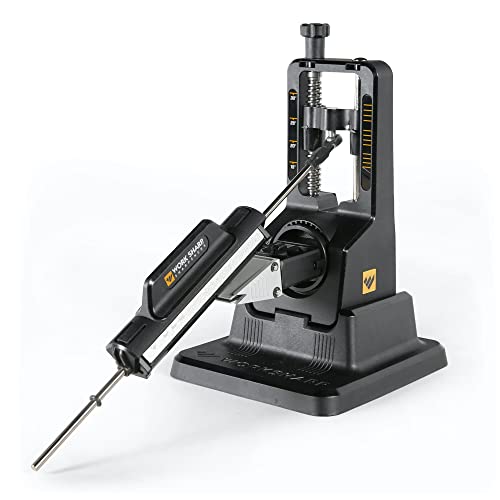
Clamp the knife, dial the angle from 15 to 30 degrees, and stroke the abrasive across it. It’s the easiest way I know to get the same edge every time on almost any knife.

Work Sharp’s best powered machine: a flexible belt, an adjustable 15 to 30 degree guide and variable speed. Quick on knives, scissors and tools alike.

Diamond plates, ceramic rods and a leather strop folded into one pocket-sized tool, with 20 and 25 degree guides. The sharpener I’d throw in a hunting pack.

A cheap two-stage pull-through that uses diamond rather than carbide, so it grinds the edge instead of scraping it. Fine for an everyday block of Western knives.

A magnetic angle block with four preset angles and a diamond roller. Pleasant to use on the counter, and the abrasives can be replaced.

A ceramic rod with built-in angle guidance, for a few quick strokes before you cook. It keeps knives sharp longer between full sharpenings.
What Work Sharp Does Well
Guided angles for people who don’t want to learn a stone
Work Sharp’s real strength is angle control. The Precision Adjust, Guided Field Sharpener, rolling sharpener and Ken Onion all hold or guide the blade at a set angle, which is the hardest part of sharpening by hand. That makes a sharp, even edge possible on day one.
One brand for kitchen and outdoor knives
Most sharpening brands lean kitchen or lean outdoor. Work Sharp covers both: adjustable systems for chef’s knives at 15 to 20 degrees, field kits for hunting knives at 20 to 25, and belt machines that also do scissors, axes and garden tools.
Support and spare parts
Work Sharp designs, engineers and calibrates its sharpeners in Ashland, Oregon, and its listings promise a 3-year warranty. Replacement belts and abrasives are easy to buy, which matters for belt machines and rolling sharpeners that wear through abrasives.
What Work Sharp Does Badly
Belt machines are easy to misuse
A rounded tip is the problem owners of Work Sharp’s belt sharpeners report more than any other. If you drag the point off the end of the belt, it takes the tip with it, and belts remove steel fast. They reward a few careful practice sessions on a cheap knife.
A confusing lineup
MK2, Mk.2, Ken Onion Mk2, Ken Onion Elite Mk2, E2, E5, Precision Adjust, Precision Adjust Elite, Professional Precision Adjust: the names overlap and the differences aren’t always clear on a listing. I’ve sorted the main ones in the table below.
The kitchen electrics say little
Work Sharp’s compact kitchen electrics, like the E2, don’t publish an angle or abrasive on their listings. I prefer its guided and belt systems, where you know exactly what you’re getting.
Work Sharp Sharpeners Compared
| Model | Type | Angle | Abrasives | Best for |
|---|---|---|---|---|
| Precision Adjust | Guided, manual, clamp | 15 to 30 degrees | Coarse to fine set | Mixed knife collections |
| Precision Adjust Elite | Guided, manual, clamp | 15 to 30 degrees | 320 and 600 diamond, ceramic, serrated rod | Upgrade with more abrasives |
| Ken Onion Mk2 | Electric belt | 15 to 30 degrees | Quick-change belts | Fast sharpening, tools |
| MK2 Knife and Tool | Electric belt, two speeds | Edge guide | Flexible belts | Garage, garden tools |
| Guided Field Sharpener | Handheld field kit | 20 or 25 degrees | Diamond, ceramic, leather | Hunting, camping, pocket knives |
| Rolling Knife Sharpener | Magnetic block and roller | Four presets | Diamond | Kitchen knives on the counter |
| Pull Through Kitchen | Manual pull-through | Fixed | Diamond, two stages | Budget kitchen upkeep |
| Kitchen Ceramic Honing Rod | Honing rod | Angle guidance | Ceramic | Daily touch-ups |
1. Work Sharp Precision Adjust Knife Sharpener: Best Work Sharp Overall
Who it’s for: anyone with a mix of kitchen, pocket and hunting knives who wants reliable results without learning freehand sharpening.
The Precision Adjust is the Work Sharp I’d buy first. You lock the blade in its clamp, pick an angle between 15 and 30 degrees, then sweep a guided abrasive along the edge. Because the angle is fixed by the jig, every stroke hits the same bevel, which is what makes an edge sharp. Work Sharp includes graded abrasives from coarse to fine, so it can repair a chipped blade and then refine it.
The angle range is why it suits mixed collections: 15 for a Japanese gyuto, 20 for a German chef’s knife, 25 for a hunting knife, 30 for something that takes abuse. It needs no power, folds down to store and is quiet enough for a kitchen counter.
It’s slower than an electric, and long kitchen knives need a little care to keep the tip and heel at the same angle. If you outgrow the stock abrasives, the Precision Adjust Elite adds 320 and 600 grit diamond plates, a ceramic rod and a rod for serrated knives.
Key specs
- Type: manual, guided, fixed-angle clamp system
- Angle: adjustable 15 to 30 degrees
- Graded abrasives, coarse to fine
- No power needed; folds for storage
Pros
- Repeatable edge with no freehand skill
- Suits kitchen, pocket and hunting knives
- Gentle on steel compared with a belt
Cons
- Slower than an electric
- Long blades take some care
My verdict: the Work Sharp almost everyone should start with. Only buy the Ken Onion if speed matters more than control.
2. Work Sharp Ken Onion Mk2 Electric Knife Sharpener: Best Electric
Who it’s for: people who sharpen often, for several households or a big collection, and want it done fast.
The Ken Onion edition is named after the well-known knife designer, and it’s Work Sharp’s most capable machine. A flexible belt runs past an adjustable guide, set anywhere from 15 to 30 degrees, and a speed control lets you slow it down for finishing or speed it up to repair a damaged edge. Belts swap in seconds when you move from coarse to fine.
The flexible belt is what makes it more versatile than a wheel sharpener. It follows curved blades, recurves and tanto tips, and Work Sharp lists serrated blades, scissors, shears and garden tools as well. For someone sharpening knives for friends and family, nothing else in the range is as quick.
It’s also the easiest Work Sharp to get wrong. Belts take off steel quickly, the tip rounds if you pull it off the end of the belt, and replacement belts add up over time. I’d practice on an old knife before touching a good one.
Key specs
- Type: electric belt sharpener
- Angle: adjustable 15 to 30 degrees
- Variable speed; quick-change belts
- Knives, serrated blades, scissors, shears, tools
Pros
- Fastest sharpener in the range
- Handles odd blade shapes
- Adjustable angle and speed
Cons
- Learning curve; tips round easily
- Belts are an ongoing cost
- Most expensive pick here
My verdict: the powered Work Sharp worth owning if you sharpen a lot. For a few kitchen knives, the Precision Adjust is safer and cheaper.
3. Work Sharp Guided Field Sharpener: Best for the Field
Who it’s for: hunters, campers, anglers and pocket knife owners who need a complete sharpener in a pack.
This is a whole sharpening kit in one compact body. You get diamond plates for sharpening, a rotating ceramic rod with coarse, fine and grooved surfaces, a leather strop, and angle guides at 20 and 25 degrees. Pull the diamond plates off and there’s a broad head wrench underneath, a nice touch for hunters.
The angle guides help, but unlike the Precision Adjust they guide rather than hold the blade, so you still need a steady hand. That’s the fair trade for something you can carry in a pocket. For pocket knife owners, my guide on how to sharpen a pocket knife walks through the strokes.
It’s designed for outdoor knives. A thin kitchen knife at 15 degrees isn’t what it’s built for, and the small plates are slow on long chef’s knives.
Key specs
- Type: handheld field sharpener
- Angles: 20 and 25 degree guides
- Diamond plates, ceramic rod (coarse, fine, grooved), leather strop
- Broad head wrench under the diamond plates; 3-year warranty
Pros
- Complete kit, pocket-sized
- Strop and ceramic for a refined edge
- Low cost for what’s included
Cons
- Guides, doesn’t hold the angle
- Slow on long kitchen knives
My verdict: the outdoor sharpener I’d recommend to almost anyone who hunts or camps. Keep it out of the kitchen drawer.
4. Work Sharp Pull Through Kitchen Knife Sharpener: Best Budget Kitchen
Who it’s for: cooks with ordinary Western kitchen knives who want a cheap, quick fix.
Most cheap pull-through sharpeners use carbide blades that scrape steel off the edge, which works but leaves a rough, torn edge. Work Sharp’s version uses diamond instead, which grinds the edge more evenly. There’s a coarse stage for dull knives and a fine stage to refine, and Work Sharp lists chef’s, paring, utility and serrated knives plus shears.
For the price, it’s the pull-through I’d keep in a kitchen drawer. It’s small, it needs no skill, and it’s a big step up from the free sharpener that comes with many knife sets.
A pull-through still grinds at one fixed angle, so it isn’t a good choice for hard Japanese knives. And like any coarse stage, save the first slot for knives that have properly lost their bite.
Key specs
- Type: manual pull-through, two stages (coarse, fine)
- Abrasive: diamond, not carbide
- Chef’s, paring, utility and serrated knives; shears
- Compact countertop footprint
Pros
- Costs very little
- Diamond grinds more evenly than carbide
- No skill needed
Cons
- One fixed angle
- Not for Japanese knives
My verdict: the cheapest way into Work Sharp for a kitchen. If your knives are good, step up to the rolling sharpener or Precision Adjust.
5. Work Sharp Rolling Knife Sharpener: Best Rolling Sharpener
Who it’s for: home cooks who want a guided sharpener that sits nicely on the counter.
Rolling sharpeners have become popular for a simple reason: they’re easy. You stick the knife to a magnetic angle block, then roll a diamond disc along the edge. The block holds the angle, the roller does the grinding, and you get a consistent edge without holding anything at an angle yourself. Work Sharp’s version offers four preset angles for different kitchen knives.
What makes me prefer it to most rolling sharpeners is support. Work Sharp sells replacement abrasives for it, while many look-alike rollers are effectively disposable once the disc wears out.
It’s a kitchen tool: pocket and hunting knives with short or curved blades fit awkwardly on the block. Expect it to be slower than an electric, and it costs more than the Precision Adjust.
Key specs
- Type: rolling sharpener with magnetic angle block
- Angles: four presets
- Abrasive: diamond; replacement abrasives available
- For chef’s, santoku, paring and utility knives
Pros
- Very easy to use
- Consistent angle on every knife
- Replaceable abrasives
Cons
- Kitchen knives only
- Costs more than the Precision Adjust
My verdict: a pleasant, foolproof choice for a kitchen-only household. Anyone with outdoor knives too should choose the Precision Adjust.
6. Work Sharp Kitchen Ceramic Honing Rod: Best for Daily Upkeep
Who it’s for: anyone who owns a sharpener and wants to use it less often.
Most knives that feel dull aren’t worn out; the edge has just rolled over a little. A few strokes on a ceramic rod realign and lightly refine it, and the knife cuts well again in seconds. I prefer ceramic to the grooved steel that comes with most knife blocks because it’s gentler and works on harder steels too.
Work Sharp adds angle guidance to the rod, which is the part beginners usually get wrong, and lists it for chef’s, santoku, paring, utility and serrated kitchen knives. I’ve also recommended it in my guide on how to sharpen Miyabi knives, where a gentle ceramic rod suits hard Japanese steel.
It’s maintenance, not sharpening. Once a knife is truly dull or chipped, the rod won’t bring it back, and ceramic rods can break if dropped on a hard floor.
Key specs
- Type: ceramic honing rod with angle guidance
- For chef’s, santoku, paring, utility and serrated knives
Pros
- Fast daily touch-ups
- Angle guidance helps beginners
- Gentle on hard steel
Cons
- Doesn’t fix a dull or chipped edge
- Ceramic can break if dropped
My verdict: the cheapest Work Sharp purchase that makes the biggest daily difference. Pair it with any sharpener above.
Work Sharp vs Other Sharpening Brands
Work Sharp vs Chef’sChoice
Chef’sChoice is better for kitchen-only households that want a fixed-slot electric with no learning curve. Work Sharp is better if you have outdoor knives or want to set your own angle.
Work Sharp vs Lansky
Both make clamp-style guided systems. Lansky’s clamp kits cost less; the Precision Adjust is easier to set up and lets you dial any angle from 15 to 30 instead of choosing from a few fixed holes. My guide to the Lansky pocket knife sharpener covers its handheld tools.
Work Sharp vs Smith’s
Smith’s is the budget choice, with many cheap pull-through and pocket sharpeners. Work Sharp costs more but gives better angle control and better spare-part support. See my guide on how to use a Smith’s knife sharpener for that range.
FAQ
Is Work Sharp a good brand?
Yes. Work Sharp is one of the most trusted names in home knife sharpening, with guided, electric and field sharpeners and a 3-year warranty. Choose the model carefully, because the range covers very different uses.
Where are Work Sharp sharpeners made?
Work Sharp designs, engineers and calibrates its sharpeners in Ashland, Oregon. Its listings mention outside manufacturers as suppliers, so don’t assume every part is made in the USA.
Which Work Sharp is best for kitchen knives?
The Precision Adjust is best for kitchen knives if you want control over the angle; it’s my pick in how to sharpen Cutco knives for that reason. The rolling sharpener is easiest for kitchen-only use, and the pull-through is the budget choice.
Is the Ken Onion worth it over the Precision Adjust?
Only if you sharpen a lot or want speed. The Ken Onion Mk2 is much faster and handles tools, but it removes steel quickly and needs practice. The Precision Adjust is slower, cheaper and gentler on your knives.
Can Work Sharp sharpen serrated knives?
Some models can. The Ken Onion Mk2, MK2, pull-through kitchen sharpener and ceramic honing rod list serrated knives, and the Precision Adjust Elite includes a rod for them.
What angle should I use on a Work Sharp?
Use about 15 degrees for Japanese kitchen knives, 20 for German and most Western kitchen knives, and 25 for hunting and outdoor knives. If the maker publishes an angle, match it. My guide on whether your knife is sharp enough shows how to check the result.
Final Verdict
The Work Sharp Precision Adjust is the model I’d recommend to most people: guided, adjustable from 15 to 30 degrees, and kind to your knives. If you sharpen a lot and want speed, the Ken Onion Mk2 is Work Sharp’s best electric, and for hunting and camping the Guided Field Sharpener is hard to beat.
Prefer a Japanese-style approach? My guide on how to sharpen Shun knives covers stones and honing for hard steel.

Gary Portman founded knivesadvice.com in 2019. He learned to cook in his family’s kitchen as a kid and has used kitchen, pocket and outdoor knives ever since, from paring and fillet knives to survival blades he carries camping and hiking. He writes the site’s buying guides, brand reviews and sharpening how-tos to help readers find the right knife for the job. More about Gary.