
Before you sharpen a Cutco knife, look closely at its edge. Cutco makes two kinds. Straight-edge knives, like the chef’s knives, santoku and paring knives, sharpen like any other kitchen knife. Double-D knives have a pattern of tiny recessed scallops along the edge, and those are not meant for home sharpening at all.
Cutco is clear about this. Its straight edges are ground at 15 degrees, and it says you can maintain them with any stone, steel or sharpening device. Double-D and Micro Double-D edges should go back to Cutco, because a home sharpener can damage both the edge and the sharpener. That factory service is free under the Forever Guarantee; you only cover the shipping.
So the plan is short: hone straight edges often, sharpen them at 15 degrees when honing stops working, and mail the Double-D knives to Cutco every few years. For home sharpening I’d use the Work Sharp Precision Adjust, because it locks in that 15 degree angle for you. If you’d rather learn freehand, the Sharp Pebble 1000/6000 whetstone is the better buy.
Step 1: Check Which Cutco Edge You Have
Hold the knife edge up under a light. A straight edge is one smooth line from heel to tip. A Double-D edge shows a repeating pattern: groups of small points with a recessed scallop between them. Micro Double-D is the same idea at a smaller scale.
Straight edges: sharpen at home with the steps below. Double-D and Micro Double-D: skip to the section on Cutco’s sharpening service. Running a serrated Cutco through a pull-through or electric sharpener flattens the points and ruins the pattern, so don’t experiment.
If you’re still choosing which Cutco knives to buy, my Cutco knives review notes which models have which edge.
What Angle Are Cutco Knives Sharpened At?
Cutco straight-edge knives are designed at 15 degrees. Cutco’s own sharpener has carbide inserts fixed at that angle, which is why its instructions never ask you to set one.
Matching 15 degrees means you only refresh the existing bevel instead of grinding a new one. A wider angle, like the 20 degrees many German knives use, would still cut, but the first sharpening would remove more steel and leave a slightly thicker edge.
That’s a little lower than you might expect for a Western knife. Shun, for comparison, uses 16 degrees on much harder steel (see my Shun sharpening guide). Cutco’s 440A stainless is softer, so it sharpens quickly but rolls sooner, which makes regular honing important.
Step 2: Hone Straight-Edge Cutco Knives Every Week or Two
Hone first, sharpen later. Most of the time a Cutco that feels dull has a rolled edge, not a worn one, and a honing rod pushes it straight again in a few seconds.
- Hold the rod upright with the tip on a towel on the counter.
- Set the knife’s heel against the top of the rod at about 15 degrees. The guides on the Work Sharp rod help you find it.
- Draw the blade down and toward you so the whole edge, heel to tip, touches the rod in one smooth stroke.
- Do the same on the other side. Five or six light strokes per side is plenty.
Light pressure matters more than speed. Once a few strokes stop restoring the bite, it’s time to sharpen. Not sure? The paper and tomato tests in my guide on how to tell if a knife is sharp enough settle it quickly.
Step 3: Sharpen a Straight-Edge Cutco on a Whetstone
A whetstone gives the best edge and teaches you a skill you can use on every knife you own. Cutco’s steel is soft enough that you won’t need a coarse stone unless the edge is chipped.
- Soak the stone. Put the Sharp Pebble in water until the bubbles stop, about 10 minutes, and set it on its base with the 1000 side up.
- Set 15 degrees. Clip on the angle guide, or tilt the spine about the height of two stacked coins off the stone on a small knife.
- Sharpen one side. Push the edge across the stone as if slicing a thin layer off it, sweeping from heel to tip. Keep the angle steady. Repeat 10 to 15 times.
- Feel for the burr. Run a fingertip gently off the edge on the other side (never along it). A slight rough lip along the whole length means you’ve sharpened all the way to the edge.
- Sharpen the other side the same way until the burr flips back.
- Polish on 6000. Turn the stone over and repeat with lighter, fewer strokes, alternating sides, to remove the burr and refine the edge.
- Wash and dry the knife to remove metal grit, and rinse the stone.
Step 3 (Alternative): Use a Guided or Electric Sharpener
If freehand sharpening doesn’t appeal, a guided sharpener (my top pick in best knife sharpeners) gets you the same 15 degrees with almost no skill. On the Work Sharp Precision Adjust, set the angle dial to 15, clamp the knife, and work through the coarse, medium and fine abrasives with light, even strokes on both sides.
The Chef’sChoice 15XV is quicker still. Pull the knife slowly through each slot in order, alternating sides, with no downward pressure. It removes more metal than a stone, so use the fine stage alone for touch-ups and save the coarse stage for truly dull knives.
Whatever you use, keep Double-D and Micro Double-D knives away from it.
How to Get Double-D Cutco Knives Sharpened
Send them to Cutco. The Forever Guarantee covers free sharpening of all Cutco knives, Double-D included. You pay to ship the knives to the factory in Olean, New York, plus a small return shipping fee. Cutco also has sharpening representatives who can do the job in your home in some areas.
How to ship them safely, based on Cutco’s instructions:
- Start a service request on Cutco’s website (or include a note explaining what you need).
- Wrap each knife separately and pack them in a sturdy cardboard box, not a padded envelope.
- Don’t put tape on blades or handles, and don’t ship the block or tray.
- Expect the knives back in a week or two after they arrive. Check Cutco’s site for current fees and limits before you send them.
The good news: Double-D edges stay sharp a long time because the points that do the cutting sit slightly back from the board. Most households only need to send them in every few years. You can send straight-edge knives in the same box if you’d rather not sharpen them yourself.
What Not to Do With Cutco Knives
Don’t sharpen Double-D edges at home
No pull-through, electric sharpener, stone or rod. Cutco warns it damages the knife and the sharpener, and it can’t be undone at home.
Don’t skip honing
440A steel is tough but fairly soft. A quick hone each week keeps the edge working, and it means you’ll sharpen far less often.
Don’t let the dishwasher undo your work
Whatever a label says, rattling against other cutlery and harsh detergent dull an edge faster. Hand wash and dry the straight-edge knives you sharpen yourself.
Tools I’d Use
You only need one of the first two, plus the rod.
1. Work Sharp Precision Adjust Knife Sharpener: Easiest Way to Hold 15 Degrees
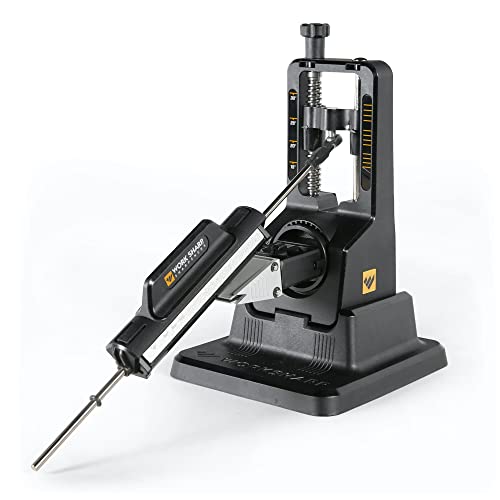
A clamp holds the knife while you swing the abrasive along a guide arm that adjusts between 15 and 30 degrees, so you set Cutco’s 15 once and every stroke matches it. That removes the wobble that rounds most home-sharpened edges. It’s slower than an electric sharpener and longer blades need the clamp moved, which is no burden for a few kitchen knives.
2. Sharp Pebble 1000/6000 Whetstone Kit: For Learning Freehand

The 1000 side sharpens and the 6000 side polishes off the burr, with an angle guide and bamboo base to help while you learn. Cutco’s 440A steel raises a burr quickly, which makes it forgiving to practice on. Expect a few uneven edges at first, and you’ll need water and counter space every time.
3. Work Sharp Kitchen Ceramic Honing Rod: For Weekly Honing

The tool you’ll actually use most: built-in angle guides keep the strokes consistent, and ceramic removes a hair of steel, so it does a bit more than a smooth steel. A few passes before cooking keep a straight-edge Cutco biting for months. Ceramic is brittle, so keep it where it can’t roll onto a tile floor.
FAQ
Can you sharpen Cutco knives yourself?
Yes, if they have a straight edge. Cutco says any stone, steel or sharpening device can be used on its straight-edge knives. Double-D and Micro Double-D knives should be sent to Cutco instead.
What degree are Cutco knives?
Cutco straight-edge knives are designed at 15 degrees. Cutco’s own sharpener is fixed at that angle, so aim for 15 degrees with any other tool.
Is Cutco sharpening really free?
The sharpening itself is free under the Forever Guarantee, for all Cutco knives. You pay to ship them to Cutco plus a small return shipping fee. Check Cutco’s website for the current amount.
How long does Cutco sharpening take?
Cutco says to allow one to two weeks for your knives to come back after they arrive at the factory in Olean, New York, plus shipping time each way.
Can I use a regular knife sharpener on Cutco knives?
On straight-edge Cutco knives, yes: stones, rods, guided and electric sharpeners all work, ideally at 15 degrees. Never use one on a Double-D edge.
How often should you sharpen Cutco knives?
Hone straight-edge knives every week or two and sharpen them when honing no longer restores the edge, often once or twice a year for a home cook. Double-D knives usually go years between factory sharpenings.
Final Verdict
Sharpening Cutco knives is easy once you separate the two edges. Hone the straight ones every week or two, sharpen them at home at 15 degrees when honing stops working, and let Cutco handle the Double-D knives for free.
Own knives from other brands too? My guides to sharpening Wüsthof knives and sharpening Cuisinart knives cover their angles and quirks.

Gary Portman founded knivesadvice.com in 2019. He learned to cook in his family’s kitchen as a kid and has used kitchen, pocket and outdoor knives ever since, from paring and fillet knives to survival blades he carries camping and hiking. He writes the site’s buying guides, brand reviews and sharpening how-tos to help readers find the right knife for the job. More about Gary.