
Most dull knives aren’t dull because of the sharpener. They’re dull because the angle wobbled. Freehand sharpening on a whetstone asks your wrists to hold the same angle for hundreds of strokes, and a few degrees of drift rounds the edge instead of sharpening it. Pull-through gadgets fix the angle but force every knife into the same one, and they chew steel.
A guided system sits between the two. It clamps the knife, or holds the stone, at an angle you choose, then lets you work through real abrasives from coarse to fine. You get whetstone-quality results without the years of practice, on kitchen knives, pocket knives and hunting knives alike. The price is time: a guided sharpener is slower than a pull-through, and it takes a session or two to learn the setup.
The one I’d buy is the Work Sharp Precision Adjust Elite. Its dial covers 15 to 30 degrees, it comes with enough abrasives for repair and finishing, and even handles serrated knives. If you want the classic budget clamp, the Lansky Universal has been doing the job for decades.
My Top 6 Guided Sharpening System Picks

Clamp the knife, dial the angle, sharpen, flip, repeat. It’s the guided system I’d give a complete beginner, and the Elite kit adds the finer and serrated abrasives the basic version lacks.

All-metal build, a digital angle indicator and seven abrasives from 220 diamond to a leather strop. For the person who sharpens the whole family’s knives and wants it repeatable to the degree.
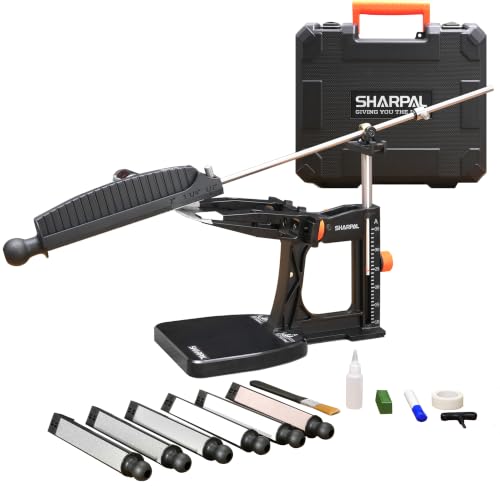
Goes down to 10 degrees and up to 35, with diamond plates, two water stones and a strop in the box. The one for owners of thin Japanese knives and heavy cleavers at once.

A clamp with fixed angle holes, four hones on guide rods and a bottle of oil. Simple, made in the USA, and the system a lot of hunters learned on.

An aluminum adjustable-angle rig with three diamond plates. A cheap way to try a modern guided system before deciding whether to spend more.

A 4-ounce handheld sharpener with a built-in 20 degree guide, a diamond stone, a ceramic hone and a strop. Guided sharpening that fits in a pack or a glovebox.
Guided Sharpening Systems Compared
| System | Type | Angles | Abrasives included | Serrated | Best for |
|---|---|---|---|---|---|
| Work Sharp Precision Adjust Elite | Clamp with flip, guided arm | 15 to 30 | 320 and 600 diamond, ceramic, serrated rod, curved-blade attachment | Yes | Mixed kitchen and pocket knives |
| Work Sharp Professional Precision Adjust | Metal clamp system, digital indicator | 15 to 30 | 220 to 800 diamond, ceramic, strop | Not stated | Frequent sharpeners |
| SHARPAL 202H | Sliding clamps with flip | 10 to 35 | 220 to 1000 diamond, 3000/6000 stones, strop | Not stated | Thin Japanese knives to cleavers |
| Lansky Universal | Clamp with angle holes, hones on rods | Fixed holes | Coarse, medium, fine, serrated hone, oil | Yes | Hunting and pocket knives |
| XARILK GEN3 | Adjustable aluminum rig | Adjustable | 320, 800, 2000 diamond | Not stated | Trying a guided system |
| Wicked Edge Venture WE20 | Handheld angle guide | 20 (other guides sold separately) | 500 diamond, fine ceramic, strop | Not stated | Field and travel |
1. Work Sharp Precision Adjust Elite: Best Overall
Who it’s for: home cooks and knife owners with a mixed collection who want consistent edges without learning freehand sharpening.
The Precision Adjust is also my top pick across every sharpener type, and the Elite kit is the version I’d buy. You clamp the knife in a V-shaped jaw, set the angle on a dial from 15 to 30 degrees, and stroke the abrasive along the edge on a guided arm. Then you rotate the clamp to do the other side at exactly the same angle.
The Elite adds what the basic kit lacks: 320 and 600 grit diamond plates for setting and refining the bevel, a ceramic rod for finishing, a tapered ceramic rod for serrated knives, and an attachment for curved blades. That covers a chipped hunting knife, a soft German chef’s knife at 20 degrees and a thinner Japanese blade at 15.
My reservation is long knives. The clamp holds the blade near its middle, so on a 10-inch slicer you have to work carefully at the tip and heel to keep the angle even. It also takes longer than an electric machine, but in exchange it removes far less steel.
Key specs
- Angle range: 15 to 30 degrees, adjustable
- Abrasives: 320 and 600 grit diamond, ceramic finishing rod, serrated rod, curved-blade attachment
- Type: clamp with flip, guided arm
- Maker: Work Sharp, designed in Ashland, Oregon; 3-year warranty
Pros
- Dial covers every common edge angle
- Sharpens serrated knives too
- Easy to learn for beginners
Cons
- Long blades need extra care at the tip
- Slower than electric or pull-through sharpeners
My verdict: the guided system for most people, from first-timers to families with drawers of mixed knives. If you’ll sharpen every week, the Professional version is the better long-term tool.
2. Work Sharp Professional Precision Adjust: Best Premium
Who it’s for: enthusiasts who sharpen often, and the person everyone in the family hands their dull knives to.
The Professional takes the Precision Adjust idea and builds it like a workshop tool. The frame is metal rather than plastic, which means less flex when you press, and a digital angle indicator lets you set and repeat an angle precisely instead of reading a printed dial.
The kit comes with seven abrasives: 220, 320, 400, 600 and 800 grit diamond plates, a fine ceramic and a leather strop. That’s a smoother progression than the Elite’s, and the jump from 800 diamond to ceramic to strop gives a more polished edge. Work Sharp says it handles everything down to small pen knives, at angles as low as 15 degrees.
Is it worth the premium over the Elite? Only if you sharpen a lot. For a few knives every couple of months, the Elite gets you to the same practical sharpness.
Key specs
- Angle range: 15 to 30 degrees, digital angle indicator
- Abrasives: 220, 320, 400, 600, 800 diamond; fine ceramic; leather strop
- Build: metal construction
- Designed, engineered and calibrated in Ashland, Oregon; 3-year warranty
Pros
- Rigid metal build
- Digital indicator makes angles repeatable
- Seven abrasives for a fine finish
Cons
- Overkill for occasional sharpening
- Takes up more space than the Elite
My verdict: the Work Sharp to buy if sharpening is a hobby or a household job you do every week. Occasional sharpeners should save their money for the Elite.
3. SHARPAL 202H Precision System: Best Angle Range
Who it’s for: owners of thin Japanese knives who want angles below 15 degrees, and people with everything from pocket knives to cleavers.
Most guided systems stop at 15 degrees per side. The SHARPAL 202H goes down to 10 and up to 35, which matters at both ends: very thin Japanese blades and slicers at the low end, cleavers and heavy outdoor blades at the high end. Its other trick is how it sets the angle. SHARPAL keeps the distance from the edge to the clamp fixed, so the angle stays accurate on a narrow pocket knife and a wide cleaver alike; with many clamp systems, a wider blade changes the real angle.
The kit is generous: diamond plates in 220, 325, 600 and 1000 grit, water stones in 3000 and 6000 for a polished finish, and a leather strop with green compound. Dual sliding clamps hold long blades, and a flip mechanism keeps the same angle on both sides. It comes in a carry case.
The downside is the learning curve. More adjustment means more to get right, and I’d only recommend it to someone happy to read the manual first.
Key specs
- Angle range: 10 to 35 degrees, distance-based angle setting
- Abrasives: 220, 325, 600, 1000 diamond; 3000 and 6000 water stones; leather strop and compound
- Clamps: dual sliding clamps with flip
- Build: metal, anti-slip base, carry case
Pros
- Widest angle range of my picks
- Angle stays accurate on wide and narrow blades
- Water stones for a polished Japanese-style finish
Cons
- More setup than the Work Sharp
- Bigger and heavier to store
My verdict: the system for people whose collection runs from a thin gyuto to a cleaver. If you’ve never sharpened before, start with the Work Sharp Elite.
4. Lansky Universal Sharpening System: Best Classic Clamp
Who it’s for: hunters, campers and pocket-knife owners who want a simple, proven clamp system.
Lansky’s clamp-and-rod design is the system many people learned guided sharpening on. You clamp the knife in a metal jaw with angle holes along one side, slide a hone’s guide rod into the hole for the angle you want, and stroke the hone across the edge. The angle comes from geometry, not from your wrist.
The Universal kit includes four hones (coarse, medium, fine and a medium serrated hone), the multi-angle clamp, honing oil and a molded case. The listing says it’s made in the USA. That’s everything you need for straight, serrated and scalloped edges on outdoor knives.
The fixed holes are both its strength and its limit: you choose from a handful of preset angles rather than any angle you like. Long, wide kitchen knives are also awkward in the small clamp. For a closer look at Lansky’s handheld tools, see my Lansky pocket knife sharpener review.
Key specs
- Type: clamp with fixed angle holes, hones on guide rods
- Hones: coarse, medium, fine, medium serrated
- Includes: multi-angle clamp, honing oil, storage case
- Made in USA (per listing); 1-year warranty
Pros
- Simple and proven design
- Handles serrated and scalloped edges
- Made in the USA
Cons
- Preset angles only
- Small clamp struggles with big kitchen knives
My verdict: the classic guided system for outdoor knives, and still a good one. Kitchen-knife owners will be happier with the Work Sharp.
5. XARILK GEN3 Guided System: Best Budget Adjustable
Who it’s for: curious first-timers who want to try an adjustable guided system without spending much.
Affordable aluminum guided sharpeners have multiplied in recent years, and the XARILK GEN3 is one of the more popular ones. It’s machined from aluminum alloy, the angle is adjustable, and it comes with three diamond plates: 320 grit for restoring dull edges, 800 for refining and 2000 for polishing.
For a first guided system, that’s a sensible kit. Diamond plates cut every common knife steel, including the harder powder steels that wear out cheap ceramic hones, and the jump from 800 to 2000 leaves a clean working edge.
What you give up is support and extras. The listing publishes no angle range or warranty, and there are no serrated or stropping accessories in the box.
Key specs
- Abrasives: 320, 800 and 2000 grit diamond plates
- Build: aluminum alloy
- Angle: adjustable (range not published)
- For: kitchen, outdoor and folding knives
Pros
- Adjustable angle for little money
- Diamond plates handle hard steels
- Solid aluminum build
Cons
- Angle range and warranty not published
- No serrated rod or strop
My verdict: a good way to find out whether guided sharpening suits you. If it does, the Work Sharp Elite is the better tool to keep.
6. Wicked Edge Venture WE20: Best Portable
Who it’s for: hikers, hunters and anglers who want guided sharpening away from a workbench.
Wicked Edge is best known for big bench-mounted clamp systems, and the Venture brings its angle-guided approach to a handheld tool. A guide rests on the blade spine and holds the stone at 20 degrees, so you get a consistent bevel without a clamp. Knife guides for 15, 17 and 25 degrees are sold separately.
The WE20 comes with a 500 grit diamond stone and a fine ceramic hone on opposite sides, plus a leather strop. At 4 ounces it disappears into a pack. Wicked Edge says it’s made in the USA and backs it with a 5-year warranty.
The fixed 20 degrees out of the box suits most outdoor knives but not thin kitchen blades, and a handheld guide is never as steady as a clamp. Use it for touch-ups in the field and keep a bench system for full resharpening.
Key specs
- Angle: 20 degrees built in; 15, 17 and 25 degree guides sold separately
- Abrasives: 500 grit diamond, fine ceramic hone, leather strop
- Weight: 4 ounces
- Made in the USA; 5-year warranty
Pros
- Guided angle in a pocket-size tool
- Diamond and ceramic in one
- Long warranty
Cons
- One angle without extra guides
- Less steady than a clamp system
My verdict: the guided sharpener for your pack. At home, a clamp system does a better job.
How Guided Sharpening Systems Differ
Clamp systems with a flip
The knife is held still and the abrasive moves on a guided arm or rod, so the angle is set by the machine. Work Sharp’s Precision Adjust and the SHARPAL 202H flip the clamped knife over so both sides get the same angle. This is the most consistent design and the easiest to learn.
Clamps with fixed angle holes
Lansky-style clamps give you a few preset angles through holes in the clamp. They’re simple and cheap, but the real angle shifts slightly with blade width, and you can’t fine-tune between holes.
Handheld guides
Tools like the Wicked Edge Venture rest a guide on the spine and hold the stone at a set angle. They’re portable but rely on a steady hand more than a clamp does.
V-rod systems and whetstone guides
V-rod sharpeners such as the Spyderco Sharpmaker hold two rods at a fixed angle and you draw the knife down them vertically; they’re excellent for touch-ups but slow on very dull blades. Clip-on whetstone guides help freehand beginners but don’t lock the angle. Both are outside the scope of this list.
How I’d Choose a Guided Sharpener
Match the angle range to your knives
Check the lowest angle first. German and American kitchen knives are usually sharpened around 20 degrees per side and Japanese knives around 15, while hunting knives often sit at 20 to 25. If you own thin Japanese blades, make sure the system goes to 15 or below; my how to sharpen a gyuto guide explains why.
Look at the abrasives in the box
Diamond plates cut any steel, including hard powder steels; ceramic and water stones refine and polish. A good kit runs from a coarse grit for repair to a fine grit or strop for finishing. A system with only one or two grits will either be slow on dull knives or leave a rough edge.
Think about blade length
Short and medium blades are easy in any clamp. Long slicers and big chef’s knives need a clamp that holds the blade firmly and an arm that reaches the tip; dual clamps help.
Serrated knives
Only some systems include a tapered rod for serrations. If you want to sharpen bread and steak knives at home, choose one that does, such as the Work Sharp Elite or the Lansky.
Single-bevel knives
Guided systems are made for double-beveled edges. Single-bevel Japanese knives like a yanagiba have a flat back and need whetstones.
How to Use a Guided Sharpening System
- Mark the bevel. Color the edge bevel with a permanent marker. After a few strokes, where the ink is removed shows whether your angle matches the existing edge.
- Clamp the knife centered and tight. Place the clamp near the middle of the blade so the abrasive reaches heel and tip evenly. A loose knife changes the angle on every stroke.
- Start coarse until you raise a burr. Grind the first side until a slight burr runs along the whole opposite edge, heel to tip. Then switch sides.
- Step up through the grits. Repeat with each finer abrasive, using lighter pressure and fewer strokes as you go.
- Strop and test. Finish on a strop or the finest stone to remove the burr. A sharp edge slices printer paper cleanly from heel to tip.
My guides on how to strop a knife and how to tell if a knife is sharp enough cover the last step in more detail.
FAQ
Are guided knife sharpeners better than whetstones?
They’re more consistent for most people. A guided system holds the angle for you, so beginners get a clean edge quickly. A skilled freehand sharpener can match it on a whetstone, but that takes practice most people never put in.
What angle should I sharpen my knife at?
About 20 degrees per side for German and American kitchen knives, about 15 for Japanese knives, and 20 to 25 for hunting and outdoor knives. When in doubt, match the existing bevel using the marker trick.
Is the Work Sharp Precision Adjust worth it?
Yes, for most people who want to sharpen at home. It adjusts between 15 and 30 degrees, is easy to learn and removes far less steel than electric machines. The Elite kit adds finer and serrated abrasives.
Lansky or Work Sharp: which is better?
Work Sharp is better for kitchen knives and mixed collections because the angle is fully adjustable and long blades are easier to hold. Lansky is simpler and suits hunting and pocket knives with its preset angles.
Can guided sharpeners sharpen serrated knives?
Some can. The Work Sharp Precision Adjust Elite has a tapered ceramic rod for serrations, and the Lansky Universal includes a serrated hone. Check that a system includes one before you buy it for bread or steak knives.
Final Verdict
A guided system is the best way for most people to get a whetstone-quality edge without years of practice. The Work Sharp Precision Adjust Elite is my pick for nearly everyone: adjustable, easy to learn and able to handle serrated knives. For frequent sharpening, the metal Work Sharp Professional is the upgrade, and for outdoor knives on a budget, the Lansky Universal is still a classic.
To compare guided systems with electric, whetstone and pull-through options, read my best knife sharpener guide, or my Smith’s knife sharpener review for budget alternatives.

Gary Portman founded knivesadvice.com in 2019. He learned to cook in his family’s kitchen as a kid and has used kitchen, pocket and outdoor knives ever since, from paring and fillet knives to survival blades he carries camping and hiking. He writes the site’s buying guides, brand reviews and sharpening how-tos to help readers find the right knife for the job. More about Gary.