
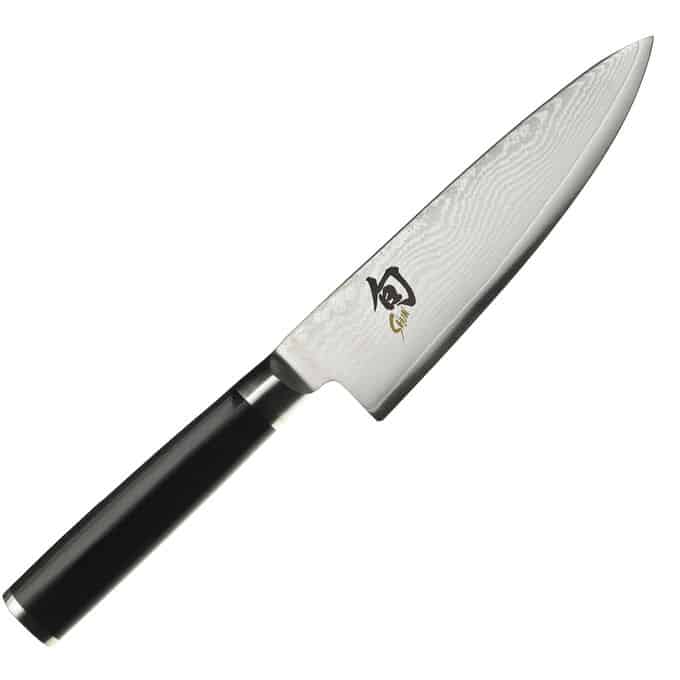
Yes, Shun knives are good, and for a careful cook they’re among the best you can buy in the US. They’re made in Seki, Japan, from hard VG-MAX steel with a 16 degree edge, so they cut cleanly and stay sharp for a long time. The catch is that hard steel chips if you twist it, hit bone or cut on glass. If that sounds like your kitchen, buy German. If not, start with the Shun Premier 6″ Chef’s Knife.
My Top 3 Ways to Try a Shun

A full Shun chef’s knife in a shorter, easier size. The hammered Premier finish and the rounded handle make it the Shun I’d hand to someone moving up from a German knife.

Shun’s original Classic line in its smallest form. Peeling, trimming and coring with a VG-MAX edge show you what the fuss is about without buying a full-size knife.

A honing rod with a built-in 16 degree guide, made for Shun edges. Use it between free factory sharpenings and your Shun stays sharp far longer.
Why Shun Knives Are So Good
The edge is the whole point
Shun’s main lines use VG-MAX steel at around 61 HRC, ground to 16 degrees on each side. That’s harder and thinner than a typical German knife, so tomatoes, onions and fish cut with almost no pressure, and the edge lasts far longer between sharpenings.
Free sharpening for the original owner
Shun will sharpen your knives for free for as long as you own them; you just pay to post them. It’s the feature I’d point to first, because it removes the biggest worry about owning a hard Japanese knife.
A Japanese knife that doesn’t feel foreign
Most Shun chef’s knives keep a curved belly, so you can still rock through herbs the way you would with a Wüsthof. That makes Shun the easiest step up for cooks raised on German knives. Still deciding between the two styles? My German vs Japanese knives guide lays out the trade-offs.
Shun vs a German Knife at a Glance
| What matters | Shun (Classic or Premier) | Typical German (Wüsthof Classic) |
|---|---|---|
| Steel hardness | VG-MAX, about 61 HRC | 58 HRC |
| Edge | 16 degrees per side, very thin | Thicker, more robust |
| When it’s abused | Chips | Rolls, hones straight again |
| Upkeep | Hone gently, whetstone or free Shun service | Honing steel every week or two |
| Dishwasher | No | No |
| Best for | Careful cooks, produce and fish | Busy kitchens, bones and squash |
Where Shun Lets People Down
Chips are the number one complaint
Ask Shun owners what went wrong and the answer is nearly always a chipped tip or edge. It’s a trade-off of hard steel, not a defect, but it surprises people who used to pry and twist with a German knife. Keep it away from bones, frozen food, hard squash and glass or stone boards.
The wrong sharpener ruins the edge
Pull-through sharpeners set up for German knives grind the wrong angle onto a Shun and can chip it. Use a whetstone, Shun’s honing steel, or the free service. My guide on how to sharpen Shun knives covers all three.
The price adds up quickly
Every Shun line costs much more than a good German or Swiss knife, and the Damascus layers are mostly there for looks. That’s why my picks here are small ones: try the edge before you buy a block.
1. Shun Premier 6″ Chef’s Knife: Best Way to Try Shun
Who it’s for: cooks who want a real Shun chef’s knife without committing to the full 8″ size.
This has everything that makes Premier my favorite-looking Shun line: a VG-MAX core wrapped in 68 Damascus layers, a hammered tsuchime finish (small dimples that reduce drag and help food fall away) and a contoured Pakkawood handle that suits left and right hands. The edge is the standard Shun 16 degrees.
The 6″ length is what makes it a good trial. It’s light and quick on a small board, great for onions, garlic, chicken breasts and herbs, and less intimidating than a long blade. The trade-off is reach: a big cabbage or a pile of carrots is easier with an 8″. If you love it, the 8″ Premier will feel instantly familiar.
Key specs
- Blade: 6″, VG-MAX steel clad in 68 Damascus layers, hammered tsuchime finish
- Edge: 16 degrees
- Handle: contoured Pakkawood, for either hand
- Handcrafted in Japan; free sharpening and honing
Pros
- Rounder handle suits more hands than the Classic’s D shape
- Hammered finish helps food release
- Compact and easy to control
Cons
- Short for big batches
- Hard edge chips under twisting or on bones
My verdict: the Shun I’d try first. Know you want a full-size knife? My review’s Classic 8″ is the better buy.
2. Shun Classic 3.5″ Paring Knife: Smallest Way In
Who it’s for: anyone curious about Shun, or shopping for a small gift for a keen cook.
According to Shun, Classic was its original authentic Japanese line for American kitchens; this paring knife is the smallest piece of it. You still get the full recipe: VG-MAX steel, 68 Damascus layers, a 16 degree edge and a D-shaped Pakkawood handle.
A paring knife is also the gentlest way to learn how a Shun wants to be treated. Peeling apples, hulling strawberries and trimming shallots never put sideways stress on the edge, so it’s hard to chip. The D-shaped handle is the one thing to try in person if you can; some hands love it, some don’t.
Key specs
- Blade: 3.5″, VG-MAX steel clad in 68 Damascus layers
- Edge: 16 degrees
- Handle: D-shaped Pakkawood
- Handcrafted in Japan; free sharpening and honing
Pros
- Small, low-risk way to own a Shun
- Paring work rarely chips hard steel
- Same steel and finish as the Classic chef’s knife
Cons
- Won’t tell you much about chopping
- D-shaped handle doesn’t suit every hand
My verdict: a small, safe first Shun and a lovely gift. If you want to judge Shun as a main knife, start with the Premier 6″.
3. Shun Premier 9″ Combination Honing Steel: Best Shun Upkeep
Who it’s for: every Shun owner who wants the edge to last between sharpenings.
Honing doesn’t remove much metal; it straightens the tiny bends that form along an edge as you cut. On a hard Shun that has to be done gently and at the right angle, which is why I like this one: it has a built-in guide that sets a 16 degree angle, matching Shun’s own edges.
One side is smooth for weekly honing and the other is micro-ribbed for a monthly touch-up, and the Pakkawood handle matches the Premier knives. Pair it with Shun’s free sharpening service and you may never need to buy a whetstone.
Key specs
- Length: 9″ stainless steel rod
- Surfaces: smooth side (weekly) and micro-ribbed side (monthly)
- Angle guide: built in, 16 degrees
- Handle: contoured Pakkawood
Pros
- Angle guide matches Shun edges
- Keeps knives sharp between sharpenings
- Works for any Shun line
Cons
- Can’t repair chips or a truly dull edge
- Needs a light hand to avoid damaging hard steel
My verdict: the accessory every Shun owner should have. If your Shun is chipped, send it to Shun instead of honing.
FAQ
Are Shun knives good quality?
Yes. They’re handcrafted in Seki, Japan, by Kai, use hard VG-MAX steel and come with free sharpening for the original owner. Fit and finish are excellent across the lines.
Are Shun knives worth it?
For careful cooks, yes: you get a very sharp, long-lasting edge and a lifetime of free sharpening. If you’re rough on knives, a German brand is better value. My Shun knives review compares every main line.
Why do Shun knives chip?
Because hard steel is less tough than soft steel. Twisting, prying, bones, frozen food and glass or stone boards are the usual causes. Small chips can be sharpened out, and Shun’s free service does it for you.
Is Shun better than Wüsthof?
Neither is better for everyone. Shun is sharper and lighter, Wüsthof tougher and more forgiving. My Shun vs Wüsthof comparison helps you choose by how you cook.
Which Shun line is best, Classic or Premier?
Classic for most people; Premier if you prefer a rounder handle and a hammered finish that helps food release. The steel and edge are the same. My Shun Premier vs Classic comparison goes into the details.
Final Verdict
Shun knives are good, very good, as long as you use them for what they are: precise Japanese tools, not pry bars. The Premier 6″ chef’s knife is the best way to try one, the Classic paring knife is the smallest step in, and the Premier honing steel keeps either one sharp.
Comparing Shun with other Japanese makers? My best Japanese knife sets guide puts them side by side.

Gary Portman is the founder and main author of Knivesadvice.com. With his extensive knowledge and experience, he is committed to assisting people in choosing the perfect knife for their needs. Through his articles, Gary shares valuable insights on various aspects of knives. With his expertise, readers can make informed decisions and find a knife that is tailored to their preferences and requirements. You can find more info about Gary here.