
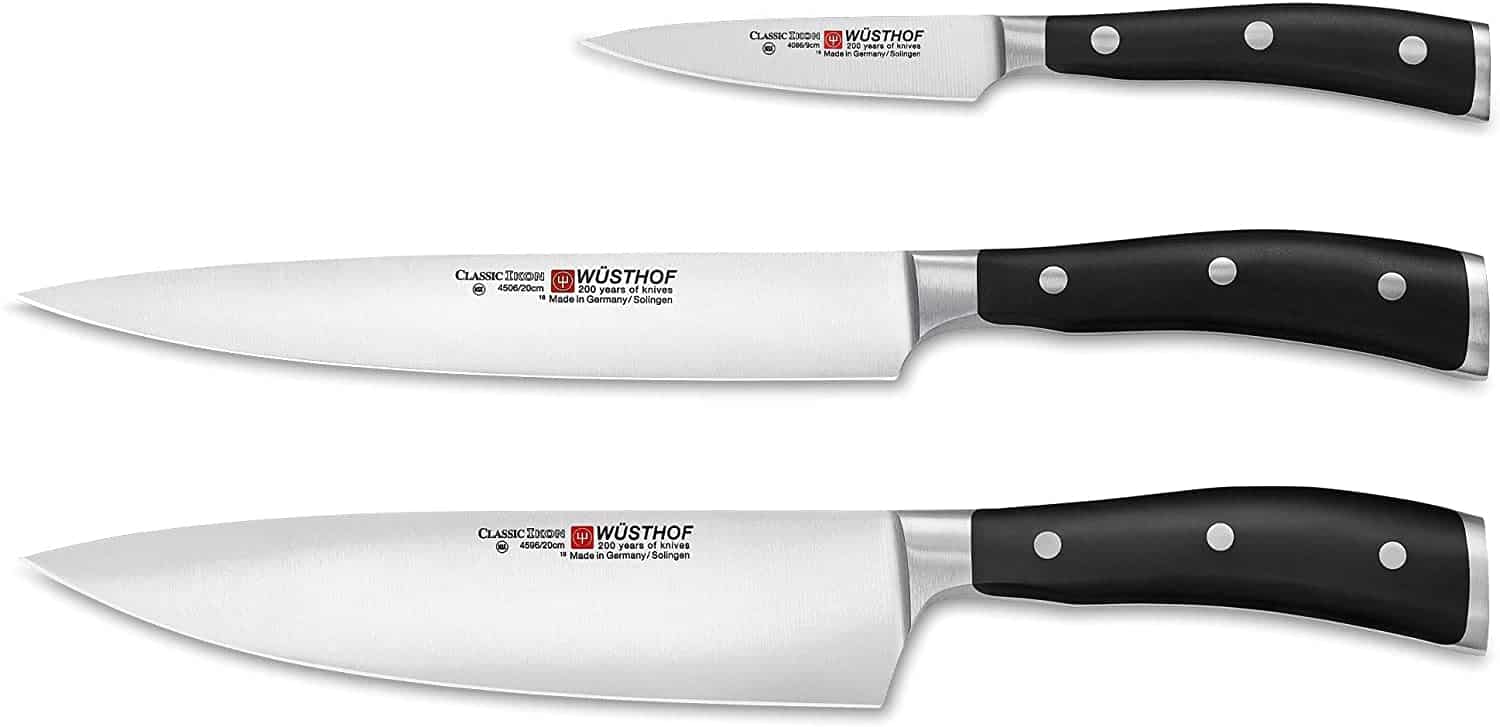
Yes. Wüsthof knives are good, and the reason isn’t the famous name: it’s that they’re very hard to ruin. The main lines are forged in Solingen, Germany, from stainless steel hardened to 58 HRC, softer than Japanese steel on purpose. A Wüsthof can take a chicken bone, a hard squash or a week without sharpening, and a honing steel brings the edge right back.
They aren’t the sharpest knives you can buy, and they aren’t cheap. If you want a laser-thin edge, buy Japanese; if you want the most knife for the least money, buy Victorinox. For a cook who wants a knife to last decades without fuss, I’d start with the Wüsthof Classic Hollow Edge 2-Piece Chef’s Knife Set.
My Top 3 Ways to Start With Wüsthof
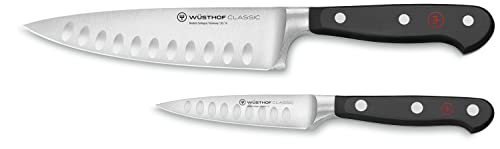
A 6″ chef’s knife and a 3.5″ paring knife, both forged Classic. Two knives that handle most weeknight cooking, without paying for a block.

A light, German-made santoku from the stamped Gourmet line. A cheap way to find out whether you like the Wüsthof feel before buying forged.

Wüsthof’s own honing rod. Softer German steel needs regular honing, and this is the tool that keeps any Wüsthof cutting like new.
Who Wüsthof Is Good For (and Who Should Skip It)
Good for busy kitchens and first serious knives
If your knife gets used on everything from bread to chicken thighs, washed in a hurry and occasionally dropped, Wüsthof is a great match. The forged Classic blades are thick at the spine, full tang and heavy enough to do the work for you.
Good if you want to buy once
Wüsthof is family-owned, has been making knives in Solingen since 1814 and keeps its Classic range in production year after year. Buy one knife now and you can add matching pieces much later.
Skip it if you want the sharpest edge
Japanese knives are harder and thinner, so they cut tomatoes and fish more cleanly and stay sharp longer. If that’s what you’re after, my German vs Japanese knives guide will point you the right way, and my Shun knives review covers the Japanese brand most Wüsthof shoppers compare it with.
Skip it if you won’t hone
Softer steel bends out of line faster. A Wüsthof that’s never honed will feel dull within weeks. A minute on a steel every week or two fixes that, but you do have to do it.
What the Wüsthof Name Gets You
Solingen making
Every knife here is made in Solingen, a city whose name is legally reserved for blades that meet its quality rules. It’s one of the few labels in the knife world that guarantees where a knife comes from.
Forged or stamped: know which you’re buying
Classic, Classic Ikon and Performer are forged from one piece of steel. Gourmet is laser cut from sheet steel, which makes it lighter and cheaper. Both are real Wüsthofs, but they feel different. My Wüsthof Classic vs Gourmet comparison goes into the details.
The lines at a glance
| Line | Made by | Bolster | Who it suits |
|---|---|---|---|
| Classic | Forged | Full, down to the heel | Most cooks, the safe default |
| Classic Ikon | Forged | Double (blade and handle end) | Cooks who want a rounder handle |
| Gourmet | Laser cut (stamped) | None | Lighter knives, tighter budgets |
| Performer | Forged, black coated | Forged thickening | A modern look and grippy handle |
A lifetime warranty
Wüsthof covers its knives against defects for life. Dishwasher damage and misuse aren’t covered, so hand wash and dry them.
Where Wüsthof Falls Short
The price is the obvious one: a forged Wüsthof chef’s knife costs much more than a Victorinox that cuts nearly as well. The Classic’s full bolster also makes the heel awkward to sharpen over the years, and the heavy 8″ Classic tires some hands. None of these are deal breakers, but they’re why I recommend starting small.
1. Wüsthof Classic Hollow Edge 2-Piece Chef’s Knife Set: Best Way to Start
Who it’s for: cooks who want to try forged Wüsthof with the two knives they’ll use most.
This is the Classic line in miniature. The 6″ chef’s knife is forged from a single block of high-carbon stainless at 58 HRC, with hollow-edge scallops along the blade (shallow dimples that help slices of potato or cheese fall away). The 3.5″ paring knife handles peeling, trimming and coring.
I like the 6″ size as a first Wüsthof. It’s lighter and nimbler than the 8″ Classic, fits a small board and still handles a whole chicken or a pile of onions. If you cook big batches, you’ll want the 8″ later, and it will match perfectly.
Key specs
- Pieces: 6″ hollow edge chef’s knife, 3.5″ hollow edge paring knife
- Steel: forged high-carbon stainless, 58 HRC
- Handle: synthetic, full tang, triple riveted
- Made in Solingen, Germany; hand wash only
Pros
- Lower commitment than a block set
- Lighter than the 8″ Classic
- Scallops help food release
Cons
- 6″ is short for big prep
- Full bolster complicates sharpening the heel
My verdict: the easiest way to find out whether Wüsthof suits you. Already sure? Go straight for the 8″ Classic in my review.
2. Wüsthof Gourmet 7″ Hollow Edge Santoku: Best Low-Cost Wüsthof
Who it’s for: cooks who chop more than they rock and want Wüsthof quality for little money.
A santoku is a Japanese-style shape with a flatter edge and a rounded tip, good for chopping vegetables and slicing boneless meat. Wüsthof says this one has a thinner blade than its chef’s knives and a straighter edge that only curves up near the tip, with hollow-edge scallops to keep slices from sticking.
It’s a Gourmet knife, so it’s laser cut rather than forged: lighter, no bolster, and much cheaper than the Classic set. I’d choose it if you mostly cut vegetables, or as a second knife next to a chef’s knife you already own. Torn between the two shapes? My santoku vs chef’s knife comparison settles it.
Key specs
- Blade: 7″ hollow edge, high-carbon stainless steel, laser cut
- Handle: synthetic polypropylene
- Made in Germany; limited lifetime warranty
- Hand wash only
Pros
- Costs much less than the Classic set
- Light and easy to control
- No bolster, so the whole edge sharpens easily
Cons
- Flat edge doesn’t rock like a chef’s knife
- Rounded tip limits fine point work
My verdict: a low-risk first Wüsthof for vegetable cooks. If you rock your knife through herbs, get a chef’s knife instead.
3. Wüsthof 10″ Sharpening Steel: Best Wüsthof Upkeep
Who it’s for: anyone who owns, or is about to own, a Wüsthof without a honing rod.
Despite the name, this is a honing steel: it doesn’t grind away metal like a sharpener, it pushes a bent edge back into line. That’s exactly what a 58 HRC German edge needs every week or two, and it’s why a Wüsthof stays sharp for years between real sharpenings.
At 10″, it’s long enough for chef’s knives and slicers. Hold the knife at roughly the angle of its edge, alternate sides, and use light strokes. When honing stops helping, it’s time for a whetstone or a sharpener.
Key specs
- Length: 10″ honing rod
- Steel: high-carbon stainless, 58 HRC
- Made in Germany; limited lifetime warranty
Pros
- Keeps any German knife cutting well
- Long enough for 8″ and 10″ blades
- Takes a minute once you learn it
Cons
- Doesn’t fix a truly dull or chipped edge
- Takes some practice to hold a steady angle
My verdict: the cheapest thing that makes a Wüsthof better. Skip it only if a steel already came with your set.
FAQ
Are Wüsthof knives good quality?
Yes. The forged lines are made in Solingen, hardened to 58 HRC and backed by a lifetime warranty against defects. They’re built to be tough and easy to maintain rather than as sharp as possible.
Are Wüsthof knives worth the money?
For cooks who want one knife to last decades, yes. If you just need something sharp for very little, a Victorinox does most of the job. Cooks who look after their knives get the most from a Wüsthof.
Is Wüsthof better than Henckels?
Not across the board. Wüsthof Classic and ZWILLING’s Solingen lines are close equals; HENCKELS-branded budget lines are a step below. My Wüsthof vs Henckels comparison sorts out which is which.
Do Wüsthof knives stay sharp?
They stay sharp for a long time if you hone them every week or two. Without honing, the softer edge rolls and feels dull sooner than a Japanese knife.
Can Wüsthof knives go in the dishwasher?
No. Wüsthof lists its knives as hand wash only, and dishwasher damage isn’t covered by the warranty. I explain why in are Wüsthof knives dishwasher safe?
Final Verdict
Wüsthof knives are good because they’re tough, easy to keep sharp and made to be kept for decades. They’re not the sharpest or the cheapest, and that’s fine for most home cooks. The Classic Hollow Edge 2-piece set is the best way to start, the Gourmet 7″ santoku is the low-cost route, and the 10″ steel keeps either one cutting well.
Ready to choose a specific knife? My Wüsthof knives review compares every main line and names the six Wüsthofs I’d buy.

Gary Portman is the founder and main author of Knivesadvice.com. With his extensive knowledge and experience, he is committed to assisting people in choosing the perfect knife for their needs. Through his articles, Gary shares valuable insights on various aspects of knives. With his expertise, readers can make informed decisions and find a knife that is tailored to their preferences and requirements. You can find more info about Gary here.