
A bread knife has one job, and cheap ones tend to fail at it the same way: the teeth are small, pointy and packed close, so they snag soft bread, squash it and spray crumbs across the counter. Good ones have wide, rounded scallops and a blade long enough to cross a sourdough loaf in full strokes instead of sawing back and forth.
My pick for nearly every kitchen costs very little: the Mercer Culinary Millennia 10-inch Wide Wavy Edge Bread Knife. If you bake crusty loaves every week and want a forged knife that outlives the oven, the WÜSTHOF Classic 9-inch Double Serrated is the upgrade.
My Top 6 Bread Knife Picks
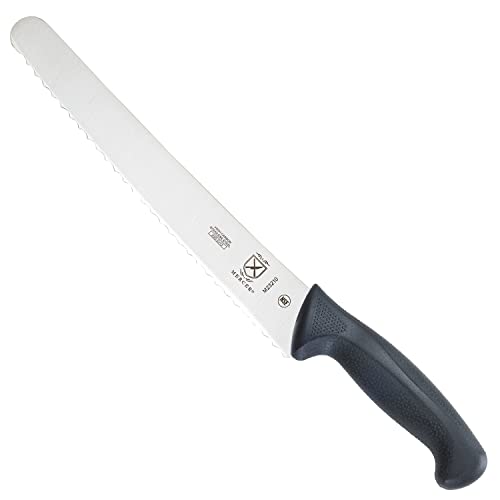
Ten inches of wide, gentle scallops that cross a big boule and still leave sandwich bread fluffy. The textured handle is easy to hold, and the price means you never have to worry about it.
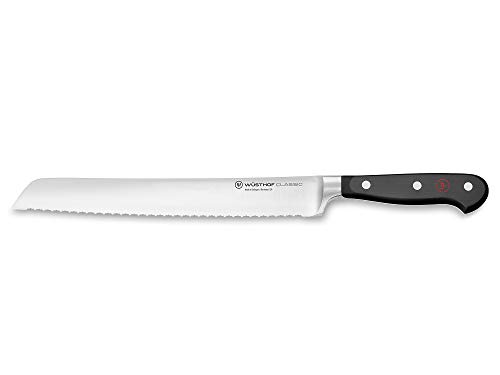
Small serrations inside the big ones bite into a dark, hard crust without a fight. Forged in Solingen and heavy enough to let its own weight do part of the work.

The handle sits higher than the blade, so your knuckles clear the board when you finish a cut. Great for sandwiches, bagels and anyone who keeps scraping their fingers.

The longest knife here and the one bakeries tend to keep on the bench. The Fibrox handle stays put with floury hands.
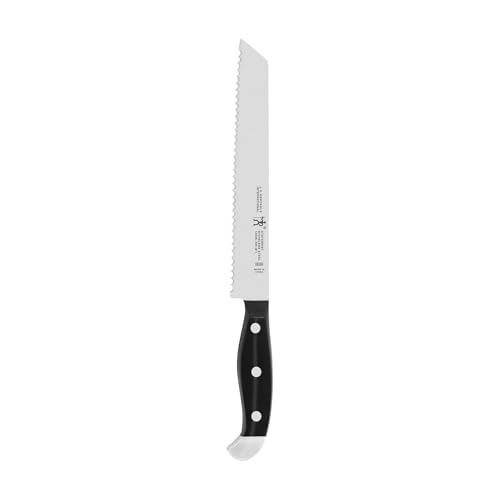
A light 8-inch bread knife for baguettes, rolls and sandwich loaves in a small kitchen. Easy to store in a drawer or a crowded block.

The one to buy if the rest of your block is Shun. Wide teeth, a D-shaped Pakkawood handle and the same rippled Damascus look as the other Classic knives.
Bread Knives Compared
| Knife | Length | Edge | Handle | Best for |
|---|---|---|---|---|
| Mercer Millennia Wide Wavy | 10″ | Wide wavy scallops | Textured, finger points | Every home kitchen |
| WÜSTHOF Classic | 9″ | Double serrated, forged, 58 HRC | Riveted synthetic, full tang | Hard crusts, weekly baking |
| Mercer Millennia Offset | 9″ | Wavy, offset blade | Textured, finger points | Sandwiches, bagels, knuckle room |
| Victorinox Fibrox | 10.25″ | Serrated | Fibrox, non-slip | Wide loaves, cake layers |
| HENCKELS Statement | 8″ | Serrated | Synthetic | Baguettes, small kitchens |
| Shun Classic | 9″ | Wide serrations, VG-MAX core | D-shaped Pakkawood | Matching a Shun set |
1. Mercer Culinary Millennia 10-Inch Wide Wavy Edge Bread Knife: Best Overall
Who it’s for: anyone who needs a bread knife, from the occasional supermarket loaf to home-baked sourdough.
Price and quality don’t line up neatly with bread knives, and this Mercer is the proof. The edge is a row of wide, rounded waves rather than sharp little points, and that shape is what you want for bread: each wave grips the crust, then the long flat sections between them glide through the soft crumb without tearing it. The 10-inch blade also matters more than people expect, because it lets you cross a large round loaf in one or two long strokes.
Mercer makes the blade from a single piece of Japanese high-carbon steel, and the handle has textured finger points that keep a floury or buttery hand from sliding. It’s a plain, commercial-looking knife, which is exactly why it turns up in so many restaurant and culinary-school kitchens.
My reservation is long-term: serrated edges are fiddly to sharpen, and on a knife this cheap I’d rather replace it after several years than pay to have it sharpened. Mercer also says hand wash only, so keep it out of the dishwasher.
Key specs
- Blade: 10-inch wide wavy edge, one-piece high-carbon Japanese steel
- Handle: ergonomic, textured finger points, non-slip
- Hand wash only
Pros
- Wide waves cut cleanly with few crumbs
- Long enough for big boules
- Costs very little
Cons
- Plain, utilitarian look
- Not worth sending out for sharpening
My verdict: the bread knife I’d put in almost any kitchen first. Only buy something pricier if you want a forged knife or a specific shape.
2. WÜSTHOF Classic 9-Inch Double Serrated Bread Knife: Best for Crusty Sourdough
Who it’s for: home bakers who slice dark, hard-crusted loaves several times a week, and WÜSTHOF Classic owners.
Double serrated means each big serration has a smaller row of teeth inside it. On a deeply baked sourdough or a rye with a crust like bark, those extra points catch where a plain wavy edge can skate, and the cut starts without you pressing down and flattening the loaf. WÜSTHOF says the design also leaves fewer crumbs.
WÜSTHOF forges it from a single block of steel, hardens it to 58 HRC and fits the full-tang, triple-riveted Classic handle. That makes it noticeably heavier than the Mercer, and I like the weight here: on a crusty loaf a heavier knife does part of the cutting for you. If you’re weighing it against the cheaper stamped version, my WÜSTHOF Classic vs Gourmet comparison puts the two bread knives side by side.
Nine inches is the one compromise. It handles sandwich loaves, baguettes and most boules, but a very wide country loaf will need a couple of extra strokes. It’s also hand wash only and costs much more than the Mercer.
Key specs
- Blade: 9-inch double serrated, forged, 58 HRC
- Handle: full tang, triple-riveted synthetic
- Made in Solingen, Germany; hand wash only
Pros
- Bites into the hardest crusts
- Solid forged build that lasts
- Matches a WÜSTHOF Classic block
Cons
- A little short for very wide loaves
- Expensive for a bread knife
My verdict: worth it if crusty bread is a weekly habit or you own other Classic knives. Occasional bread buyers won’t notice the difference over the Mercer.
3. Mercer Culinary Millennia 9-Inch Offset Wavy Edge Bread Knife: Best Offset
Who it’s for: sandwich makers, bagel slicers and anyone who keeps hitting the board with their knuckles.
On a straight bread knife the handle sits in line with the blade, so when you finish a cut your fingers end up at board level. An offset knife drops the blade below the handle, and your knuckles stay clear all the way through. It sounds like a small thing until you’ve sliced a stack of bagels or a tall sub roll with one.
Otherwise it’s the same recipe as my top pick: wide wavy scallops, one-piece high-carbon Japanese steel and the textured Millennia handle. The 9-inch blade is a touch shorter, which suits sandwiches and rolls better than wide loaves.
The offset shape takes a few uses to get used to on whole loaves, because the blade sits lower than your hand expects. If you mostly slice big rounds of bread, the straight 10-inch Mercer is the simpler choice.
Key specs
- Blade: 9-inch offset, wide wavy edge, one-piece high-carbon Japanese steel
- Handle: textured finger points, non-slip
- Hand wash only
Pros
- Knuckles clear the board
- Great for sandwiches and bagels
- Inexpensive
Cons
- Shorter than the straight Mercer
- Offset takes getting used to on whole loaves
My verdict: the smart second bread knife, or the first one for a sandwich-heavy house.
4. Victorinox 10.25-Inch Serrated Bread Knife with Fibrox Handle: Best Long Blade
Who it’s for: bakers of wide country loaves and cooks who split cake layers.
At 10.25 inches this is the longest blade on my list, and length is what you want when a loaf is wider than an ordinary sandwich loaf. A blade that reaches past both sides of the bread lets you cut in long, even strokes, which gives straighter slices and fewer torn edges. The same length makes it handy for leveling and splitting cake layers.
The Fibrox handle is the reason I’d pick it over other long serrated knives. It’s textured, non-slip and comfortable when your hands are covered in flour. It’s Swiss made, and the dishwasher is allowed by Victorinox; I’d hand wash it anyway, since rattling around with other cutlery blunts the points.
It’s a light, stamped knife with a commercial look, and the pointed serrations are a little more aggressive than Mercer’s waves on very soft bread.
Key specs
- Blade: 10.25-inch serrated stainless steel
- Handle: Fibrox, non-slip
- Swiss made; dishwasher safe per Victorinox
Pros
- Longest blade here, for wide loaves
- Excellent grip with floury hands
- Good for cake layers too
Cons
- Light, plain build
- Pointier teeth can tear very soft bread
My verdict: the pick if your loaves are big. For mixed everyday bread, the cheaper Mercer is just as good.
5. HENCKELS Statement 8-Inch Bread Knife: Best Compact
Who it’s for: small kitchens, baguette and roll eaters, and anyone who wants a bread knife that fits a standard block slot.
Not every kitchen needs a 10-inch blade. If your bread is baguettes, rolls, bagels and sandwich loaves, an 8-inch knife is easier to control and easier to store, and this HENCKELS is a light, well-made one from a big German brand. HENCKELS describes it as lightweight and easy to use, and it fits in most block slots that a 10-inch knife won’t.
HENCKELS says it’s dishwasher safe and rust-free. That’s convenient, though a bread knife’s teeth last longer when washed by hand. It’s also a useful knife for cutting cakes, large fruit and tomatoes.
The short blade is the trade-off. On a wide sourdough you’ll be sawing more, and the light build doesn’t give the momentum of the heavier WÜSTHOF on a hard crust.
Key specs
- Blade: 8-inch serrated, stain and rust resistant
- Lightweight design
- Dishwasher safe per HENCKELS
Pros
- Easy to control and store
- Light in the hand
- Well-known brand at a low cost
Cons
- Too short for big round loaves
- Light build on hard crusts
My verdict: a tidy pick for small kitchens and small breads. Bakers of large loaves should go longer.
6. Shun Classic 9-Inch Bread Knife: Best Japanese
Who it’s for: Shun Classic owners who want a matching bread knife.
Shun’s bread knife has wide teeth that Shun says slice both tender and crusty bread without ripping or squashing it, VG-MAX steel wrapped in 68 Damascus layers, and the D-shaped Pakkawood handle used across the Classic line. It’s a lovely knife and it fits the look of a Shun block perfectly.
I’ll be honest about what you’re paying for, though. Hard Japanese steel matters most on a smooth edge, where it holds a finer bevel for longer. On a serrated knife the teeth do most of the work, so the steel adds less than it would on a chef’s knife. The listing promises free honing rather than free sharpening, too, so read the service terms before you count on it. My Shun vs WÜSTHOF comparison sets this knife against the WÜSTHOF Classic bread knife.
Pakkawood is comfortable but smoother than textured plastic, and the knife needs hand washing and drying.
Key specs
- Blade: 9-inch serrated, VG-MAX steel inside Damascus cladding (68 layers)
- Edge: 16 degrees
- Handle: D-shaped Pakkawood, left or right hand
- Handcrafted in Japan
Pros
- Matches a Shun Classic set
- Wide teeth gentle on soft bread
- Beautiful finish
Cons
- Hard steel adds little to a serrated edge
- Expensive
- Smoother handle than textured plastic
My verdict: buy it to complete a Shun block. If looks don’t matter, the Mercer or WÜSTHOF cut bread just as well.
What Makes a Good Bread Knife
Wide teeth beat sharp, crowded ones
Wide, rounded scallops cut bread most cleanly. They grip the crust, then the flat stretches between them slice the soft middle instead of tearing it. Small, pointed, tightly packed teeth snag soft bread and throw more crumbs. Double serrated edges add a second row of points for very hard crusts.
Length: longer than your widest loaf
Choose a blade a few inches longer than the widest bread you cut. That’s 8 inches for baguettes and sandwich loaves, 9 inches for most homes, and 10 inches or more for large sourdough boules and cake layers. Too short means sawing, and sawing crushes the loaf.
Straight or offset
Straight blades are best for whole loaves; offset blades are best for sandwiches, bagels and anything you cut flat on the board, because your knuckles stay clear. If you can only have one, take a straight knife.
Grip matters more than steel
A textured handle that holds with floury or buttery fingers is worth more than fancy steel on a bread knife. Serrations do most of the cutting, so a cheap knife with a good handle is often the better tool.
Plan for how you’ll sharpen it
Serrated knives stay sharp for a long time because the points take the wear, but when they finally dull you need a tapered ceramic rod worked into each scallop, or a professional service. Most pull-through slots just round over the teeth. On a cheap knife, replacing it after several years is often the sensible move.
How to Slice a Crusty Loaf Without Crushing It
- Let fresh bread cool fully, at least an hour. Warm crumb is still setting and squashes under any knife.
- Lay the loaf on its side for tall breads like a boule, so the knife cuts through the softer side crust instead of the hard top.
- Start with light, long strokes using the whole blade. Let the teeth break the crust; don’t push down.
- Keep sawing gently through the crumb with the same long strokes until you reach the base.
- Finish through the bottom crust with a couple of short strokes at the heel of the knife, holding the loaf from the top with your fingers well back.
FAQ
What is a serrated knife used for?
A serrated knife is used for foods with a hard or slippery outside and a soft inside: bread, bagels, tomatoes, citrus and cake. The teeth bite through the surface without crushing what’s underneath. My guide to what a bread knife is covers its other uses and care.
How long should a bread knife be?
A 9 to 10-inch bread knife suits most homes. Go for 10 inches or more if you bake wide sourdough loaves, and 8 inches if you mainly cut baguettes and sandwich bread.
Can you sharpen a bread knife?
Yes, but not like a straight knife. Use a tapered ceramic rod in each scallop on the beveled side, then remove the burr with a light pass on the flat side, or use a professional sharpener. My guide on how to sharpen WÜSTHOF knives includes a bread knife section.
Is a scalloped edge the same as a serrated edge?
Not quite. Serrated edges have pointed teeth like a saw; scalloped or wavy edges have rounded waves. Both cut bread, but scalloped edges tear soft bread less and leave fewer crumbs.
Can you cut meat with a bread knife?
Only crusty things like a sandwich or a pizza. Serrated teeth shred tender roast meat, so use a straight or Granton-edge carving knife for that.
Can a bread knife go in the dishwasher?
Some makers allow it, but I’d wash every bread knife by hand. Knocking against other cutlery dulls the points, and they’re the hardest part of the knife to sharpen again.
Final Verdict
For nearly everyone, the Mercer Culinary Millennia 10-inch Wide Wavy Edge is the bread knife to buy: long, gentle on soft bread and very cheap. Bakers who cut hard sourdough crusts every week will enjoy the forged WÜSTHOF Classic 9-inch Double Serrated, and sandwich makers should look at the Mercer Millennia 9-inch Offset.
Still filling gaps in your knife block? My best kitchen knives under $100 guide covers the other knives worth owning after a chef’s knife.

Gary Portman founded knivesadvice.com in 2019. He learned to cook in his family’s kitchen as a kid and has used kitchen, pocket and outdoor knives ever since, from paring and fillet knives to survival blades he carries camping and hiking. He writes the site’s buying guides, brand reviews and sharpening how-tos to help readers find the right knife for the job. More about Gary.