
“Survival knife” means two very different things on a store shelf. One is the movie version: a huge serrated blade with a hollow handle full of fishhooks, a compass in the pommel and a tang that stops a couple of inches into the grip. The other is the knife people who teach wilderness skills actually carry, and it looks almost boring next to the first one.
What the second kind gets right is strength where it matters. If you may have to split firewood by hammering the spine with a log (batoning), pry a stuck lid or lean your weight on the blade, you want a full tang: one piece of steel running the whole length of the handle, with the grip bolted to it. Add a thick spine, a plain edge you can sharpen on a rock if you must, and a sheath that won’t drop the knife when you crawl under a log. That’s a survival knife. My best bushcraft knives guide covers cheap, lighter carving knives; this list is the tougher tier above it.
My pick is the ESEE-4, a 4.5-inch 1095 carbon steel drop point that is about as close to a standard as this category has. If you want stainless and Scandinavian simplicity, the Morakniv Garberg is the other knife I’d trust.
My Top 6 Survival Knife Picks

The size I’d choose if I could only carry one fixed blade: big enough to baton, small enough for carving a trap trigger. Thick 1095 steel, full tang, and a no-questions-asked lifetime guarantee from ESEE.

Mora’s only full-tang knife. The flat Scandi grind makes feather sticks and notches easy, the square spine throws sparks off a ferro rod, and the multi-mount sheath fits a belt or a pack strap.

A quarter inch of 1095 Cro-Van that people baton through knotty logs on purpose. It’s heavy and a poor slicer, but I can’t think of a knife on this list you’re less likely to break.
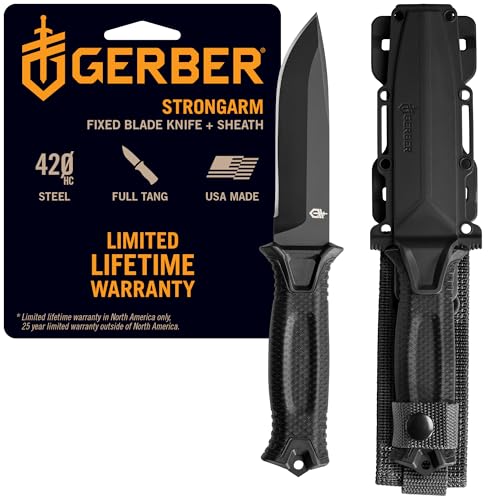
Stainless 420HC that shrugs off rain and sweat, a rubbery diamond-texture grip, and a sheath you can mount upright or sideways. A good choice for anyone who won’t oil a carbon blade.
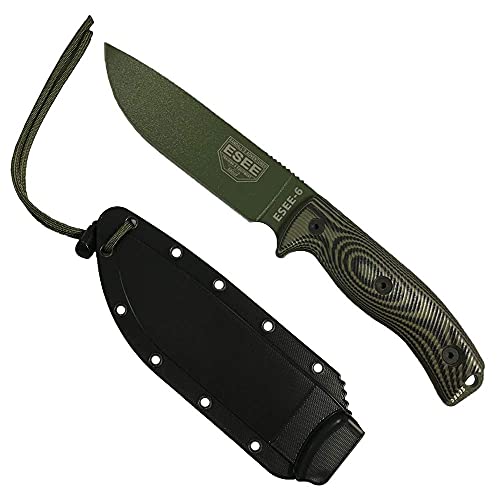
The bigger brother of my top pick, with a 6.5-inch blade that chops kindling and clears small brush. Worth the extra weight for canoe trips, base camps and vehicle kits.

A thick 6-inch clip point with a grippy Kray-Ex handle, a design Cold Steel has sold for decades. It costs much less than the ESEEs and does most of the same jobs.
Survival Knives Compared
| Knife | Blade | Steel | Thickness | Handle | Best for |
|---|---|---|---|---|---|
| ESEE-4P | 4.5″ drop point, full tang | 1095 carbon | 0.188″ | Micarta | One knife for everything |
| Morakniv Garberg | 4.3″ Scandi, full tang | Carbon, DLC coated | 3.2 mm | Polymer | Fire, carving, feather sticks |
| KA-BAR Becker BK2 | 5.25″ drop point, full tang | 1095 Cro-Van | 0.25″ | Ultramid | Batoning, prying, abuse |
| Gerber StrongArm | 4.8″ drop point, full tang | 420HC stainless | Not stated | Rubberized | Rain, salt air, low upkeep |
| ESEE-6 | 6.5″ drop point, full tang | 1095 carbon | 0.188″ | G10 | Chopping, base camp |
| Cold Steel SRK | 6″ clip point | SK-5 carbon | 5 mm | Kray-Ex | Budget, vehicle kit |
1. ESEE-4P (Grey Micarta Handle): Best Overall
Who it’s for: anyone who wants one fixed blade for camping, backcountry trips and an emergency kit, and is happy to look after carbon steel.
The ESEE-4 is the knife I think of when someone asks what a survival knife should look like. The blade is 4.5 inches overall with just over 4 inches of cutting edge, which is the sweet spot: long enough to split wrist-thick wood by batoning, short enough to control the tip when you carve. At 0.188 inches thick, the spine is stout without turning the knife into a pry bar that can’t slice.
ESEE uses 1095 carbon steel at a moderate hardness (55 to 57 HRC), a choice that favors toughness over long edge life. It bends before it snaps and it sharpens quickly on almost anything. The Micarta handle scales unscrew, so you can clean underneath or wrap the bare tang in paracord. The molded sheath has a clip plate for belt or pack carry, and ESEE’s guarantee is famously generous: break it and they replace it, no questions about how.
My reservations are the ones that come with this steel. 1095 rusts if you put it away wet, so the coating does most of the work and the edge needs a wipe of oil. At 8 ounces for the knife alone, it’s also no ultralight blade.
Key specs
- Blade: 4.5″ drop point (4.1″ cutting edge), 1095 carbon, 55 to 57 HRC
- Thickness 0.188″; full tang; overall 9″
- Handle: removable grey Micarta scales
- Molded polymer sheath with clip plate; weight 8 oz; made in USA
Pros
- Ideal all-round size for hard use
- Tough, easy-to-sharpen steel
- Lifetime guarantee with no conditions
Cons
- Carbon steel rusts without care
- Heavy for its blade length
My verdict: the survival knife I’d buy first. If rust worries you more than weight, look at the Gerber StrongArm instead.
2. Morakniv Garberg Carbon (Multi-Mount): Best Scandi Grind
Who it’s for: fire-starting and wood-craft fans who like the way a Mora carves but want a knife that survives batoning.
Morakniv is the outdoor brand I named for value in my best knife makers roundup. Most of its knives have a rat-tail tang that ends partway into the handle, which is why they’re cheap and why people break them when they hammer them through logs. The Garberg is Mora’s answer: a full-tang 4.3-inch blade, 3.2 mm thick, with the classic Scandi grind. That grind is one wide, flat bevel, and it bites into wood and holds a steady angle for feather sticks better than any other shape on this list.
The spine is ground square, so it strikes a ferro rod properly, and the black DLC coating keeps the carbon steel from rusting as quickly as a bare blade. This version comes with Mora’s multi-mount kit: a polymer sheath with a click lock, a belt loop and straps for MOLLE webbing. The handle is symmetrical, so it feels the same blade-up or blade-down.
It costs a lot more than the Companion-type Moras in my bushcraft guide, and the Scandi edge is less happy with heavy chopping or prying than the thicker ESEE and Becker blades. The coating protects the flats, but the edge itself is bare carbon steel and still needs a wipe of oil.
Key specs
- Blade: 4.3″ Scandi grind, carbon steel, black DLC coating
- Thickness 3.2 mm; full tang; square spine for ferro rods
- Overall 9″; weight 9.6 oz
- Polymer sheath with click lock, belt loop and MOLLE multi-mount
Pros
- Best carving and feather-stick grind here
- Sparks off a ferro rod out of the box
- Flexible mounting options
Cons
- Scandi edge isn’t meant for prying
- Expensive for a Mora
My verdict: the pick for people who build a lot of fires. Those who chop more than they carve will be happier with the ESEE-6.
3. KA-BAR Becker BK2 Campanion: Toughest Blade
Who it’s for: people who want a knife they can split wood with all weekend and never worry about.
The BK2 is the knife enthusiasts hand over when someone says “I want something I can’t break.” Its 5.25-inch drop point is cut from a quarter inch of 1095 Cro-Van carbon steel, about a third thicker than the ESEE blades. Batoning, splitting kindling, chopping notches and prying apart frozen firewood are what it does best.
Ethan Becker designed it as a camp knife, and KA-BAR has made it for years with a black powder-coated blade and Ultramid handle scales that bolt onto the full tang. The scales are grippy enough and can be swapped for Micarta or wood if you want to customize it.
All that steel has a cost. The knife weighs about a pound, and the thick blade wedges in food and tough material instead of slicing through. The sheath that ships with it is the part owners grumble about most, and many upgrade it. Think of the BK2 as a small axe with a knife edge.
Key specs
- Blade: 5.25″ drop point, 1095 Cro-Van carbon, black powder coat
- Thickness 0.25″; full tang
- Handle: Ultramid scales, replaceable
- Meets US military specification
Pros
- Practically indestructible in normal use
- Splits wood like a hatchet
- Easy to customize the handle
Cons
- Heavy and a poor slicer
- Many owners replace the sheath
My verdict: the knife for wood processing and rough use. For a mix of carving and camp cooking, the ESEE-4 is the better all-rounder.
4. Gerber StrongArm (Plain Edge): Best for Wet Climates
Who it’s for: paddlers, coastal campers and anyone who wants a full-tang knife that doesn’t need oiling.
Carbon steel is tough and easy to sharpen, but it punishes neglect. The StrongArm takes the other route with 420HC stainless, the same easy-going steel Buck uses on its hunting knives. Its edge gives up sooner than premium steels do, but it resists rust in rain and salt air, and a few passes on a rod bring it back.
The full-tang blade is 4.8 inches long, and the rubberized handle has a diamond texture that grips well with wet or gloved hands. The sheath is the clever part: it can sit on a belt, mount horizontally or attach to MOLLE webbing on a pack or vest. The exposed pommel works as a striking surface for breaking ice or glass.
420HC is a soft steel by survival-knife standards, so a weekend of batoning and carving will dull it sooner than 1095, and the black coating shows wear quickly. I’d also skip the serrated version: a plain edge is easier to sharpen in the field.
Key specs
- Blade: 4.8″ drop point, 420HC stainless, plain edge
- Full tang; striking pommel
- Handle: rubberized, diamond texture
- MOLLE-compatible sheath, vertical or horizontal carry
Pros
- Stainless steel needs little care
- Very secure grip when wet
- Versatile sheath
Cons
- Edge dulls sooner than 1095 under hard use
- Coating wears fast
My verdict: the low-maintenance survival knife. Skip it if you mostly carve, where the Garberg’s grind does better.
5. ESEE-6 (G10 3D Handle): Best Large Blade
Who it’s for: canoe trippers, base campers and vehicle kits, where weight matters less than reach.
Some jobs want more blade: chopping kindling, clearing small brush, splitting bigger rounds. The ESEE-6 keeps everything I like about the ESEE-4 and stretches the blade to 6.5 inches, with 5.75 inches of cutting edge, a full flat grind and the same 0.188-inch 1095 steel. The extra length lets it chop with real momentum.
This version has ESEE’s 3D-contoured G10 handle, which fills the hand better than the older flat scales, and the ambidextrous polymer sheath has a clip plate. ESEE’s lifetime guarantee applies here too.
It’s a big knife to wear: 13 ounces alone, 18 with the sheath. On a belt it hits your leg when you sit, and for fine carving it feels clumsy next to the 4. I wouldn’t take it backpacking, but it’s an excellent knife to keep in a canoe pack or a truck.
Key specs
- Blade: 6.5″ drop point (5.75″ edge), 1095 carbon, 55 to 57 HRC
- Thickness 0.188″; full flat grind; overall 11.75″
- Handle: 3D-contoured G10
- Ambidextrous polymer sheath with clip plate; 13 oz (18 oz with sheath); made in USA
Pros
- Chops far better than a 4-inch knife
- Same tough steel and guarantee as the ESEE-4
- Comfortable contoured handle
Cons
- Heavy and long to carry all day
- Clumsy for small carving
My verdict: the best big survival knife here. If you’ll carry it on foot most of the time, the ESEE-4 is the smarter size.
6. Cold Steel SRK (SK-5 Steel): Best Budget
Who it’s for: buyers who want a proven, thick-bladed survival knife without paying ESEE prices.
The SRK (Survival Rescue Knife) is one of the oldest designs on this list, and Cold Steel says it has long been popular with military and law enforcement users. The 6-inch clip point is 5 mm thick SK-5, a Japanese high-carbon steel known for toughness, with a black coating to slow rust.
The Kray-Ex handle is a rubbery, textured material that stays secure when wet, and the Secure-Ex sheath is a rigid, snap-in design. At 7.9 ounces, it’s lighter than you’d expect for a 6-inch blade this thick.
The clip point (the classic bowie knife tip) is finer and weaker than the drop points above, so treat the tip with some respect. The coating also rubs off near the edge with use. Neither stops this from being the best value here.
Key specs
- Blade: 6″ clip point, SK-5 carbon steel, black coating
- Thickness 5 mm; overall 10.75″
- Handle: 4.75″ Kray-Ex, textured
- Secure-Ex sheath; weight 7.9 oz
Pros
- Thick, tough blade for the money
- Grippy handle in rain
- Light for its size
Cons
- Clip point tip is the weak spot
- Coating wears near the edge
My verdict: the survival knife to buy when the budget is tight. Spend more on the ESEE-4 if you want a lifetime guarantee behind it.
What Separates a Real Survival Knife From a Gimmick
A full tang, not a hollow handle
A survival knife should have a full tang, with the steel running the length of the handle. Hollow-handle knives store matches in the grip, but the joint where blade meets handle is the first thing to fail when you baton or pry. Put the survival kit in your pocket, not in the knife.
Blade length: 4 to 6.5 inches
Four to five inches is the best single size, because it carves, cooks and batons. Six inches and up chops better and suits canoes and base camps. Anything longer is a machete or a camp knife, and it’s harder to control for fine work. For pack-weight trips, my best knives for backpacking are the lighter choice.
Spine thickness and grind
Choose a blade at least 3 mm thick for batoning; 4 to 6 mm is tougher still but slices worse. A Scandi grind carves wood best, while a flat or saber grind is a better compromise for food and general cutting.
Carbon or stainless steel
Carbon steels like 1095 are tough and easy to sharpen, but they rust if neglected. Stainless like 420HC needs less care and holds up in wet climates at the cost of edge life. My carbon vs stainless steel guide explains the trade-off in more detail.
A sheath that holds
The sheath should lock the knife in place even upside down. Molded polymer or Kydex sheaths with a click fit are the most secure; leather looks good but stretches when wet. If you carry on a pack, look for MOLLE or clip-plate mounts.
Plain edge over serrations
A plain edge is easier to sharpen in the field and carves cleanly. Serrations help with rope, but they’re hard to maintain and they snag in wood.
How to Baton Wood Safely
- Pick dry, straight wood no thicker than about two-thirds of your blade length, so the tip sticks out the far side.
- Stand the round on a stable base, such as a larger log, never on rock or bare frozen ground.
- Set the edge across the top of the round, away from knots, with the handle level.
- Strike the spine with a thick stick, not a rock or hammer, close to where it meets the wood.
- Tap the exposed tip once the blade is buried, keeping your other hand on the handle and your legs out of the line of the split.
- Stop if it twists or sticks. Wiggling a stuck blade sideways is how tips snap; use a wooden wedge instead.
FAQ
What is the best survival knife?
The ESEE-4 is the best survival knife for most people: a 4.5-inch full-tang 1095 blade with a lifetime guarantee. The Morakniv Garberg is the best choice for fire-making and carving, and the Cold Steel SRK is the best budget option.
What is the difference between a survival knife and a bushcraft knife?
A survival knife is built tougher: thicker steel and a full tang for batoning, prying and abuse. A bushcraft knife is usually thinner and lighter, made for carving and camp chores. Many knives sit in between, like the Garberg.
Is a full tang necessary?
For a knife you’ll baton or pry with, yes. A full tang spreads the stress along the handle, so the blade can’t snap off at the handle joint. A partial tang is fine for carving and camp kitchen jobs.
Should a survival knife have a serrated edge?
No, a plain edge is better for most people. It’s easier to sharpen with a small stone or rod, and it carves wood cleanly. Serrations only help with rope and webbing.
How long should a survival knife be?
Around 4 to 5 inches of blade covers most survival jobs. Go to 6 or 6.5 inches if you need to chop and weight doesn’t matter, as on canoe trips.
Is a carbon steel survival knife a bad idea in wet places?
Not if you look after it. Coated 1095 holds up well when you dry the blade and add a drop of oil after use. If you know you won’t, a stainless knife like the Gerber StrongArm is the safer choice.
Final Verdict
The ESEE-4 is the survival knife I’d recommend first: the right size, a full tang, tough 1095 steel and a guarantee that covers almost anything. The Morakniv Garberg wins for fire-making and carving, and the KA-BAR Becker BK2 is the knife to choose when you expect to abuse it.
Need a cheap, tough backup for the truck? My Glock field knife review covers one of the best bargains in hard-use fixed blades.

Gary Portman founded knivesadvice.com in 2019. He learned to cook in his family’s kitchen as a kid and has used kitchen, pocket and outdoor knives ever since, from paring and fillet knives to survival blades he carries camping and hiking. He writes the site’s buying guides, brand reviews and sharpening how-tos to help readers find the right knife for the job. More about Gary.