
Most people buy the wrong machete for their yard. They pick the thickest, meanest-looking blade on the shelf, then find it tires their arm in ten minutes and bounces off green vines. For brush, weeds and blackberry canes, a long, thin, light blade wins every time. Thick and heavy only pays off when you’re chopping wood. The second mistake is ignoring the handle: a machete that twists in a sweaty hand is how people get hurt.
The one I’d buy for general yard and trail work is the Gerber Gator Machete: an 18 inch blade, a saw on the back and a grippy rubber handle. If your work is mostly wood at camp, the Condor Bushcraft Parang is the better tool.
My Top 7 Machete Picks
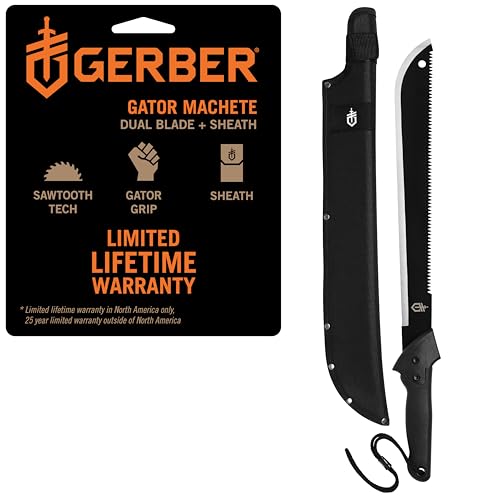
Long enough for real brush clearing, light enough to swing all afternoon, and the saw back handles branches the edge can’t. It’s the machete I’d give anyone with an overgrown fence line.

A traditional Latin American pattern done properly: convex-ground high carbon steel, a walnut handle and a stitched leather sheath. It feels like a tool you keep for decades.
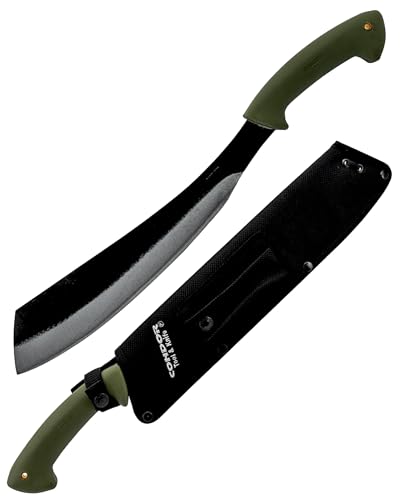
A shorter, heavier blade with its weight forward. It splits and chops camp wood where a thin machete just flexes.

The machete farm workers in Latin America actually use. Plain, long, light and very inexpensive, and it sharpens with a file in no time.

The US-made military machete design, thin and fast. A good shed tool for anyone who likes a classic and doesn’t need a saw.

A 17 inch kukri curve on a thin, light blade. The bent shape bites into saplings better than a straight machete of the same weight.

A 10 inch recurve that fits in a pack or behind a truck seat. Ideal for campsite chores and short trails.
Machetes Compared
| Machete | Blade | Steel | Handle | Sheath | Best for |
|---|---|---|---|---|---|
| Gerber Gator | 18″ straight, saw back | High carbon stainless | Rubberized Gator Grip | Nylon | All-round yard and trail work |
| Condor El Salvador | 18″ Latin style, 3 mm | High carbon steel | Walnut | Welted leather | Brush clearing, buy-once tool |
| Condor Bushcraft Parang | 13″ parang | 1075 carbon | Polypropylene | Ballistic nylon | Chopping camp wood |
| Tramontina 24″ | 24″ class, Latin style | Carbon steel | Polypropylene | Not listed | Tall grass, cane, low budget |
| Ontario 6144 | 18″ military | Carbon steel | Plastic | Not listed | Vines and weeds |
| Cold Steel Magnum Kukri | 17″ kukri, 2.8 mm | 1055 carbon | Polypropylene | Cor-Ex | Saplings and mixed growth |
| Kershaw Camp 10 | 10″ recurve | 65Mn carbon | Glass-filled nylon, rubber grip | Molded nylon | Camp and pack carry |
1. Gerber Gator Machete with Saw, 18 Inch Blade: Best Overall
Who it’s for: homeowners, hunters and hikers who want one machete that handles weeds, vines and the occasional branch.
The Gator is 25 inches overall with an 18 inch plain edge on one side and a saw on the other. That combination is why it’s my top pick. The edge takes care of anything green and soft, and when you hit a dead limb too hard to chop cleanly, you flip it over and saw. Most yard jobs have both.
The Gator Grip handle is the other reason. It’s a textured rubber that holds in wet or sweaty hands, and that matters more on a machete than on almost any other blade, because a slipping machete is a dangerous one. The steel is a stainless type, so a damp morning in the dew won’t leave rust spots.
My reservations: stainless machete steel is softer than good carbon steel and needs touching up more often, and the saw teeth will snag on clothing and the sheath. The nylon sheath is basic but does its job.
Key specs
- Blade: 18 inch plain edge with a saw on the spine
- Overall length: 25 inches
- Steel: high carbon stainless
- Handle: rubberized Gator Grip
- Sheath: nylon; Gerber limited lifetime warranty
Pros
- Edge plus saw covers most yard jobs
- Very secure grip when wet
- Resists rust
Cons
- Softer steel needs frequent touch-ups
- Saw teeth snag gloves and clothing
- Thin blade isn’t for splitting wood
My verdict: the safest machete to buy if you only want one. Wood choppers should look at the Parang below.
2. Condor El Salvador Machete, 18 Inch, Walnut: Best Premium
Who it’s for: landowners and gardeners who clear brush often and want a better-made tool than a hardware store machete.
Condor makes its machetes in El Salvador, and this is the pattern named after the country: a long, straight Latin blade that widens toward the tip. That extra width puts weight where the blade meets the brush, so each swing carries more energy without the handle end feeling heavy.
What you pay for is finish. The 3 mm high carbon blade has a convex grind, which is thicker behind the edge and resists chipping on hidden rocks and roots. The walnut handle is shaped well, and the welted leather sheath is the kind people keep long after the original blade has worn out.
The trade-offs come with carbon steel and wood. Put it away damp and the blade will spot with rust, and the walnut handle gets slick in the rain compared with the Gerber’s rubber. It also costs much more than the Tramontina, which does the same basic job.
Key specs
- Blade: 18 inch Latin style, 3 mm thick, convex grind
- Steel: high carbon steel
- Handle: walnut
- Sheath: handcrafted welted leather
- Made in El Salvador
Pros
- Forward weight for efficient swings
- Tough convex edge
- Excellent leather sheath
Cons
- Carbon steel rusts without care
- Wood handle is slippery when wet
- Costs more than a basic machete
My verdict: a buy-once machete for people who clear land every year. Occasional users won’t feel the difference over the Gerber.
3. Condor Bushcraft Parang, 13 Inch: Best for Chopping Wood
Who it’s for: campers and bushcrafters who chop and split firewood more than they clear grass.
A parang is the Malaysian and Indonesian cousin of the machete: shorter, thicker and heavier toward the tip. Condor’s version has a 13 inch blade of 1075 high carbon steel with a convex grind and weighs about 23 ounces. In practice that means it bites deep into dry wood and pops chunks out instead of sticking.
It’s my pick for camp because it does the jobs of a small hatchet and a long knife in one tool. You can split kindling by batoning it, limb a fallen branch and still clear a tent site of brambles. The polypropylene handle shrugs off weather, and the ballistic nylon sheath is sturdy.
Don’t buy it for an acre of tall grass. The extra weight that makes it chop well also makes it tiring for long sessions of light cutting, where the thin 18 inch blades above are faster.
Key specs
- Blade: 13 inch parang, convex grind
- Steel: 1075 high carbon steel
- Weight: 22.9 oz
- Handle: high impact polypropylene
- Sheath: ballistic nylon
Pros
- Chops and splits wood well
- Weather-proof handle
- Compact enough for a pack
Cons
- Heavy for long brush clearing
- Carbon blade needs oiling
- Shorter reach than a full-size machete
My verdict: the best camp chopper here. For yard work, pick one of the long, thin blades instead.
4. Tramontina 24 Inch Carbon Steel Machete: Best Budget
Who it’s for: anyone with tall grass, cane or thick weeds to cut who wants the simplest, cheapest tool that works.
Tramontina is a Brazilian company, and its machetes are standard farm tools across Latin America. This one is the long version: a thin carbon steel blade with a polypropylene handle fixed with aluminum rivets. Length is its advantage. With 24 inches of reach, you can cut low grass without bending as far and keep your legs well away from the swing.
It’s the machete I’d recommend to someone who has never owned one. It costs very little, so learning to sharpen and swing on it carries no risk. The carbon steel files sharp in a few minutes and is easy to keep that way.
It is a bare tool. No sheath is listed, the edge usually needs work out of the box, and a blade this long and thin is too whippy for wood. Make or buy a simple sheath before you carry it anywhere.
Key specs
- Blade: 24 inch class, Latin style, carbon steel
- Handle: polypropylene with aluminum rivets
- Made in Brazil
Pros
- Long reach for grass and cane
- Very light and inexpensive
- Easy to sharpen
Cons
- No sheath listed
- Usually needs sharpening when new
- Flexes on anything woody
My verdict: the smart cheap machete for grass and weeds. Skip it if you need to carry it on a belt.
5. Ontario 6144 Military Machete, 18 Inch: Best Military Pattern
Who it’s for: people who want a straight, simple US-made machete for vines and weeds.
Ontario has made machetes in New York for more than 70 years, and the 18 inch military pattern is the one most people picture. It’s a plain straight blade of carbon steel with a black handle and nothing extra. Without a saw or a heavy tip, it’s light and quick for swinging through honeysuckle, ivy or the weeds along a ditch.
I rate it a little behind the Gerber because it lacks the saw and the rubber grip, and the factory edge usually needs work. If you prefer a classic tool and want to support US manufacturing, it’s still a fine choice.
Like every thin machete here, it flexes on hard wood. Keep it for green growth.
Key specs
- Blade: 18 inch carbon steel
- Pattern: Ontario military-issue machete
- Package weight: about 1.5 pounds
- Made in the USA
Pros
- Light, fast and simple
- US-made classic
- Files sharp easily
Cons
- Edge usually needs sharpening first
- No saw, plain handle
- Sheath not listed
My verdict: a good, honest machete for soft brush. Pick the Gerber if you want a better grip.
6. Cold Steel Magnum Kukri Machete: Best Kukri-Style
Who it’s for: people clearing mixed growth (saplings, cane and vines together) who want more bite than a straight machete.
This is a kukri shape stretched to machete length: a 17 inch blade of 1055 carbon steel, only 2.8 mm thick, with a black anti-rust finish. The bend in the blade pushes weight forward and angles the edge into the cut, so it chops small trees better than a straight machete of the same weight. At 20.1 ounces, it’s still light enough for long sessions.
The handle is polypropylene molded over a full tang, and it comes with a Cor-Ex sheath (a corrugated plastic sheath that’s light but not pretty). I’d call this the best value for anyone who likes the kukri idea but needs real reach. If you want a true, thick kukri for wood, my bushcraft knife guide and kukri guide go that way instead.
Cold Steel edges often arrive rough, and the coating scratches off along the edge after the first sharpening. Both are cosmetic.
Key specs
- Blade: 17 inch kukri style, 2.8 mm thick
- Steel: 1055 carbon, black anti-rust finish
- Handle: polypropylene over a full tang, 5 inches
- Weight: 20.1 oz
- Sheath: Cor-Ex
Pros
- Curved blade bites into saplings
- Light for its length
- Full tang under the handle
Cons
- Rough factory edge
- Basic sheath
- Curve takes some getting used to
My verdict: the best choice for mixed brush with small trees. For plain weeds, a straight blade is simpler.
7. Kershaw Camp 10 Machete: Best Compact
Who it’s for: campers, hunters and overlanders who want a short machete that rides on a pack or in a vehicle.
The Camp 10 is about as short as a machete gets: a 10 inch recurve blade of 65Mn carbon tool steel with a black powder coat. The recurve (an edge that curves in, then out) gives it more cutting edge and a heavier tip than a straight blade of the same length. It’s full tang, with a glass-filled nylon handle, a rubbery grip and a built-in guard.
Why carry a machete this small? Because a 10 inch blade is still enough for clearing a campsite, cutting tent poles and making kindling, and it straps to the outside of a pack without catching on branches. The molded nylon sheath with gear straps is better than most at this size.
The drawbacks: it’s short for real brush clearing, and the powder coat wears off with use, especially near the edge.
Key specs
- Blade: 10 inch recurve, black powder coat
- Steel: 65Mn carbon tool steel
- Construction: full tang
- Handle: glass-filled nylon with rubberized grip and guard
- Sheath: glass-filled nylon with gear straps
Pros
- Easy to carry on a pack
- Good guard and grip
- Sheath is better than average
Cons
- Too short for big clearing jobs
- Coating wears quickly
- Recurve is harder to sharpen
My verdict: the machete to keep in a camping kit. For yard work, get a longer blade.
Choosing a Machete for the Job
Match the length to what you cut
For grass, cane and weeds, go long: 18 to 24 inches gives reach and speed. For mixed brush and small trees, 14 to 18 inches is the most controllable. For camp chores and pack carry, 10 to 13 inches is enough. Longer blades also keep your legs farther from the swing.
Thin blades for green growth, thick for wood
Thickness matters more than most buyers think. A thin blade (around 2 to 3 mm) cuts soft vegetation quickly and doesn’t tire you. A thick, forward-heavy blade like a parang or kukri chops wood but is slow and tiring in grass. Decide which work you’ll do most and buy for that.
Blade shapes in plain words
The Latin or “panga” style is straight and widens at the tip: the all-rounder. A bolo bulges near the tip for chopping. A parang or golok is shorter and heavier for wood. A kukri curves forward for biting cuts. A recurve adds tip weight to a short blade. If you’re not sure, a straight 18 inch Latin blade covers the most ground. For a wider overview of shapes, see my guide to knife blade types.
Carbon or stainless steel
Carbon steel is tougher, easier to sharpen and the choice of people who use machetes for a living, but it rusts. Stainless machete steel resists rust and suits humid yards and boats, but it’s usually softer and needs more frequent sharpening. Either is fine; just know what care you’re signing up for.
Handle and sheath
Choose a handle that grips when wet: rubber or textured plastic beats smooth wood. A lanyard hole helps too. A sheath is not optional if you carry the machete anywhere, so budget for one if the machete doesn’t include it.
Is a saw back worth it?
Yes, for yard work, where you meet dead branches the edge can’t chop cleanly. No, if the machete lives on a pack, where the teeth snag everything. Saw backs also make the spine less comfortable to hold for choking up. Glock’s small field knife uses the same idea, and my Glock knife review covers how useful those teeth really are.
How to Sharpen a Machete
Use a mill file for the first sharpening. Clamp the machete or rest it on a bench, and push the file along the edge at a low angle, about 25 degrees, working from handle to tip. Keep filing the first side until a slight burr (a thin lip of metal) runs the full length of the edge, then switch sides.
Finish with a puck or a coarse stone. A two-sided axe puck is ideal because you can use it in the field. Machetes don’t need a razor edge: a slightly toothy, durable edge cuts green growth better and lasts longer. Touch it up whenever it starts to bounce off stems rather than slicing them.
FAQ
What is a machete used for?
A machete is a long, thin blade for clearing vegetation: grass, weeds, vines, cane and small saplings. People also use them for farm work, cutting trails and camp chores. Heavier versions like the parang chop and split wood.
What length machete should I buy?
For most yard work, 18 inches is the length I’d choose. Go to 22 to 24 inches for tall grass and cane, and down to 10 to 13 inches for camping and pack carry.
Is a carbon steel or stainless machete better?
Carbon steel is tougher and easier to sharpen, so most experienced users prefer it. Stainless is better if your machete will stay damp or you won’t oil it. The Gerber Gator is the stainless pick in this list.
Machete or kukri: which is better?
A machete is faster for grass, vines and soft brush. A kukri chops wood and saplings harder thanks to its forward-weighted curve. The Cold Steel Magnum Kukri is a hybrid that does some of both.
Why is my new machete not sharp?
Many machetes ship with an unfinished working edge on purpose: makers expect users to sharpen them to suit the job. A mill file and a little patience will fix it.
Is it legal to carry a machete?
Laws vary by state, country and even city. Carrying a machete to work in your yard or on your land is normally fine, but carrying one in public can be restricted. Check your local rules before you carry one off your property.
Final Verdict
The Gerber Gator is the machete most people should buy: long, light, grippy and fitted with a saw for the branches that need it. If you clear brush every season and want a lifetime tool, the Condor El Salvador is worth the extra money. For camp wood, the Condor Bushcraft Parang chops where thin machetes give up, and the Tramontina is the cheapest way to start.
Heading into the woods with more than a machete? My best knives for backpacking list covers lighter options, and my carbon vs stainless steel guide explains which steel suits wet weather.

Gary Portman founded knivesadvice.com in 2019. He learned to cook in his family’s kitchen as a kid and has used kitchen, pocket and outdoor knives ever since, from paring and fillet knives to survival blades he carries camping and hiking. He writes the site’s buying guides, brand reviews and sharpening how-tos to help readers find the right knife for the job. More about Gary.