

Ceramic knives have a reputation for being either magic or useless, and both camps are half right. A zirconia blade stays sharp far longer than steel, never rusts and weighs almost nothing, but it snaps if you twist it, drop it or hit a bone. So the smartest first ceramic knife is a small one that only meets fruit and vegetables.
That’s why my pick is the Kyocera Revolution 3-inch Paring Knife, not a big chef’s knife. If you already know you like ceramic and want it for daily prep, the Kyocera INNOVATIONwhite 7-inch Chef’s Knife is the longest ceramic blade I’d trust in a home kitchen.
My Top 6 Ceramic Knife Picks

Short blades are where ceramic shines and where it’s hardest to break. This one peels, hulls and trims for a very long time between sharpenings, and it costs little enough to settle the question of whether ceramic suits you.

Seven inches is as long as I’d go with zirconia. It handles a full board of vegetables and boneless chicken, and its light weight is a real help for cooks with sore wrists or arthritis.

A compact all-rounder that suits small hands and small boards. The rounded tip makes it a calm, controlled slicer for herbs, onions and fruit.

Fine teeth catch tomato skin, citrus peel and peppers straight away, and ceramic doesn’t react with acidic food. A great second ceramic knife after the paring knife.

A tall, flat blade made for straight up-and-down chopping, which is the motion ceramic likes best. The wide face also doubles as a scoop for whatever you just chopped.
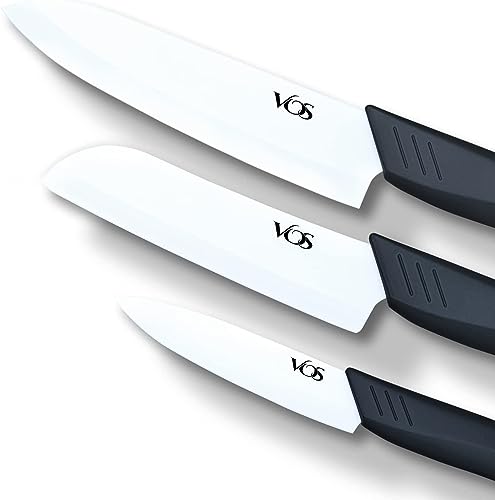
Three ceramic knives with covers in a gift box for very little money. Not Kyocera quality, but a sensible way to try ceramic in a camper, a dorm or a fruit drawer.
Ceramic Knives Compared
| Knife | Blade | Edge | Line | Best for |
|---|---|---|---|---|
| Kyocera Revolution 3-inch Paring Knife | 3″, white zirconia | Plain | Revolution | Peeling, hulling, trimming |
| Kyocera INNOVATIONwhite 7-inch Chef’s Knife | 7″, white zirconia | Plain | INNOVATION | Daily vegetable and boneless meat prep |
| Kyocera Revolution 5.5-inch Santoku | 5.5″, white zirconia | Plain | Revolution | Small hands, small boards |
| Kyocera Revolution 5-inch Micro-Serrated Knife | 5″, white zirconia | Micro-serrated | Revolution | Tomatoes, citrus, peppers |
| Kyocera INNOVATIONwhite 6-inch Nakiri | 6″, white zirconia | Plain | INNOVATION | Chopping piles of vegetables and herbs |
| Vos Ceramic Knife Set | 4″, 5″ and 6″, zirconia | Plain | Vos | Trying ceramic, second kitchens |
1. Kyocera Revolution 3-inch Paring Knife: Best Overall
Who it’s for: anyone curious about ceramic, and cooks who peel and trim a lot of fruit and want an edge that stays keen for months.
Every weakness of ceramic grows with blade length. A long, thin zirconia blade has more leverage working against it, so it’s the long knives that snap when someone pries at a squash. A 3-inch blade barely gives you leverage to misuse. That’s the main reason I put this little knife at the top: you get almost all of ceramic’s benefits with very little of its risk.
And the benefits are real in a paring knife. Ceramic is far harder than kitchen steel, so the edge lasts a long time when it only meets strawberries, apples and garlic. It doesn’t rust, it doesn’t react with lemon juice, and it rinses clean. Kyocera says its blades stay sharp up to ten times longer than steel; I’d treat that as a best case, but the edge life is the reason people fall for ceramic in the first place.
The reservation is the same one every ceramic owner learns: the tip is the weak point. Don’t pop jar lids, pry out pits or dig into a frozen bag with it. Kyocera did more than anyone to bring ceramic kitchen knives into home kitchens, and the problem ceramic owners report again and again is a broken tip from exactly that kind of job. This listing is the red-handle version; the blade is the same as the other colors.
Key specs
- Blade: 3 inches, white zirconia ceramic
- Edge: plain
- Line: Kyocera Revolution
- Handle: red resin
Pros
- Short blade keeps ceramic’s breakage risk low
- Edge lasts a long time on fruit and vegetables
- Rust-proof and non-reactive with acidic food
Cons
- Tip snaps if used for prying or twisting
- Needs diamond tools or Kyocera’s service to sharpen
My verdict: the first ceramic knife I’d tell anyone to buy. If you end up loving it, the chef’s knife below is the next step; if you don’t, you’ve lost very little.
2. Kyocera INNOVATIONwhite 7-inch Chef’s Knife: Best Ceramic Chef’s Knife
Who it’s for: careful cooks who prep mostly vegetables, fruit and boneless meat, and anyone whose wrists tire with a heavy steel chef’s knife.
I stop at seven inches with ceramic. Beyond that, the blade gets long enough that a sideways push at the tip can snap it, and the board space you gain isn’t worth that. At seven inches you still get a proper chef’s knife: room to rock through herbs, enough length for a big onion, and a light blade that doesn’t drag on a long prep session.
Kyocera points out that light knives help cooks with arthritis or hand injuries, and I agree with that more than with most marketing lines. A ceramic chef’s knife asks very little of your grip. The INNOVATION line also has a more shaped handle than the plain Revolution handles, which suits long sessions.
What it can’t do is the rough work a steel chef’s knife shrugs off. No chicken bones, no winter squash, no frozen anything, no scraping food off the board with the edge (flip it and use the spine). If your household shares one knife and somebody will use it as a pry bar, buy steel for the main knife and keep this for yourself. My ceramic vs steel knife comparison goes into that choice in more detail.
Key specs
- Blade: 7 inches, white zirconia ceramic
- Edge: plain, shaped for rocking cuts
- Line: Kyocera INNOVATION
- Non-reactive and non-corrosive (Kyocera)
Pros
- Light enough for long prep with sore hands
- Long edge life on vegetables and boneless meat
- Rocking-friendly profile, unlike many ceramic chef’s knives
Cons
- Not for bones, squash or frozen food
- Too fragile to be a household’s only knife
My verdict: the ceramic chef’s knife to buy if you’re disciplined about what it cuts. Families who share and bang knives around should look elsewhere.
3. Kyocera Revolution 5.5-inch Santoku: Best for Small Hands
Who it’s for: cooks with small hands or small boards who want one compact ceramic knife for most everyday slicing.
A 5.5-inch santoku is short for a main knife, and that’s the point here. It’s long enough to slice a cucumber or a chicken breast in one stroke and short enough to keep the blade’s leverage low. Kyocera calls it a good first ceramic knife for beginning cooks, and I’d agree for anyone who finds a 7-inch blade too much.
The santoku shape also suits ceramic. Its flatter edge and rounded tip push you toward straight down-and-forward cuts rather than rocking, and that gentle motion is exactly what a brittle blade wants. If you’re new to the shape, my guide on how to use a santoku knife covers the grip and the cutting motion.
My one reservation: it’s small for big jobs. Halving a cabbage or a melon asks for more length and more force than I’d put through a short ceramic blade.
Key specs
- Blade: 5.5 inches, white zirconia ceramic
- Edge: plain, rounded tip
- Line: Kyocera Revolution, made in Japan (per listing)
- Rust-proof and resistant to acids (Kyocera)
Pros
- Compact size suits small hands and boards
- Rounded tip is less likely to snap than a pointed one
- Good all-rounder for fruit, vegetables and boneless meat
Cons
- Too short for big produce like cabbages and melons
- Same brittleness as every ceramic blade
My verdict: the ceramic knife I’d give someone who cooks for one or two. Big batch cooks will want the 7-inch chef’s knife instead.
4. Kyocera Revolution 5-inch Micro-Serrated Knife: Best for Tomatoes
Who it’s for: anyone who slices a lot of tomatoes, citrus, peppers or soft-skinned fruit and wants an edge that doesn’t need upkeep.
Tomato skin is the classic test for a dull knife: a tired edge slides over it and squashes the fruit. Fine serrations fix that by catching the skin instantly, and on a ceramic blade those teeth stay keen for a long time. Ceramic also doesn’t react with acidic juice, so the blade never discolors and leaves no metallic taste on cut fruit.
Kyocera lists this one for fruit, vegetables and boneless meat, and I’d use it the same way: as a tomato and sandwich knife that also handles a steak on the plate. It’s a natural partner for the paring knife, and the two cover most of what ceramic does best.
The downside of micro-serrations is sharpening. Very few home tools can follow fine teeth on zirconia, so this is a knife you use until it’s tired and then send off or replace. If you’d rather have teeth you can touch up with a tapered rod, a steel serrated tomato knife from Victorinox costs very little.
Key specs
- Blade: 5 inches, white zirconia ceramic
- Edge: micro-serrated
- Line: Kyocera Revolution
- For fruit, vegetables and boneless meat; not hard or frozen food (Kyocera)
Pros
- Catches tomato and citrus skin without squashing
- Serrations stay sharp for a long time
- Non-reactive with acidic food
Cons
- Hard to sharpen at home
- Not for crusty bread or anything hard
My verdict: the best second ceramic knife for most kitchens. Pass on it if you’d rather own knives that sharpen on any tool.
5. Kyocera INNOVATIONwhite 6-inch Nakiri: Best for Vegetable Prep
Who it’s for: vegetarian cooks and anyone who chops big piles of vegetables and herbs most days.
The nakiri comes from Japanese home kitchens: a tall, flat, rectangular blade built for vegetables. You chop straight down and lift, with no rocking and no tip work, and that’s the gentlest way to use a ceramic edge. Of all the ceramic shapes, I think this one plays to the material’s strengths most honestly.
The tall blade has a second job: it’s a scoop. Chop a pile of carrots, slide the blade under them and carry them to the pan. Kyocera’s listing mentions boneless proteins too, and slicing a chicken breast is fine, but I’d keep it mostly for produce.
The flat edge is also its limit. If you rock-chop herbs or like to pivot on the tip, a nakiri will feel clumsy and you’ll be happier with the chef’s knife. My nakiri knife guide covers steel versions if you want to compare.
Key specs
- Blade: 6 inches, white zirconia ceramic, wide nakiri shape
- Edge: plain, flat
- Line: Kyocera INNOVATION
- For vegetables, herbs and boneless proteins (Kyocera)
Pros
- Straight chopping motion suits a brittle blade
- Tall face scoops food off the board
- Light for a big vegetable knife
Cons
- Flat edge doesn’t rock-chop
- No tip for detail work
My verdict: a lovely vegetable knife if you already chop straight down. Rockers should buy the chef’s knife.
6. Vos Ceramic Knife Set (4, 5 and 6 inch): Best Budget Set
Who it’s for: people who want to try ceramic cheaply, and second kitchens like campers, dorms and holiday rentals.
Vos sells a 4-inch paring knife, a 5-inch santoku and a 6-inch chef’s knife with a cover for each, packed in a gift box. For very little money, that’s a complete ceramic setup for fruit, vegetables and boneless meat, and the covers matter more than they look: ceramic edges chip when they knock against other utensils in a drawer.
I’d be clear about what you’re buying. Vos is a budget brand and the listing names neither the country of manufacture nor the grade of zirconia, so I wouldn’t expect Kyocera’s finish or edge life. As an introduction or a spare set, though, it does the job.
Vos says the knives are dishwasher safe. I’d still wash them by hand: a dishwasher rack is exactly where a ceramic blade meets a pan and chips.
Key specs
- Knives: 6″ chef’s knife, 5″ santoku, 4″ paring knife
- Blades: zirconia ceramic
- Covers: one per knife
- Lifetime guarantee (Vos)
Pros
- Three useful sizes for very little money
- Covers protect the edges in a drawer
- Gift box makes it an easy present
Cons
- Maker, origin and ceramic grade not stated
- Edge life and finish below Kyocera
My verdict: a cheap, honest way to find out if ceramic suits you. If it does, upgrade the knife you use most to a Kyocera.
What I Look for in a Ceramic Knife
Solid ceramic, not ceramic-coated steel
Check that the blade is zirconia, not steel with a ceramic coating. Many colorful “ceramic” knives are ordinary stainless steel with a nonstick coating; they sharpen and behave like steel, and the coating wears at the edge. A real ceramic blade is solid zirconia all the way through, usually white or black.
Short blades first
The shorter the blade, the safer the ceramic. Paring knives and small utility knives get the full benefit of a long-lasting edge with little leverage to snap them. I’d only go to 7 inches for a chef’s knife, and I’d skip ceramic bread knives and slicers altogether.
A maker that stands behind the edge
Buy from a maker that can sharpen or support the knife later. Kyocera runs a mail-in sharpening service for its own knives (check the current terms before sending one), which matters because few people own the diamond tools ceramic needs. No-name listings rarely offer anything like it.
A plan for sharpening
Ceramic stays sharp for a long time, but not forever, and steel honing rods do nothing to it. You need diamond: a diamond stone, a diamond wheel sharpener or an electric sharpener rated for ceramic. My guide on how to sharpen a ceramic knife walks through the tools and what to do about chips.
Storage that keeps edges apart
Give ceramic its own slot, cover or block. Rattling against steel knives in a drawer is one of the most common ways a ceramic edge gets nicked. A blade guard or a slotted block costs little and saves the knife.
What Not to Cut With a Ceramic Knife
Keep ceramic away from anything hard, frozen or bony, and never twist the blade. The list is short and worth memorizing:
- Bones and joints: even small chicken bones can chip the edge.
- Frozen food: it’s as hard as a bone to the blade.
- Hard squash and big roots: they wedge the blade and invite twisting.
- Pits and shells: no prying out avocado pits or cracking nuts.
- Glass, stone or ceramic boards: use wood or soft plastic only.
- Scraping: push food off the board with the spine, not the edge.
Cut straight down or with a gentle forward slice, and let the edge do the work. If a cut needs force, it’s a job for steel.
FAQ
Are ceramic knives better than steel?
Ceramic knives are better at holding an edge and resisting rust, and worse at everything that involves force. Steel survives drops, bones and twisting and sharpens on any tool. For most kitchens, steel is the main knife and ceramic is a useful second knife for fruit and vegetables.
Do ceramic knives stay sharp forever?
No. They stay sharp much longer than steel on soft food, but the edge eventually wears and small chips appear. When that happens you need a diamond sharpener or the maker’s sharpening service, since a steel honing rod won’t touch zirconia.
Can ceramic knives go in the dishwasher?
Some makers say yes, but I’d always wash ceramic by hand. The blade itself copes with heat and detergent; the danger is knocking against pans and cutlery in the rack, which chips the edge. A rinse and a towel take seconds.
Why did my ceramic knife break?
Almost always because it was twisted, dropped or used on something hard. Ceramic is very hard but brittle, so it doesn’t bend before it breaks the way steel does. Tips snap from prying, and edges chip on bones, frozen food and hard boards.
Are ceramic knives safe to use?
Yes. Zirconia is a food-safe, non-reactive material that doesn’t rust or leave a metallic taste. The only safety issue is the same as with any very sharp knife: keep fingers clear and store the blade covered.
Who makes the best ceramic knives?
Kyocera is the name I’d start with. It’s the company most associated with ceramic kitchen knives, it sells a wide range of shapes, and it offers a sharpening service for its own knives. Budget brands like Vos are fine for trying ceramic.
Final Verdict
Start small. The Kyocera Revolution 3-inch Paring Knife gives you ceramic’s long-lasting, rust-proof edge with the least chance of breaking it, and it’s the best way to learn whether ceramic suits the way you cook. If it does, the Kyocera INNOVATIONwhite 7-inch Chef’s Knife is the one to add for daily vegetable prep, and the 5-inch micro-serrated knife takes care of tomatoes and citrus.
Keep a good steel knife for everything ceramic can’t do. If you’re choosing that one, my best chef knife guide and best paring knife picks are the places to start.

Gary Portman founded knivesadvice.com in 2019. He learned to cook in his family’s kitchen as a kid and has used kitchen, pocket and outdoor knives ever since, from paring and fillet knives to survival blades he carries camping and hiking. He writes the site’s buying guides, brand reviews and sharpening how-tos to help readers find the right knife for the job. More about Gary.