
The best chef knife for most kitchens is the WÜSTHOF Classic 8-inch. It’s forged, heavy enough to do the work for you, and tough enough to survive a busy family kitchen for decades. The one thing to weigh first is how you treat a knife: if you’re careful and want the keenest edge, a Japanese blade like the Shun Classic suits you better, and if you’d rather spend very little, the Victorinox Fibrox Pro cuts nearly as well.
My Top 6 Chef Knife Picks
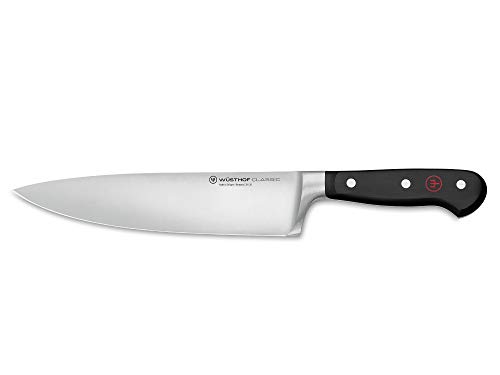
This is the knife I’d buy if I could only ever own one. It does every job in the kitchen, it rolls rather than chips when you’re careless, and a weekly hone keeps it going. Boring advice, maybe, but it’s the safest money in kitchen knives.

Proof that you don’t have to spend much for a great chef knife. It’s thin, light and grips well even when your hands are wet. It looks plain, and I’ve never seen that slow anyone down.

My pick for a first Japanese chef knife because it keeps the curved belly Western cooks already know, so the switch feels natural. The hard VG-MAX edge stays sharp far longer than German steel; it just asks you to be gentle.

If you hold a knife the way chefs do, with your thumb and finger on the blade, the sloped bolster on this ZWILLING is the most comfortable on my list. It’s the German alternative to the WÜSTHOF that I’d pick by feel.

For cooks who find German knives tiring, this one-piece steel knife feels almost weightless and takes a keen edge. The all-metal handle is the catch, so I’d try one in a shop before buying.
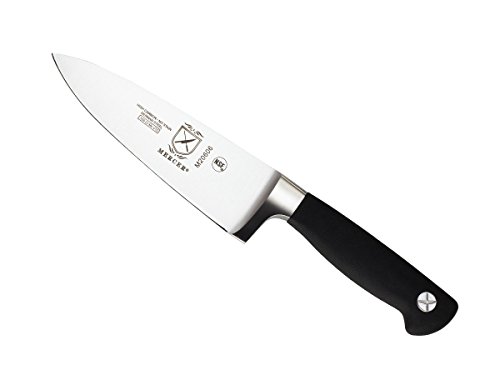
Small hands, small cutting boards and small kitchens are better served by a 6-inch knife than people assume. The Genesis is forged, has a grippy handle and costs very little.
Chef Knives Compared
| Knife | Blade | Steel style | Handle | Best for |
|---|---|---|---|---|
| WÜSTHOF Classic | 8″, forged, full bolster | German, 58 HRC | Synthetic, triple riveted | Most kitchens |
| Victorinox Fibrox Pro | 8″, stamped | Swiss stainless | Textured TPE | Low cost, wet hands |
| Shun Classic | 8″, 16 degree edge | Japanese VG-MAX | D-shaped Pakkawood | Careful cooks, keen edge |
| ZWILLING Pro | 8″, forged, sloped bolster | German, ice hardened | Synthetic, triple riveted | Pinch grip |
| Global G-2 | 8″, one piece | Japanese molybdenum/vanadium | Dimpled stainless steel | Light hands |
| Mercer Genesis | 6″, forged | German high-carbon | Non-slip synthetic | Small hands and kitchens |
1. WÜSTHOF Classic 8-Inch Chef’s Knife: Best Overall
Who it’s for: home cooks who want one serious knife that handles everything and forgives mistakes.
When people ask me which chef knife to buy without knowing anything else about them, this is my answer. WÜSTHOF names Classic as its best-selling series, each blade is forged from one block of steel in Solingen, and the 8-inch chef’s knife is the one that made the line famous. It weighs about 8.5 oz, which is heavy enough that the knife falls through carrots and squash under its own weight.
The steel is tempered to 58 HRC. That’s softer than Japanese steel, and I count that as a strength for a first good knife: a careless twist or a chicken bone bends the edge slightly instead of chipping it, and a quick hone puts it right. Families, shared kitchens and people who cook fast benefit most.
My reservation is the full bolster, the thick steel collar where blade meets handle. It guards your fingers and helps the balance, yet it extends down to the end of the edge, which makes the last inch harder to sharpen over the years. Long-time owners mention it more than anything else. The weight also won’t suit everyone; if you find heavy knives tiring, look at the Global or the Victorinox.
I’ve covered the brand in depth in my WÜSTHOF knives review, and the Classic is still the line I recommend most often.
Key specs
- Blade: 8-inch forged high-carbon stainless steel (single block), 58 HRC
- Handle: 5-inch synthetic, full tang, triple riveted
- Weight: 8.5 oz; full bolster and finger guard
- Made in Solingen, Germany
Pros
- Tough edge that rolls instead of chipping
- Heft and balance make chopping easy
- Durable handle that doesn’t fade
Cons
- Full bolster makes heel sharpening harder over time
- Heavy for cooks who prefer a light knife
- Needs regular honing to stay at its best
My verdict: if you want one chef knife for the next twenty years and don’t want to baby it, this is it. Pass on it if you prefer a light knife or the thinnest possible edge.
2. Victorinox Fibrox Pro 8-Inch Chef’s Knife: Best Value
Who it’s for: first-time buyers, students, and anyone who would rather spend money on ingredients than knives.
If the WÜSTHOF is the knife for the next twenty years, the Fibrox Pro is the knife for right now. It’s stamped from a sheet of steel instead of forged, so it’s thinner and much lighter, and that thinness is the secret to why it cuts so well. Onions and potatoes split cleanly instead of wedging the blade.
The handle is the other reason I rank it this high. It’s a textured TPE that stays grippy when wet or greasy, which matters more for safety than any steel spec. Victorinox has made knives in Switzerland since 1884 and backs this one with a lifetime warranty against defects.
The trade-offs are easy to live with. It looks like restaurant equipment because it is restaurant equipment, and it feels light if you’re used to heavy forged knives. The softer steel also needs a hone every few uses. And although Victorinox calls it dishwasher safe, I’d still wash it by hand: dishwashers dull edges faster. I go into more detail in my Victorinox chef knife review.
Key specs
- Blade: about 8-inch (7.9″) stamped stainless steel, tapered edge
- Handle: textured TPE that grips wet hands
- Made in Switzerland; lifetime warranty against defects
Pros
- Thin blade slices dense vegetables cleanly
- Best wet grip of any knife here
- Light and easy on the wrist
Cons
- Plain, utilitarian looks
- Feels flimsy to fans of heavy forged knives
- Edge needs frequent honing
My verdict: the best chef knife for the money, full stop. If you’re not sure what you want yet, buy this and learn your preferences on it. For more choices at this level, see my best chef knives under $100.
3. Shun Classic 8-Inch Chef’s Knife: Best Japanese
Who it’s for: careful cooks who want a sharper, longer-lasting edge and are moving up from a German knife.
Shun was the first authentic Japanese kitchen knife line many Americans ever saw, and the Classic 8-inch is still the knife I’d point a curious cook to first. The reason is the shape. Unlike a traditional gyuto, it keeps a pronounced curve toward the tip, so if you rock-chop herbs the way most Western cooks do, nothing about your technique has to change.
What changes is the edge. The VG-MAX core is much harder than the WÜSTHOF’s steel, and Shun sharpens it to 16 degrees per side. That combination glides through tomatoes and fish with less pressure and stays sharp for months, not weeks. The 68-layer Damascus cladding is mostly about looks and some stain resistance; the core steel does the cutting.
Hard steel has a price: it chips if you twist the blade, hit bone, cut frozen food or use a glass board. Owners report chipping more than any other problem, and I see it as a trade-off, not a defect. Shun also offers free sharpening for the original owner (you pay postage), a perk I wish German brands matched. The D-shaped handle suits most hands, though some people find it odd at first.
If you want the traditional Japanese shape instead, my best gyuto knife guide covers flatter, lighter options.
Key specs
- Blade: 8-inch; VG-MAX steel core clad in 68 Damascus layers; edge at 16 degrees
- Handle: D-shaped Pakkawood, for left- or right-handed use
- Handcrafted in Japan; free sharpening and honing service
Pros
- Very sharp out of the box and holds the edge a long time
- Western-style curve, easy to adopt
- Free sharpening service
Cons
- Chips if misused (bone, frozen food, twisting)
- Needs a whetstone or ceramic rod, not a pull-through
- Costs much more than the Victorinox
My verdict: the Japanese chef knife I’d recommend to most people. Skip it if your kitchen is rough on knives or you won’t hand wash.
4. ZWILLING Pro 8-Inch Chef’s Knife: Best for Pinch Grip
Who it’s for: cooks who hold the knife by the blade (pinch grip) and want a forged German knife that’s built around it.
ZWILLING and WÜSTHOF are the two big names of Solingen, and on steel they’re close to a tie. What separates the Pro line is the bolster. Instead of a straight collar, it curves and slopes down toward the blade, giving your thumb and index finger a natural place to rest. If you’ve learned the pinch grip, it’s the most comfortable German knife I know of.
ZWILLING forges the Pro from a single piece of its own steel formula and ice hardens it (FRIODUR), which helps the edge last. The sloped bolster has a second benefit over the WÜSTHOF Classic: it doesn’t run all the way down to the heel, so you can sharpen the full length of the edge for years.
The blade shape is a mix of German and Japanese, with a little less belly than the WÜSTHOF, so it rocks a bit less and push-cuts a bit more. That’s either a plus or a minus depending on how you chop. ZWILLING lists it as dishwasher safe, but I’d hand wash it like any good knife.
Key specs
- Blade: 8-inch SIGMAFORGE single-piece forged high-carbon stainless steel
- Ice-hardened FRIODUR blade, laser-controlled edge
- Curved, sloped bolster; full tang, triple-riveted handle
- Made in ZWILLING’s own German factory
Pros
- Most comfortable pinch grip on this list
- Full edge stays sharpenable to the heel
- Robust German steel that forgives mistakes
Cons
- Less rocking belly than a classic German chef knife
- Heavy compared with the Japanese picks
My verdict: if you hold a knife by the blade, choose this over the WÜSTHOF. If you hold it by the handle, they’re equals and the WÜSTHOF is easier to find in every size.
5. Global G-2 8-Inch Chef’s Knife: Best Lightweight
Who it’s for: cooks with tired wrists or small hands who still want a full 8-inch blade.
The G-2 is one of the most recognisable knives ever made: a single piece of steel from tip to handle, with a dimpled pattern on the grip. It’s light and nimble in a way no forged German knife can be, and the molybdenum/vanadium stainless steel takes a keen, thin edge that holds well.
I’ve always said the Global splits people, and the reason is the handle. It’s hygienic and easy to clean, but bare steel turns slippery once your hands get wet or oily, and the handle is slim. Some people love it immediately; others never get comfortable. That’s why I’d hold one in a store before ordering.
If it suits your hand, it’s a joy for long prep sessions. Its warranty covers defects and breakage for life.
Key specs
- Blade: 8-inch (20 cm) molybdenum/vanadium stainless steel
- Handle: stainless steel, molded and dimpled for grip
- One-piece construction; lifetime warranty against defects and breakage
Pros
- Lightest full-size knife here
- Keen edge with good retention
- No seams where food can collect
Cons
- Steel handle can slip when wet or greasy
- Slim grip doesn’t suit large hands
My verdict: a fantastic knife for the right hand and a frustrating one for the wrong hand. Try before you buy if you can.
6. Mercer Culinary Genesis 6-Inch Chef’s Knife: Best Compact
Who it’s for: cooks with small hands, small boards or small kitchens, and anyone who mostly cooks for one or two.
The 8-inch knife is the standard, but it isn’t a rule. If you mostly prep a few vegetables and a chicken breast on a compact board, a 6-inch knife is easier to control and less intimidating. The Genesis gives you a real forged German-steel knife in that size for very little money.
The handle is the highlight: Mercer calls it non-slip even with wet hands, and its soft texture is comfortable for long sessions. The taper-ground edge comes sharp, and the full tang gives it a balanced feel that cheap knives lack. It’s a common sight in culinary schools for good reason.
The obvious limit is size. A 6-inch blade struggles with a whole cabbage or a large melon, and you’ll need more strokes for big batches. Mercer also asks for hand washing only.
Key specs
- Blade: 6-inch, forged German high-carbon steel with a taper-ground edge
- Handle: ergonomic non-slip synthetic
- Full tang; hand wash only
Pros
- Easy to control for small hands
- Forged and well balanced for the money
- Grippy, comfortable handle
Cons
- Too short for large produce and big batches
- Not dishwasher safe
My verdict: the right first knife for small hands or small kitchens. If you cook for a family, buy an 8-inch instead.
What Separates a Good Chef Knife From a Bad One
German or Japanese: decide how you treat knives
Choose German if you cook fast, cut near bone or share the kitchen, and Japanese if you’re careful and want a keener edge. German steel (around 56 to 58 HRC) is tougher and rolls instead of chipping. Japanese steel (around 60 HRC and up) is harder, thinner and sharper, but brittle. My German vs Japanese knives comparison covers this in depth.
8 inches is the default, not a rule
An 8-inch blade suits most people because it’s long enough for a cabbage and short enough to control. Choose 6 inches for small hands or tiny kitchens, and 10 inches only if you have a large board and like a long stroke.
Weight is personal
Heavier forged knives (WÜSTHOF, ZWILLING) do more of the chopping for you; lighter knives (Victorinox, Global) are faster and less tiring. Neither is better. If you can, hold a few before buying.
The handle matters more than the steel
A handle that fits your hand and stays grippy when wet will make you safer and faster than any steel upgrade. Textured synthetic handles grip best; polished wood and bare steel are the most slippery.
Forged vs stamped
Forged knives are usually heavier, with a bolster; stamped knives are lighter and thinner. Stamped isn’t worse: the Victorinox proves it. Choose by weight and feel, not by the word “forged”.
How to Keep a Chef Knife Sharp
Hone it once a week (or before every big prep session) and sharpen it every few months. Wash it by hand, dry it straight away and store it in a block, on a magnetic strip or in a guard, never loose in a drawer. Use a wood or plastic board; glass and stone boards destroy edges. A relaxed pinch grip also keeps the edge straighter than a white-knuckle hold.
FAQ
What chef knife do professional chefs use?
Many professional kitchens use inexpensive, grippy knives like the Victorinox Fibrox Pro or Mercer Genesis because they’re tough and easy to replace. Chefs who buy their own knives often choose German brands like WÜSTHOF or ZWILLING, or Japanese gyutos.
Is a Japanese chef knife better than a German one?
Neither is better overall. Japanese knives are sharper and hold their edge longer; German knives are tougher and easier to maintain. Pick by how carefully you treat your knives.
What size chef knife should I get?
An 8-inch chef knife suits most home cooks. Choose a 6-inch if you have small hands or a small board, and a 10-inch only for large boards and big batches.
Is an expensive chef knife worth it?
Only if you’ll maintain it. A well-kept budget knife like the Victorinox outperforms a neglected premium knife. Expensive knives earn their price through better fit, finish, edge retention and durability, not by cutting dramatically better on day one.
Santoku or chef knife: which should I buy first?
A chef knife is the more versatile first knife because its curved belly lets you rock-chop and its pointed tip handles fine work. A santoku is shorter and flatter, better for push cutting vegetables. My santoku vs chef’s knife comparison explains both.
Final Verdict
For one knife that does everything and forgives everything, I’d buy the WÜSTHOF Classic 8-inch. If you want to spend as little as possible without giving up much, the Victorinox Fibrox Pro is unbeatable value, and careful cooks ready for a keener edge should step up to the Shun Classic.
Curious which brands I trust beyond these six? My best knife makers guide ranks them.

Gary Portman founded knivesadvice.com in 2019. He learned to cook in his family’s kitchen as a kid and has used kitchen, pocket and outdoor knives ever since, from paring and fillet knives to survival blades he carries camping and hiking. He writes the site’s buying guides, brand reviews and sharpening how-tos to help readers find the right knife for the job. More about Gary.