

Mercer Culinary is the knife brand culinary students are handed on day one, and that tells you most of what you need to know. These are plain, grippy, honest working knives that cost little and take an edge easily. They aren’t heirlooms, they aren’t pretty, and the steel is on the soft side, so you will hone them often. That trade suits most home kitchens better than people expect.
For a home cook, the line I’d start with is Genesis: forged German steel and one of the best non-slip handles on any forged knife. If you want the cheapest knife that still does the job well, the stamped Millennia chef’s knife is the one restaurant cooks know best.
My Top 6 Mercer Culinary Picks

Forged German steel, a full bolster and a soft, grippy handle that stays secure with wet hands. It gives you the weight and feel of a German forged knife without the German price tag.
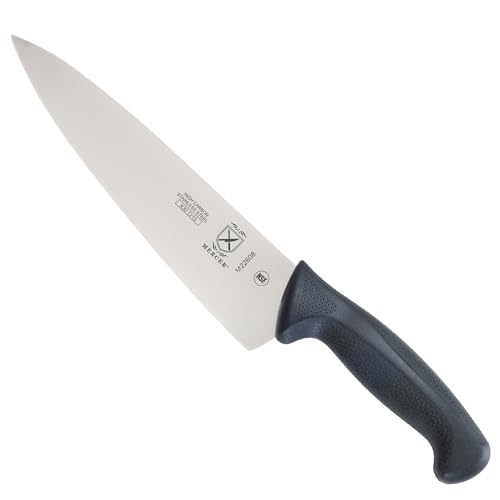
The stamped Japanese-steel chef’s knife in countless culinary school kits. Light, thin and easy to sharpen, with a textured handle that has finger points for a sure grip.

A paring knife, a utility knife and a 7-inch Granton santoku in a knife roll. Renaissance has a shortened bolster, so you can sharpen the whole edge right to the heel.
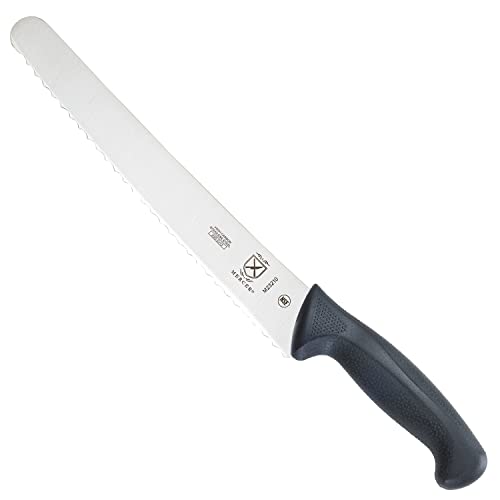
Still the first bread knife I’d buy anyone. Wide wavy teeth, enough length for a big boule and a handle that doesn’t slip on a floury board.

Mercer’s butcher line: forged, ice-hardened German steel with a mirror finish and a textured nylon handle. For home cooks who break down big cuts or whole loins.
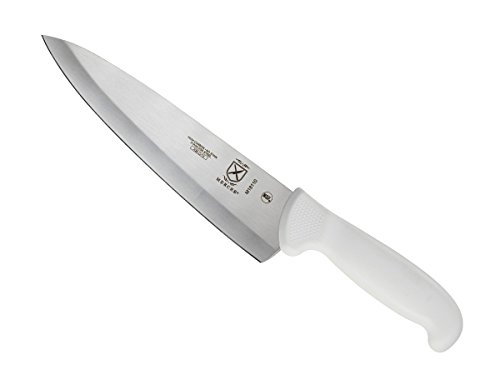
A bare-bones chef’s knife that costs very little. It makes sense as a second knife for guests, a camp kitchen or a first apartment.
What Mercer Culinary Does Well
Handles built for wet, busy hands
Mercer designs for professional kitchens, and it shows in the grips. Millennia and Ultimate White have textured handles with finger points; Genesis uses a soft non-slip material that Mercer calls the finest handle in forged cutlery. I’d put grip ahead of steel on any knife you use with wet or greasy hands, and this is where Mercer beats many pricier brands.
A line for every budget and job
Few brands cover so much ground: stamped knives for students, forged knives for home cooks, a full butcher line, Japanese-style knives and a big range of pastry and kitchen tools. You can build a whole kit from one maker and keep a consistent feel.
Easy to sharpen
The steels Mercer uses are on the softer side of kitchen cutlery, which means a honing rod brings the edge back in seconds and a whetstone or pull-through restores it quickly. That suits a cook who wants sharp knives without fuss.
A lifetime warranty for home users
Mercer’s limited warranty covers defects in materials and workmanship for the consumer’s lifetime on products listed as lifetime-covered. Dishwasher damage and misuse are excluded, as with most brands.
What Mercer Culinary Does Badly
Softer steel dulls faster
The other side of easy sharpening is edge life. Expect to hone a Mercer more often than a WÜSTHOF or a Japanese knife, and to give it a proper sharpening every couple of months in a kitchen that cooks every day.
Plain looks
Mercer knives look like what they are: tools from a restaurant supply catalog. If you want a knife block that impresses guests, this isn’t it.
Not made in Germany or Japan
Mercer is a New York company. Its forged Genesis and Renaissance knives use German steel, but retailer listings give Taiwan as the country of manufacture. That doesn’t make them worse knives, but buyers expecting German-made at this price should know.
Confusing line names
Millennia, Millennia Colors, Ultimate White, Genesis, Renaissance, Züm, BPX, MX3: the names say little about what’s inside. The table below sorts them out.
Mercer Culinary Lines Compared
| Line | Steel | Build | Handle | Best for |
|---|---|---|---|---|
| Millennia | High-carbon Japanese steel | Stamped, one piece | Textured with finger points | Students, first knives, best value |
| Ultimate White | High-carbon Japanese steel | Stamped | White textured | Spares and cheap extra knives |
| Genesis | High-carbon German steel | Forged, full bolster | Soft non-slip | Home cooks who want weight and grip |
| Renaissance | High-carbon German steel | Forged, short bolster | Triple-riveted Delrin | A classic riveted look; full-length sharpening |
| BPX | German steel, ice-hardened | Forged, mirror finish | Textured glass-reinforced nylon | Butchering large cuts |
| MX3 | VG-10 core, san mai | Layered | Triple-riveted | Japanese-style blades (gyuto, petty, sujihiki) |
| Züm | High-carbon German steel | Forged | Contoured | A dressier forged option |
1. Mercer Culinary Genesis 8-Inch Chef’s Knife: Best Mercer Chef’s Knife
Who it’s for: home cooks who like a solid, forged chef’s knife and want it to stay put in a wet hand.
Genesis is Mercer’s answer to the classic German forged knife, and its 8-inch chef’s knife is where I’d begin. The steel is German, the blade is forged and the edge is taper-ground, and the full bolster gives it the balance people expect from a WÜSTHOF or a ZWILLING.
What sets it apart is the handle. It is softer and grippier than the hard plastic or wood on most forged knives, and it keeps its hold with hands still wet from rinsing lettuce or slick from trimming chicken thighs. I’ve picked Genesis knives in several guides on this site for exactly that reason.
My reservation is the full bolster. It makes the heel of the blade awkward to sharpen, so over years the edge can develop a small dip near the handle. If that bothers you, Mercer sells a short-bolster version of the same knife.
Key specs
- Blade: 8 inches, forged high-carbon German steel
- Edge: taper-ground
- Handle: soft non-slip, full bolster
- Hand wash only
Pros
- Grippiest forged handle at its level
- Solid, balanced German feel
- Easy to hone back to sharp
Cons
- Full bolster makes heel sharpening harder
- Softer steel needs regular honing
- Heavier than the Millennia
My verdict: the Mercer chef’s knife most home cooks should buy. Pick the Millennia instead if you prefer a light knife.
2. Mercer Culinary Millennia 8-Inch Chef’s Knife: Best Value Line
Who it’s for: culinary students, new cooks and anyone who wants a light, cheap knife that works.
The Millennia is stamped from a single piece of high-carbon Japanese steel, so it is thinner and lighter than the Genesis. That makes it quicker through onions and carrots and less tiring over a long prep session, which is why so many school kits are built around it.
The handle is the familiar Mercer design with textured finger points, and it is easy to recognize in a busy kitchen. Mercer also sells the same knife in Millennia Colors handles, useful if you color-code knives for raw meat and vegetables.
It has less heft than a forged knife, so harder jobs like splitting squash take more effort. And it is a tool, not a showpiece.
Key specs
- Blade: 8 inches, stamped one-piece high-carbon Japanese steel
- Handle: textured with finger points
- Also sold in colored handles (Millennia Colors)
- Hand wash only
Pros
- Light and thin, quick through vegetables
- Non-slip textured grip
- Costs very little
Cons
- Lacks weight for hard squash and big jobs
- Utilitarian look
My verdict: the best value in Mercer’s range. Choose Genesis only if you want a heavier, forged feel.
3. Mercer Culinary Renaissance 4-Piece Forged Starter Set: Best Mercer Starter Set
Who it’s for: someone setting up a small kitchen who prefers a santoku to a chef’s knife.
This set gives you three forged Renaissance knives and a four-pocket roll: a 3.5-inch paring knife, a 5-inch utility knife and a 7-inch santoku with a Granton edge (the hollow dimples that help food release). Those three cover most daily cutting.
Renaissance is Mercer’s take on the classic triple-riveted knife, with a Delrin handle and a rounded spine. The detail I like most is the shortened bolster: it stops short of the edge, so you can sharpen the full length of the blade, the problem I flagged on the Genesis.
There’s no bread knife and no chef’s knife in the box, and a roll suits a cook who moves knives around more than one who wants a block. Add the Millennia bread knife below and the kit is complete.
Key specs
- 3.5″ paring, 5″ utility, 7″ Granton edge santoku
- Forged high-carbon German steel
- Triple-riveted Delrin handles, shortened bolster
- 4-pocket knife roll included
Pros
- Full edge sharpenable thanks to the short bolster
- Three knives that cover most jobs
- Roll for travel or a small kitchen
Cons
- No bread knife or chef’s knife
- Smooth Delrin handle grips less than Genesis
My verdict: a smart small set for santoku fans. Chef’s-knife cooks are better off buying the Genesis on its own.
4. Mercer Culinary Millennia 10-Inch Wide Wavy Edge Bread Knife: Best Mercer Bread Knife
Who it’s for: anyone who still tears loaves with a dull or tiny serrated knife.
This is one of the best-known knives Mercer makes, and it earns that. The edge has wide, rounded waves rather than small pointed teeth, which bite into crust without ripping the soft crumb. Ten inches is long enough for a large sourdough boule.
It’s stamped from the same Japanese steel as the Millennia chef’s knife, with the same textured grip. I’ve said before that at this price you replace a bread knife after years of use rather than paying to sharpen it, and that still holds.
Mercer lists it for cake, meatloaf, tomatoes and fruit too. It handles soft foods well, though a roast deserves a proper slicer.
Key specs
- Blade: 10 inches, wide wavy edge
- Stamped one-piece high-carbon Japanese steel
- Textured handle with finger points
- Hand wash only
Pros
- Clean slices through crusty bread
- Long enough for big loaves
- Non-slip handle
Cons
- Serrations are hard to sharpen at home
- Thin blade flexes on very hard crusts
My verdict: the easiest Mercer recommendation I make. Buy it even if your other knives come from another brand.
5. Mercer Culinary BPX 10-Inch Breaking Butcher Knife: Best for Butchering
Who it’s for: home butchers, hunters and BBQ cooks who break down large cuts.
BPX is Mercer’s dedicated butcher line, and the 10-inch breaking knife is its all-rounder. The curved blade lets you strip, split and trim big pieces like a whole pork loin or a beef subprimal in long strokes. My guide to the best knife for cutting meat explains where a breaking knife fits next to a boning knife and a slicer.
The steel is forged German and ice-hardened, with a mirror finish that helps meat slide off. The handle is textured glass-reinforced nylon, which still grips with fatty fingers.
Ten inches is a lot of blade for a chicken or a small roast. If you mostly cut smaller pieces, the 8-inch BPX is easier to control.
Key specs
- Blade: 10 inches, curved breaking profile
- Forged German high-carbon steel; ice-hardened; mirror-finished blade
- Handle: textured glass-reinforced nylon
- Hand wash only
Pros
- Built specifically for butchering
- Grippy handle with greasy hands
- Long strokes through big cuts
Cons
- Too long for small jobs
- Not for cutting through bone
My verdict: the Mercer for anyone who buys meat in big pieces. Kitchen cooks who only trim chicken won’t need it.
6. Mercer Culinary Ultimate White 8-Inch Chef’s Knife: Best Spare Knife
Who it’s for: anyone who needs an extra chef’s knife that they won’t worry about.
Ultimate White is Mercer’s value line, made from high-carbon Japanese steel with a white textured handle. The 8-inch chef’s knife is a sensible choice for a vacation rental, an RV, a camp kitchen box or a helper at Thanksgiving who shouldn’t touch your good knife.
It isn’t refined. The blade is basic and the handle is plain plastic, so compared with the Millennia it feels like the cheaper knife it is. But it cuts well when sharp, and the soft steel comes back quickly on a rod.
Key specs
- Blade: 8 inches, high-carbon Japanese steel
- Handle: white, textured with finger points
- Hand wash only
Pros
- Costs very little
- Easy to sharpen
- Fine as a guest or travel knife
Cons
- Basic finish and feel
- White handle shows stains
My verdict: a good spare, not a main knife. For your everyday blade, spend a little more on the Millennia or Genesis.
Mercer Culinary vs Victorinox, WÜSTHOF and Dexter-Russell
Mercer vs Victorinox: the closest rival. The Millennia and Victorinox’s Fibrox Pro are both light stamped knives with grippy handles. I trust the Fibrox handle a touch more when wet, as I wrote in my Victorinox chef knife review, but the gap is small.
Mercer vs WÜSTHOF: Genesis feels like a German forged knife; a WÜSTHOF Classic is the real thing, made in Solingen, with better fit and finish and a longer-lasting edge. My WÜSTHOF knives review covers what the extra money buys.
Mercer vs Dexter-Russell: both are restaurant-supply brands. Dexter-Russell makes many of its knives in the USA and is strongest in fish, meat and oyster knives; Mercer has the broader home-kitchen range and the better forged line.
Which Mercer Line Should You Buy?
For a first chef’s knife: Millennia or Genesis
Choose by weight. If you like a light, nimble knife, buy the Millennia; if you like heft and a bolster, buy the Genesis. Both have grips I’d trust with wet hands.
For a full kitchen on a budget: mix lines
Mercer’s lines don’t need to match. A Genesis chef’s knife, a Millennia bread knife and a cheap paring knife cost less than most block sets and cut better. My guide to the best kitchen knives under $100 shows other ways to build that kind of kit.
For meat: BPX
The BPX line exists for butchery. Its handles and blade shapes are built for long strokes through raw meat, which the kitchen lines aren’t.
For a gift: Renaissance or a set
The riveted Renaissance handle looks more traditional, and the starter set comes in a roll. For a block set instead, see my picks for the best knife set under $200.
FAQ
Are Mercer Culinary knives good?
Yes, for the money they are some of the best working knives you can buy. They are sharp, grippy and easy to maintain. They aren’t luxury knives: the steel is softer and the finish plainer than WÜSTHOF or Shun.
Where are Mercer knives made?
Mercer Culinary is based in New York. Retailer listings give Taiwan as the country of manufacture for its forged Genesis and Renaissance knives, made from German steel; the Millennia and Ultimate White lines use Japanese steel.
Which is better, Mercer Genesis or Millennia?
Neither is better at cutting; they suit different hands. Genesis is forged, heavier and has a full bolster; Millennia is stamped, thinner and lighter. Light-knife fans and students usually prefer Millennia.
Can Mercer knives go in the dishwasher?
No. Mercer tells you to hand wash with warm water and mild soap and dry completely, and its warranty excludes dishwasher damage.
Do Mercer knives have a warranty?
Yes. Mercer’s limited warranty covers defects in materials and workmanship for the consumer’s lifetime on products listed as lifetime-covered. Normal wear, misuse and dishwasher damage aren’t covered.
Why do culinary schools use Mercer knives?
Because they are cheap, durable and easy to sharpen, and Mercer packages them into student kits. A student can learn knife skills without worrying about damaging an expensive blade.
Final Verdict
Mercer Culinary makes some of the best value knives in any kitchen. Buy the Genesis 8-inch chef’s knife if you want a forged knife that grips in wet hands, the Millennia if you want light and cheap, and the Millennia bread knife no matter what else you own. The BPX breaking knife is the Mercer for meat, and the Renaissance starter set is a tidy small kit for santoku cooks.
Comparing chef’s knives from other brands too? My guide to the best chef knives under $100 puts Mercer next to Victorinox, Henckels and Japanese options.

Gary Portman founded knivesadvice.com in 2019. He learned to cook in his family’s kitchen as a kid and has used kitchen, pocket and outdoor knives ever since, from paring and fillet knives to survival blades he carries camping and hiking. He writes the site’s buying guides, brand reviews and sharpening how-tos to help readers find the right knife for the job. More about Gary.