
Wüsthof is the German knife brand I’d recommend to anyone who wants one good kitchen knife and never wants to think about replacing it. The knives are made in Solingen, Germany, by a family company founded in 1814, and the main lines are forged from a single piece of stainless steel hardened to 58 HRC. That’s softer than Japanese steel, which is exactly the point: a Wüsthof shrugs off chicken joints, hard squash and the odd careless moment, and a quick session on a honing steel brings the edge back.
Skip Wüsthof if you want the thinnest, sharpest edge you can buy, or if you’d rather not hone your knives every week or two. A Japanese brand suits you better. And if you just want sharp knives for very little money, Victorinox gets you most of the way for much less.
Which line? Classic is the one to buy for most people, Gourmet is the cheaper stamped line, Classic Ikon has the nicer handle, and Performer is the black-coated modern one. My pick is the Wüsthof Classic 8″ Chef’s Knife. The Gourmet 8″ is the way in on a tighter budget.
My Top 6 Wüsthof Picks
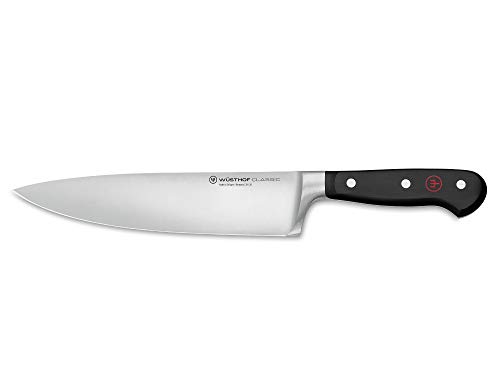
The knife most people mean when they say “a Wüsthof”, and the one I’d buy first. Forged, full tang, heavy enough to power through a squash, and easy to keep sharp with a steel.
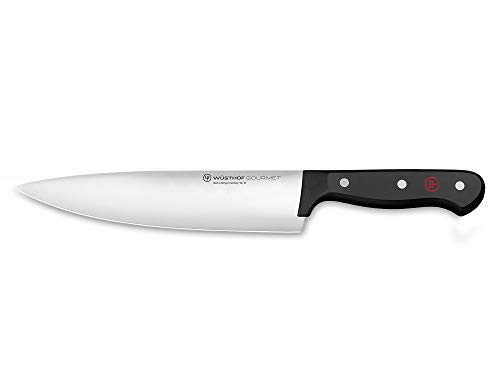
Same Solingen steel, same lifetime warranty, but laser cut instead of forged. The cheapest way to own a real Wüsthof chef’s knife.

The Classic blade with a sleeker, more rounded handle and a second bolster for balance. For cooks who find the Classic handle blocky.
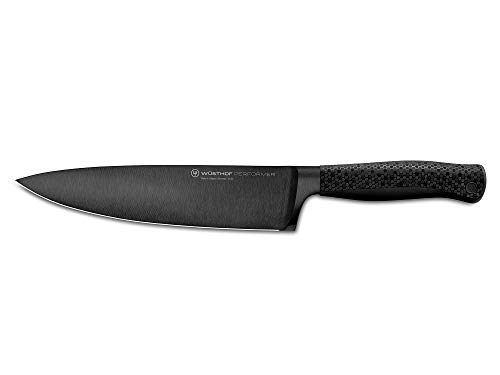
A forged chef’s knife with a black DLC coating and a hexagon-textured grip. It’s the Wüsthof for cooks who want something that doesn’t look like their parents’ knife.

Six Classic knives, a honing steel and shears in a 17-slot block with room to grow. If you want the whole kitchen in one buy, this is the size I’d stop at.
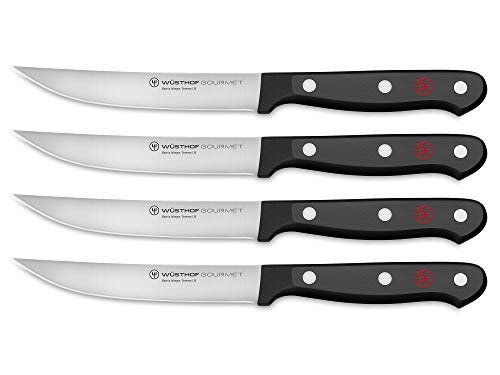
Four 4.5″ steak knives with triple-riveted handles. They look right next to any Wüsthof kitchen knife and cost far less than the Classic steak set.
What Wüsthof Does Well
Tough, forgiving steel
Wüsthof hardens its forged blades to 58 HRC. A harder Japanese blade keeps its edge longer, but a Wüsthof edge rolls instead of chipping, and rolling is easy to fix with a honing steel. For a busy family kitchen, I think that’s the better trade.
Made in Solingen, by the same family since 1814
Every line I recommend here is made in Solingen, the German city whose name is protected for blades that meet its standards. Wüsthof has been family-owned for seven generations, and that shows in how little the Classic line changes: a knife you buy today matches one you’ll add in ten years.
A real lifetime warranty
Wüsthof covers its knives with a limited lifetime warranty against defects. It doesn’t cover abuse or the dishwasher, but it’s one more reason a Wüsthof tends to be the last chef’s knife people buy.
Easy to find, easy to match
The Classic range is huge: chef’s knives from 6″ to 10″, santokus, bread, boning, carving and steak knives, all with the same handle. You can start with one knife and build a matching set over years.
What Wüsthof Does Badly
The full bolster gets in the way of sharpening
The Classic’s thick bolster runs right down to the heel of the edge. It protects your fingers and adds weight, but what long-time owners grumble about most is that it makes the back of the edge hard to sharpen. After years of sharpening, a small dip can form in front of the bolster unless it’s ground down too.
You have to hone often
Softer steel loses its keenness faster than Japanese steel. A few passes on a honing steel every week or two fixes it, but if you never hone, a Wüsthof will feel dull sooner than you expect.
Too many lines that look alike
Classic, Classic Ikon, Gourmet, Performer, Crafter, Amici, Epicure and colored Classic versions: the names don’t tell you much. The biggest trap is Gourmet, which looks like Classic in photos but is stamped rather than forged. My Wüsthof Classic vs Gourmet comparison explains the difference.
Heavier than many cooks expect
The Classic 8″ weighs 8.5 oz. That heft helps on dense food, but cooks used to light Japanese knives can find it tiring for long prep sessions.
Wüsthof Lines Compared
| Line | Construction | Hardness (HRC) | Made in | Handle | Best for |
|---|---|---|---|---|---|
| Classic | Forged, full bolster, full tang | 58 | Solingen, Germany | Synthetic, triple riveted | Most home cooks |
| Classic Ikon | Forged, double bolster | 58 | Solingen, Germany | Synthetic, rounded | Comfort and balance |
| Gourmet | Laser cut (stamped) | Not listed | Solingen, Germany | Synthetic polypropylene | Value, lighter knives |
| Performer | Forged, black DLC coated blade | Not listed | Solingen, Germany | Hexagon Power Grip | Modern look, wet hands |
1. Wüsthof Classic 8″ Chef’s Knife: Best Overall
Who it’s for: home cooks who want one German chef’s knife for nearly everything.
Wüsthof calls Classic its best-selling series, and the 8″ chef’s knife is the center of it. It’s forged from one block of high-carbon stainless, hardened to 58 HRC, with a full bolster, a full tang and a triple-riveted synthetic handle. The blade has a generous curved belly, so it rocks through herbs and garlic in the way most Western cooks were taught.
What I like is how little it asks of you. Use it on a chicken, a butternut squash or a crusty loaf in a pinch; the edge may roll a bit, and a honing steel puts it back. It’s the knife I’d hand to a new cook and to a seasoned one.
My reservation is the bolster. It makes the knife feel solid but complicates sharpening at the heel, and the 8.5 oz weight isn’t for everyone. If you prefer a lighter knife, the Gourmet below is worth a look.
Key specs
- Blade: 8″, high-carbon stainless steel, 58 HRC
- Construction: forged from a single block, full bolster and finger guard, full tang
- Handle: 5″, synthetic, triple riveted
- Weight: 8.5 oz
- Made in Solingen, Germany; limited lifetime warranty
Pros
- Tough edge that forgives rough use
- Classic rocking curve
- Huge matching range to build on
Cons
- Full bolster makes sharpening the heel harder
- Heavy for long prep sessions
- Needs regular honing
My verdict: the Wüsthof to buy if you buy just one. Cooks chasing a razor edge should look at a Japanese chef’s knife instead.
2. Wüsthof Gourmet 8″ Chef’s Knife: Best Value Line
Who it’s for: cooks who want a German-made Wüsthof without paying for forging.
Gourmet knives are laser cut from a sheet of steel instead of forged. That makes them lighter and much cheaper, with no heavy bolster at the heel, which also means you can sharpen the whole edge without fighting a lump of steel. The handle is synthetic polypropylene, and like every Wüsthof here, it’s made in Germany and carries the lifetime warranty.
I’d buy this over a forged no-name knife every time, and it’s the Wüsthof I named in my best chef’s knife under $100 guide. It won’t feel as substantial as the Classic, and Wüsthof doesn’t publish its hardness, but it’s a properly made German chef’s knife from a company that will still be around to honor the warranty.
Key specs
- Blade: 8″, high-carbon stainless steel, laser cut (stamped)
- Handle: synthetic polypropylene
- Made in Germany; limited lifetime warranty
- Hand wash only
Pros
- Lowest-cost Wüsthof chef’s knife
- Lighter than the forged lines
- No bolster, so the whole edge sharpens easily
Cons
- Less heft for heavy chopping
- Hardness isn’t published
My verdict: the smart Wüsthof on a budget. If you can stretch, the Classic feels like more knife in the hand.
3. Wüsthof Classic Ikon 8″ Chef’s Knife: Best Handle Upgrade
Who it’s for: cooks who like the Classic blade but not its squared-off handle.
Classic Ikon uses the same forged 58 HRC steel as the Classic. The difference is in your hand: a sleeker, curved black handle and a double bolster, one at the blade and one at the end of the handle, which moves the balance back toward your grip.
I’d choose the Ikon if you hold a knife for long stretches or have smaller hands; the rounder handle is easier to pinch. If the Classic already feels fine, there’s no reason to pay for the Ikon, because the blade cuts the same.
Key specs
- Blade: 8″, high-carbon stainless steel, 58 HRC
- Construction: forged from a single block, double bolster
- Handle: contoured synthetic
- Made in Solingen, Germany
Pros
- More comfortable handle shape
- Balanced toward the grip
- Same tough Classic steel
Cons
- You pay for the handle, not a better blade
- Smaller matching range than the Classic
My verdict: the Wüsthof for comfort. Pick the plain Classic if handle shape doesn’t bother you.
4. Wüsthof Performer 8″ Chef’s Knife: Best Modern Wüsthof
Who it’s for: cooks who want a forged German knife with a modern, all-black look.
Performer is the Wüsthof line people search for most after Classic. The blade is forged and coated in black DLC (diamond-like carbon), which Wüsthof says raises the surface hardness and reduces friction as you cut. The handle has a hexagon texture that Wüsthof calls the Hexagon Power Grip, designed to stay put in a wet or greasy hand.
Under the coating, it’s still a German chef’s knife: tough, forgiving and happy with a honing steel. That’s both its appeal and my hesitation. You pay a lot for the look and the grip, and the edge itself won’t feel very different from a Classic. Sharpening also exposes a line of bright steel along the black edge, which some owners don’t expect.
Key specs
- Blade: 8″, forged stainless steel with DLC coating
- Handle: Hexagon Power Grip, non-slip texture
- Bolster: forged thickening between blade and handle
- Made in Solingen, Germany
Pros
- Grippy handle for wet hands
- Distinctive modern design
- Coating reduces sticking and friction
Cons
- Costs the most of my single-knife picks
- Sharpening leaves a bright line on the black edge
My verdict: buy it if you love the look and the grip. If you only care about how it cuts, the Classic does the same job.
5. Wüsthof Classic 9-Piece Knife Block Set: Best Block Set
Who it’s for: someone equipping a kitchen in one go, or a wedding gift.
I usually tell people that piece count is marketing, and that three or four good knives cover nearly everything. This set is close to that idea: an 8″ chef’s knife, an 8″ bread knife, a 3.5″ paring knife and three utility knives, plus a 9″ honing steel and come-apart shears. The 17-slot block leaves room for a boning or carving knife later.
My one complaint is the three utility knives (4.5″ plain, 4.5″ Asian and 5″ serrated). Most cooks will use one of them. Still, you get the chef’s, bread and paring knives you need, all in Classic steel, plus the honing steel every Wüsthof owner should use.
Key specs
- Knives: 8″ chef’s, 8″ bread, 3.5″ paring, 4.5″ utility, 4.5″ Asian utility, 5″ serrated utility
- Also: 9″ honing steel, come-apart kitchen shears, 17-slot block
- Steel: forged high-carbon stainless, 58 HRC
- Made in Solingen, Germany; limited lifetime warranty
Pros
- All the core knives in Classic steel
- Honing steel included
- Block has room to grow
Cons
- Three overlapping utility knives
- Big block takes counter space
My verdict: the Wüsthof set I’d buy for a full kitchen. If you already own a decent bread knife, buy the Classic chef’s knife alone and add pieces as you need them.
6. Wüsthof Gourmet 4-Piece Steak Knife Set: Best Steak Knives
Who it’s for: anyone who wants steak knives that match their Wüsthof kitchen knives.
Steak knives get used at the table, dropped in the sink and loaned to guests, so I don’t see the point of forged ones. This Gourmet set gives you four laser-cut 4.5″ steak knives with triple-riveted synthetic handles that look the part next to a Classic block.
The one rule is the same as for the rest of Wüsthof: hand wash only. If your steak knives will go in the dishwasher anyway, buy a cheaper set you won’t mind wearing out.
Key specs
- Pieces: four 4.5″ steak knives
- Construction: laser cut (stamped), high-carbon stainless steel
- Handle: synthetic polypropylene, triple riveted
- Made in Germany; limited lifetime warranty
Pros
- Matches the Classic look
- Much cheaper than forged steak knives
- Comfortable riveted handles
Cons
- Only four knives
- Hand wash only
My verdict: the steak knives I’d pair with any Wüsthof kitchen. Hosting bigger groups means buying two sets.
Wüsthof vs Other Brands
Wüsthof vs ZWILLING J.A. Henckels
The closest rival: also from Solingen, also forged, also around the same hardness. ZWILLING’s Pro and Four Star lines are just as good; buy whichever handle you prefer. My ZWILLING vs Wüsthof comparison goes line by line.
Wüsthof vs Shun
German vs Japanese. Wüsthof is heavier, softer and tougher; Shun is lighter, harder and sharper but chips if misused. My Shun vs Wüsthof comparison helps you decide by how you cook.
Wüsthof vs Victorinox
Victorinox’s Fibrox knives cut nearly as well for far less money but feel like restaurant tools. Wüsthof gives you forged steel, a nicer handle and a knife you’ll keep for decades.
Wüsthof vs Cangshan
Cangshan makes good-looking forged knives in China, and the gap in cutting is smaller than the names suggest. Wüsthof wins on track record, Solingen making and a range that stays the same for decades. My Cangshan knives review covers its best lines.
FAQ
Are Wüsthof knives worth the money?
Yes, if you want a tough knife that lasts for decades. You pay for forged Solingen steel, a lifetime warranty and a range you can add to for years. My shorter answer is in are Wüsthof knives good?
Which Wüsthof knife line is best?
Classic for most people. Classic Ikon if you want a more comfortable handle, Gourmet for the lowest price, and Performer for a modern coated blade and a grippy handle.
Is the Wüsthof Performer worth it?
Only if you value its look and grip. The DLC coating and hexagon handle are real features, but the blade cuts much like a Classic, which costs less.
Where are Wüsthof knives made?
In Solingen, Germany. Wüsthof was founded there in 1814 and is still family-owned.
Are Wüsthof steak knives good?
Yes. The Gourmet steak knives are laser cut rather than forged, which is all a table knife needs, and they match the rest of the range. Keep them out of the dishwasher.
How do you sharpen a Wüsthof knife?
Hone it on a steel every week or two, and sharpen it on a whetstone or a sharpener set for German knives when honing stops working.
Final Verdict
Wüsthof makes the safe choice in German kitchen knives: forged in Solingen, tough enough for real family cooking, and built to be the last chef’s knife you buy. For most kitchens, I’d start with the Wüsthof Classic 8″ Chef’s Knife. The Gourmet 8″ gets you a genuine Wüsthof for less, and the Classic 9-piece block is the set to buy if you want everything at once.
Still deciding between styles? My German vs Japanese knives guide explains which suits your cooking.

Gary Portman founded knivesadvice.com in 2019. He learned to cook in his family’s kitchen as a kid and has used kitchen, pocket and outdoor knives ever since, from paring and fillet knives to survival blades he carries camping and hiking. He writes the site’s buying guides, brand reviews and sharpening how-tos to help readers find the right knife for the job. More about Gary.