
Dalstrong vs WÜSTHOF is a closer fight than the names suggest, because Dalstrong’s Gladiator line uses the same kind of German stainless steel that WÜSTHOF forges in Solingen. So the choice comes down to the things around the steel: where the knife is made, how long the company has been doing it, and how much you care about looks. For a knife you buy once and keep, my choice is WÜSTHOF’s Classic 8″ Chef’s Knife. If you want more knife and more style for the money, the Dalstrong Gladiator 8″ Chef Knife is the smart alternative.
My Dalstrong and WÜSTHOF Picks
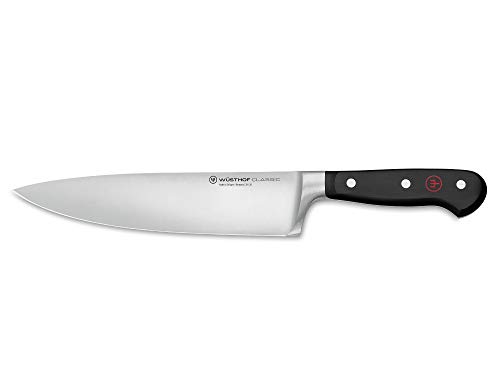
Solingen-made, 58 HRC and backed by a company that has made knives since 1814. It’s the German chef’s knife I’d expect to hand down, heavy bolster and all.

Forged German-type steel, a G10 handle and a sheath for a lot less than the WÜSTHOF. It cuts much like the Classic; what you give up is the Solingen name and track record.

Chef’s, bread and paring knives, a honing steel and shears in Classic steel. Nothing exotic, just the tools a home kitchen reaches for, with empty slots to grow into.

Two chef’s knives, a santoku, a nakiri, boning and fillet knives and six steak knives. It suits a cook who wants a specialist blade for every job, but you’ll need to buy a bread knife separately.
Dalstrong Gladiator vs WÜSTHOF Classic at a Glance
| Feature | Dalstrong Gladiator | WÜSTHOF Classic |
|---|---|---|
| Company | Dalstrong, Canada | WÜSTHOF, family-owned since 1814 |
| Made in | China | Solingen, Germany |
| Steel | Forged high-carbon German stainless | Forged high-carbon stainless, one block |
| Hardness | 56+ HRC | 58 HRC |
| Edge | 16 to 18 degrees each side | PEtec precision edge |
| Handle | G10, triple riveted | Synthetic, triple riveted |
| Bolster | Hybrid bolster | Full bolster to the heel |
| Extras | Sheath, gift box, NSF certified | Limited lifetime warranty |
| Best for | More knife and style for less money | A knife you buy once and keep |
How the Two Brands Differ
Heritage and manufacturing
WÜSTHOF is one of the oldest names in kitchen knives: founded in Solingen in 1814 and still family owned, with its Classic knives made there. Dalstrong is a young Canadian company whose knives are made in China. That matters less for how the knife cuts and more for what happens over 20 years: WÜSTHOF has a long record of knives lasting, and it backs the Classic with a limited lifetime warranty. For a tradition older still, the Sabatier knives of Thiers, France go back to the 1800s; my Sabatier knives review explains which ones are really made there.
Steel and hardness
Both lines use forged, high-carbon German-type stainless steel. WÜSTHOF publishes 58 HRC for the Classic; Dalstrong quotes 56+ HRC for the Gladiator, which puts it in the same tough, forgiving family. Both knives roll rather than chip when they hit a bone, and a quick pass over a honing steel brings either one back. If you want a much harder edge from Dalstrong, that’s the Shogun line, which I compare with Shun in my Dalstrong vs Shun post.
Handles and balance
The Gladiator’s G10 handle is a fiberglass laminate: grippy, water-proof and a little more sculpted than WÜSTHOF’s plain synthetic handle. WÜSTHOF’s full bolster runs down to the heel of the blade, which adds weight and protects your fingers but makes the heel harder to sharpen after years of use.
Looks and packaging
Dalstrong puts real effort into how its knives look and arrive, down to the gift box and sheath. WÜSTHOF looks like what it is: a plain, traditional German knife. If the knife is a present, Dalstrong makes the bigger first impression; if it’s for your own drawer for decades, the plain look doesn’t matter.
Line names
Both brands have a habit of confusing buyers. Dalstrong sells many lines with different steels, so always check which steel you’re getting. WÜSTHOF’s Gourmet line looks a lot like the Classic but is laser cut from sheet steel rather than forged; my WÜSTHOF Classic vs Gourmet comparison explains the difference.
Which One Fits You?
Choose WÜSTHOF for the long haul
If you want one chef’s knife that will still be in your kitchen in 20 years, made by a company that will still be there too, WÜSTHOF is the safer bet.
Choose Dalstrong for value and looks
If you’d rather spend less, like a bolder design or want a knife that doubles as a gift, the Gladiator gives you very similar steel for much less than the Classic.
Choose by the set’s contents, not its piece count
Between the two block sets, the right one is the set whose knives you’ll actually use. The WÜSTHOF covers bread and small jobs; the Dalstrong covers meat, fish and vegetables.
Chef’s Knives and Block Sets Compared
I’ve matched the two brands’ German-steel lines twice: once as a single chef’s knife and once as a full block.
1. WÜSTHOF Classic 8″ Chef’s Knife: Best Buy-Once Chef’s Knife
Who it’s for: home cooks who want one tough German chef’s knife from a maker with a long record.
The Classic is WÜSTHOF’s best-selling series, and the 8″ chef’s knife is the center of it. Each blade starts as a single piece of high-carbon stainless that WÜSTHOF forges, hardens to 58 HRC and finishes with its PEtec edge. The bolster runs the full height of the heel, three rivets hold the synthetic handle, and the curved belly rocks easily through herbs and onions.
Next to the Gladiator, the difference isn’t the cut; it’s confidence. This knife is made in Solingen by a family firm with two centuries behind it and comes with a limited lifetime warranty. My reservations: at 8.5 oz it’s heavy for long prep sessions, and the full bolster eventually needs grinding back at the heel. I go through every WÜSTHOF line in my WÜSTHOF knives review.
Key specs
- Blade: 8″, single-piece forged high-carbon stainless, 58 HRC
- Handle: 5″, synthetic, triple riveted, full tang; full bolster
- Weight: 8.5 oz
- Made in Solingen, Germany
Pros
- Proven, long-lived design
- Tough edge that hones back quickly
- Strong warranty and brand support
Cons
- Heavy for some hands
- Full bolster complicates sharpening the heel
My verdict: the one to buy if you only ever want to buy one. Spend less and get a sheath with the Gladiator if heritage isn’t the point for you.
2. Dalstrong Gladiator 8″ Chef Knife: Best Value Chef’s Knife
Who it’s for: cooks upgrading from a cheap starter knife who want a forged German-style blade without the WÜSTHOF price.
The Gladiator is the Dalstrong line I’d point most people to, and it’s the right one to set against WÜSTHOF because the steel is so similar. It’s forged, full-tang, high-carbon German stainless at 56+ HRC, with a hand-polished edge of 16 to 18 degrees on each side, with a triple-riveted G10 handle and a hybrid bolster. It’s also NSF certified for professional kitchens.
In use it behaves like a German knife: forgiving with chicken joints and hard squash, quick to hone. What you don’t get is the WÜSTHOF’s maker history, and Dalstrong’s styling is louder than some kitchens want. My full take on the brand’s lines is in my Dalstrong knives review.
Key specs
- Blade: 8″, forged high-carbon German stainless, 56+ HRC
- Edge: hand polished, 16 to 18 degrees each side
- Handle: G10, triple riveted, full tang; hybrid bolster
- NSF certified; made in China
Pros
- Similar steel to WÜSTHOF for much less
- Grippy, water-proof G10 handle
Cons
- Shorter track record than WÜSTHOF
- Bold branding isn’t for every kitchen
My verdict: the best value in this comparison and a great gift. If you’re buying for the next 20 years, I’d still stretch to the WÜSTHOF.
3. WÜSTHOF Classic 9-Piece Knife Block Set: Best Block for Everyday Cooking
Who it’s for: households that bake bread, cook every day and want the basics in one WÜSTHOF block.
This set gives you the three knives that do most of the work in a home kitchen: the 8″ Classic chef’s knife, an 8″ bread knife and a 3.5″ paring knife. Add a 4.5″ utility, a 4.5″ Asian utility and a 5″ serrated utility knife, a 9″ honing steel and come-apart shears, all in a 17-slot block with room left over.
The honing steel is the quiet hero here, because Classic steel stays sharp longest when you hone it every week or two. My complaint is overlap: three small utility knives is two more than most people need, and there’s no boning or fillet knife. It also costs much more than the Gladiator set, which is the price of Solingen forging across every blade.
Key specs
- Knives: 8″ chef’s, 8″ bread, 3.5″ paring, 4.5″ utility, 4.5″ Asian utility, 5″ serrated utility
- Also: 9″ honing steel, come-apart shears, 17-slot block
- Steel: forged high-carbon stainless, 58 HRC
- Made in Solingen, Germany; limited lifetime warranty
Pros
- Includes a bread knife and a honing steel
- Forged Classic steel in every knife
- Spare slots for later additions
Cons
- Three overlapping utility knives
- No boning, fillet or steak knives
My verdict: the better block for everyday cooking and baking. If meat and fish are your main jobs, the Dalstrong set covers them better.
4. Dalstrong Gladiator 12-Piece Block Set: Most Knives per Block
Who it’s for: cooks who break down meat and fish at home and want six steak knives in the same block.
Dalstrong takes a different approach from WÜSTHOF: instead of utility knives, the block holds two chef’s knives (8″ and 6″), two Japanese vegetable shapes (a 7″ santoku and a 7″ nakiri), boning and fillet knives at 6″ each, and six straight-edged steak knives. Every blade is full tang German high-carbon steel.
That’s a better set for someone who trims roasts, fillets fish and serves steak; it’s a worse one for a baker, because there’s no bread knife, no paring knife and no honing steel listed. Budget for those three, or the “complete” set isn’t complete. For other brands’ blocks, my best knife sets guide compares several.
Key specs
- Prep knives: chef’s 8″ and 6″, santoku 7″, nakiri 7″, boning 6″, fillet 6″
- Table: six 5″ straight-edge steak knives
- Steel: German high-carbon, full tang
- Handles: black
- Storage: wood block
Pros
- Meat, fish and vegetable specialists included
- Six matching steak knives
- Same forgiving steel throughout
Cons
- No bread knife, paring knife or honing steel
- Two chef’s knives plus a santoku overlap
My verdict: the set for meat-and-fish cooks who host. Bakers and everyday cooks are better served by the WÜSTHOF block.
Keeping German Steel Sharp
- Hone every week or two. Soft German-type steel bends out of line before it truly dulls; a steel pushes it back.
- Sharpen once or twice a year. When honing stops helping, use a whetstone or a sharpener set to the maker’s angle.
- Hand wash and dry. WÜSTHOF says hand wash only, and the same goes for any good forged knife.
- Store blades apart. A block, magnetic strip or sheath stops edges knocking together in a drawer.
FAQ
Is Dalstrong better than WÜSTHOF?
Not better, but better value. The Gladiator uses similar German-type steel to the WÜSTHOF Classic for much less, while WÜSTHOF offers Solingen manufacturing, a longer track record and a slightly harder 58 HRC blade.
Where are Dalstrong and WÜSTHOF knives made?
Dalstrong is a Canadian company with knives made in China. WÜSTHOF makes its Classic knives in Solingen, Germany, where the company was founded in 1814.
Do Dalstrong and WÜSTHOF use the same steel?
Similar, not identical. Both forge high-carbon German-type stainless steel; WÜSTHOF quotes 58 HRC for the Classic and Dalstrong 56+ HRC for the Gladiator. Dalstrong’s Shogun line is different: a much harder Japanese AUS-10V steel.
Which brand lasts longer?
Both can last decades with hand washing and regular honing. WÜSTHOF has the longer record of knives doing exactly that, which is why I’d pick it for a buy-once knife.
Final Verdict
For a single chef’s knife you’ll keep for decades, I’d choose the WÜSTHOF Classic 8″. The Dalstrong Gladiator 8″ cuts in much the same way for much less and makes the better gift. For a whole block, pick by contents: the WÜSTHOF Classic 9-piece for everyday cooking and bread, the Dalstrong Gladiator 12-piece for meat, fish and steak nights.
Still deciding between German and Japanese steel altogether? My German vs Japanese knives guide covers that choice.

Gary Portman founded knivesadvice.com in 2019. He learned to cook in his family’s kitchen as a kid and has used kitchen, pocket and outdoor knives ever since, from paring and fillet knives to survival blades he carries camping and hiking. He writes the site’s buying guides, brand reviews and sharpening how-tos to help readers find the right knife for the job. More about Gary.