
ZWILLING and WÜSTHOF are neighbors in Solingen, both forge their best knives from German stainless steel, and both make a chef’s knife that will outlive most of the food you cut with it. That’s why most “which is better” answers online end in a shrug.
The useful differences are smaller and more personal: ZWILLING’s steel is a touch softer at 57 HRC and sharpened to a published 15 degrees per side, WÜSTHOF’s is 58 HRC, and the two handles sit differently in the hand. Then there’s the name confusion. HENCKELS is not a third rival; it’s ZWILLING’s own value brand, which explains why “ZWILLING J.A. Henckels” appears on so many boxes.
So hold both if you can and buy the handle you like. If you can’t, I default to WÜSTHOF and its Classic 8″ Chef’s Knife, with the ZWILLING Professional S 8″ Chef’s Knife as an equal you should take the moment its grip feels better to you.
My ZWILLING, WÜSTHOF and HENCKELS Picks
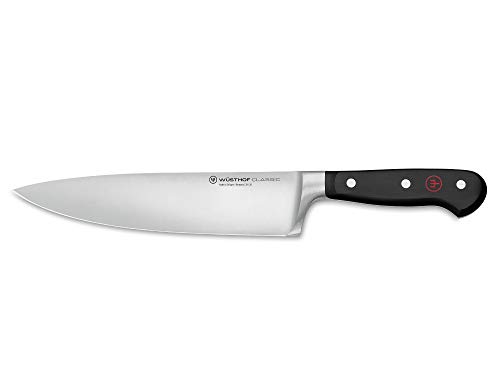
Forged in Solingen by a family firm, 58 HRC, 8.5 oz of solid German knife. When someone can’t try both, this is the one I tell them to buy.

Ice-hardened FRIODUR steel, 15 degrees per side and a full bolster, made in ZWILLING’s own German factory. It’s the traditional ZWILLING I’d start with.

A short, stiff Classic parer for peeling, trimming and coring. It’s a cheap way to see whether you like WÜSTHOF’s handle before buying a chef’s knife.

Half an inch longer than the WÜSTHOF, which helps on larger fruit and shallots. Same steel and angle as its big brother.

Chef’s, utility and paring knives from ZWILLING’s value brand. It covers most daily cutting without the premium-brand price.
The Three Brands at a Glance
| Feature | ZWILLING (Professional S) | WÜSTHOF (Classic) | HENCKELS (Classic) |
|---|---|---|---|
| Company | ZWILLING J.A. Henckels, Solingen, 1731 | WÜSTHOF, family owned, Solingen, 1814 | ZWILLING’s value brand |
| Logo | Twin figures | Red trident | Single figure |
| Made in | Germany (company-owned factory) | Solingen, Germany | “German engineered” on the listing |
| Construction | Forged from one piece (Sigmaforge) | Forged from one block | Satin-finished blade, details not published |
| Hardness | 57 HRC, FRIODUR ice hardened | 58 HRC | Not published |
| Edge | 15 degrees per side | PEtec precision edge | Finely honed |
| Handle | Polymer, three rivets | Synthetic, three rivets | Not detailed on the listing |
| Best for | Cooks whose hand prefers its grip | A default buy when you can’t try both | A first set on a tight budget |
ZWILLING vs WÜSTHOF: What Actually Separates Them
One family name, two brands, and a rival
Yes, ZWILLING and HENCKELS belong together; WÜSTHOF is the separate company. ZWILLING J.A. Henckels is the parent, founded in Solingen in 1731, and it sells premium knives under the ZWILLING name (twin logo) and value knives under HENCKELS (single figure). It also owns the Japanese brand Miyabi. WÜSTHOF, founded in 1814 and still family owned, is the rival down the road. When you see “J.A. Henckels” on an older ZWILLING box, it’s the same company. I untangle the factories in my where ZWILLING knives are made post.
Steel and hardness
Both forge their top lines from high-carbon German stainless. ZWILLING ice-hardens its blades with a process it calls FRIODUR and lists 57 HRC; WÜSTHOF lists 58 HRC for the Classic. In the kitchen, one point of hardness is hard to notice. Both roll rather than chip, both come back quickly on a honing steel, and both need a real sharpening once or twice a year.
Edge angle
ZWILLING publishes 15 degrees per side for the Professional S, which is sharp for a German knife and much closer to a Japanese edge than the old 20-degree standard. WÜSTHOF finishes the Classic with its PEtec process, a laser-guided edge it says comes out sharper and lasts longer. Out of the box, either one will slice a ripe tomato cleanly.
Handles and balance
This is where I’d make the choice, because on paper the two flagships are near twins: forged full tang, three rivets, a full bolster, a synthetic handle. The difference is in the shape of the handle under your fingers, and that’s personal. Neither one is a light knife (WÜSTHOF lists 8.5 oz for the Classic 8″), so if you like heft, both will please you. If you can get to a store, hold both for a minute in a pinch grip; the one that disappears in your hand is the right one.
Bolsters and sharpening
Both flagship lines have a full bolster running down to the heel. It guards your fingers and adds heft, but after years of sharpening it can leave a dip near the heel unless you grind the bolster back. ZWILLING’s Pro line changes this with a sloped bolster that leaves the whole edge sharpenable. For the WÜSTHOF routine, see my how to sharpen WÜSTHOF knives guide.
Where HENCKELS Fits
HENCKELS knives are what ZWILLING sells to people who want a dependable knife for much less money. The listings usually say “German engineered” rather than “made in Germany”, and many HENCKELS lines don’t publish a steel hardness. That doesn’t make them bad knives; it makes them a different purchase. If you want a lifetime knife, buy ZWILLING or WÜSTHOF. If you want a sharp, low-stress set for a first apartment, a rental or a kitchen where knives go in the dishwasher, HENCKELS makes more sense than stretching for a premium name.
Chef’s Knives, Paring Knives and a Starter Set
Each brand’s flagship chef’s knife and paring knife, matched, then one HENCKELS set for the value end.
1. WÜSTHOF Classic 8″ Chef’s Knife: Best for Cooks Who Like Heft
Who it’s for: cooks who want a solid German chef’s knife and can’t try the two brands side by side before buying.
WÜSTHOF forges this blade in one piece from high-carbon stainless steel, tempers it to 58 HRC and puts on its PEtec edge. The full bolster and finger guard sit in front of a 5″ synthetic handle riveted three times to a full tang, and the whole knife weighs 8.5 oz, which you feel when you chop through carrots or a whole chicken.
It gets my default vote over the ZWILLING for two small reasons, not one big one: the Classic is the line I’ve recommended most across this site, and WÜSTHOF’s family ownership and single Solingen focus make it an easy brand to trust for decades. My hesitation is weight: after an hour of dicing, a lighter knife is kinder to your wrist. Every WÜSTHOF line is covered in my WÜSTHOF knives review.
Key specs
- Blade: 8″, one-piece forged high-carbon stainless, 58 HRC
- Edge: PEtec precision edge
- Handle: 5″, synthetic, triple riveted; full bolster and finger guard
- Weight: 8.5 oz; made in Solingen
Pros
- Heft helps on dense food
- Tough edge, easy to hone
- Family firm with a long Solingen record
Cons
- Tiring for long prep sessions
- Full bolster gets in the way of sharpening the heel
My verdict: the safe default when you have to choose blind. If the ZWILLING’s handle feels better to you, buy that instead without a second thought.
2. ZWILLING Professional S 8″ Chef’s Knife: Best Classic ZWILLING
Who it’s for: cooks who want a traditional German chef’s knife with a published, sharper-than-usual edge angle.
The Professional S is ZWILLING’s classic three-rivet line, and its 8″ chef’s knife is the knife I’d compare most directly with the WÜSTHOF Classic. ZWILLING forges it from one piece of its special formula steel (Sigmaforge), ice-hardens it with FRIODUR to 57 HRC and sharpens it to 15 degrees per side. It’s made in ZWILLING’s company-owned factory in Germany.
Spec for spec, it matches the WÜSTHOF closely, and ZWILLING is the more open of the two about its edge, which is why I like recommending it to people who want to know exactly what they’re buying. The listing calls it dishwasher safe, but I’d still hand wash it like any good forged knife; the dishwasher dulls edges and dries out handles over time. I go through the rest of ZWILLING’s lines in my are ZWILLING knives good post.
Key specs
- Blade: 8″, forged from one piece, FRIODUR ice hardened, 57 HRC
- Edge: 15 degrees per side, laser controlled
- Handle: polymer, three rivets, full tang; full bolster
- Made in Germany
Pros
- Sharp 15-degree edge for a German knife
- Full tang with a balanced, bolstered blade
- Made in ZWILLING’s own German factory
Cons
- Full bolster, same heel-sharpening issue
- Plain styling
My verdict: an equal to the WÜSTHOF in every way that matters. Pick it if the handle suits you better, which is the honest tiebreaker.
3. WÜSTHOF Classic 3.5″ Paring Knife: Best WÜSTHOF Paring Knife
Who it’s for: cooks who do a lot of small, in-hand work and want a parer from the same family as their chef’s knife.
A paring knife is where you notice handle shape most, because you hold it close and choke up on the blade. This Classic parer has the same full-tang, triple-riveted handle as the chef’s knife, so it’s an inexpensive way to find out whether WÜSTHOF’s grip suits you before committing to the bigger knife.
The 3.5″ blade is short and stiff, good for peeling apples, hulling strawberries and scoring. It’s a touch short for big shallots or halving larger fruit, where the extra half inch of the ZWILLING helps. Like all Classic knives, it’s hand wash only.
Key specs
- Blade: 3.5″, WÜSTHOF Classic
- Handle: synthetic, full tang, triple riveted
- Made in Solingen, Germany
Pros
- Short blade gives fine control
- Same handle feel as the Classic chef’s knife
Cons
- Short for larger fruit
- Hand wash only
My verdict: a great first WÜSTHOF and a smart test of the handle. Choose the ZWILLING if you want a little more reach.
4. ZWILLING Professional S 4″ Paring Knife: Best ZWILLING Paring Knife
Who it’s for: cooks who want a paring knife that can also stand in for a small utility knife.
The 4″ Professional S parer is the same recipe as the chef’s knife, scaled down: forged from one piece, FRIODUR ice hardened to 57 HRC, 15 degrees per side, polymer three-rivet handle on a full tang. That extra half inch over the WÜSTHOF makes it more useful for slicing a lime or segmenting an orange on the board.
The trade-off is a little less precision for tiny in-hand jobs like turning mushrooms or deveining shrimp. Between these two parers, I’d let the chef’s knife decide: buy the paring knife from the brand whose handle you already like.
Key specs
- Blade: 4″, forged from one piece, FRIODUR, 57 HRC
- Edge: 15 degrees per side
- Handle: polymer, three rivets, full tang
- Made in Germany
Pros
- Longer blade handles board work too
- Same steel and angle as the chef’s knife
Cons
- Slightly less nimble for fine in-hand work
- Bolster adds weight to a small knife
My verdict: the more versatile parer. The WÜSTHOF is the better pure peeling knife.
5. HENCKELS Classic 3-Pc Starter Set: Best HENCKELS Value Set
Who it’s for: first kitchens and anyone who wants a solid trio of knives without paying for a premium name.
This set gives you the three knives most home cooks use daily: an 8″ chef’s knife, a 6″ utility knife and a 4″ paring/utility knife, all with satin-finished blades. The listing describes them as lightweight and says they can go in the dishwasher or be washed by hand.
What you don’t get is the published detail of the ZWILLING and WÜSTHOF knives above: no hardness rating, no stated edge angle, and “German engineered” rather than “made in Germany”. For a first set, I don’t mind that at all. Expect to hone more often and sharpen sooner than with the premium knives. For more sets in this range, my knife sets under $100 guide has other options.
Key specs
- Knives: 8″ chef’s, 6″ utility, 4″ paring/utility
- Blades: satin finished, stain and rust resistant
- Care: dishwasher or hand wash, per the listing
- Brand: HENCKELS, ZWILLING’s value line
Pros
- Three useful knives, no filler
- Light and easy to handle
- Backed by the ZWILLING group
Cons
- No published hardness or edge angle
- No block or honing steel included
My verdict: the smart buy for a first kitchen. Step up to ZWILLING or WÜSTHOF when you want one knife to last decades.
FAQ
Which knives are better, WÜSTHOF or ZWILLING?
Neither is better. Both make forged German knives in Solingen with very similar steel (58 HRC for WÜSTHOF Classic, 57 HRC for ZWILLING Professional S). Choose by which handle feels better in your hand.
Are ZWILLING and WÜSTHOF the same company?
No. ZWILLING J.A. Henckels (founded 1731) and WÜSTHOF (founded 1814, family owned) are separate rivals, both based in Solingen. ZWILLING does own HENCKELS and Miyabi.
What is the difference between ZWILLING and HENCKELS?
Same parent company, different tiers. ZWILLING (twin logo) is the premium brand with forged, German-made flagship lines; HENCKELS (single figure) is the value brand, often described as German engineered rather than German made.
I prefer heavier knives with thicker spines: WÜSTHOF or ZWILLING?
Either flagship will suit you. WÜSTHOF Classic and ZWILLING Professional S are both forged, full tang and fully bolstered, the heavy German style; the Classic 8″ is listed at 8.5 oz. Avoid the stamped lines of either brand (WÜSTHOF Gourmet, ZWILLING Twin Signature), which are lighter.
Is WÜSTHOF better than HENCKELS?
For a knife you’ll keep for decades, yes: WÜSTHOF’s forged Solingen lines publish their hardness and come with a long record. HENCKELS is the better value for a first set or a kitchen where knives get rough treatment.
Final Verdict
ZWILLING vs WÜSTHOF is a tie on steel, so let your hand break it. Buying blind, I’d take the WÜSTHOF Classic 8″; if the ZWILLING Professional S 8″ feels better when you hold it, it’s every bit as good a knife. If you’re furnishing a first kitchen and the premium names feel like too much, the HENCKELS Classic 3-piece set is the value end of the ZWILLING family.
Curious how WÜSTHOF stacks up against a Japanese brand instead? My Shun vs WÜSTHOF comparison covers that matchup.

Gary Portman founded knivesadvice.com in 2019. He learned to cook in his family’s kitchen as a kid and has used kitchen, pocket and outdoor knives ever since, from paring and fillet knives to survival blades he carries camping and hiking. He writes the site’s buying guides, brand reviews and sharpening how-tos to help readers find the right knife for the job. More about Gary.