
Victorinox’s Fibrox Pro is the least expensive chef’s knife here and the one I’d still give most new cooks: light, grippy when wet and Swiss made. WÜSTHOF earns its higher price in heft, finish and a forged option Victorinox doesn’t really match. For most kitchens I’d choose the Victorinox Fibrox Pro 8″ Chef’s Knife; WÜSTHOF’s forged Classic 8″ Chef’s Knife is the one to get if you want a forged knife for decades.
My WÜSTHOF and Victorinox Picks

A thin, light blade on a textured handle that holds even when your hands are wet. It’s the knife I’d buy for a first kitchen, a busy family or a cook who just wants something that works.
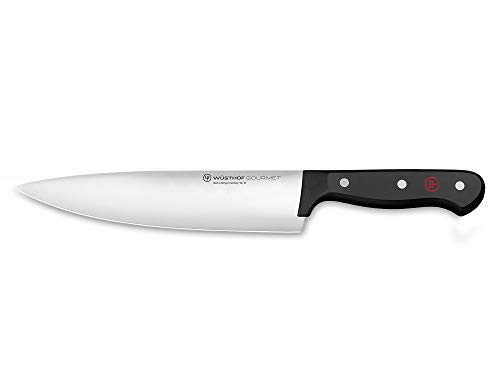
Laser cut and stamped like the Fibrox, but German made with WÜSTHOF’s traditional handle. The extra money buys the name and the more classic look.
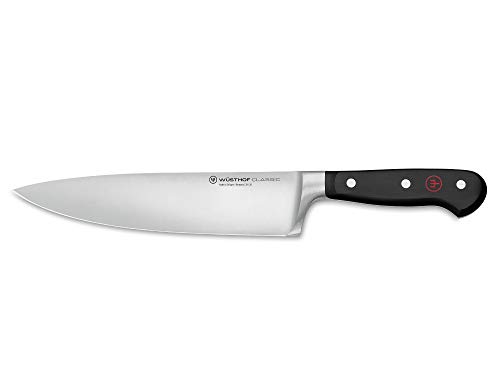
The real reason to choose WÜSTHOF over Victorinox: forged from one piece, 58 HRC, full bolster. Heavier and more planted than either stamped knife.

Four colorful serrated parers with grippy handles. Tomatoes, citrus and sandwiches all go faster, and you won’t panic if one disappears in a picnic bag.

A straight-edged, forged parer for fine peeling and trimming. One knife to keep for years rather than a handful to use hard.
WÜSTHOF and Victorinox at a Glance
| Feature | Victorinox Fibrox Pro | WÜSTHOF Gourmet | WÜSTHOF Classic |
|---|---|---|---|
| Made in | Switzerland | Solingen, Germany | Solingen, Germany |
| Construction | Stamped | Laser cut, stamped | Forged from one piece |
| Hardness | Not published | Not published | 58 HRC |
| Handle | Textured TPE, non-slip when wet | Synthetic polypropylene | Synthetic, triple riveted |
| Bolster | None | None | Full bolster |
| Feel | Light and nimble | Light, more traditional look | Heavy (8.5 oz) and solid |
| Warranty | Lifetime against defects | Limited lifetime | Limited lifetime |
| Best for | First knife, wet hands, value | WÜSTHOF look on a smaller budget | A forged knife for decades |
How the Two Brands Compare
Stamped vs forged is the real dividing line
Comparing “WÜSTHOF vs Victorinox” only makes sense line by line. Victorinox’s kitchen knives that most people buy, Fibrox Pro and Swiss Classic, are stamped: cut from a sheet of steel, then ground and sharpened. WÜSTHOF sells both kinds. Its Gourmet line is laser cut and stamped too, so the Fibrox vs Gourmet match is a fair fight; its Classic line is forged, which brings a bolster, more weight and a thicker spine. Forging changes weight and balance, not how sharp a knife can get.
Handles and grip
This is where Victorinox wins outright. The Fibrox handle is a textured thermoplastic elastomer that doesn’t slide around in wet, oily or chicken-greasy hands. Both WÜSTHOF handles are smoother synthetics: comfortable and classic looking, but slicker in a messy kitchen. I’ve said it before on this site and I’ll say it again: grip matters more than steel specs when your hands are wet.
Weight and feel
The Fibrox and the Gourmet are both light, which helps on long prep sessions and suits smaller hands. The Classic at 8.5 oz is a different tool: it powers through dense squash and joints with less effort but tires the wrist sooner. If you’ve only ever used a light knife and want to know whether you like heft, the Classic is the way to find out.
Looks
Nobody buys a Fibrox for its looks. It’s plain black plastic that says “restaurant kitchen”. WÜSTHOF looks like a traditional German knife, red trident and all, which matters if your knives live on a magnetic strip or you’re buying a gift.
Care and warranty
The Fibrox listing says dishwasher safe; WÜSTHOF says hand wash only. My advice is the same for both: hand wash and dry, because a dishwasher dulls any edge faster and knocks knives against other things. I explain why in more detail in my are WÜSTHOF knives dishwasher safe post. Victorinox offers a lifetime warranty against defects in material and workmanship; WÜSTHOF gives a limited lifetime warranty. Cutco is the brand that adds free sharpening on top of its guarantee, which I cover in my Cutco knives review.
Which One Should You Buy?
Choose Victorinox for value and grip
If this is your first good knife, your hands are often wet, or several people share it, the Fibrox Pro is the easier knife to live with and costs much less than either WÜSTHOF.
Choose WÜSTHOF Gourmet for the look and the name
If you like the traditional German look and want a light WÜSTHOF, the Gourmet is a fine knife. Just know it’s the same type of construction as the Fibrox, so you’re paying for the brand and the style rather than a different kind of blade. My WÜSTHOF Classic vs Gourmet comparison explains the two lines in depth.
Choose WÜSTHOF Classic for a forged knife
If you want weight, a bolster and a knife built to be handed down, skip both stamped knives and buy the Classic.
Chef’s Knives and Paring Knives Compared
The two stamped chef’s knives first, then WÜSTHOF’s forged step up, then a paring option from each brand. For paring knives from other makers too, see my best paring knife picks.
1. Victorinox Fibrox Pro 8″ Chef’s Knife: Best Value Chef’s Knife
Who it’s for: new cooks, families and anyone who wants a chef’s knife that grips well and doesn’t need babying.
The Fibrox Pro is about as close as kitchen knives get to a universal recommendation, and Victorinox has been making knives in Switzerland since 1884. The blade is thin, tapered stainless steel just under 8″ long, and the TPE handle has a texture that stays secure when wet. You’ll find this knife, or one like it, in a lot of restaurant and butcher kitchens.
Against the WÜSTHOF Gourmet, the Fibrox cuts just as well, grips better and costs less. Its softer steel rolls instead of chipping, so hone it every few uses and it stays sharp. My reservations are the looks and the weight: it’s plain, and cooks who like a heavy knife will find it too light. I’ve covered Victorinox’s chef’s knife range in my Victorinox chef knife review.
Key specs
- Blade: 7.9″, stamped stainless steel, tapered edge
- Handle: thermoplastic elastomer (TPE), non-slip when wet
- Made in Switzerland
- Lifetime warranty against defects; dishwasher-safe materials (hand washing still best)
Pros
- Best grip in this comparison, wet or dry
- Light and easy on the wrist
- Forgiving steel that hones back quickly
Cons
- Plain, utilitarian looks
- Too light for cooks who like heft
My verdict: the knife most people should buy first. Move to the WÜSTHOF Classic only once you know you want a heavier, forged knife.
2. WÜSTHOF Gourmet 8″ Chef’s Knife: Best Entry to WÜSTHOF
Who it’s for: cooks who want a WÜSTHOF without paying for a forged knife, and who prefer a classic look to the Fibrox’s plastic.
The Gourmet is WÜSTHOF’s laser-cut, stamped line, made in Germany with a synthetic polypropylene handle that resists fading and heat. WÜSTHOF describes the 8″ chef’s knife as weighted and balanced enough for heavier work like cutting through thick vegetables, and it carries the same limited lifetime warranty as the forged lines.
Next to the Fibrox, it’s a closer contest than the price suggests. Both are stamped, both are light, and both cut well; the WÜSTHOF looks more like a “real” German knife and the Victorinox grips better when wet. WÜSTHOF doesn’t publish a hardness for the Gourmet. If you choose it, choose it because you like the look or the name, not because it cuts better than the Fibrox.
Key specs
- Blade: 8″, laser cut, stamped high-carbon stainless
- Handle: synthetic polypropylene
- Made in Solingen, Germany
- Limited lifetime warranty; hand wash
Pros
- Traditional WÜSTHOF look for less
- Light enough for long prep
- German made with a long warranty
Cons
- Costs more than the Fibrox for similar construction
- Smoother handle, less secure when wet
My verdict: a good knife, but the Fibrox does the same job for less. Buy the Gourmet if the WÜSTHOF look matters to you.
3. WÜSTHOF Classic 8″ Chef’s Knife: Best Forged Upgrade
Who it’s for: cooks who have outgrown a light stamped knife and want a heavier, forged blade to keep for decades.
This is where WÜSTHOF pulls away from Victorinox. The Classic 8″ starts as one solid blank of high-carbon steel; WÜSTHOF forges it, tempers it to 58 HRC, finishes it with its PEtec edge and fits a full bolster and a triple-riveted handle. At 8.5 oz it has real heft, and the thicker spine handles chicken joints and winter squash with more authority than either stamped knife.
Victorinox’s own forged line, Grand Maître, exists but is a niche range with few published steel details, so for most buyers this Classic is the forged choice in this matchup. My cautions: the weight wears on you during long sessions, and the full bolster complicates sharpening the heel after years of use. My WÜSTHOF knives review covers its siblings too.
Key specs
- Blade: 8″, forged, high-carbon stainless steel; 58 HRC; PEtec edge
- Handle: 5″, synthetic, triple riveted, full tang; full bolster
- Weight: 8.5 oz
- Made in Solingen, Germany
Pros
- Heft and thick spine for tough jobs
- Published 58 HRC hardness
- Built to last decades
Cons
- Heavy for long prep sessions
- Costs much more than the Fibrox
My verdict: the one WÜSTHOF that clearly does something the Fibrox can’t. Buy it when you know you want a heavy knife.
4. Victorinox Swiss Classic 4-Piece Paring Set: Best Everyday Paring Set
Who it’s for: households that go through paring knives quickly, or want one for the kitchen, the lunchbox and the picnic basket.
Four 4.3″ serrated parers in bright colors, each with a contoured handle inspired by the Fibrox Pro. Serrations make them excellent on tomatoes, citrus, sausages and crusty rolls, and the colors make it easy to keep one for fruit and one for raw meat.
The downside of serrations is that you can’t really sharpen them at home, and they tear rather than slice when you try fine peeling. Think of these as hard-working knives you use daily and replace eventually, not heirlooms. Paired with a Fibrox chef’s knife, they make a very capable kitchen for very little money.
Key specs
- Set: four 4.3″ serrated paring knives, multicolored
- Handle: contoured, Fibrox-inspired, grips when wet
- Made in Switzerland
Pros
- Great on tomatoes and citrus
- Colors help separate food types
- Grippy handles
Cons
- Serrations are hard to sharpen
- Not ideal for fine peeling
My verdict: the practical choice for busy kitchens. For precise peeling and trimming, get the WÜSTHOF parer.
5. WÜSTHOF Classic 3.5″ Paring Knife: Best Forged Paring Knife
Who it’s for: cooks who do careful in-hand work and want one parer they’ll sharpen and keep.
WÜSTHOF’s Classic paring knife has a straight 3.5″ edge, a full tang and the same triple-riveted handle as the Classic chef’s knife. The plain edge is better than serrations for peeling apples, trimming Brussels sprouts or cutting segments, and you can sharpen it like any other knife.
It’s a single knife, so you’re giving up the Victorinox set’s spares and colors in exchange for one more refined tool. My complaint is the same as with every Classic knife: hand wash only, and the smooth handle is less secure than the Victorinox’s when wet. If you already own a WÜSTHOF Classic chef’s knife, this is the natural partner.
Key specs
- Blade: 3.5″, straight edge, WÜSTHOF Classic
- Handle: synthetic, full tang, triple riveted
- Made in Solingen, Germany; hand wash only
Pros
- Straight edge for fine peeling and trimming
- Sharpenable like any plain-edge knife
Cons
- One knife instead of a set
- Smoother handle when wet
My verdict: the better tool for precise work. The Victorinox set is the better buy for a busy family.
FAQ
Is WÜSTHOF better than Victorinox?
Not for most people. A Victorinox Fibrox Pro cuts about as well as a WÜSTHOF Gourmet, grips better when wet and costs much less. WÜSTHOF is better if you want a forged, heavier knife like the Classic.
Are Victorinox knives forged or stamped?
The Fibrox Pro and Swiss Classic lines are stamped. Victorinox does make a forged line, Grand Maître, but it’s the Fibrox most people buy and recommend.
Is the WÜSTHOF Gourmet worth it over the Fibrox Pro?
Only if you prefer its look or the WÜSTHOF name. Both are stamped, light knives that cut well; the Fibrox has the grippier handle, while the Gourmet looks more traditional.
Which is better for beginners?
Victorinox. The Fibrox Pro is light, forgiving and hard to slip with, and its softer steel comes back to sharp with a few passes on a honing rod.
Final Verdict
For most kitchens, the Victorinox Fibrox Pro 8″ is the better buy: it cuts as well as the stamped WÜSTHOF Gourmet, grips better and pairs well with the Swiss Classic paring set. Choose the Gourmet only if you want the WÜSTHOF look. When you’re ready for a heavy, forged knife, the WÜSTHOF Classic 8″ is where WÜSTHOF genuinely beats Victorinox.
Shopping on a budget? My best chef knives under $100 guide compares the Fibrox with other options, and my ZWILLING vs WÜSTHOF comparison covers WÜSTHOF’s German rival.

Gary Portman founded knivesadvice.com in 2019. He learned to cook in his family’s kitchen as a kid and has used kitchen, pocket and outdoor knives ever since, from paring and fillet knives to survival blades he carries camping and hiking. He writes the site’s buying guides, brand reviews and sharpening how-tos to help readers find the right knife for the job. More about Gary.