
Do you need a special knife for sushi at home? For rolls, not really: any sharp chef’s knife cuts maki if you wet the blade. Sashimi is different. Raw fish is soft and slippery, and the moment you saw at it the cut face turns ragged and loses its glossy look. A yanagiba fixes that. It’s a long, narrow slicer ground on one side only, made to draw through a block of tuna in one smooth pull. The Mercer Asian Collection 10-inch Yanagi is where I’d start, with the right length and a true single edge for very little money. If sashimi has turned into a real hobby, the hand-finished Yoshihiro Inox 270mm is my premium choice.
My Top 7 Sushi and Sashimi Knife Picks

This is the yanagi I’d tell most home cooks to buy first. Mercer makes tools for culinary schools and restaurant kitchens, and this one gets the important things right: a generous ten inch blade and a true single edge, for very little money. Spend what you save on good fish.

Nervous about keeping a single bevel edge sharp? Kai offers free sharpening, and that alone makes this my pick for cautious beginners. The 240mm stainless blade forgives a damp counter, and the riveted full-tang handle feels more solid than most budget yanagiba.
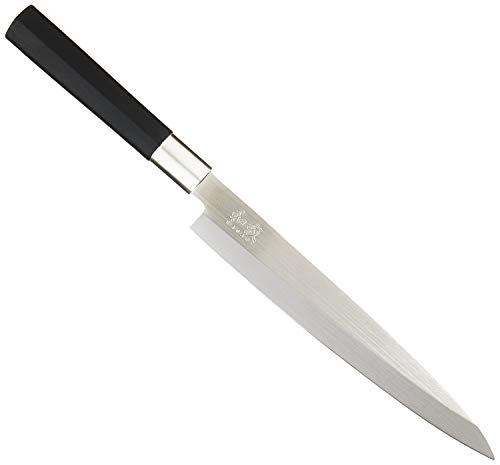
Not every kitchen has room for a ten inch slicer. The Wasabi is shorter, light and easy to store, which makes it my pick for small cutting boards, small fish and people who want a gentle first step into Japanese knives.

This is the knife I’d buy once sushi night becomes a ritual. It’s handcrafted in Japan with the traditional hollow back, comes with a wooden saya (sheath), and the longer 270mm blade lets you cut even big blocks in one pull.

I picked the Global for cooks who want a yanagiba that looks modern and cleans in seconds. The seamless stainless construction has no wood to swell or crack, and there’s a left-handed version too.

Left-handed, or nervous about sharpening a one-sided edge? A sujihiki is a long slicer sharpened on both sides, and I think Tojiro’s is the most sensible one around. It slices fish beautifully and doubles as a roast and brisket slicer.

A yanagiba slices; it should never touch a fish head or spine. If you buy whole fish and break them down yourself, a deba is the heavy, thick-spined knife for that work, and Mercer’s is an inexpensive way to own one.
Sushi Knives Compared
| Knife | Style | Length | Edge | Handle | Best for |
|---|---|---|---|---|---|
| Mercer Asian Collection Yanagi | Yanagiba | 10″ | Single bevel | Wood | Most home sushi cooks |
| Kai PRO Yanagiba | Yanagiba | 9.5″ (240mm) | Single bevel, 16 degrees | Riveted POM | Beginners who want sharpening support |
| Kai Wasabi Yanagiba | Yanagiba | 8.25″ | Single bevel | Polypropylene and bamboo | Small kitchens, small fish |
| Yoshihiro Inox Yanagi | Yanagiba | 10.5″ (270mm) | Single bevel, hollow back | Wa (Japanese) style | Serious hobbyists |
| Global G-11 | Yanagiba | 10″ | Single bevel | Stainless steel | Easy cleaning, modern look |
| Tojiro DP Sujihiki | Sujihiki | 9.4″ (240mm) | Double bevel (50/50) | Composite wood | Left-handers, fish and meat |
| Mercer Asian Collection Deba | Deba | 6″ | Single bevel | Wood | Breaking down whole fish |
1. Mercer Culinary Asian Collection Yanagi 10-Inch: Best Overall
Who it’s for: most right-handed home cooks making sushi and sashimi, from first-timers to regulars on a sensible budget.
Mercer is best known for the knives handed out in culinary schools and used on restaurant lines, and that background shows here: nothing fancy, just the right shape at a price that lets you experiment. You get a 10-inch blade of high-carbon German steel, taper ground with a stone finish into a single edge, and a simple traditional wooden handle.
I put it first because it nails the one spec that matters most. Ten inches gives you plenty of room for long, unhurried strokes, which matters more for clean sashimi than any steel spec. And because it costs so little, you can learn whetstone sharpening on it without fear. For slicing salmon nigiri or tuna sashimi at home, it does exactly what it should.
Where it shows its price is the finish and the edge out of the box. Budget single bevel knives often need a proper sharpening on a whetstone before they’re truly sushi-sharp, and I’d plan on that. The wooden handle also wants a quick dry after washing. Left-handed? Mercer sells a left-handed version of this knife with a grippy NSF handle, which is rare at this level.
Key specs
- Blade: 10 inch high-carbon German steel, taper ground, stone finish
- Edge: single bevel
- Handle: traditional wood
- Hand wash only
Pros
- Very low cost for a true yanagi
- Generous 10-inch length
- Left-handed version available
Cons
- Plan on sharpening it before first use for the best results
- Basic fit and finish
- Wooden handle needs drying after every wash
My verdict: the best place to start, and for many people the only yanagi they’ll need. Skip it if you want a more refined finish or a sharpening service behind your knife.
2. Kai PRO 9.5-Inch Yanagiba: Best With Free Sharpening
Who it’s for: right-handed beginners who want a sturdier yanagiba and someone to sharpen it for them.
Kai is one of the big names in Seki, Japan’s historic knife city, and it’s a brand I’ve spent a lot of time on here (my Kai knives review covers the wider range). The PRO line is their workhorse series, and this 9.5-inch yanagiba is a very comfortable length for home sushi: long enough that a typical block of salmon or tuna is cut in a single pull, short enough to fit on a normal cutting board.
The edge is single bevel at 16 degrees. If that term is new: the front of the blade is ground at an angle while the back is nearly flat, which lets the knife slide through fish with very little resistance and leave a smooth, shiny cut face. The steel is German DIN 1.4116 stainless. It isn’t the hardest or most exotic steel on this list, and I actually see that as a plus for a first yanagiba. It’s tough, resists rust and is easy to bring back on a whetstone.
Two things earn it a place next to the cheaper Mercer. The handle is riveted to a full tang, so it feels solid rather than delicate, and Kai supports it with free sharpening and honing. Sharpening a single bevel edge is the part that scares most people off these knives, so a safety net matters.
My reservation: it costs more than the Mercer and is a little shorter. The Western-style handle also won’t please purists who want a traditional wooden one. And like nearly every yanagiba, it’s right-handed.
Key specs
- Blade: 9.5 inch (240mm), German DIN 1.4116 stainless steel, full tang
- Edge: single bevel, 16 degrees
- Handle: contoured POM, riveted
- Free sharpening and honing from Kai
Pros
- Comfortable 240mm length
- Forgiving, rust-resistant steel that’s easy to sharpen
- Sturdy riveted handle
- Free sharpening support
Cons
- Softer steel needs touching up more often than the premium picks
- Right-handed only
- Western handle rather than a traditional one
My verdict: worth the extra over the Mercer if free sharpening gives you peace of mind. Pass on it if you’re left-handed or already know you want a handmade blade.
3. Kai Wasabi 8.25-Inch Yanagiba: Best Compact
Who it’s for: cooks with small boards or small kitchens, people slicing smaller fish, and anyone who finds a ten inch blade intimidating.
The Wasabi is a good knife, but I don’t rank it higher because, for most people, a little more length makes sashimi easier. At 8.25 inches you’ll sometimes need to keep your stroke very long or cut smaller blocks. But that shorter blade is exactly why some readers will prefer it: it’s lighter, less intimidating and fits in a drawer or a standard knife block.
The blade is high-carbon stainless, sharpened on one side in the traditional way. The handle is the interesting part: a symmetrical Japanese-style shape made from a polypropylene and bamboo blend. It’s comfortable, light and doesn’t mind getting wet the way plain wood can.
The trade-off is in the feel. Next to the Yoshihiro, it’s clearly a mass-produced knife, and the light weight means you do a bit more of the guiding yourself. Kai’s free sharpening support applies here too.
Key specs
- Blade: 8.25 inch high-carbon stainless steel
- Edge: single bevel
- Handle: symmetrical Japanese-style, polypropylene and bamboo blend
- Free sharpening and honing from Kai
Pros
- Compact and light, easy to store
- Moisture-friendly handle
- Gentle price for a first Japanese knife
Cons
- Shorter blade means bigger blocks may need care to cut in one stroke
- Light weight gives less momentum through the cut
My verdict: the right yanagiba when space or nerves are the issue. If you have room, the 10-inch Mercer is easier to get great slices with.
4. Yoshihiro Inox Yanagi 270mm: Best Premium
Who it’s for: home cooks who make sushi often, want a traditionally made knife, and are ready to learn whetstone sharpening.
This is the point where a yanagiba stops being a tool you own and becomes one you enjoy. Yoshihiro’s Inox yanagi is handcrafted in Japan with the full traditional geometry: a flat bevel on the front, and on the back a shallow hollow (called urasuki) with a thin flat rim (uraoshi) around it. The hollow back is what makes a real yanagiba release slices so cleanly, and it also makes sharpening the back side much quicker.
The steel is AUS8 stainless at 60 HRC. In practice that gives you a fine, keen edge with good stain resistance, so you don’t have to panic every time fish juices sit on the blade. The 270mm length is a step up from my top pick: it suits bigger blocks, longer strokes and anyone who already finds 240mm a bit short. A magnolia wood saya comes with it, which protects the edge and looks the part.
My honest hesitation is the price, which is far above the Kai PRO, and the fact that it deserves proper care. Yoshihiro itself says to use only water whetstones and to hand wash and dry it immediately, especially after acidic food. If that sounds like a chore rather than a pleasure, it isn’t your knife yet.
Key specs
- Blade: 10.5 inch (270mm), Inox AUS8 stainless steel, 60 HRC
- Edge: single bevel, flat front (shinogi), hollow back (urasuki) with flat rim (uraoshi)
- Handle: Wa-style (traditional Japanese)
- Magnolia wood saya included; handcrafted in Japan
Pros
- True traditional geometry for the cleanest release
- Long blade for big blocks and single-stroke cuts
- Stainless, so less worry than carbon steel
- Saya included
Cons
- Expensive
- Whetstones only; no pull-through or electric sharpeners
- 270mm is long for a small cutting board
My verdict: a beautiful, serious knife for people who already slice sashimi regularly. Beginners will get more value from the Mercer or the Kai PRO for now.
5. Global G-11 Yanagi 10-Inch: Best All-Steel Design
Who it’s for: cooks who want a hygienic, easy-to-clean yanagiba with a modern look, and left-handers willing to pay for a matching version.
Global’s knives are instantly recognizable: one seamless piece of stainless steel from tip to handle, with a dimpled grip pattern. On a fish knife I see real advantages in that. There’s no wooden handle to soak up fish smells, no joint where scales and juices collect, and nothing that cares if the knife gets wet. Rinse, dry, done.
The G-11 is a 10-inch traditional-style yanagi with a single bevel edge. Global says it’s razor sharp, stays sharp and is well balanced, and its long, slim blade has the shape you want for sashimi. It’s also one of the few established brands that makes a left-handed yanagiba (the G-11L).
The question is the handle, and I’m not going to pretend otherwise. Global’s all-steel grip is the most divisive design in kitchen knives: some people love the light, seamless feel, and others never warm to it. Fish work keeps your hands wet, and wet steel is less grippy than wood or textured plastic. Hold one in a store first if you can.
Key specs
- Blade: 10 inch, stainless steel, single bevel
- Construction: seamless stainless steel, blade and handle
- Left-handed version available (G-11L)
- Made in Japan
Pros
- Very hygienic, easy to clean
- No wood to swell, crack or hold odors
- Left-handed version from an established brand
Cons
- Steel handle can feel slippery with wet hands
- Costs much more than the Kai PRO
- The look and feel aren’t for everyone
My verdict: great if you already like Global handles or value easy cleaning above all. If you’ve never held one, the Kai PRO is the safer bet.
6. Tojiro DP Sujihiki 9.4-Inch: Best Double Bevel
Who it’s for: left-handed cooks, people who don’t want to learn single bevel sharpening, and anyone who wants one long slicer for fish and roasts.
A sujihiki is the Japanese answer to the Western slicing knife: long and narrow like a yanagiba, but sharpened on both sides. That one difference changes a lot. It works the same in either hand, you sharpen it like any other kitchen knife, and it’s equally at home on a salmon block, a pork roast or a holiday ham.
Tojiro’s DP line is famous for value. The core is hard, stain-resistant steel at 60 HRC, wrapped in softer stainless, with a 50/50 edge and a composite wood handle. That hardness lets it take a fine, long-lasting edge for clean fish slices. I’d call it the most practical knife on this list.
So why isn’t it number one? Because for pure sashimi, a single bevel yanagiba still has the edge. Its one-sided grind slides through fish with a little less drag and leaves a slightly glossier cut face. The difference is real but small, and for many home cooks the sujihiki’s flexibility wins. Like other hard Japanese steels, it can chip if you twist it or hit bone, so keep it for slicing.
Key specs
- Blade: 9.4 inch (240mm), stain-resistant steel, 60 HRC (plus or minus 1)
- Edge: double bevel, 50/50
- Handle: composite wood
Pros
- Works for left and right hands
- Easy to sharpen like a normal knife
- Slices fish, roasts and brisket
Cons
- Slightly less clean on sashimi than a good yanagiba
- Hard edge can chip on bone or with twisting
My verdict: the best choice for left-handers and for anyone who wants one slicer for everything. Right-handed sashimi purists should stick with a yanagiba.
7. Mercer Culinary Asian Collection Deba 6-Inch: Best for Whole Fish
Who it’s for: cooks who buy whole fish from the market and want to fillet, behead and portion it themselves before slicing.
This one isn’t a slicer, and that’s the point. A yanagiba has a thin edge that will chip if you use it on a fish head or a spine. A deba is the opposite: short, heavy and thick at the spine, made to cut through heads and tails and separate fillets from the bone. In Japanese kitchens it does the rough work so the yanagiba can do the fine work.
Mercer’s version is the inexpensive way to add one. It’s the same Asian Collection build as the budget yanagi, with high-carbon German steel stone-ground to a single edge and a traditional wooden handle. For a home cook breaking down a few fish a month, that’s all you need.
I’d only buy it if you really do work with whole fish. If you buy ready-cut sashimi blocks from a fishmonger, you’ll never use it. It’s also a single bevel, right-handed design, and like the yanagi, it’s hand wash only.
Key specs
- Blade: 6 inch, high-carbon German steel, taper ground, stone finish
- Edge: single bevel
- Handle: traditional wood
- Designed for cutting fish heads, tails and other heavy work
Pros
- Protects your yanagiba from heavy work
- Very affordable
- Right size for home-sized fish
Cons
- Useless if you only buy pre-cut blocks
- Right-handed design
- Basic finish
My verdict: a smart second knife for whole-fish cooks. Everyone else can skip it.
Picking a Sashimi Knife: What Actually Matters
Single bevel vs double bevel
Traditional yanagiba are sharpened on one side only. That makes them glide through fish and leave a smooth, glossy surface, but it also means they’re made for one hand (almost always the right) and need a specific sharpening technique. Double bevel slicers like the Tojiro sujihiki give up a little of that finish in exchange for working in either hand and sharpening like any other knife.
Length: 240mm for most, 270mm for long strokes
The blade should be long enough to cut each slice in one pull, from heel to tip. For home cooks, 240mm (about 9.5 inches) is the sweet spot. Go to 270mm if you cut large blocks or have a big board; drop to about 210mm only if space is tight.
Stainless or carbon steel
Many traditional yanagiba are carbon steel, which takes a wonderful edge but rusts and discolors quickly around wet fish. That’s why every knife on this list is stainless or stain-resistant. For home use, I think it’s the right call. I compare the two in more depth in carbon vs stainless steel knives.
Hardness and chipping
Harder Japanese steels hold a sharper edge for longer but are more brittle. Keep sashimi knives for boneless fish, never twist them in the cut, and use a wooden or soft plastic board. Glass, stone and bamboo boards ruin edges fast.
Handle
Fish work means wet hands. Textured plastic and composite handles grip well; plain wood is comfortable but needs drying; all-steel handles are the slickest. Traditional Japanese (wa) handles are lighter and move the balance toward the blade, which many people like for slicing.
Sharpening and care
Plan on a whetstone. Pull-through sharpeners are wrong for single bevel edges. Hand wash, dry immediately and store the knife in a saya or edge guard. If you’d rather not sharpen, choose a brand with a sharpening service, like Kai.
How to Slice Sashimi With a Yanagiba
- Start cold. Keep the fish block chilled; firm fish slices cleaner.
- Set up the knife. Wipe it with a damp cloth so the fish doesn’t stick.
- Place the heel. Rest the heel of the blade on the far edge of the block, angled slightly.
- Pull, don’t press. Draw the whole blade toward you in one long stroke, letting the weight of the knife do the cutting. Never saw back and forth.
- Move the slice. Use the blade to carry each slice to the side, then wipe and repeat.
For the vegetables in your rolls, a chef’s knife or nakiri works better than a slicer. My picks for the best nakiri knife are a good place to start.
FAQ
What’s the difference between a sushi knife and a sashimi knife?
They’re usually the same knife. “Sushi knife” in everyday use means a yanagiba, the long single bevel slicer used for sashimi and the fish on nigiri. Rolls can be cut with any sharp, long knife.
Can I use a chef’s knife for sushi?
For rolls and vegetables, yes. For sashimi, a chef’s knife is short and wide, so you tend to saw, which tears the fish. A yanagiba or sujihiki gives much cleaner slices.
Are there left-handed sushi knives?
Yes, but they’re less common. Mercer and Global both make left-handed yanagiba, or you can choose a double bevel sujihiki like the Tojiro DP, which works in either hand.
What size yanagiba should I buy?
240mm (about 9.5 inches) suits most home cooks. Choose 270mm for large blocks and long strokes, or around 210mm for small kitchens.
How do I sharpen a single bevel knife?
On whetstones: sharpen the beveled front side at its existing angle until a burr forms, then lay the back nearly flat on the stone for a few light strokes to remove it. Never use a pull-through sharpener.
Do I need a deba as well?
Only if you buy whole fish. A deba handles heads, tails and bones, which would chip a yanagiba. If you buy ready-cut blocks, you don’t need one. For filleting fish without the Japanese technique, see my best fish fillet knives.
Is a sashimi knife dishwasher safe?
Treat it as hand wash only. Dishwashers dull and chip fine edges and damage wooden handles.
Final Verdict
For most home sushi cooks, the Mercer Asian Collection 10-inch Yanagi is the best balance of length, true single bevel design and price. If you’d like free sharpening and a sturdier handle, the Kai PRO 9.5-inch is worth the step up. And if you’re left-handed or want one slicer for fish and meat, the double bevel Tojiro DP Sujihiki is the one I’d choose.
Building out a Japanese knife kit? See my picks for the best gyuto knife and the best Japanese knife sets. If an oyster platter sits next to the sashimi, my oyster knife picks cover safe shucking.

Gary Portman founded knivesadvice.com in 2019. He learned to cook in his family’s kitchen as a kid and has used kitchen, pocket and outdoor knives ever since, from paring and fillet knives to survival blades he carries camping and hiking. He writes the site’s buying guides, brand reviews and sharpening how-tos to help readers find the right knife for the job. More about Gary.