
An electric knife sharpener is a motor spinning an abrasive past a fixed guide. You pull the knife through a slot (or along a belt), and the machine grinds a fresh edge at an angle you never have to hold yourself. That’s the whole appeal: a sharp knife in a minute, with no skill to learn. It’s also the whole risk, because a motor removes steel much faster than your hand would, and a knife dragged through the coarse slot every week gets visibly narrower within a few years.
So the machine matters less than two questions. First, what angle does it grind? Most German and American kitchen knives leave the factory around 20 degrees per side, Japanese knives closer to 15, and a sharpener that only does one of those will reshape the other. Second, what kind of abrasive is it? Diamond-wheel slots suit kitchen knives; powered belts handle almost anything, including pocket knives, axes and serrated blades, but ask more care from you.
For most kitchens I recommend the Chef’sChoice 15XV EdgeSelect. If you own both German and Japanese knives, the Chef’sChoice AngleSelect keeps each at its own angle, and if your knives live in a tackle box as often as a drawer, look at the Work Sharp Ken Onion Mk2.
My Top 6 Electric Sharpener Picks

The electric I’d put on most kitchen counters. Diamond stages, spring guides that set the angle for you, and a stropping stage that makes the weekly touch-up gentle.

Separate 15 and 20 degree slots, so a German chef’s knife and a Japanese santoku each keep the edge their maker gave them. The right machine for a block with both.

A belt sharpener with an angle guide you dial from 15 to 30 degrees and a speed control. It sharpens kitchen knives, hunting knives, scissors and tools on one machine.
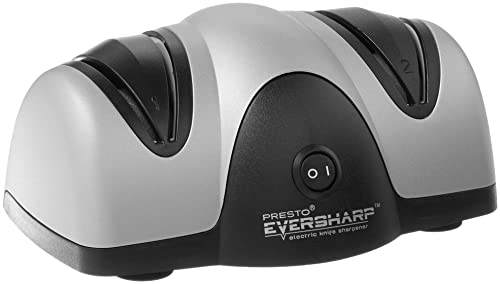
Two simple stages, blade guides and a small price. It does a fine job on ordinary straight-edge kitchen and sport knives, and that’s all it tries to do.

Small enough to keep in a drawer, with guided slots that need no skill. Work Sharp lists it for chef, santoku, paring, utility and serrated kitchen knives.
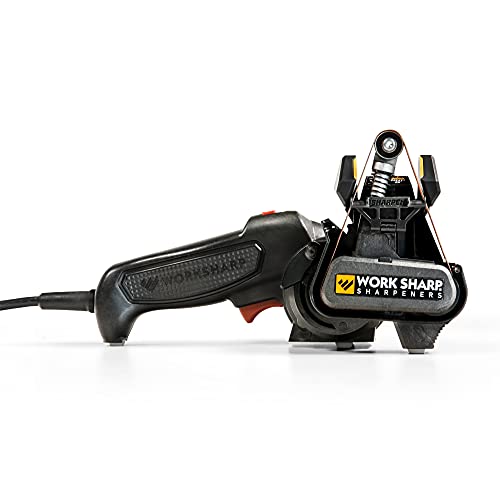
A two-speed belt grinder for the garage as much as the kitchen: pocket knives, axes, lawn mower blades and garden tools. More machine than most cooks need, and a bargain if you need it.
Electric Knife Sharpeners Compared
| Sharpener | Abrasive | Angle | Serrated | Best for |
|---|---|---|---|---|
| Chef’sChoice 15XV | Diamond wheels plus stropping stage | 15 degrees (converts 20) | Yes, stropping stage | Western kitchen knives |
| Chef’sChoice AngleSelect | Diamond plus stropping disks | 15 or 20 degrees | Yes | German and Japanese knives together |
| Work Sharp Ken Onion Mk2 | Flexible belts | Adjustable, 15 to 30 degrees | Yes | Kitchen, outdoor knives, tools |
| Presto 08800 EverSharp | Sapphirite wheels | Fixed guides | No | Budget, plain-edge knives |
| Work Sharp E2 | Guided slots | Fixed guides | Yes, per Work Sharp | Small kitchens |
| Work Sharp MK2 | Flexible belts, two speeds | Edge guide | Yes | Garage, garden tools, pocket knives |
1. Chef’sChoice 15XV EdgeSelect Electric Knife Sharpener: Best Overall
Who it’s for: home cooks with German, American or other Western knives who want a quick, repeatable edge.
Ask a room of cooks to name an electric knife sharpener and most will say Chef’sChoice, and among its machines the 15XV is the one I’d buy. Stages one and two are diamond, for sharpening and then refining; stage three is a flexible stropping stage that polishes the edge. Patented spring guides press the blade against the abrasive at the set angle, so your only job is a slow, even pull from heel to tip.
It grinds a 15 degree edge, and the first time you use it on a knife that left the factory at 20 degrees, it converts the bevel. That first session takes the longest and removes the most steel; afterwards a German chef’s knife feels keener on tomato skins and onion layers than it ever did new.
How you use it decides how long your knives last. The coarse first stage is only for knives that are properly dull, a few times a year. For weekly upkeep, a few pulls through stage three is enough. Chef’sChoice lists it for serrated knives too, in the stropping stage. I’d keep hard Japanese and single-bevel knives away from it.
Key specs
- Type: electric, three stages (two diamond, one stropping)
- Edge: 15 degree Trizor XV; converts 20 degree factory edges
- Flexible spring guides for angle control
- Straight-edge and serrated knives
Pros
- Fast, consistent edge with no skill
- Stropping stage for gentle weekly touch-ups
- Makes Western knives cut better than new
Cons
- Coarse stage eats steel if overused
- Not for hard Japanese or single-bevel knives
- Big and pricey for an appliance
My verdict: the electric to buy if your block is mostly Western steel. Japanese knife owners should look at the AngleSelect next.
2. Chef’sChoice AngleSelect 15 and 20 Degree Electric Sharpener: Best for Mixed Collections
Who it’s for: kitchens with a German chef’s knife next to a Japanese santoku or gyuto.
Most electric sharpeners pick one angle and force every knife into it. The AngleSelect doesn’t. It has a 20 degree slot for European and American knives and a 15 degree slot for Asian-style blades, so each knife keeps the geometry it was designed around. That matters more than it sounds: a soft German blade ground to 15 degrees can roll, and a Japanese knife pushed to 20 loses the thin edge you paid for.
Chef’sChoice says the machine handles straight and serrated knives, and lists double- and single-bevel blades. Sharpening and honing use diamond abrasives, and flexible stropping disks polish the finished edge. It also carries a 3-year limited warranty.
It’s a large machine that needs a permanent spot on the counter or a deep cupboard. And while it treats Japanese knives better than single-angle electrics, my rule still applies: the harder and more expensive a Japanese knife is, the more it belongs on a whetstone. For Shun owners, my guide on how to sharpen Shun knives covers the gentler routes.
Key specs
- Type: electric, 15 and 20 degree slots
- Abrasive: 100 percent diamond, plus flexible stropping/polishing disks
- Straight, serrated, single- and double-bevel knives per Chef’sChoice
- Size: 12 x 6.2 x 6.4 inches; 3-year limited warranty
Pros
- Right angle for both German and Japanese knives
- Stropping disks give a clean finish
- Covers serrated knives
Cons
- Bulky
- Still aggressive for premium Japanese steel
My verdict: the one electric I’d trust with a mixed block. If every knife you own is German, the 15XV is simpler.
3. Work Sharp Ken Onion Mk2 Electric Knife Sharpener: Best Adjustable Angle
Who it’s for: people who sharpen kitchen knives, hunting and pocket knives, scissors and tools, and want control over the angle.
The Ken Onion Mk2 works differently from the Chef’sChoice machines. Instead of fixed slots with wheels inside, it runs a flexible abrasive belt past a guide you set anywhere from 15 to 30 degrees. That means a thin kitchen knife at 15, a pocket knife at 20 and a thick hunting blade at 25 can each get their own edge, and the flexible belt follows curved blades and recurves that a wheel can’t reach.
A speed control lets you slow the belt for finishing and speed it up for repairing a chipped or badly worn edge, and belts swap in seconds, from coarse to fine. Work Sharp also lists scissors, serrated blades, shears and garden tools.
The flexibility is also the catch. A belt removes steel fast, and it’s easy to round the tip if you drag it off the end of the belt. Expect a few careful sessions before it feels natural, and budget for replacement belts. I cover the rest of the range, manual and electric, in my Work Sharp sharpener review.
Key specs
- Type: electric belt sharpener with adjustable guide
- Angle: 15 to 30 degrees
- Variable belt speed; quick-change belts
- Knives, serrated blades, scissors, shears, tools
Pros
- Any angle from 15 to 30 degrees
- Handles curved and serrated blades
- One machine for kitchen, outdoor and tools
Cons
- Learning curve; easy to round the tip
- Belts are an ongoing cost
My verdict: the most capable electric here for mixed knife owners. Cooks who only want a quick kitchen edge should stick with Chef’sChoice.
4. Presto 08800 EverSharp Electric Knife Sharpener: Best Budget
Who it’s for: anyone with an ordinary block of plain-edge kitchen knives who wants them sharp for very little money.
The Presto is the simplest machine on my list. Stage one grinds the edge with Sapphirite wheels, stage two hones and polishes it, and blade guides hold the knife at a fixed angle in each slot. You draw the knife through a few times per side and you’re done. Presto says it works on kitchen and sport knives.
It does what it promises on the soft stainless knives that come in most supermarket and department-store sets, and those are the knives that most need frequent sharpening. For a family kitchen where knives get used hard and nobody wants to learn a stone, I think it’s money well spent.
Know its limits before you buy. Presto lists it for non-serrated blades only, so bread and steak knives need something else. There’s no angle choice, which makes it a poor match for thin Japanese knives. And like every electric, the first slot should be used only when the knife is properly dull.
Key specs
- Type: electric, two stages (grind, then hone/polish)
- Abrasive: Sapphirite wheels
- Precision blade guides
- Non-serrated kitchen and sport knives
Pros
- Costs little
- Dead simple to use
- Good match for soft, inexpensive kitchen knives
Cons
- No serrated knives
- One fixed angle
My verdict: the budget electric that makes sense. Anyone with good knives should spend more.
5. Work Sharp E2 Electric Kitchen Knife Sharpener: Best Compact
Who it’s for: small kitchens and apartments where a big sharpener would never leave the cupboard.
A sharpener that’s a hassle to get out doesn’t get used. The E2 is small enough to live in a drawer next to the knives, and that alone makes it more useful than a bigger machine buried behind the stand mixer. You pull the blade through guided slots; there’s no angle to set and nothing to learn.
Work Sharp lists it for chef’s, santoku, paring, utility and serrated kitchen knives, which covers a normal block. It comes from the same Oregon company that makes the Ken Onion and the Precision Adjust, so it’s a well-supported brand rather than a no-name gadget.
Work Sharp doesn’t publish the angle or the abrasive on this listing, so I can’t tell you how it treats hard Japanese steel; I’d keep those knives for a stone or a guided system. It’s a kitchen-only tool, too: pocket and hunting knives belong on the belt machines.
Key specs
- Type: electric, guided slots, no angle to set
- Chef’s, santoku, paring, utility and serrated knives per Work Sharp
- Compact, fits in a drawer
Pros
- Small footprint
- No skill needed
- Covers serrated kitchen knives
Cons
- Angle and abrasive not published
- Kitchen knives only
My verdict: a sensible small-kitchen sharpener for Western knives. If counter space isn’t a problem, the 15XV does more.
6. Work Sharp MK2 Electric Knife and Tool Sharpener: Best for Knives and Tools
Who it’s for: homeowners, hunters and gardeners who sharpen knives and tools in the garage.
The MK2 is a belt sharpener built for variety. Work Sharp lists pocket and kitchen knives, serrated blades and scissors, plus axes, lawn mower blades and garden tools. The flexible belt conforms to the edge, the edge guide supports the knife all the way to the tip, and a two-speed motor gives you a slower setting for knives and more power for heavy grinding.
I see it as the workshop sibling of the Ken Onion: simpler, cheaper, and happier with a rusty hatchet than a fine kitchen knife. Work Sharp designs and calibrates its machines in Ashland, Oregon and backs them with a 3-year warranty.
For a kitchen it’s overkill, and like any belt it can remove a lot of steel quickly. Go gently with thin kitchen knives, and keep expensive Japanese blades off it entirely.
Key specs
- Type: electric belt sharpener, two speeds
- Flexible belts; edge guide supports the blade to the tip
- Knives, serrated blades, scissors, axes, mower blades, garden tools
- 3-year Work Sharp warranty
Pros
- Sharpens almost any edged tool
- Costs much less than the Ken Onion
- Good warranty
Cons
- Overkill for kitchen-only use
- Aggressive on thin blades
My verdict: the one to buy if the garage has as many dull edges as the kitchen. Kitchen-only households should look at the Chef’sChoice pair.
Choosing an Electric Sharpener Without Ruining Your Knives
Match the angle to your knives
Buy a sharpener that grinds the angle your knives were made with: about 20 degrees per side for most German and American knives, about 15 for Japanese ones. A single-angle machine slowly reshapes every knife to its own angle, so a mixed collection needs a two-angle model like the AngleSelect or an adjustable belt.
Wheels or belts
Wheel-slot machines (Chef’sChoice, Presto, Work Sharp E2) are easiest for kitchen knives because the slot controls everything. Belt machines (Ken Onion, MK2) handle any blade shape and tools too, but you control the pressure and the pull, so they take some practice.
Serrated knives need a plan
Check whether the sharpener handles serrated edges before you count on it for bread and steak knives. Some do it in a polishing stage only, and some (like the Presto) don’t do it at all; a tapered ceramic rod is the fallback.
Keep Japanese and single-bevel knives off fixed slots
Hard, thin Japanese blades and single-bevel knives are safest on a whetstone or a guided system. Electrics remove steel quickly, and harder steel is more likely to chip at the edge under that kind of pressure.
Use the coarse stage rarely
The coarse stage is for genuinely dull knives a few times a year. Between sharpenings, use the fine or stropping stage, or a ceramic honing rod. That one habit decides whether an electric sharpener is kind to your knives or wears them out early.
How to Use an Electric Knife Sharpener
- Clean and dry the knife. Grease and food bits clog abrasives.
- Start with the coarse slot only if the knife is truly dull, for example if it slides off a tomato skin. Otherwise skip to the fine slot.
- Pull slowly and evenly from heel to tip, a few seconds per pass, letting the guide hold the angle. Don’t press down.
- Alternate sides with the same number of pulls, usually a few per side per stage.
- Lift the tip slightly near the end so the curve of the blade stays in contact, without dragging the point off the abrasive.
- Finish in the fine or stropping stage, then wipe the blade to remove metal dust before using it on food.
FAQ
Are electric knife sharpeners bad for knives?
No, but they’re easy to overuse. A good electric with proper angle guides gives a fine edge; the damage comes from running knives through the coarse stage too often, which removes steel faster than necessary. Use the coarse stage only when a knife is dull.
Can you sharpen Japanese knives with an electric sharpener?
You can with a 15 degree slot or an adjustable belt, but I don’t recommend it for hard, expensive Japanese knives. A whetstone or guided system removes less steel and lowers the risk of chipping. Single-bevel knives should never go in a double-sided slot.
Can electric sharpeners sharpen serrated knives?
Some can. The Chef’sChoice models and Work Sharp’s belt machines list serrated knives; the Presto 08800 doesn’t. Electric sharpening of serrations is a quick touch-up rather than a true resharpening of each scallop.
Is an electric or manual sharpener better?
Electric sharpeners are faster and need no skill; manual sharpeners remove less steel and give more control. For a kitchen of Western knives and a cook who won’t practice, electric wins. For Japanese knives or enthusiasts, a whetstone or guided manual system is better.
How often should you use an electric knife sharpener?
Use the full sequence a few times a year, when a knife fails a tomato or paper test. Use the fine or stropping stage between those sharpenings when the edge feels slightly less keen. My guide on telling whether a knife is sharp enough explains the simple tests.
Can you sharpen ceramic knives in an electric sharpener?
Only in one designed for ceramic, with diamond abrasives. Ordinary electric sharpeners can chip ceramic blades. My guide on how to sharpen a ceramic knife covers the right tools.
Final Verdict
The Chef’sChoice 15XV EdgeSelect is the electric sharpener I’d recommend to most kitchens: diamond stages, reliable guides and a stropping stage for gentle upkeep. Owners of both German and Japanese knives should choose the Chef’sChoice AngleSelect, and anyone sharpening outdoor knives and tools as well should look at the Work Sharp Ken Onion Mk2.
Not sure a machine is right for you? My guide on how to sharpen Cuisinart knives compares pull-through, electric and whetstone methods for everyday kitchen knives. And if you’d rather the knife block did the upkeep, I weigh that up in are self-sharpening knife blocks worth it.

Gary Portman founded knivesadvice.com in 2019. He learned to cook in his family’s kitchen as a kid and has used kitchen, pocket and outdoor knives ever since, from paring and fillet knives to survival blades he carries camping and hiking. He writes the site’s buying guides, brand reviews and sharpening how-tos to help readers find the right knife for the job. More about Gary.