
The best pocket knife sharpener is the one that’s with you when the edge goes, and for most people that means something that lives in a pack, a glovebox or a tackle box rather than on a bench. My pick is the Work Sharp Guided Field Sharpener: diamond plates, ceramic rods, a strop and angle guides in one handheld tool. If you want something that truly fits a pocket, the Lansky BladeMedic is the one I’d carry.
My Top 6 Pocket Knife Sharpener Picks

It’s a full sharpening kit that weighs a few ounces: coarse and fine diamond, ceramic for honing and serrations, leather to finish, and guides that keep your angle honest. Nothing else this size takes a properly dull hunting knife back to sharp.

Four sharpeners in a metal body the size of a fat key fob. Two pull-through slots for quick fixes, a tapered ceramic rod for serrations and a diamond rod for gut hooks. The one to forget in a jacket until you need it.

A folding diamond stone that weighs 2.4 ounces and needs no water or oil. For people who already sharpen freehand, it puts a real stone in a pocket, made in the USA.

A tapered diamond cone that fits serrations from tiny to large, plus gut hooks. If your rescue knife, fishing knife or EDC folder has teeth, this is the tool that keeps them biting.
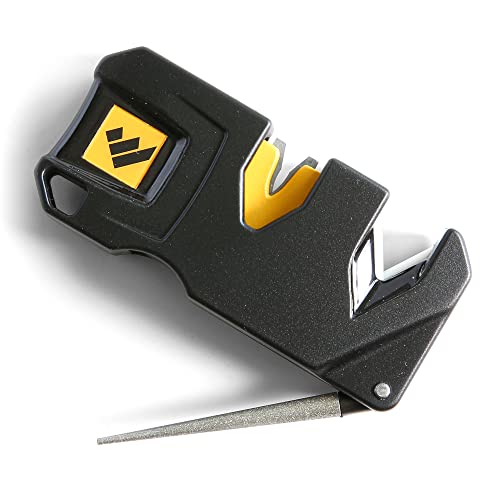
A tiny carbide, ceramic and diamond sharpener on a pivoting head that follows the curve of the blade. Easy enough for someone who has never sharpened anything.
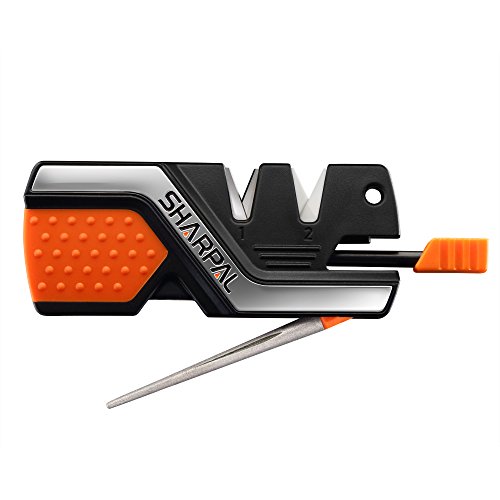
Carbide, ceramic and two diamond rods, plus a ferro rod and a whistle. It earns a spot in a bug-out bag or a kid’s first camping kit because it does more than sharpen.
Pocket Knife Sharpeners Compared
| Sharpener | Abrasives | Angle control | Serrations | Best for |
|---|---|---|---|---|
| Work Sharp Guided Field | Diamond 220/600, ceramic, leather strop | 20° and 25° guides | Ceramic rod | Hunting packs, trucks, tackle boxes |
| Lansky BladeMedic | Carbide, ceramic, ceramic rod, diamond rod | Fixed slots | Tapered ceramic rod | Jacket pocket, quick fixes |
| DMT DiaFold Extra Fine/Fine | Diamond, two grits | Freehand | No | Freehand sharpeners |
| DMT DiaFold Serrated | Diamond cone, 600 mesh | Freehand | Yes, all sizes | Serrated knives, gut hooks |
| Work Sharp EDC Pivot Plus | Carbide, ceramic, diamond rod | Fixed 25°, pivoting head | Diamond taper rod | Beginners, everyday carry |
| SHARPAL 101N | Carbide, ceramic, two diamond rods | Fixed slots | Tapered diamond rod | Survival and camping kits |
1. Work Sharp Guided Field Sharpener: Best Overall
Who it’s for: hunters, anglers and campers who want one sharpener that can fix a truly dull blade, not just touch up a good one.
Most pocket sharpeners are good at one stage of sharpening. This one covers all of them. A coarse 220 grit diamond plate sets a new edge, a fine 600 grit plate refines it, ceramic rods hone the edge and work into serrations, and a leather strop polishes off the burr at the end. That’s the same sequence you’d follow at a bench, folded into one handheld tool.
The part I value most is the angle guides. You rest the blade against a 20° or 25° guide before each set of strokes, which teaches your hand where to hold the knife. Freehand field sharpening usually fails because the angle wobbles, and the guides solve that without a clamp. Small extras matter outdoors too: a groove in the ceramic rod for fish hooks, a broadhead wrench and a lanyard hole.
It weighs 4.6 ounces, which is fine for a pack and heavy for a pocket. And the guides only offer two angles, both on the thick side for a thin Japanese kitchen knife. It’s an outdoor tool, which is exactly why it’s here; I made the same point when I picked it for pocket and hunting knives in my knife sharpener guide.
Key specs
- Abrasives: coarse 220 and fine 600 grit diamond plates, ceramic rods, leather strop
- Angle guides: 20° and 25°
- Weight: 4.6 oz
- Fish hook groove, broadhead wrench, lanyard hole
- 3-year warranty
Pros
- Repairs dull edges, not just touch-ups
- Angle guides make field sharpening consistent
- Strop finishes the edge cleanly
Cons
- Pack-sized rather than pocket-sized
- Only two guide angles
My verdict: the field sharpener I’d keep in the truck or the hunting pack. If it has to ride in your pocket every day, the Lansky BladeMedic is the better size.
2. Lansky BladeMedic: Best Pocket All-in-One
Who it’s for: anyone who wants a sharpener that disappears in a pocket and handles both plain and serrated edges.
The BladeMedic packs four sharpeners into a metal body: a tungsten carbide pull-through slot, a ceramic pull-through slot, a tapered ceramic rod for serrations and a diamond rod for gut hooks and stubborn spots. The diamond rod folds away and is held closed by a magnet, so it doesn’t snag on your keys or pocket lining.
The trick is using the slots in the right order. Carbide removes steel fast, so it’s only for a blade that is really dull: three or four light pulls toward you, then finish in the ceramic slot. For a knife that’s only lost its bite, the ceramic slot alone is enough. I’ve covered every part of it in my Lansky BladeMedic how-to, including how to work serrations one by one on the rod.
The fixed slots mean you sharpen at Lansky’s angle, not yours, and heavy carbide use will chew through a thin blade over time. It’s a maintenance tool for working knives, not a way to build a refined edge.
Key specs
- Tungsten carbide pull-through slot
- Ceramic pull-through slot
- Tapered ceramic rod for serrations
- Diamond rod, held closed by a magnet
- Metal body
Pros
- Truly pocket-sized
- Handles plain edges, serrations and gut hooks
- Fast, almost no learning curve
Cons
- Carbide slot is aggressive if overused
- No angle choice in the slots
My verdict: the best sharpener to carry every day without noticing it. Keep the carbide slot for emergencies and it will treat your knives well.
3. DMT DiaFold Extra Fine/Fine: Best Freehand Diamond Stone
Who it’s for: people who already sharpen on a stone at home and want the same control on the trail.
Pull-through sharpeners decide the angle for you. A stone lets you keep the angle your knife came with, and the DiaFold is the most packable stone I know of. The two diamond plates sit in handles that fold over to protect them, it weighs 2.4 ounces, and diamond cuts dry or with a splash of water, so there’s no oil to carry or spill in your bag.
Diamond also cuts every steel, including the hard, wear-resistant ones in many modern folders, which can feel slow on ceramic. DMT makes its stones in the USA and has been bonding diamonds to steel plates for over 50 years. The polka-dot surface isn’t decoration: the holes catch the steel swarf so the plate keeps cutting.
This version pairs fine and extra-fine sides, which is ideal for keeping a decent edge sharp and slow for repairing a dull or chipped one. If your knives get neglected, DMT sells coarser DiaFolds; for most pocket knife owners who touch up often, fine and extra fine is the right pair. And freehand means you need a steady hand.
Key specs
- Abrasive: monocrystalline diamond, fine and extra-fine sides
- Folding handles protect the plates
- Weight: 2.4 oz
- Use dry or with water, no oil
- Made in USA
Pros
- You keep your knife’s own angle
- Cuts hard modern steels well
- Very light and mess-free
Cons
- No coarse side for repairs
- Needs freehand skill
My verdict: the pick for people who sharpen, not just people who own a sharpener. Beginners will get better results from the Work Sharp guides.
4. DMT DiaFold Serrated Sharpener (Fine): Best for Serrated Blades
Who it’s for: owners of partly or fully serrated knives, gut hooks and hawkbills.
Serrations are where most pocket sharpeners give up. Flat plates skip right over the scallops, and pull-through slots round the points off. What works is a tapered rod you can match to each scallop, and this DMT is a good one: a 4 inch diamond cone that runs from 1/4 inch down to 1/16 inch, so the same tool fits tiny teeth near the tip and big ones near the handle.
The fine 600 mesh diamond (25 micron) cuts steadily without being harsh. The handles fold over the cone like the flat DiaFold, it’s 5 inches closed, and it’s made in the USA. It also doubles as a gut hook sharpener and a small conical file. If you carry a hawkbill, my hawkbill sharpening guide shows how a tapered rod handles that inside curve.
It does one job. Plain edges are possible on a cone but slow, so you’ll still want a flat sharpener. And serrations are always patient work: one scallop at a time, bevel side only.
Key specs
- Abrasive: fine diamond, 600 mesh (25 micron)
- 4 inch cone, 1/4 to 1/16 inch diameter
- 9.5 inches open, 5 inches closed
- Also sharpens gut hooks
- Made in USA
Pros
- Fits serrations of every size
- Diamond works on hard steels
- Folds closed to protect the cone
Cons
- Slow on plain edges
- Serrations still take time
My verdict: the add-on every serrated knife owner should have. Pair it with the DiaFold stone and you have a complete freehand kit.
5. Work Sharp EDC Pivot Plus: Best for EDC Carry
Who it’s for: first-time sharpeners and people who want the smallest sharpener that still handles serrations.
The Pivot Plus is built around a simple idea: the carbide and ceramic heads pivot as you pull, so they follow the curve of the blade from heel to tip and keep the same 25° angle the whole way. That’s the part beginners struggle with on a pull-through, where the belly of a drop point usually gets less attention than the flat.
The carbide creates a slightly convex edge, which is durable and suits pocket and camp knives that cut cardboard, rope and wood. The ceramic hones it afterwards, and a medium diamond taper rod handles serrations. It’s small enough to ride in a pocket or hang in a pack, and it costs very little.
The trade-offs are the fixed 25°, which is fine for outdoor knives and too blunt for thin kitchen blades, and carbide’s appetite for steel. Use the ceramic for routine touch-ups.
Key specs
- Pivoting convex carbide sharpener, 25°
- Pivoting ceramic hone
- Medium diamond taper rod for serrations
- Compact carry size
Pros
- Pivot follows the curve of the blade
- Very easy for beginners
- Includes a serration rod
Cons
- One fixed angle
- Carbide removes steel fast
My verdict: the easiest sharpener here to use well on day one. Anyone who wants to refine an edge will outgrow it.
6. SHARPAL 101N 6-in-1: Best for Survival Kits
Who it’s for: preppers, scouts and campers building a compact emergency kit.
The 101N is a sharpener first: a coarse carbide V-notch to set an edge, a fine ceramic notch to hone it, a tapered 400 grit diamond rod for serrations and gut hooks, and a second diamond rod. Then SHARPAL added a ferro rod fire starter and an emergency whistle to the same body, with a lanyard hole to tie it all to a pack strap.
I’d normally be wary of gadgets that try to do everything, but a survival kit is exactly where combining tools makes sense. You save space and weight, and the sharpening parts are the same carbide and ceramic you’d find in a dedicated pocket sharpener. SHARPAL is a sharpening brand, not a novelty maker, which is why it’s here rather than a no-name multi-tool.
Like every carbide notch, the coarse slot takes metal off quickly, so treat it as the repair stage only. The preset angles aren’t adjustable, and the fire starter is a backup, not a replacement for a proper ferro rod.
Key specs
- Coarse carbide V-notch and fine ceramic V-notch
- Tapered diamond rod, medium 400 grit, for serrations and gut hooks
- Second diamond rod
- Ferro rod fire starter, emergency whistle, lanyard hole
Pros
- Sharpener plus fire and signal tools
- Handles serrations and gut hooks
- Costs very little
Cons
- Fixed angles
- Small fire rod is a backup only
My verdict: a smart addition to a survival kit or a kid’s camping bag. For a dedicated hunting sharpener, take the Work Sharp.
What Makes a Good Field Sharpener
The abrasive decides what it can fix
Diamond removes steel fastest and works on every steel, so it’s the abrasive for repairing a dull edge. Carbide pull-throughs are faster still but rougher; use them only when the knife won’t cut. Ceramic is the finisher: it hones and touches up without taking much metal. The best kits combine a cutting abrasive with a ceramic one.
Angle control matters more than grit
A wobbling angle is the reason field sharpening goes wrong. Guides, like those on the Work Sharp, or fixed slots hold the angle for you; a stone like the DiaFold leaves it to your hand. If you don’t sharpen often, choose something that controls the angle.
Serrations need a tapered rod
If any knife you carry has teeth, make sure the sharpener has a tapered rod. Flat plates and V-slots can’t reach inside the scallops properly.
Size follows where it lives
A pocket tool like the BladeMedic or Pivot Plus gets carried and used. A larger kit like the Guided Field belongs in a pack, truck or tackle box. Buy for where it will actually be.
Match it to your knives
Pocket, hunting and fishing knives are usually sharpened at about 20° to 25° per side, which is what these tools are built for. Thin kitchen knives at 15° are better served by a sharpener at home.
How to Sharpen a Pocket Knife in the Field
- Check the edge first. If it still catches on a fingernail but feels dull, you only need ceramic. If it slides or reflects light along the edge, start on diamond or carbide.
- Brace the sharpener. Rest it on a log, a tailgate or your knee, never in the hand behind the blade’s path.
- Hold one angle. Use the guide or slot, and keep the same tilt from heel to tip.
- Raise a burr, then refine. Work one side until you feel a slight lip on the other, switch sides, then move to the finer abrasive.
- Finish lightly. A few very light ceramic or strop strokes per side remove the burr.
My pocket knife sharpening guide goes deeper on each step, and stropping gets its own article in my guide to stropping a knife.
FAQ
How do you sharpen a pocket knife without a bench?
Use a tool that holds a steady angle: a guided field sharpener or a stone used carefully. Start coarse only if the edge is really dull, finish on ceramic or a strop, and sharpen a little and often rather than a lot once a year.
Are pull-through sharpeners bad for pocket knives?
No, as long as you use the carbide slot only when the knife is very dull. Carbide removes steel quickly; daily use of it wears blades down. The ceramic slot is gentle enough for regular touch-ups.
Can you sharpen a serrated pocket knife?
Yes, with a tapered rod. Work each scallop on the beveled side only, matching the angle of the existing bevel, then take one light pass on the flat side to remove the burr. Never run serrations through a carbide slot.
What angle should a pocket knife be sharpened at?
Most pocket knives are sharpened at about 20° per side; hard-use outdoor knives often go to 25° for a tougher edge. If you don’t know your knife’s angle, match the existing bevel by coloring it with a marker and checking where the abrasive removes the ink.
How often should you sharpen a pocket knife?
Touch it up on ceramic or a strop whenever it starts to drag, which for daily carry might be every week or two. A full sharpening with diamond or carbide is only needed when touch-ups stop working.
Final Verdict
For a sharpener that can rescue a properly dull knife far from home, the Work Sharp Guided Field Sharpener is my first choice. The Lansky BladeMedic is the one to carry in a pocket every day, and the DMT DiaFold is the stone for anyone who already sharpens freehand.
Sharpening kitchen knives as well? My Smith’s knife sharpener guide covers another set of handy pull-throughs and stones.

Gary Portman founded knivesadvice.com in 2019. He learned to cook in his family’s kitchen as a kid and has used kitchen, pocket and outdoor knives ever since, from paring and fillet knives to survival blades he carries camping and hiking. He writes the site’s buying guides, brand reviews and sharpening how-tos to help readers find the right knife for the job. More about Gary.