
A tomato is the cruelest test in the kitchen. The skin is tough and slippery, the inside is mostly juice, and a blade that’s even slightly dull rolls over the top and presses the fruit flat before it cuts. That’s why a lot of cooks blame their tomatoes when the real problem is the edge.
A tomato knife fixes it with small, sharp serrations. The teeth bite into the skin on the first stroke, so you saw lightly instead of pushing, and the soft middle never gets crushed. Because the teeth do the work, a serrated tomato knife goes on biting well past the point where a plain edge starts to skate. Most are short, 4 to 6 inches, and the best ones double as a sandwich, bagel, citrus and steak knife, which is why I think every kitchen should have one even if it already owns a good chef’s knife.
My favorite is the Victorinox Swiss Classic Tomato and Table Knife: it costs very little, grips well and slices cleanly. If you like the forked tip that lifts slices onto a plate, get the WÜSTHOF Gourmet 5-Inch Tomato Knife.
My Top 6 Tomato Knife Picks

Fine serrations, a non-slip handle and Swiss build for very little money. It’s the knife I’d keep next to the cutting board for tomatoes, lemons and sandwiches, and the one I’d buy two of.

The classic German tomato knife: fine teeth to cut, and a forked tip to pick up the slices and lay them on a plate. A neat little tool for anyone who serves a lot of salads and platters.
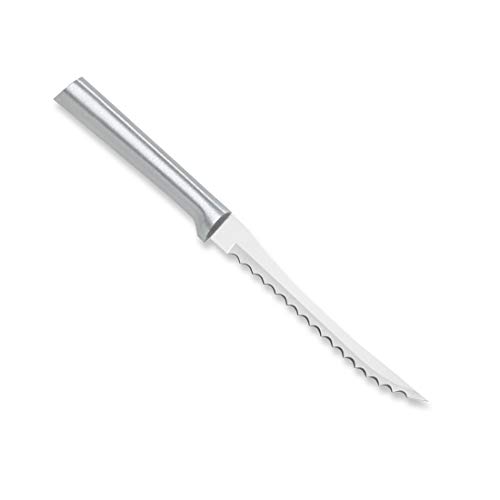
A dual-serrated blade made in Iowa from raw material to finished knife. Cheap, thin and very effective on ripe summer tomatoes.

A VG10 serrated edge from Japan that handles tomatoes, crusty rolls and peppers equally well. For cooks who want one small serrated knife that feels as good as their chef’s knife.

A grippy serrated knife with a locking sheath, so it can go in a picnic basket, lunch bag or camper drawer without dulling the teeth or cutting anyone.

Ceramic teeth that stay sharp for a very long time and never react with acidic juice. For careful cooks who mostly slice tomatoes, citrus and fruit.
Tomato Knives Compared
| Knife | Blade | Edge | Handle | Best for |
|---|---|---|---|---|
| Victorinox Swiss Classic Tomato and Table Knife | 4.3″, stainless | Serrated | Textured, non-slip | Everyday tomatoes, table use |
| WÜSTHOF Gourmet 5″ Tomato Knife | 5″, stamped stainless | Serrated, forked tip | Synthetic | Serving slices, salads |
| Rada Tomato Slicer R126 | 5″, T420 stainless | Dual-serrated | Cast aluminum | Thin slices, US-made |
| Shun Sora 5.5″ Serrated Utility | 5.5″, VG10 edge | Wavy serrated, 16° | PP/TPE, full tang | Tomatoes plus crusty bread |
| OXO Good Grips 5″ Serrated Utility | 5″, stainless | Serrated | Non-slip, locking sheath | Picnics, lunch bags, campers |
| Kyocera Revolution 5″ Micro-Serrated | 5″, zirconia ceramic | Micro-serrated | Resin | Long edge life, acidic fruit |
1. Victorinox Swiss Classic Tomato and Table Knife (4.3 Inch): Best Overall
Who it’s for: every home cook. It’s the tomato knife I’d buy before any other.
This is a small, plain knife that happens to be extremely good at its job. The fine serrations catch tomato skin straight away, the blade is thin enough to make slices you can almost see through, and the textured handle holds when your fingers are wet with juice. Victorinox grinds the blade conically and ice-tempers it, and the Swiss Classic line is made in Switzerland.
Victorinox calls it a “tomato and table knife”, and that second half is worth noting. It’s short and light enough to put on the table as a steak or sandwich knife, so it ends up being used far more often than a single-purpose slicer. It costs so little that buying two, one for the board and one for the table, makes sense.
My reservation is size. A 4.3-inch blade struggles with big beefsteak tomatoes, large melons or a wide loaf, so for those you’d want something longer. And like any serrated knife, it can’t be sharpened on a pull-through or regular stone; a thin tapered rod or a sharpening service does it, or you simply replace it after a few years.
Key specs
- Blade: 4.3 inches, high-carbon stainless steel, conical ground, ice tempered
- Edge: serrated
- Handle: textured, non-slip (this listing is blue)
- Lifetime guarantee against defects (Victorinox)
Pros
- Cuts tomatoes cleanly with almost no pressure
- Grippy handle stays secure when wet
- Works as a table and sandwich knife too
Cons
- Short for big tomatoes and melons
- Serrations need a tapered rod to sharpen
My verdict: the best small serrated knife for most kitchens. Only skip it if you regularly slice very large fruit.
2. WÜSTHOF Gourmet 5-Inch Tomato Knife: Best Forked Tip
Who it’s for: cooks who serve a lot of salads, sandwiches and platters, and anyone who already likes WÜSTHOF knives.
This is the shape most people picture when they hear “tomato knife”: a narrow 5-inch blade with fine serrations and two little prongs at the tip. The serrations cut through skins and rinds, and the forked tip spears a slice so you can move it to a plate or burger without touching it. It sounds like a gimmick until you’ve laid out a caprese salad with it.
The Gourmet line is WÜSTHOF’s stamped range, laser-cut rather than forged, with synthetic handles that resist heat and fading. It’s lighter and much cheaper than the forged Classic version of the same knife, and for a small serrated blade I don’t think forging adds anything you’d notice. My WÜSTHOF knives review explains how Gourmet compares with the other lines.
The cons are small. The fork makes the tip less useful for detail work like coring, and WÜSTHOF says hand wash only. It also costs more than the Victorinox for the same basic cutting job; you’re paying for the fork and the German brand.
Key specs
- Blade: 5 inches, laser-cut stamped high-carbon stainless steel
- Edge: serrated, forked tip (WÜSTHOF)
- Handle: synthetic polypropylene
- Care: hand wash only (WÜSTHOF)
Pros
- Forked tip picks up and serves slices
- Fine serrations cut skins and rinds cleanly
- Light, well-finished stamped blade
Cons
- Fork gets in the way of detail work
- Costs more than the Victorinox for the same cut
My verdict: worth it if you’ll use the fork. If you won’t, the Victorinox cuts just as well.
3. Rada Tomato Slicer R126: Best Made in USA
Who it’s for: gardeners with a glut of summer tomatoes, and anyone who wants a US-made knife for very little money.
Rada makes its knives in Iowa, and the listing says this one is made in the USA from raw materials through to the finished knife. The blade is hollow ground T420 high-carbon stainless steel with what Rada calls a dual-serrated edge: small teeth set inside larger ones. In practice that gives a very quick bite on tomato skin and lets you cut slices thick or thin without the fruit sliding around.
It’s a thin, light, sharp little knife, and like most Rada knives it’s best at exactly this kind of small job. The 5-inch blade also handles peppers, citrus, salami and soft bread rolls.
The handle is the catch. It’s cast aluminum with a satin finish, and Rada says hand wash only: the dishwasher dulls the finish and can leave grey marks on your hands. Aluminum is also slicker than a textured synthetic handle when wet. Rada sells a black resin version (W226) if you’d prefer a dishwasher-safe handle. I wouldn’t bother sharpening the serrations; at this price, replace it when it’s tired.
Key specs
- Blade: 5 inches, T420 high-carbon stainless steel, hollow ground
- Edge: dual-serrated
- Handle: cast brushed aluminum, hand wash only
- Made in the USA (per listing)
Pros
- Fast bite on tomato skin
- Made in the USA
- Thin blade gives even, thin slices
Cons
- Aluminum handle is slick when wet
- Hand wash only, or the handle discolors
My verdict: the best cheap US-made tomato knife. Choose the Victorinox if a grippy handle matters more to you.
4. Shun Sora 5.5-Inch Serrated Utility Knife: Best Premium
Who it’s for: cooks who want a premium small serrated knife that handles tomatoes, crusty rolls and bagels equally well.
The Sora is Shun’s more affordable line, made in Japan with a VG10 steel edge joined to a 420J stainless upper blade. On this serrated utility knife, the wavy edge is ground to 16 degrees, and the result is a small knife that cuts tomatoes, peppers and crusty rolls with the same clean bite. It’s the most versatile serrated knife on this list.
The handle is a textured polymer blend over a full tang, symmetrical enough for left- and right-handed cooks. It’s comfortable and grippy, more practical than the wooden handles on Shun’s Classic line. My Shun knives review covers how the Sora compares with Shun’s pricier lines.
My reservations: it costs far more than the Victorinox, and the hard VG10 edge doesn’t like bones, frozen food or being twisted. If you only cut tomatoes, the extra money buys you little. If you want one small serrated knife for tomatoes, sandwiches and rolls that feels like a fine knife, it’s lovely.
Key specs
- Blade: 5.5 inches, VG10 edge with 420J stainless upper
- Edge: wavy serrated, 16 degrees
- Handle: textured PP/TPE polymer, full tang, either hand
- Handcrafted in Japan
Pros
- Handles tomatoes and crusty bread equally well
- Grippy, ambidextrous handle
- Premium Japanese build
Cons
- Costs much more than the Victorinox
- Hard edge dislikes bones and twisting
My verdict: a treat for anyone who wants a small serrated knife they’ll enjoy using every day. Tomato-only cooks should save the money.
5. OXO Good Grips 5-Inch Serrated Utility Knife: Best With a Sheath
Who it’s for: picnics, packed lunches, campers, RVs and anyone who keeps knives loose in a drawer.
Serrated knives lose their bite fastest when they knock about against other tools. The OXO solves that with a locking sheath that clicks over the blade, so you can throw it in a picnic basket or a lunch bag without blunting the teeth or cutting your hand when you reach in. I value that more than any spec.
The knife itself is a compact 5-inch serrated blade with OXO’s familiar soft, non-slip grip. OXO pitches it for tomatoes, cake, bagels and crusty bread, and that’s the right list: it’s an all-round small serrated knife rather than a dedicated tomato slicer.
OXO doesn’t give a steel grade, and the finish is functional rather than refined. It’s hand wash only. For the board at home I’d still pick the Victorinox; for anywhere the knife has to travel, this is the one.
Key specs
- Blade: 5 inches, serrated stainless steel
- Handle: non-slip Good Grips
- Locking sheath included
- Care: hand wash only (OXO)
Pros
- Locking sheath protects teeth and fingers
- Comfortable, grippy handle
- Handles tomatoes, bagels and cake
Cons
- Steel grade not stated
- Less refined slicing than the Victorinox
My verdict: the serrated knife to pack. At home, the Victorinox is the better slicer.
6. Kyocera Revolution 5-Inch Micro-Serrated Knife: Best Ceramic
Who it’s for: careful cooks who slice a lot of tomatoes, citrus and fruit and never want to think about sharpening.
Ceramic makes sense for a tomato knife in a way it doesn’t for a chef’s knife. Tomatoes and citrus are soft and acidic, exactly the food a zirconia blade handles best. The micro-serrations stay sharp for a very long time, and ceramic never rusts, discolors or leaves a metallic taste on cut fruit.
Kyocera makes the blade in Japan from its own zirconia and says it’s for fruit, vegetables and boneless meat, never hard or frozen food. I’d add: no twisting, no prying, wood or plastic boards only, and a slot or cover of its own in storage. Ceramic is very hard but brittle, so it chips or snaps where steel would bend. My ceramic vs steel knife comparison goes through those trade-offs.
The other drawback is sharpening. Fine ceramic teeth are almost impossible to sharpen at home, so when this knife finally dulls, you send it off or replace it.
Key specs
- Blade: 5 inches, Kyocera zirconia ceramic, made in Japan
- Edge: micro-serrated
- Rust-proof and resistant to acids (Kyocera)
- Not for hard or frozen food (Kyocera)
Pros
- Teeth stay sharp a very long time
- Never reacts with acidic juice
- Very light
Cons
- Brittle: chips or snaps if twisted or dropped
- Very hard to sharpen at home
My verdict: lovely for a careful cook who mostly slices fruit. Busy family kitchens should stick with steel.
Choosing a Tomato Knife
Fine serrations over big teeth
Pick small, closely spaced serrations for tomatoes. They catch thin, slippery skin immediately and leave a clean slice. The wide scalloped teeth on a bread knife are great on crust but tear soft tomato flesh, which is why a bread knife is a poor substitute.
Blade length: 4 to 6 inches
Most tomato knives are 4 to 5 inches, and that’s right for everyday tomatoes, lemons and sandwiches. Go to 5.5 or 6 inches if you also want to cut bagels, rolls or big beefsteak tomatoes. Longer than that and you’re into bread knife territory; my bread knife guide covers those.
Forked tip or plain tip
A forked tip is a serving feature, not a cutting one. It’s handy for lifting slices onto plates and burgers. A plain pointed or rounded tip is more versatile for coring and small jobs. Choose the fork only if you’ll use it.
Handle grip
Tomato juice makes handles slippery, so a textured synthetic handle beats smooth metal or polished wood. That’s the main reason I rank the Victorinox above the Rada.
Tomato knife or serrated paring knife
A serrated paring knife is a shorter version of the same idea, around 3 to 4 inches. It’s better for small fruit and garnishes, slightly worse for big tomatoes. My paring knife guide includes a serrated option if you’d rather have one knife for both jobs.
How to Slice a Tomato Cleanly
- Core first: cut out the stem with the tip of the knife.
- Lay it on its side: stem end facing your knife hand side, so slices come out as clean rounds.
- Saw, don’t press: use light, long back-and-forth strokes and let the teeth do the work.
- Hold it with a claw grip: fingertips tucked, knuckles guiding the blade.
- Keep slices even: about 1/4 inch for burgers and sandwiches, thinner for salads.
If your tomato knife squashes the fruit even with light strokes, it’s dull. Slicing a tomato is also one of the best quick sharpness tests for any knife, because a dull edge shows itself on tomato skin straight away.
FAQ
What is a tomato knife?
A tomato knife is a small serrated knife, usually 4 to 5 inches, made to cut through tomato skin without crushing the soft inside. Many have a forked tip for lifting slices. It also works well on citrus, soft fruit, sandwiches and bagels.
Do I really need a tomato knife?
No, a very sharp chef’s knife cuts tomatoes well. But chef’s knives are rarely that sharp for long, while a serrated tomato knife keeps biting even when it’s not freshly sharpened. Good ones cost very little, so it’s an easy, useful addition.
What is the fork on a tomato knife for?
The forked tip lets you spear a slice and move it to a plate, burger or salad without touching it. It’s a serving feature; it doesn’t help the knife cut. Some cooks also use it to lift out the stem.
Can you sharpen a tomato knife?
Yes, but not on a pull-through or flat stone. Steel serrations are sharpened one by one with a thin tapered ceramic or diamond rod, or by a professional service. Ceramic micro-serrations are very hard to sharpen at home, and many people simply replace cheap tomato knives after a few years.
Is a serrated utility knife the same as a tomato knife?
They’re close. A serrated utility knife is usually a little longer, 5 to 6 inches, and is meant for sandwiches, rolls and bagels as well as tomatoes. A tomato knife is shorter and sometimes has a forked tip. Either one does the tomato job well.
Can I use a bread knife on tomatoes?
You can, but it’s not ideal. Bread knife teeth are wide and spaced for crust, so they tend to tear soft tomato flesh and leave ragged slices. A tomato knife’s finer serrations give a cleaner cut.
Final Verdict
The Victorinox Swiss Classic Tomato and Table Knife is the tomato knife I’d put in every kitchen: fine teeth, a grippy handle and a price low enough to buy two. If you serve a lot of salads and burgers, the WÜSTHOF Gourmet’s forked tip is a genuinely useful extra, and the Shun Sora is the premium choice for one small serrated knife that handles tomatoes and crusty rolls alike.
For more small knives worth owning, see my steak knife guide, where serrated table knives come up again.

Gary Portman founded knivesadvice.com in 2019. He learned to cook in his family’s kitchen as a kid and has used kitchen, pocket and outdoor knives ever since, from paring and fillet knives to survival blades he carries camping and hiking. He writes the site’s buying guides, brand reviews and sharpening how-tos to help readers find the right knife for the job. More about Gary.