
Most dull kitchen knives aren’t ruined. They’re just rolled over at the very edge, and the wrong sharpener turns that small problem into a big one: a coarse slot that chews off steel every week, or an electric grinder set to an angle the knife was never made for. So before naming a winner, it helps to know that “knife sharpener” covers six quite different tools.
Guided systems clamp or hold the blade at an angle you choose. Electric sharpeners spin abrasive wheels behind spring guides. Whetstones are flat stones you work by hand. Pull-through sharpeners have fixed V slots. Field sharpeners fold small enough for a pack. And honing rods don’t sharpen much at all; they straighten an edge between sharpenings. Which one suits you depends on two things: what steel your knives are (soft German or hard Japanese) and how much fuss you’ll put up with.
For most homes I’d buy the Work Sharp Precision Adjust. It sets any angle from 15 to 30 degrees, so it handles a Wüsthof, a Shun and a pocket knife equally well, and it can’t overheat or over-grind anything. If you want speed over control, get the Chef’sChoice 15XV; if you want to learn the real craft, the Sharp Pebble 1000/6000 whetstone.
My Top 6 Knife Sharpener Picks
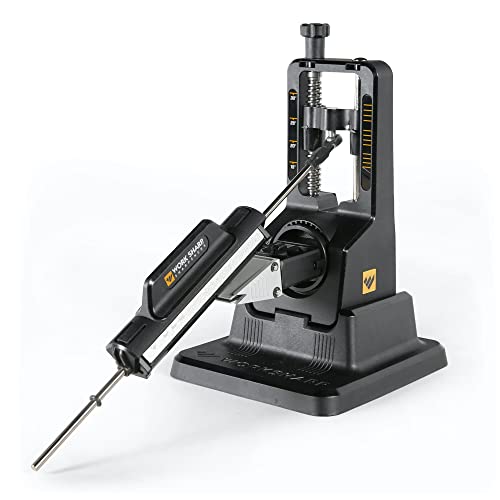
I like this one because it removes the hardest part of sharpening, holding a steady angle, without taking control away from you. You dial in the angle the knife was made with and stroke away. It’s the sharpener I’d hand to someone with a drawer of mixed knives.

For people who will only sharpen if it takes a minute, this is the answer. Its spring guides do the angle work, the diamond wheels are quick, and it converts ordinary 20 degree edges to a keener 15. Just go easy: it removes steel faster than anything else here.

If you own Japanese knives, or you’d simply like to learn sharpening properly, start here. One side repairs, the other polishes, and the angle guide takes the worst of the guesswork out of your first sessions. Water only, no oil.

Sometimes you just need the cheap German knives in a rental or a first apartment to cut tomatoes again. This little sharpener does that, and the ceramic slot means you don’t have to use the aggressive carbide side every time.

This is the one I’d throw in a pack or a tackle box. Diamond plates, ceramic rods, a strop and angle guides all fold into one handheld tool, so a folder or a fixed blade gets a proper edge away from the kitchen.

Every sharpener on this list lasts longer if you own one of these. A few light strokes before you cook bring a slightly dull edge back without grinding anything away, and ceramic is hard enough for Japanese steel too.
Knife Sharpeners Compared
| Sharpener | Type | Angle | Effort | Best for |
|---|---|---|---|---|
| Work Sharp Precision Adjust | Guided, manual | 15 to 30 degrees, adjustable | Medium | Mixed kitchen and pocket knives |
| Chef’sChoice 15XV | Electric, 3 stages | 15 degrees | Low | Fast results on Western knives |
| Sharp Pebble 1000/6000 | Whetstone | Your choice (guide included) | High | Japanese knives, learning the skill |
| KitchenIQ Edge Grip | Pull-through, 2 stages | Preset | Very low | Cheap and soft-steel knives |
| Work Sharp Guided Field | Handheld field kit | 20 or 25 degrees | Medium | Pocket, hunting and camp knives |
| SHARPAL 118H | Ceramic honing rod | 20 degree guides | Low | Keeping any edge sharp longer |
1. Work Sharp Precision Adjust Knife Sharpener: Best Overall
Who it’s for: anyone with a mix of knives (German, Japanese, pocket, fillet) who wants proper edges without learning freehand sharpening.
The reason most people fail with a whetstone isn’t the stone. It’s the angle: tilt the blade a few degrees differently on each stroke and you round the edge instead of sharpening it. The Precision Adjust fixes that. The knife sits in a clamp, you set the angle anywhere from 15 to 30 degrees, and every stroke of the abrasive lands at that same angle.
That adjustability is why it’s my top pick rather than the electric. A Japanese chef’s knife wants something near 15 degrees, a German one is happier closer to 20, and a pocket knife or hunting knife often wants more. Fixed-slot sharpeners force one angle on all of them. This one lets each knife keep the geometry it was ground with, and it moves from coarse to fine abrasives in the same setup, so a chipped edge can be reshaped and then refined.
The trade-off is time. Clamping, stroking one side, flipping, then working through the grits takes several minutes per knife, not the few seconds of a pull-through. Long slicers also need a little care to keep the whole edge even, since the clamp holds them near the middle. I don’t mind that: you only do this every few months, and a honing rod covers the weeks in between.
Work Sharp designs and calibrates its sharpeners in Ashland, Oregon, and backs them with a three-year warranty. My Work Sharp sharpener review compares this kit with the brand’s other models. I’ve written about plenty of single-brand sharpening methods on this site, and this is the most universal tool I can point people to. It’s the one I suggest in how to sharpen Cutco knives, because it holds Cutco’s 15 degrees for you.
Key specs
- Type: fixed-angle guided manual sharpener with clamp
- Angle: adjustable from 15 to 30 degrees
- Abrasives: graded coarse to fine in one setup
- Works on kitchen, pocket, fillet and hunting knives; no power needed
- 3-year Work Sharp warranty
Pros
- Any angle, so one tool suits German and Japanese knives
- Repeatable edges without freehand skill
- Gentle: nothing heats up or grinds away more than you choose
- Can repair chips, not just touch up
Cons
- Slower than electric or pull-through sharpeners
- Takes up a bit of counter space while you work
- Very long blades need repositioning to keep the edge even
My verdict: the best single sharpener for a household with more than one kind of knife. Skip it only if you know you’ll never spend five minutes on a knife.
2. Chef’sChoice 15XV EdgeSelect Electric Sharpener: Best Electric
Who it’s for: busy cooks with Western-style knives who want a sharp edge in about a minute and won’t touch a stone.
Chef’sChoice is the name most people picture when they hear “electric knife sharpener”, and the 15XV is the model I’d pick from the range. It has three stages: the first two use diamond abrasives to sharpen and hone, and the third is a stropping stage that polishes the edge. Spring-loaded guides hold the blade at the angle, so all you do is pull the knife through slowly, heel to tip, alternating sides.
The headline feature is the conversion from the traditional 20 degree edge most Western knives ship with to a 15 degree edge. That narrower angle makes a German chef’s knife feel noticeably keener on tomatoes and onions. The catch is the first conversion removes a fair amount of steel; after that, the regular touch-ups are quick.
My reservation is the same one I have with every electric: it’s very easy to take off more metal than you need. Use stage one only when the knife is truly dull, and stage three on its own for weekly upkeep. I also wouldn’t put a hard, thin Japanese knife or a single-bevel blade through it; those are whetstone knives. Serrated knives go through the stropping stage only, per Chef’sChoice. If you’ve already decided on an electric, my best electric knife sharpeners guide compares the 15XV with its rivals.
Key specs
- Type: electric, 3 stages (two diamond stages plus stropping stage)
- Edge: 15 degree Trizor XV edge; converts 20 degree factory edges
- Spring-loaded angle guides; simple on/off switch
- Straight-edge and serrated knives
Pros
- Fastest way on this list to a properly sharp knife
- Angle guides mean no skill needed
- Stropping stage gives a cleaner edge than most electrics
Cons
- Removes steel quickly if you overuse the coarse stage
- Costs much more than the manual sharpeners here
- Not for single-bevel Japanese knives
My verdict: buy it if speed matters more than anything and your knives are mostly German or Western. If you own a Shun or a Miyabi you care about, spend the money on a stone instead. I compare more models in my guide to self-sharpening knife sets, for people who’d rather the block did the work.
3. Sharp Pebble 1000/6000 Whetstone Kit: Best Whetstone
Who it’s for: owners of Japanese knives, and anyone curious enough to learn sharpening by hand.
A whetstone is the oldest sharpener there is and still the one I trust most with expensive knives. Nothing is fixed: you control the angle, the pressure and how much steel comes off. That’s exactly why it suits hard Japanese steel, which takes a very fine edge but chips if a machine grinds it carelessly.
The Sharp Pebble is a sensible first stone. The 1000 grit side restores a dull edge, and the 6000 side polishes it to the kind of finish that glides through tomato skin. It comes on a non-slip bamboo base with a clip-on angle guide, and it’s a water stone, so there’s no oil to buy or clean up.
Be honest with yourself about the learning curve, though. Your first few knives won’t be perfect, and that’s normal. Start with a cheap knife, mark the edge bevel with a marker so you can see where the stone is cutting, and use light pressure. Over time any stone wears a shallow dip in the middle, so plan to flatten it now and then.
Key specs
- Type: dual-sided water stone, 1000 and 6000 grit
- Includes non-slip bamboo base, angle guide and instructions
- Water only, no honing oil needed
- Works on kitchen and pocket knives, plus tools like chisels
Pros
- Total control: the safest way to sharpen hard Japanese steel
- Two grits cover repair and polishing
- Removes very little steel when used well
Cons
- Real learning curve before the edges come out even
- Slow and a bit messy (water, slurry)
- Needs flattening once it wears hollow
My verdict: the right sharpener for Japanese knives and for anyone who enjoys the process. If you want results tonight with no practice, choose the Work Sharp or the Chef’sChoice. I go through the stone routine for one brand step by step in how to sharpen Shun knives.
4. KitchenIQ Edge Grip 2-Stage Sharpener: Best Budget
Who it’s for: anyone with inexpensive, soft-steel kitchen knives who wants them cutting again for very little money.
I’m not a big fan of pull-through sharpeners in general, but I’d be pretending if I said they have no place. A cheap stamped knife in a holiday rental or a student kitchen isn’t worth twenty minutes on a stone. It just needs to work. This KitchenIQ does that job well, and it has two details I like.
The first is the ceramic stage. The coarse carbide slot scrapes a new edge onto a dull knife, and it’s aggressive, so use it only when the knife really is dull. The ceramic rods in the fine slot are gentle enough for regular touch-ups, which means you can keep the knife going without chewing it down. Serrated knives should only see the ceramic side.
The second is the V-shaped notch underneath. It hooks over the edge of a counter or table, so the tip of a long chef’s knife hangs past the edge instead of dragging across the worktop. A small thing that makes a cheap tool safer to use.
Keep it away from thin, hard Japanese knives. Carbide slots can tear fine edges, and the preset angle won’t match them anyway.
Key specs
- Type: manual pull-through, 2 stages
- Coarse: carbide blades; fine: ceramic rods
- Pre-set angles; non-slip base and soft-grip rubber handle
- “V” edge grip to sit on a counter edge
Pros
- Costs very little and takes seconds to use
- Ceramic stage allows gentle touch-ups
- Compact enough for a utensil drawer
Cons
- Carbide stage removes steel fast and leaves a rougher edge
- One fixed angle for every knife
- Not suitable for Japanese or premium knives
My verdict: a smart buy for cheap knives and second kitchens. Don’t use it on anything you paid real money for.
5. Work Sharp Guided Field Sharpener: Best for Pocket and Hunting Knives
Who it’s for: hunters, campers, anglers and everyday carriers who need to sharpen away from home.
Outdoor knives get dull in places with no counter, no water and no outlet. The Guided Field Sharpener packs five abrasives into one handheld tool: diamond plates for real sharpening, ceramic rods with coarse and fine faces for honing, a grooved section, and a leather strop to finish. Built-in guides help you hold 20 or 25 degrees, which suits most pocket and hunting blades.
What I like is that it doesn’t force a choice between quick and proper. A few strokes on the rod bring a folder back between tasks, and the diamond plate is there when a blade has been used to open boxes all week. The diamond plates also lift off to reveal a broad-head wrench, a nice touch for anyone who shoots a bow.
It is a field tool, though. Long kitchen knives are awkward on a handheld plate, and the fixed guide angles are too wide for a Japanese chef’s knife. Keep it in the truck or the pack and use one of the picks above in the kitchen. If you prefer a simpler pocket tool, I explain the slots and rods in my Smith’s knife sharpener guide.
Key specs
- Type: handheld guided field sharpener, 5 abrasives
- Diamond plates, coarse/fine ceramic rods, grooved surface, leather strop
- Guides for 20 and 25 degree angles
- Diamond plates remove to expose a broad-head wrench
- 3-year Work Sharp warranty
Pros
- Complete sharpening kit in one pocketable tool
- Angle guides keep field sharpening consistent
- No water, oil or power needed
Cons
- Awkward with long kitchen knives
- Guide angles too wide for thin Japanese blades
My verdict: the best way to keep an outdoor knife sharp where you actually use it. It’s not a kitchen sharpener, and it doesn’t pretend to be. Another compact option is covered in how to use a Lansky pocket knife sharpener.
6. SHARPAL 118H Ceramic Honing Rod: Best Honing Rod
Who it’s for: everyone who sharpens with one of the tools above and wants to do it less often.
Most “my knife is dull” moments aren’t dullness at all. The thin edge has bent slightly to one side from use, and it feels dull because it’s hitting the food at an angle. A honing rod pushes that edge straight again in a few strokes. Sharpen every few months, hone every week or before cooking, and your knives stay sharp far longer.
I chose a ceramic rod over the grooved steel kind for two reasons. Ceramic is harder than any kitchen steel, so it works on hard Japanese knives that a softer steel rod would barely touch. And at 3000 grit it removes a tiny amount of metal, which means it gently refreshes the edge rather than just straightening it. The SHARPAL adds built-in 20 degree guides on the hand guard, a hexagonal guard so it doesn’t roll off the counter, and a rubber cap to protect the tip.
The weakness of any ceramic rod is that it can crack if dropped on a hard floor. Store it in a drawer or hang it, and don’t bang knives against it.
Key specs
- Type: ceramic honing rod, 3000 grit
- Built-in 20 degree angle guides
- Hexagonal hand guard, removable rubber cap
- 3-year SHARPAL commitment
Pros
- Works on German and Japanese steel alike
- Angle guides help beginners hone consistently
- Seconds of upkeep instead of frequent sharpening
Cons
- Won’t bring back a very dull or chipped edge
- Ceramic can break if dropped
My verdict: not a replacement for a sharpener, but the best partner for one. Buy it alongside whatever you choose above.
How to Pick the Right Sharpener Type
Start with your steel
Match the sharpener to the hardest knife you own. Softer German-style steel (Wüsthof, ZWILLING, Victorinox, most budget brands) forgives any method, including pull-throughs and electrics. Hard Japanese steel (Shun, Miyabi and most gyutos) chips if it’s ground roughly, so it wants a whetstone, a guided system or a ceramic rod. I explain the difference in more depth in German vs Japanese knives.
Know the angle your knives were made with
Western knives are traditionally sharpened at about 20 degrees per side, many Japanese knives at about 15 or less. A sharpener that can’t match the angle either wastes steel reshaping the edge or never quite reaches the apex. Adjustable tools (the Work Sharp Precision Adjust, a whetstone) avoid the problem.
Be realistic about effort
The best sharpener is the one you’ll actually use. If a stone would sit in a cupboard, buy the electric. If you like working with your hands, a whetstone pays you back with the best edges and the least steel lost.
Check what it does with serrated knives
Serrated blades need a narrow ceramic or diamond rod, or a stage made for them. Never put them through a carbide slot, which flattens the teeth. Bread knives stay sharp for years anyway, so this matters less than people think.
Don’t confuse honing with sharpening
Sharpening grinds a new edge; honing straightens the existing one. You need both. A rod used weekly can stretch the time between sharpenings from weeks to months.
How Often Should You Sharpen?
For a home cook, sharpening every two to four months is typical, with honing once a week or before each big prep session. The better test is the knife itself: if it slides off a tomato skin or crushes an onion instead of slicing it, hone first. If honing doesn’t bring it back, it’s time to sharpen. My guide is my knife sharp enough? walks through the paper and tomato tests.
FAQ
What is the best way to sharpen kitchen knives at home?
A guided sharpener or a whetstone gives the best edge at home, because both let you match the knife’s angle. Electric and pull-through sharpeners are faster but remove more steel and use a fixed angle. Hone with a rod between sharpenings either way.
Are electric knife sharpeners bad for knives?
No, as long as you use them sparingly. A good electric with angle guides, like the Chef’sChoice 15XV, gives a fine edge on Western knives. Problems come from running knives through the coarse stage every week, which wears blades down fast.
Are rolling knife sharpeners any good?
Rolling sharpeners (a disc you roll along a knife held by a magnetic angle block) work well enough for touch-ups and are easy to use. They hold one or two set angles and are slow on a very dull edge, so they suit people who sharpen often and lightly.
Can I use a pull-through sharpener on Japanese knives?
I wouldn’t. Most pull-through slots are set near 20 degrees and use carbide that can chip thin, hard Japanese edges. Use a whetstone, a guided system or a ceramic rod instead.
What angle should I sharpen my kitchen knives at?
About 20 degrees per side for German and most Western knives, about 15 degrees for most Japanese knives. If you don’t know, check the maker’s care instructions; when in doubt, a slightly wider angle is more durable.
Is a honing rod the same as a sharpener?
No. A honing rod straightens an edge that has bent over; a sharpener grinds a new edge. Fine ceramic rods do a little of both, which is why I recommend them over grooved steel rods.
Final Verdict
The Work Sharp Precision Adjust is the sharpener I’d recommend to most people, because it suits every kind of knife and makes a steady angle easy. If you want the job done in a minute, the Chef’sChoice 15XV is the electric to own, and owners of Japanese knives should learn on the Sharp Pebble 1000/6000 whetstone. Whatever you pick, add a ceramic rod and you’ll sharpen far less often.
Own ceramic knives? They need diamond abrasives and a much lighter touch, so read how to sharpen a ceramic knife before you start.

Gary Portman founded knivesadvice.com in 2019. He learned to cook in his family’s kitchen as a kid and has used kitchen, pocket and outdoor knives ever since, from paring and fillet knives to survival blades he carries camping and hiking. He writes the site’s buying guides, brand reviews and sharpening how-tos to help readers find the right knife for the job. More about Gary.