
Yes, Mora knives are good, and the cheapest one is the one I’d buy first: the Morakniv Companion. It costs very little, carves wood better than far heavier knives, and if you lose it in the leaves you shrug and order another. Everything else Morakniv makes is a variation on that idea, made in Mora, Sweden. The Kansbol is the step up for bushcraft, and the Garberg earns its price only when you need a full tang.
My Top 6 Morakniv Picks

The knife that made Mora famous outside Sweden. Light, sharp, rust resistant and so cheap that you can keep one in the car, the tackle box and the camping bin.

A slightly thicker, longer blade than the Companion, a spine ground for a fire steel and a sheath that clicks shut. My favorite Mora for the woods.

Mora’s only full tang knife, so it handles batoning and rough use the others shouldn’t take. This version comes in a proper leather sheath.

A thick, coated carbon blade with a sharp spine made for striking a fire steel. The classic choice for people who practice fire craft.
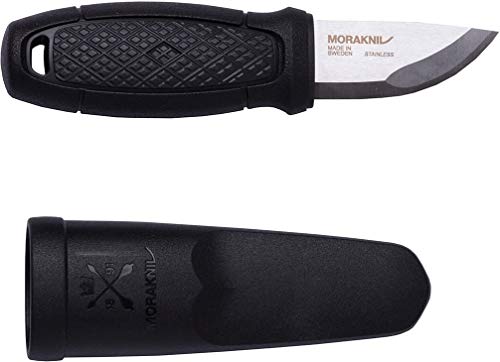
A tiny fixed blade that fits a pocket or hangs around your neck. Handy for fishing, small game and quick camp jobs.

A short, pointed laminated blade on a birch handle. The carving knife many spoon and figure carvers start with.
What Morakniv Does Well
Very sharp Scandi grinds
Most Mora outdoor knives use a Scandi grind: one wide, flat bevel on each side running straight to the edge. It bites into wood and stays put, so feather sticks and notches are easier to control. It’s also easy to sharpen at home, because you just lay that wide bevel flat on the stone.
Value
No other brand gives you this much useful knife for so little money. That’s why I named Morakniv the best outdoor value in my best knife makers list.
Grippy handles
Companion, Kansbol and Garberg handles combine hard plastic with a soft, rubbery friction grip and a small finger guard. They stay secure with wet, cold or fishy hands, which matters more outdoors than any steel spec.
A long Swedish tradition
Morakniv makes its knives in Mora, a small town in Sweden that has been a knife-making center since the 1800s. Most of its stainless knives use Sandvik 12C27, a Swedish stainless that sharpens to a keen edge and shrugs off rust.
What Morakniv Does Badly
Partial tangs on most models
The Companion, Kansbol and Bushcraft have a tang that runs only part of the way into the handle. That’s plenty for carving, food prep and light splitting, but hard batoning or prying can snap the handle. Only the Garberg is full tang.
Basic sheaths
The Companion’s plastic sheath works, but it can feel loose and rattly, and it rides awkwardly on a thick belt. The Kansbol, Garberg and Eldris sheaths are a real improvement.
Thin blades on the cheap models
The standard Companion blade is only 2 mm thick. It slices and carves very well, but it flexes under heavy twisting and isn’t built for chopping.
Rounded spines on some knives
The Companion’s spine isn’t ground square, so it won’t throw good sparks from a fire steel. If that matters to you, buy the Kansbol, Bushcraft or Garberg.
Morakniv Lines Compared
| Line | Steel | Blade | Tang | Handle | Best for |
|---|---|---|---|---|---|
| Companion | 12C27 stainless or carbon | 4.1″, 2 mm (Heavy Duty 3.2 mm) | Partial | Friction grip polymer | Everyday outdoor use, beginners |
| Kansbol | Swedish stainless | 4.3″, 2.5 mm | Partial | Friction grip polymer | Bushcraft, camping, hunting |
| Garberg | Carbon or stainless | 4.3″, 3.2 mm | Full | Friction grip polymer | Hard use, survival kits |
| Bushcraft | Carbon or stainless | 4.3″, 3.2 mm | Partial | Rubber grip | Fire lighting, carving |
| Eldris | Swedish stainless | 2.3″, 2 mm | Partial | Friction grip polymer | Pocket and neck carry |
| Wood Carving | Laminated or carbon | 2.4″ (120) | Partial | Oiled birch | Spoon and figure carving |
1. Morakniv Companion: Best Mora Knife
Who it’s for: beginners, campers, anglers and anyone who wants a capable fixed blade for very little money.
The Companion has a 4.1-inch Sandvik 12C27 stainless blade with a Scandi grind, a friction grip handle and a plastic belt sheath. That’s all, and it’s enough for most camp jobs: whittling tent pegs, cutting cord, slicing salami and cleaning fish.
The orange version is the one I recommend, because it’s easy to spot when you set it down on the forest floor. It’s also the knife I picked as the budget choice for hunters, where a dropped knife in the leaves is a real problem.
The thin blade and partial tang mean it’s not a splitting tool, and the sheath is the weakest part. But for this money, those are fair trades.
Key specs
- Blade: 4.1″ Sandvik 12C27 stainless, 2 mm thick
- Overall length: 8.5″
- Handle: polymer, soft friction grip, finger guard
- Weight with sheath: 3.9 oz
- Plastic sheath with belt clip
Pros
- Exceptional value
- Very sharp out of the box
- Rust resistant
Cons
- Not built for batoning
- Loose, basic sheath
My verdict: the best cheap fixed blade made. Buy two and keep one as a spare.
2. Morakniv Kansbol: Best for Bushcraft
Who it’s for: people who’ve outgrown the Companion and want one stainless knife for the woods.
The Kansbol is what the Companion turns into when you fix its little annoyances. The blade is longer at 4.3 inches and thicker at 2.5 mm, the spine is ground at 90 degrees for a fire starter, and the sheath clicks onto the handle so the knife can’t fall out.
It’s the knife I rank first in my bushcraft knife under $50 guide, because it does almost everything a pricier bushcraft knife does while staying stainless and light. Knife and sheath are symmetrical, so left-handers get the same experience.
It’s still a partial tang, so hard batoning through knots isn’t its job. The tip is also finer than on the Garberg, which is great for detail work but less forgiving if you pry.
Key specs
- Blade: 4.3″ Swedish stainless, 2.5 mm, Scandi grind
- Spine ground for fire starter
- Overall length: 8.9″; weight 4.7 oz
- Friction grip handle, finger guard
- Ambidextrous sheath with click lock
Pros
- Fire steel ready spine
- Secure, ambidextrous sheath
- Stainless, low care
Cons
- Partial tang
- Costs more than the Companion
My verdict: the Mora I’d keep for camping and bushcraft. Pick the Garberg only if you need to baton hard.
3. Morakniv Garberg (Carbon): Best Full Tang
Who it’s for: survival and bushcraft users who split wood with a knife and want it to survive.
The Garberg is the most rugged knife Morakniv sells. The 3.2 mm carbon steel blade continues all the way through the handle, so batoning, splitting kindling and heavy carving are fair game. A black DLC coating helps against rust and glare.
This version comes in a leather sheath, which looks and feels more traditional than the Multi-Mount plastic sheath on the other Garberg listing. Leather is quieter in the woods, but it needs the occasional bit of care and dries slowly after rain.
The price is far above the Kansbol’s, and it’s much heavier on the belt. Unless you know you’ll abuse a knife, the Kansbol is the more pleasant one to carry.
Key specs
- Blade: 4.3″ carbon steel, 3.2 mm, black DLC coating
- Full tang
- Overall length: 9″; weight with sheath 9.6 oz
- Friction grip handle, finger guard
- Leather sheath
Pros
- Strong enough for batoning
- Coated against rust
- Handsome leather sheath
Cons
- Heavy for a Mora
- Much more expensive than the Kansbol
My verdict: the Mora for hard use. Most campers will be happier with the lighter Kansbol.
4. Morakniv Bushcraft Black (Carbon): Best for Fire Lighting
Who it’s for: bushcraft fans who practice fire lighting and like carbon steel.
The Bushcraft Black was Mora’s dedicated bushcraft knife before the Kansbol and Garberg arrived, and it’s still a favorite. You get a thick 3.2 mm carbon blade with a black anti-corrosion coating, a Scandi grind, and a spine ground sharp for throwing sparks from a fire steel.
Carbon steel is easy to get very sharp and easy to touch up on a stone in camp. If you’re torn between carbon and stainless, my carbon vs stainless steel guide explains what you trade.
The tang is partial despite the thick blade, and the plain plastic sheath feels basic at this price. The coating also wears off at the edge and spine with use, and the bare steel underneath will rust if you don’t wipe it.
Key specs
- Blade: 4.3″ carbon steel, 3.2 mm, black DLC coating
- Spine ground for fire starter (fire steel not included)
- Overall length: 9.1″; weight with sheath 5.7 oz
- High-friction rubber grip
- Plastic belt sheath
Pros
- Thick, stiff blade
- Great spark spine
- Easy to sharpen
Cons
- Partial tang
- Basic sheath for the money
My verdict: a fine carbon bushcraft knife. If you’d rather never think about rust, take the Kansbol.
5. Morakniv Eldris: Best Pocket-Size
Who it’s for: anglers, hikers and anyone who wants a fixed blade small enough to forget about.
The Eldris has a 2.3-inch stainless blade and is just 5.6 inches long overall. The barrel-shaped handle is fatter than you’d expect, so it fills your hand better than most knives this size.
It won the Scandinavian Outdoor Award in 2016, and its sheath can take Morakniv’s add-on fire kit and belt loop. A fixed blade this small has no hinge to clean or lock to fail, which makes it a nice alternative to a folding knife for fishing.
The short blade limits food prep and bigger carving, and the stubby handle won’t suit everyone. Think of it as a second knife, not your only one.
Key specs
- Blade: 2.3″ Swedish stainless, 2 mm
- Overall length: 5.6″
- Barrel-shaped friction grip handle, finger guard
- Symmetrical sheath for either hand
Pros
- Fits a pocket
- Surprisingly full grip
- No moving parts
Cons
- Short blade
- Add-ons sold separately
My verdict: the best small Mora. Pair it with a saw or a bigger knife for real camp work.
6. Morakniv Wood Carving 120: Best for Woodcarving
Who it’s for: spoon, bowl and figure carvers who want a dedicated carving knife.
The 120 is a short, narrow 2.4-inch laminated steel blade on an oiled birch handle. The short blade puts your hand close to the cut, which gives you fine control for the push and pull cuts of carving.
Laminated steel has a hard cutting core between softer outer layers, so it holds a very fine edge while staying tough. Carvers have used this pattern for decades, and it’s a common first knife on carving courses.
It’s a carving tool only: the birch handle needs the odd wipe of oil, and the blade isn’t made for camp chores.
Key specs
- Blade: 2.4″ laminated steel, 2.7 mm
- Overall length: about 6.5″
- Oiled birch handle
- Limited lifetime manufacturer’s warranty
Pros
- Precise control
- Holds a very fine edge
- Comfortable wooden handle
Cons
- Carving only
- Wood handle needs care
My verdict: a great first carving knife. For general camp use, the Companion does more.
Morakniv vs Other Brands
Morakniv vs Glock
The Glock field knife is tougher for prying and has a better locking sheath. A Mora carves and slices far better. I compared them in my Glock knife review: Mora for bushcraft, Glock for the car or the range bag.
Morakniv vs Elk Ridge
Both are cheap, but they aren’t in the same class. Elk Ridge sells good-looking knives in soft steel for light use and gifts, while a Mora is a real working knife. My Elk Ridge review covers where those knives make sense.
Morakniv vs ESEE and other premium fixed blades
ESEE, Benchmade and similar brands make full tang knives in thicker steel with better sheaths and warranties, at much higher prices. A Mora carves as well or better; the premium brands win when you need a knife that takes abuse.
FAQ
Are Mora knives good?
Yes. Mora knives are some of the best value fixed blades you can buy: very sharp Scandi grinds, grippy handles and good Swedish steel. Their limits are partial tangs on most models and basic sheaths on the cheapest ones.
Where are Mora knives made?
Morakniv makes its knives in Mora, Sweden, a town with a knife-making history going back to the 1800s.
Is the Morakniv Companion full tang?
No. The Companion has a partial tang that runs part of the way into the handle. It’s strong enough for carving and camp chores, but for hard batoning choose the Garberg, Mora’s only full tang knife.
Is the Morakniv Garberg worth it?
It’s worth it if you need a full tang knife for batoning and rough use. If you mainly carve, cook and do light camp work, the Kansbol does the same jobs for much less money and weight.
Should I buy a carbon or stainless Mora?
Buy stainless if you camp in wet weather, fish or tend to forget to dry your knife. Carbon is slightly easier to sharpen and can strike a fire steel, but it rusts if you leave it wet.
Can you baton with a Mora knife?
You can split small, straight-grained wood with a Companion or Kansbol, but hard batoning risks breaking the partial tang handle. The Garberg is the Mora built for it.
How do you sharpen a Mora knife?
Lay the wide Scandi bevel flat on the stone and push the edge across it, keeping the bevel in full contact. Finish with a few light passes on a strop to remove the burr.
Final Verdict
Morakniv gives you more knife for the money than any other brand I write about. Start with the Companion, step up to the Kansbol for regular bushcraft, and buy the Garberg if your knife will be pounded through logs.
Packing light for the trail? My backpacking knives guide shows how the Companion compares with folding options.

Gary Portman founded knivesadvice.com in 2019. He learned to cook in his family’s kitchen as a kid and has used kitchen, pocket and outdoor knives ever since, from paring and fillet knives to survival blades he carries camping and hiking. He writes the site’s buying guides, brand reviews and sharpening how-tos to help readers find the right knife for the job. More about Gary.