
A kukri looks like a knife that’s been bent forward. The blade drops below the handle and widens toward the tip, so most of its weight sits out in front of your hand. Swing it and that weight does the work: it bites deeper into wood than a straight blade of the same length.
The design comes from Nepal, where the khukuri (the local spelling) is a farm tool, a kitchen knife and, famously, the Gurkha soldier’s blade. On Amazon you’ll find two very different things sold under the name: hand-forged Nepalese knives, and Western-made kukri machetes with polymer handles and coated steel. Both can be good. What isn’t good is the third group, thin decorative blades with stub tangs that are meant for a wall and can break when you chop with them.
For most buyers I’d go with the Condor K-Tact Kukri: a 10-inch carbon steel blade with Micarta handle scales, heavy enough to chop and short enough to carry. If you want the real Nepalese article, the EGKH Service No.1 is a hand-forged army-pattern khukuri. On a tight budget, the Cold Steel Kukri Plus chops far better than its price suggests.
My Top 6 Kukri Knife Picks

Thick 1075 carbon steel, a full tang and a Micarta grip that stays put when your hand sweats. It’s the kukri I’d buy to actually use around camp for years.

Hand-forged in Nepal by a workshop run by an ex-Gurkha veteran, in the current army-issue size. A hard edge and a softer spine, the way khukuris have been made for generations.

An 11.5-inch 1085 carbon blade on a grippy Kraton handle. More reach than the Condor for brush and limbs, from a brand with real outdoor credentials.

A 13-inch 1055 carbon blade with a polypropylene handle and a built-in guard. Not pretty, but it clears brush and splits kindling for very little money.
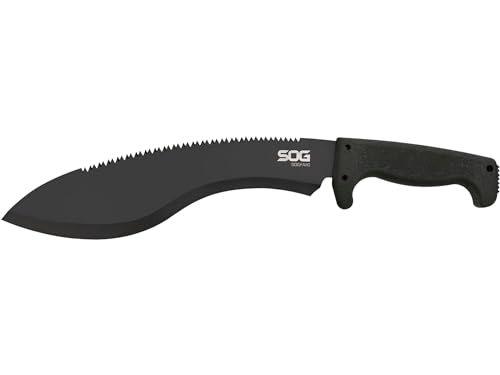
Stainless steel for wet climates and boats, plus a saw on the spine for small branches. The one to pick if you won’t oil a carbon blade.

A modern kukri from designer Ryan Johnson of RMJ Tactical that weighs under a pound. Long enough to chop, light enough to strap to a pack.
Kukri Knives Compared
| Kukri | Blade length | Steel | Grip | Origin | Ideal use |
|---|---|---|---|---|---|
| Condor K-Tact Kukri | 10″ | 1075 carbon | Micarta | El Salvador | All-round camp chopping |
| EGKH Service No.1 | 10.5″ | Hand-forged carbon | Horn | Nepal | Traditional khukuri fans |
| KA-BAR 1249 Kukri | 11.5″ | 1085 carbon | Kraton G | Taiwan | Brush and limbs |
| Cold Steel Kukri Plus | 13″ | 1055 carbon | Polypropylene | Not stated | Yard work on a budget |
| SOG Sogfari Kukri | 13″ | Stainless | Textured synthetic | Not stated | Wet climates, saw back |
| CRKT Kuk | 10.56″ | 65Mn carbon | Textured synthetic | China | Light pack carry |
1. Condor K-Tact Kukri, 10-Inch, Micarta: Best Overall
Who it’s for: campers, hunters and bushcrafters who want one serious chopper that still rides on a belt.
Condor makes its tools in El Salvador and is best known for machetes, so a kukri is right in its wheelhouse. The K-Tact has a 10-inch 1075 carbon steel blade with a convex grind, which pushes wood apart instead of sticking in it. The blade is thick, around 6 mm near the handle, and that’s what makes the blade fall hard into a cut.
The reason I put it ahead of the cheaper kukris is the handle. Micarta (layered canvas in resin) gives a secure grip when wet and doesn’t crack like wood or feel slick like hard plastic. Ten inches is also the size I think most people should start with: enough to limb a small tree or split kindling, short enough not to feel like a sword on the hip.
My reservation is weight. This is a heavy knife for its length, so it’s tiring for long brush clearing, where a longer, thinner machete is better. The carbon steel also needs a wipe and a little oil after wet use.
Key specs
- Blade: 10 inches, 1075 high carbon steel, convex grind
- Thickness: about 6 mm at the spine
- Handle: Micarta scales, full tang
- Sheath: Kydex
- Made in El Salvador
Pros
- Thick, forward-heavy blade chops hard
- Micarta handle stays grippy
- Manageable 10-inch length
Cons
- Heavy for its size
- Carbon steel rusts if put away wet
- Costs much more than the Cold Steel
My verdict: the kukri I’d buy to use rather than display. Pick the Cold Steel if you only need it for occasional yard work.
2. EGKH Service No.1 Gripper Handle Khukuri: Best Traditional Nepalese
Who it’s for: buyers who want a real hand-forged khukuri made in Nepal, to use and to keep.
EGKH (Ex-Gurkha Khukuri House) is a Nepalese workshop run by a former Gurkha soldier, and the Service No.1 is its version of the current army-issue khukuri. It has a 10.5-inch polished blade, a 5.5-inch horn handle and a spine about 3/8 inch thick, which is far heavier stock than any Western kukri here.
The detail that sold me is the heat treatment. EGKH lists three hardness zones: a soft spine (22 to 25 HRC), a medium belly (45 to 46) and a hard edge (54 to 55). That’s the traditional way of making a khukuri: an edge that holds up and a spine that bends rather than snaps. Each blade is marked by the workshop and ships with a warranty certificate.
The trade-offs come with tradition. The tang is a rat-tail that runs through the handle rather than a full slab, so it’s not for prying. A horn handle needs occasional oil and doesn’t like being left wet. And hand-forged means each knife varies a little in finish.
Key specs
- Blade: 10.5 inches, hand-forged carbon steel, polished
- Spine: about 3/8 inch thick
- Hardness: spine 22 to 25, belly 45 to 46, edge 54 to 55 HRC (maker’s figures)
- Handle: 5.5 inches, horn; rat-tail tang
- Overall length: 16 inches
- Made in Nepal
Pros
- Genuine hand-forged Nepalese khukuri
- Differential hardness: hard edge, tough spine
- Very thick spine for powerful chops
Cons
- Horn handle needs care
- Rat-tail tang, not a prying tool
- Finish varies knife to knife
My verdict: the one to buy if “kukri” means the real thing to you. Skip it if you want a grab-and-go tool you never have to look after.
3. KA-BAR 1249 Kukri: Best Long Reach
Who it’s for: anyone clearing brush, vines and small limbs who wants more reach than a 10-inch kukri.
KA-BAR’s kukri is a working tool from a brand most people know from its fighting knives. The blade is 11.5 inches of 1085 carbon steel with a black coating, 17 inches overall, on a Kraton G handle, a rubbery material that grips well in wet gloves. It comes with a leather and Cordura sheath.
I see it as the bridge between a chopping knife and a machete. The extra length gives it more reach and speed in brush than the Condor, while the kukri curve keeps it biting into wood better than a straight machete of the same size. The blade is thinner than the Condor’s, so it’s livelier in the hand and less tiring over a long session.
What I don’t love: KA-BAR rates this blade around 52 to 54 HRC, so the edge is tough but rolls sooner on hard wood and needs touching up. The coating also wears off at the edge with use, which is cosmetic but bothers some owners.
Key specs
- Blade: 11.5 inches, 1085 carbon steel, black coated
- Overall length: 17 inches
- Edge angle: 20 degrees
- Handle: Kraton G
- Sheath: leather and Cordura
- Made in Taiwan
Pros
- Good reach for brush and limbs
- Grippy handle even when wet
- Lighter swing than the Condor
Cons
- Softer edge needs more frequent touch-ups
- Coating wears off with use
My verdict: the best pick if you clear more brush than you split wood. If you mostly process firewood, the Condor’s thicker blade suits you better.
4. Cold Steel Kukri Plus: Best Budget
Who it’s for: homeowners and campers who want a kukri machete for yard work and don’t want to spend much.
The Kukri Plus is Cold Steel’s cheap, honest workhorse. You get a 13-inch 1055 carbon blade, 2.8 mm thick, with a baked-on anti-rust finish, a polypropylene handle that won’t rot or warp, and an integral steel guard to keep your hand off the edge. It weighs 17.3 ounces and ships with a Cor-Ex sheath.
At 2.8 mm it’s a machete-weight blade, not a thick kukri like the Condor or EGKH. That’s fine for vines, blackberry canes, saplings and kindling, and it makes the knife quick to swing. It’s the tool I’d keep in a shed or a truck, where it can get scratched and nobody cares.
What you give up: the factory edge is usually rough and needs a file or stone before first use, and the thin blade bounces off hard, seasoned wood. The Cor-Ex sheath is functional but basic.
Key specs
- Blade: 13 inches, 1055 carbon steel, 2.8 mm thick
- Overall length: 18 inches
- Weight: 17.3 oz
- Handle: 5-inch polypropylene, integral guard
- Sheath: Cor-Ex
Pros
- Costs very little
- Rot-proof handle and anti-rust finish
- Built-in guard protects your hand
Cons
- Needs sharpening out of the box
- Thin blade struggles on hard wood
- Basic sheath
My verdict: the smartest buy for occasional yard and camp jobs. Pay more for the Condor if you’ll chop real firewood with it.
5. SOG Sogfari Kukri 13-Inch: Best Stainless
Who it’s for: boaters, fishermen and anyone in a humid climate who wants a kukri that won’t rust.
Every other kukri here is carbon steel, which means it rusts if neglected. The SOGfari uses stainless steel, so you can leave it damp in a boat locker or a wet pack and it’ll still look fine. The 13-inch blade has a saw along the spine for small branches, and the textured handle has lanyard holes.
I like it as a low-maintenance choice for people who just won’t oil a blade. The saw is handy for notching or cutting a green branch you don’t want to hack at, though a folding saw does that job far better.
The downside is that stainless machete steel is usually softer and harder to bring back to a crisp edge than carbon steel, and SOG doesn’t publish the grade or hardness. The saw teeth also catch on clothing and gloves when you carry it.
Key specs
- Blade: 13 inches, stainless steel, saw back
- Handle: textured synthetic with lanyard holes
- Sheath: nylon
Pros
- Stainless resists rust in wet use
- Saw back for small branches
- Grippy textured handle
Cons
- Steel grade not published
- Saw teeth snag when carried
- Harder to sharpen than the carbon picks
My verdict: the right kukri for wet places and people who hate maintenance. Skip it if edge holding matters more than rust.
6. CRKT Kuk: Best Lightweight
Who it’s for: hikers and hunters who want a kukri on the pack without carrying two pounds of steel.
The Kuk was designed by Ryan Johnson of RMJ Tactical in Chattanooga, Tennessee, and built by CRKT. It’s a modern take on the shape: a 10.56-inch recurved blade in 65Mn carbon steel, about 3.5 mm thick, with a textured injection-molded handle. At around 14.7 ounces it’s the lightest kukri on this list.
That weight is the whole point. On a long walk, a lighter chopper is the one you actually bring. It handles kindling, limbing and camp clearing well enough, and CRKT covers manufacturing faults for the life of the knife.
My reservations: less weight means less chopping power than the Condor, and it’s made in China rather than by the designer’s own shop. The nylon sheath is the weak part of the package.
Key specs
- Blade: 10.56 inches, 65Mn carbon steel, black finish
- Thickness: about 3.5 mm
- Overall length: about 15.9 inches
- Weight: about 14.7 oz
- Handle: textured injection-molded
- Designer: Ryan Johnson (RMJ Tactical); CRKT limited lifetime warranty
Pros
- Light for a kukri
- Comfortable textured grip
- Lifetime warranty against defects
Cons
- Less chopping power than heavier picks
- Basic nylon sheath
My verdict: the kukri for people who count ounces. Choose the Condor if weight doesn’t matter to you.
What Makes a Good Kukri
A full or solid tang, not a stub
A kukri gets swung hard, so the tang (the part of the blade inside the handle) matters most. Full-tang Western kukris and properly forged Nepalese rat-tail tangs are fine. Cheap decorative kukris with a short tang glued into the handle can loosen or snap on the first real chop. It’s the same problem I flagged with the cheap display bowies in my Elk Ridge knives review.
Thickness decides the job
Thick blades (6 mm or more at the spine) chop and split wood well but feel heavy over time. Thin blades around 3 mm swing faster and suit brush, vines and saplings. Decide which you’ll do more of before choosing.
Length: 10 inches is the sweet spot
About 10 inches gives a balance of reach and control for most people. Go to 11 to 13 inches for brush clearing. Much longer than that and you’re really buying a machete with a kukri curve.
Carbon or stainless
Carbon steel (1055, 1075, 1085, 65Mn, 5160) takes hard chopping and sharpens quickly, yet it rusts. Stainless resists rust but is usually softer in big blades. If you want the details, my carbon vs stainless steel guide covers both.
A sheath you trust
A heavy, sharp blade needs a sheath that holds it securely and covers the curved edge fully. Kydex and molded sheaths retain best; nylon and Cor-Ex are fine for storage. Traditional khukuris come in wooden sheaths covered in leather.
How to Chop With a Kukri
Let the weight do the work. Hold the handle firmly but not tightly, with your hand toward the back of the grip, and swing from the elbow rather than the shoulder. Aim to strike with the widest part of the blade, the “sweet spot” just behind the belly, not the tip.
Cut at an angle of about 45 degrees into wood, then alternate from the other side to take out a V-shaped notch. Stand so a glancing blow goes into the ground, not your leg, and keep other people well clear. For splitting kindling, set the edge on the wood and tap the spine with a baton rather than swinging at small pieces.
Kukri vs Machete vs Bowie
A kukri chops wood better than a machete of the same length because its weight is forward and its edge curves into the cut. A machete is lighter and longer, which makes it faster for grass, vines and thin growth. A bowie knife is a big straight knife that slices and does camp chores better than either, but chops worse than a kukri. A mid-size field knife like the one in my Glock knife review sits below all three: tougher for prying, poor at real chopping.
If you’re choosing a single blade for camp, think about what you’ll cut most. For firewood and limbs, a kukri wins. For a smaller blade to carry every day in the woods, my bushcraft knife guide is a better starting point.
FAQ
What is a kukri used for?
A kukri is mainly a chopping tool: limbing, splitting kindling, clearing brush and camp work. In Nepal it’s also an everyday farm and kitchen knife. Its forward weight makes it chop harder than a straight knife of the same length.
What are the two small knives in a traditional kukri sheath?
They’re the karda and the chakmak. The karda is a small utility knife for fine cutting, and the chakmak is a blunt steel used to hone the edge and strike sparks. Many Nepalese khukuris still come with both.
What is the notch near the handle of a kukri for?
The notch is called the cho or kaudi. Explanations vary: it marks where the sharpened edge ends, stops sap or blood running onto the handle, and has religious meaning in Nepal. Practically, it’s a sign of a traditional pattern, not a feature you use.
Is a kukri better than a machete?
For chopping wood, yes. For long sessions in grass, vines or thin brush, a longer and lighter machete is faster and less tiring. Many people who camp a lot own both.
Are kukris legal to carry?
Laws on carrying large fixed blades vary by state, city and country. Carrying one to a campsite or work site is treated differently from carrying it in public. Check the local rules where you’ll carry it.
How do I sharpen a kukri?
Use a file or coarse stone to set the edge, then a fine stone or puck to finish, following the curve as you go. Because of the recurve, small handheld stones work better than bench stones. Keep a lighter, slightly steeper angle near the belly, where most chopping happens.
Final Verdict
The Condor K-Tact Kukri is the one I’d recommend to most people: thick, well balanced, with a grip that stays put. If you want a hand-forged blade from Nepal, the EGKH Service No.1 is the real thing, and if you just need a cheap chopper for the yard, the Cold Steel Kukri Plus does the job well.
For lighter blades to pair with a kukri on a trip, see my backpacking knives guide.

Gary Portman founded knivesadvice.com in 2019. He learned to cook in his family’s kitchen as a kid and has used kitchen, pocket and outdoor knives ever since, from paring and fillet knives to survival blades he carries camping and hiking. He writes the site’s buying guides, brand reviews and sharpening how-tos to help readers find the right knife for the job. More about Gary.