
Bushcraft has a reputation for expensive gear, but the jobs a bushcraft knife does are simple: carving pegs and pot hangers, shaving feather sticks, splitting small wood and striking a fire steel. That takes a sharp, sturdy edge you can control, not exotic steel. My first choice is the Morakniv Kansbol, a Scandi-ground stainless blade with a spine that throws sparks and a sheath that clicks shut. For a full tang knife with a wood handle and a leather sheath, look at the BPS Bushmate 2.0.
My Top 6 Bushcraft Knives Under $50

The Kansbol is the knife I’d send someone off into the woods with. The Scandi grind makes carving and feather sticks almost foolproof, the squared spine throws sparks from a fire steel, and the stainless blade forgives a damp pack. It feels more like a refined tool than a budget knife.

This is the one for people who like the traditional look: a walnut handle over a full tang, carbon steel and a leather sheath with a fire starter. BPS is a Ukrainian maker with a strong following in bushcraft circles, and the design came from Dutch Bushcraft Knives. A lot of character for the money.

When the job involves splitting wood rather than just carving it, I’d want a thicker, heavier knife, and the Frontier is the sturdiest option under $50 here. The five-inch 1095 blade and full tang take a beating that would worry the lighter knives.

If money is tight, this is where I’d put it. The Heavy Duty version of the famous Companion has a thicker blade than the standard model and carbon steel that’s easy to sharpen in the field. It’s the cheapest way I know to get a properly capable bushcraft knife.

A knife alone is a slow way to process wood. This set pairs Bahco’s Laplander folding saw, a classic among campers, with a simple fixed blade and a belt holster that carries both. For many people, a saw does more for their campfire than a bigger knife ever could.
The 511 is a working knife made for tradespeople, and it’s also one of the best cheap carving blades around. I’d buy one to learn on, to leave in the car or to keep as a spare in the pack, and not worry about scratching, staining or losing it.
Bushcraft Knives Under $50 Compared
| Knife | Blade | Steel | Thickness | Tang | Sheath | Best for |
|---|---|---|---|---|---|---|
| Morakniv Kansbol | 4.3″ | Swedish stainless | 2.5 mm | Partial | Polymer, click lock | All-round bushcraft |
| BPS Bushmate 2.0 | 3.9″ | 1066 carbon | 3 mm | Full | Leather, fire starter | Traditional wood and leather |
| Schrade SCHF36CP Frontier | 5″ | 1095 carbon, coated | not listed | Full | Polyester, ferro rod, stone | Batoning and heavy work |
| Morakniv Companion Heavy Duty | 4.1″ | Carbon | 3.2 mm | Partial | Plastic with belt clip | Lowest cost capable knife |
| Bahco Laplander set | 7.5″ saw + knife | Stainless knife | not listed | not listed | Belt holster for both | Wood processing |
| Morakniv Craftline Basic 511 | 3.6″ | Carbon | 2 mm | Partial | Plastic combi-sheath | Carving practice, spare |
1. Morakniv Kansbol (Stainless, 4.3 Inch): Best Overall
Who it’s for: beginners and experienced campers who want one dependable knife for carving, fire prep and camp kitchen jobs.
Ask a bushcraft group which knife to buy first and Mora is the name you’ll hear more than any other. The Kansbol is the Swedish brand’s modern take on the bushcraft knife, and I think it’s the best all-rounder it makes at this price. The 4.3-inch blade has a Scandi grind, one wide flat bevel running down to the edge. That bevel sits flat on the wood as you carve, which makes it very easy to control how deep you cut and to shave long, thin curls for feather sticks.
The spine is ground to a sharp 90-degree corner, so you can strike a ferro rod with the back of the knife instead of carrying a separate striker. The polymer handle has a soft friction grip and a small finger guard, and the sheath clicks onto the handle so the knife won’t fall out when you crawl through brush. Knife and sheath are symmetrical, which left-handed users will appreciate.
My reservation is about heavy batoning. At 2.5 mm thick, and without a full tang, the Kansbol is happy splitting kindling but isn’t designed for hammering through thick logs. For that, see the Schrade further down, or better yet, carry a saw.
Key specs
- Blade: 4.3 inch (109 mm), Swedish stainless steel, Scandi grind
- Thickness: 2.5 mm; spine ground for fire steel use
- Handle: polymer, soft friction grip, small finger guard
- Sheath: polymer, click lock, usable from either side
- 8.9 inches overall; 4.7 oz
Pros
- Superb for carving and feather sticks
- Fire steel ready spine
- Secure, ambidextrous sheath
Cons
- Not a full tang, so go easy on batoning
- Plastic sheath and handle look plain
My verdict: the best balance of carving, safety and value in this list. Choose the Frontier only if heavy splitting is a big part of your plans.
2. BPS Bushmate 2.0 (Carbon Steel, Full Tang): Best Wood and Leather Kit
Who it’s for: campers who want a classic-looking bushcraft knife with natural materials, and anyone buying a knife as a gift for an outdoors person.
BPS Knives is a Ukrainian company that specializes in camping and bushcraft knives, and the Bushmate 2.0 was designed together with DBK (Dutch Bushcraft Knives). It’s the most traditional knife on this list: a full tang carbon steel blade, a walnut handle finished with Danish oil, and a leather sheath that holds a fire starter.
The 3.9-inch blade is 3 mm thick, which gives it more backbone than the Moras for splitting small wood, and the full tang means the steel runs all the way through the handle. The steel is 1066 carbon, which sharpens quickly and takes a keen edge. Like any carbon steel, it reacts to moisture, so I’d wipe it dry after use and give it a light coat of oil now and then.
The downsides come with the materials. Leather and wood need a little care to stay in good shape, and the sheath isn’t as quick or secure as Mora’s click-in plastic. It’s also heavier than the Kansbol for a slightly shorter blade.
Key specs
- Blade: 3.9 inch (98 mm), 1066 carbon steel, 3 mm thick
- Handle: walnut, Danish oil finish, full tang
- Sheath: leather, with fire starter
- 8.7 inches overall; about 5.2 oz without sheath
- Designed with Dutch Bushcraft Knives (DBK)
Pros
- Full tang and thicker blade for sturdier work
- Attractive wood and leather package
- Fire starter included
Cons
- Carbon steel rusts if neglected
- Leather sheath needs care
- Heavier for its blade length
My verdict: the knife to pick if you enjoy the traditional side of bushcraft. If you just want function with no upkeep, the Kansbol is easier to live with.
3. Schrade SCHF36CP Frontier (1095, Full Tang): Best for Batoning
Who it’s for: campers who regularly split wood with a knife and want a heavier, tougher blade that can handle it.
Batoning means placing the knife on a piece of wood and striking the spine with a stick to split it. It’s hard on knives, and it’s where thin blades with partial tangs can bend or break. The Frontier featured here before, and the current SCHF36CP version still fits the role: a five-inch 1095 carbon steel blade on a full tang, with a ring-textured rubbery handle that stays put in wet hands.
The blade has a protective powder coating, a finger choil for close-up work and jimping (small grooves) on the spine for thumb grip. The kit also includes a ferro rod and a sharpening stone, so it can be a ready-to-go package for a new camper.
I have two reservations. At 12.3 ounces it’s the heaviest knife here by a distance, and the long blade isn’t as easy to control for fine carving as a Scandi-ground Mora. The polyester sheath is functional rather than nice. If you mostly carve, a lighter knife will serve you better.
Key specs
- Blade: 5 inch drop point, 1095 high carbon steel, powder coated
- Full tang; finger choil and spine jimping
- Handle: ring-textured thermoplastic elastomer (TPE)
- 10.4 inches overall; 12.3 oz
- Polyester belt sheath, ferro rod, sharpening stone
Pros
- Toughest build on this list
- Grippy handle in wet conditions
- Comes with fire and sharpening extras
Cons
- Heavy to carry
- Less precise for fine carving
- Basic sheath
My verdict: the one to buy if you split a lot of wood with your knife. Carvers should start with the Kansbol or Companion instead.
4. Morakniv Companion Heavy Duty (Carbon Steel): Best Budget
Who it’s for: anyone starting out in bushcraft on a tight budget, scout leaders kitting out a group, and campers who want a knife they can use hard without a second thought.
The standard Companion is probably the most widely recommended cheap outdoor knife in the world, and I picked the stainless version as the budget fixed blade in my guide to backpacking knives. For bushcraft, though, I prefer this Heavy Duty carbon version. The blade is 3.2 mm thick, noticeably beefier than the standard model, which makes it much stiffer for splitting kindling and prying apart small logs.
The carbon steel is quick to sharpen and takes a very fine edge on the Scandi-style bevel, though it will spot with rust if you leave it wet. The extra-large handle has a high-friction pattern that’s comfortable even with gloves, and it’s made in Sweden with a limited lifetime warranty.
What you give up is refinement. The plastic sheath is basic, and its tang stops short of the handle’s end, so I wouldn’t hammer it through anything thicker than your wrist. For the price, those are easy compromises.
Key specs
- Blade: 4.1 inch (104 mm), high carbon steel
- Thickness: 3.2 mm
- Handle: extra-large, high-friction grip
- 8.8 inches overall; 4.8 oz
- Plastic sheath with belt clip; made in Sweden; limited lifetime warranty
Pros
- Very low price for a capable knife
- Thicker, stiffer blade than the standard Companion
- Easy to sharpen in the field
Cons
- Carbon steel needs drying and oiling
- Partial tang limits heavy batoning
- Basic sheath
My verdict: the cheapest knife I’d trust for real bushcraft. Step up to the Kansbol if you want stainless steel and a better sheath.
5. Bahco Laplander Saw and Knife Set: Best Saw Combo
Who it’s for: campers who build a lot of fires, and anyone who wants to stop batoning and start cutting wood the easy way.
This is a slightly unusual pick, and it’s here on purpose. Many beginners buy a big, heavy knife so they can split wood, when a small folding saw would do the job faster, more safely and with far less wear on the knife. Bahco’s Laplander has been a favorite folding saw among bushcrafters for years, and this set pairs it with the 2446-LAP fixed blade knife in a belt holster that carries both.
The saw has a 7.5-inch blade with Bahco’s XT toothing at 7 teeth per inch and a low-friction coating, and it cuts green and dry wood well. The knife has a stainless steel blade and a textured handle; it’s a plain utility knife rather than a specialist carving blade, but it’s fine for food prep, cord and light carving.
My reservations: the knife is the weaker half of the set, and serious carvers may want to swap it for one of the Moras above.
Key specs
- Saw: Bahco 396-LAP folding saw, 7.5 inch blade, XT toothing, 7 TPI, low-friction coating
- Knife: Bahco 2446-LAP, stainless steel blade, textured handle
- Belt holster carries saw and knife together
Pros
- Saw makes firewood far easier and safer
- Well-known, proven folding saw
- Both tools in one holster
Cons
- Knife is basic compared with the Moras
- Saw and knife together make a bulkier belt load
My verdict: the smartest wood-processing upgrade under $50. If you already own a saw, buy one of the knives instead.
6. Morakniv Craftline Basic 511 (Carbon Steel): Best Carving Beater
Who it’s for: beginners learning to carve, and anyone who wants a cheap spare knife for the pack, the car or the workshop.
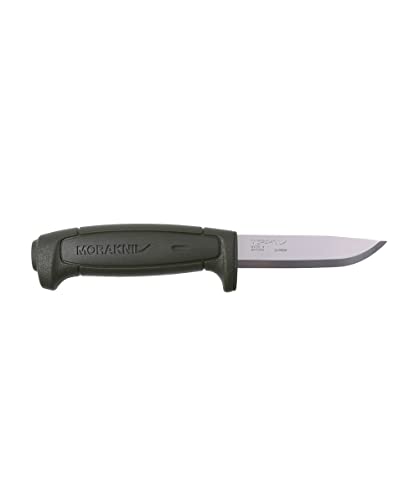
Mora designed the Craftline range for tradespeople, but bushcrafters adopted the 511 years ago because it does the basics so well for so little. The 3.6-inch carbon steel blade is thin at 2 mm and has the same easy-to-control Scandi-style bevel as Mora’s outdoor knives, which makes it a good tool for learning feather sticks, spoon blanks and simple carving.
The large handle has a friction grip and a finger guard, and the hard plastic combi-sheath has a belt clip and Mora’s Smart Button System, so you can attach several Mora sheaths together. At 3.9 ounces, it’s light enough that you’ll forget it’s in the pack.
The thin blade is also its limit: it’s not for batoning, and carbon steel rusts if neglected. The sheath holds the knife by friction rather than a locking click, so I’d check it before hiking through dense brush.
Key specs
- Blade: 3.6 inch, carbon steel, 2 mm thick
- Handle: large, impact resistant, friction grip and finger guard
- Sheath: hard plastic combi-sheath with belt clip
- 8.1 inches overall; 3.9 oz
Pros
- Lowest price on the list
- Great carving control
- Light enough to carry as a spare
Cons
- Too thin for batoning
- Carbon steel rusts if left wet
- Basic sheath retention
My verdict: the best cheap knife for learning to carve. As a main knife, the Companion Heavy Duty or Kansbol are sturdier.
What Makes a Good Bushcraft Knife on a Budget
Grind: why so many bushcraft knives are Scandi
A Scandi grind has one wide bevel that goes straight to the edge. It rests flat on wood, which makes it easy to carve with control and easy to sharpen on a flat stone. Flat and saber grinds are stronger for chopping and splitting but take more practice to carve with.
Carbon or stainless steel
Carbon steel (1095, 1066, Mora carbon) sharpens quickly and takes a very fine edge, but it rusts if you leave it wet. Stainless (Kansbol) needs far less care and is my suggestion for wet climates and beginners. Both work. I’ve explained the trade-offs in more depth in carbon vs stainless steel knives.
Thickness and tang
For carving, 2 to 3 mm is plenty. For splitting wood, a thicker blade and a full tang (Bushmate, Frontier) are more forgiving. Partial tang knives like the Moras are strong for normal use, just not for heavy batoning.
Blade length
About 4 inches is the sweet spot: long enough to split kindling, short enough to control when carving. Longer blades help with batoning but get clumsy for fine work.
Spine and sheath
A sharp, squared spine lets you strike a ferro rod without dulling the edge. A sheath that holds the knife securely, ideally with a click or snap, means you won’t lose it on the trail.
How to Sharpen a Scandi Grind in the Field
One reason bushcrafters love Scandi grinds is how easy they are to sharpen. Lay the whole bevel flat on a stone so the edge and the top of the bevel both touch, then push or pull along the stone with light, even pressure. Count the strokes on each side and keep them equal. Finish on a fine stone or a leather strop to remove the tiny burr.
Because the bevel itself sets the angle, there’s no guesswork, which makes it a good grind to learn on. A small pocket stone is enough to keep a bushcraft knife working on a long trip. For more general technique, my guide to sharpening a pocket knife covers stones, rods and angles.
FAQ
What’s the difference between a bushcraft knife and a survival knife?
A bushcraft knife is built for carving, fire making and camp chores, so it’s usually medium sized with a fine, controllable edge. Survival knives tend to be larger, heavier and built for abuse, sometimes with serrations or saw backs. Military-style field knives, like the one in my Glock knife review, sit closer to the survival side.
Do I need a full tang knife for bushcraft?
No. A full tang is stronger for heavy batoning, but partial tang knives like the Moras handle carving, fire prep and kindling splitting easily. If you plan to split a lot of wood, a saw is a better tool anyway.
Can I use a folding knife for bushcraft?
For light carving and food prep, yes. For feather sticks, batoning and fire steel work, a fixed blade is stronger and safer because there’s no lock to fail.
How do I stop a carbon steel knife from rusting?
Wipe it dry after every use, especially after cutting food, and give it a thin coat of oil before storage. A gray patina will form over time, which actually helps protect the steel.
Is Morakniv really that good for the price?
Yes. Mora knives are made in Sweden, use good steel and have simple, effective blade shapes. They’re the standard recommendation for beginner bushcraft for a reason.
Final Verdict
The Morakniv Kansbol is my pick for the best bushcraft knife under $50: it carves beautifully, works with a fire steel and needs almost no care. If you prefer natural materials and a full tang, go for the BPS Bushmate 2.0. And if you want the toughest blade for splitting wood, the Schrade Frontier is built for it.
Want a pocket knife to go with your fixed blade? My list of the best flipper knives under $50 stays within the same budget.

Gary Portman founded knivesadvice.com in 2019. He learned to cook in his family’s kitchen as a kid and has used kitchen, pocket and outdoor knives ever since, from paring and fillet knives to survival blades he carries camping and hiking. He writes the site’s buying guides, brand reviews and sharpening how-tos to help readers find the right knife for the job. More about Gary.