
Gerber is a good brand if you shop by model. Its fixed blades and multitools are tough, easy to live with and fairly priced, and a few of them are still made in Oregon. Its cheapest pocket knives are fine for chores, but softer steel and plain finishing mean they won’t feel special.
The Gerber I’d buy first is the StrongArm, a full tang fixed blade with a grippy handle and a sheath that mounts almost anywhere. For a pocket, the Paraframe I is the budget pick, and the Suspension NXT is the multitool most people need.
My Top 6 Gerber Picks
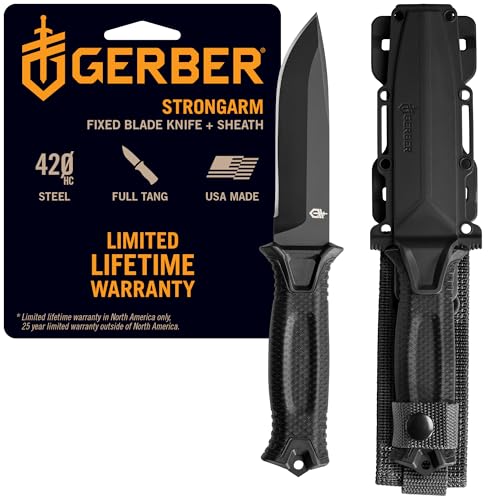
The StrongArm is Gerber at its best: a full tang 420HC blade, a rubbery diamond-texture grip that holds when your hands are wet, and a sheath you can wear on a belt, a pack or a vest. Nothing on it is fancy, and nothing on it is weak.
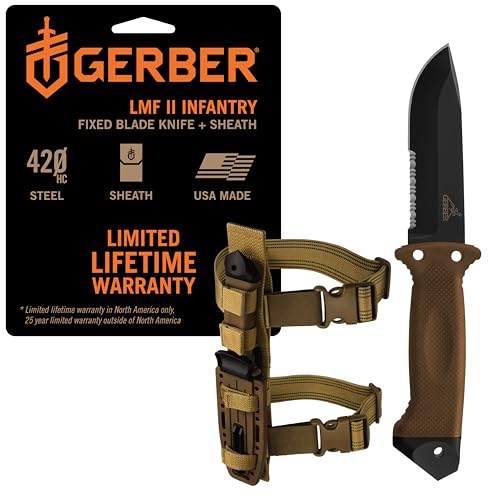
A military pattern built for aircrew rescue, with a sheath that carries its own sharpener. Heavier than most people need, but it’s the Gerber I’d keep in a vehicle kit.

A US-made lockback with the Gator Grip texture that made Gerber famous. Big in the pocket, which is why it comes with a belt sheath.

Light, slim and very cheap. The open frame looks plain, but it gives you a full-size blade for less than almost anything else with a real lock.

Pliers, drivers, scissors and a small blade in a tool that clips in a pocket. My choice when someone wants a Gerber tool rather than a knife.
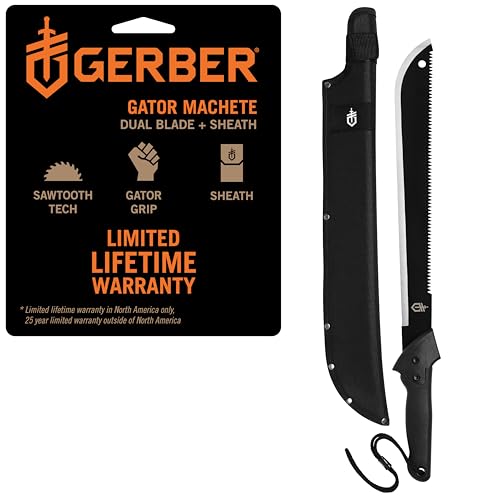
An 18 inch edge on one side and a saw on the other, with the same Gator Grip as the folder. The one I’d hang in a garden shed.
What Gerber Does Well
Grips that work wet
Gerber’s best idea is its handles. The Gator Grip on the folder and machete and the rubberized diamond texture on the StrongArm hold in rain, sweat and fish slime better than smooth G10 or wood. On a working knife, that matters more than a fancy steel.
A real Oregon history
Gerber started in Portland, Oregon, in 1939 and is now part of the Finnish Fiskars group. Some of its knives are still made in the USA: the LMF II and Gator folder listings say so, and Gerber says the StrongArm is built at its Portland factory.
Easy-care stainless steel
Most Gerber blades use 420HC or similar stainless steel. It’s on the soft side, but it shrugs off rust and comes back sharp on any basic sharpener in a few minutes. For gear that lives in a truck, a boat or a tackle box, that is a sensible choice.
Multitools and machetes, not just knives
Gerber sells a full kit for outdoor and work use, from keychain tools to machetes. If you want one brand for a pocket tool, a fixed blade and a yard machete, Gerber covers all three at prices that don’t hurt.
A lifetime guarantee
Gerber backs its knives with the Gerber Guarantee, a limited lifetime warranty against defects. It doesn’t cover wear and abuse, but it’s a reason to buy the name over a no-name lookalike.
What Gerber Does Badly
Soft steel on the cheap models
Ask Gerber owners what bugs them and edge holding tops the list. 420HC and the unnamed stainless on the budget folders dull faster than D2 or the powder steels on pricier brands. You’ll sharpen more often. It’s easy to do, but you’ll do it.
Uneven quality across a huge catalog
Gerber makes hundreds of products, from US-made fixed blades to inexpensive imported folders. The gap between the two is real. A StrongArm and a bargain-bin Gerber folder share a logo and not much else, so pick by model, not by brand.
Lots of serrated edges
Many Gerber folders and survival knives come partly or fully serrated. Serrations cut rope well, but they snag on wood and food and they are slow to sharpen at home. If you mostly cut cardboard, string and food, look for the fine edge (plain edge) version of the model you like.
Models come and go
Gerber retires and renames models often, so a knife a friend recommended a few years ago may now be hard to find. The StrongArm, LMF II, Gator and Paraframe have stayed in the catalog for a long time, which is one reason they made my list.
Gerber Lines Compared
| Line | Steel | Made in | Handle | Best for |
|---|---|---|---|---|
| StrongArm | 420HC stainless | USA (Portland) | Rubberized, diamond texture | Camping, outdoor work, one fixed blade for everything |
| LMF II Infantry | Stainless, partly serrated | USA | Textured, shock absorbing | Survival and vehicle kits |
| Gator folders | 420HC stainless | USA | Glass-filled nylon, Gator Grip | Hunting, fishing, belt carry |
| Paraframe and budget folders | Stainless (grade not listed) | Not stated | Stainless steel frame | Cheap everyday carry, spares |
| Multitools (Suspension NXT, Dime) | Stainless | Not stated | Stainless steel | Pocket repairs, camping, work |
| Gator machetes | High carbon stainless | Not stated | Rubberized Gator Grip | Brush, vines, garden clearing |
1. Gerber StrongArm, Plain Edge, Black: Best Gerber Knife Overall
Who it’s for: anyone who wants one sturdy fixed blade for camping, hunting chores, the boat or the truck, and doesn’t want to baby it.
The StrongArm is the knife I point people to when they ask whether Gerber still makes anything serious. It’s a full tang 420HC blade with a plain edge, a rubberized grip with a diamond texture and a striking pommel at the butt. The handle is the star: it stays put in a wet or gloved hand, which is exactly where a smooth handle lets you down.
The sheath is the other reason it sells so well. It’s MOLLE compatible and can be set up for belt, horizontal or pack carry, so the knife goes wherever your gear goes. Few knives in this class carry this many ways out of the box.
My reservation is the steel. 420HC is tough and rust resistant but soft, so the edge needs touching up after heavy cutting. For a knife that lives outdoors in all weather, I think that’s the right trade. If you want longer edge holding, Gerber also makes a MagnaCut version.
Key specs
- Blade: plain edge, 420HC stainless steel, full tang
- Handle: rubberized diamond-texture grip
- Pommel: striking pommel
- Sheath: MOLLE compatible, several carry options
Pros
- Grip holds when wet or gloved
- Very versatile sheath
- Stainless steel that won’t rust in a damp pack
- Easy to sharpen in the field
Cons
- Soft steel needs frequent touch-ups
- The sheath is bulky for simple belt carry
- Not a slicer for fine food prep
My verdict: the best all-round Gerber and a safe first fixed blade. Skip it only if edge holding matters more to you than toughness and rust resistance.
2. Gerber LMF II Infantry, Coyote Brown: Best for Survival Kits
Who it’s for: buyers putting together a vehicle, boat or emergency kit who want a knife built for rough rescue jobs.
The LMF II was designed for aircrew rescue, and it shows in the details. There’s a purposeful gap between the tang and the butt cap, so the butt cap can hammer and insulate against stray wires. The partly serrated edge cuts seat belts and webbing, and the sheath carries a built-in sharpener so the knife never travels without a way to fix its edge.
I like it as an emergency knife rather than an everyday camp knife. It’s large and heavy, and the serrations get in the way when you’re carving or preparing food. As a tool you hope you’ll never need, though, it’s hard to beat, and the listing says it’s made in the USA.
If you want a fixed blade to use every weekend, the StrongArm above is the better buy. The LMF II is for the glovebox and the go-bag.
Key specs
- Blade: fixed, partly serrated edge
- Handle: textured grip; butt cap insulated from the tang
- Sheath: MOLLE compatible with integrated sharpener
- Made in: USA (per listing)
Pros
- Serrations cut belts, rope and webbing fast
- Butt cap built for hammering
- Sharpener lives in the sheath
- US-made
Cons
- Heavy and long for everyday carry
- Serrations get in the way for carving and food
- Costs more than the StrongArm
My verdict: a strong emergency knife for a kit that sits in a car or boat. Campers who cut food and wood every day should take the StrongArm instead.
3. Gerber Gator Folding Knife, Serrated Edge: Best Classic Folder
Who it’s for: hunters, anglers and tradespeople who like a big lockback on the belt and a grip that won’t slip.
The Gator is the Gerber a lot of people think of first, and the reason is its handle. Glass-filled nylon with a raised alligator-skin texture gives a grip that stays put with wet, bloody or muddy hands. The lockback is simple and strong, and the 3.75 inch clip point blade is long enough for real work.
This version is serrated, which makes it better at rope, webbing and fibrous plants than at clean slices. I’d use it as a camp and boat knife rather than a field dressing blade. It comes with a ballistic nylon sheath, and I’d use it: at 5 ounces, the Gator is heavy for a trouser pocket.
It’s also one of the few Gerber folders the listing says is made in the USA, which is a nice bonus at this price.
Key specs
- Blade: 3.75 inch clip point, serrated, 420HC stainless steel
- Closed length: 4.96 inches
- Weight: 5 oz
- Lock: lockback
- Handle: glass-filled nylon, Gator Grip texture
- Includes: ballistic nylon sheath; made in USA (per listing)
Pros
- Excellent wet grip
- Strong, simple lockback
- US-made
- Belt sheath included
Cons
- Serrated edge is slow to sharpen and poor for food
- Heavy and bulky in a pocket
- No pocket clip on this version
My verdict: a classic outdoor folder for belt carry. If you want a knife that disappears in a pocket, look at the Paraframe instead.
4. Gerber Paraframe I, Fine Edge: Best Budget Pocket Knife
Who it’s for: first-time knife carriers, and anyone who wants a cheap spare to leave in the glovebox or a tool bag.
The Paraframe is one of Gerber’s best-selling knives, and the open stainless steel frame is the reason it’s so light. At 2.8 ounces, it carries like a pen, yet it gives you a full-size clip point blade, dual thumb studs and a frame lock. For a knife this cheap, that’s a real lock, not a slipjoint.
I picked the fine edge version on purpose. It’s easier to sharpen and more useful for food, packaging and string than the serrated one. In my EDC knives under $100 guide I recommend the even smaller Paraframe Mini; this full-size one suits bigger hands.
What you give up: the steel is basic and unnamed, the open frame collects pocket lint, and the metal handle can feel slick. As a knife to learn on or to lend, it’s still hard to argue with.
Key specs
- Blade: clip point, fine edge, stainless steel
- Overall length: 7.01 inches
- Weight: 2.8 oz
- Lock: frame lock; dual thumb studs
- Handle: open stainless steel frame with pocket clip
Pros
- Very light for a full-size blade
- Locks securely
- Costs very little
- Easy to open with either thumb
Cons
- Basic steel dulls quickly
- Smooth metal handle can be slippery
- Open frame collects lint
My verdict: the cheapest good way into carrying a real folding knife. Buyers who want a knife to keep for years should spend more on a CRKT or Kershaw with better steel.
5. Gerber Suspension NXT 15-in-1 Multitool: Best Gerber Multitool
Who it’s for: homeowners, campers and commuters who want pliers and drivers in the pocket in a cheaper, lighter tool than a Leatherman.
The Suspension NXT opens like a butterfly to reveal needle nose pliers, then folds back to give you access to a 2.25 inch partly serrated blade, scissors, three flathead and two cross drivers, an awl, can and bottle openers and a wire stripper. A pocket clip keeps it from needing a belt pouch.
What I like is how much it does for so little money. The tools lock, the clip works and it’s slim enough for a jacket pocket. The catch: the blade and tools sit inside the handles, so you open the whole tool to reach them, and the pliers are lighter duty than a full-size Leatherman’s.
For occasional fixes around the house and campsite, that’s no problem. For daily trade work, a heavier tool will last longer.
Key specs
- Tools: needle nose pliers, wire stripper, 3 flathead and 2 cross drivers, awl, nail file, scissors, can opener, bottle opener, 2.25 inch partly serrated blade
- Opening: butterfly, with tool lock
- Carry: pocket clip, lanyard point
- Material: stainless steel
Pros
- Lots of useful tools for the money
- Pocket clip, no pouch needed
- Tools lock open
- Scissors included
Cons
- Must open the tool to reach the blade
- Pliers are light duty
- Small blade is partly serrated
My verdict: the multitool I’d give someone who has never owned one. Tradespeople who use pliers all day need something heavier.
6. Gerber Gator Machete, 18 Inch Blade with Saw: Best Gerber Machete
Who it’s for: gardeners, landowners and campers clearing brush, vines and small branches.
The Gator Machete is the same idea as the Gator folder, scaled up: a high carbon stainless blade with a rubberized Gator Grip handle. The 18 inch edge handles weeds, vines and saplings, and the saw on the back takes care of branches too thick to chop cleanly.
I think the saw is worth having around a yard or a property, because it saves a trip back to the shed for a pruning saw. The downside is that a saw back makes the machete awkward to carry on a pack, and the nylon sheath is basic. For trail and pack use, a plainer machete carries better.
Like most budget machetes, it benefits from a few minutes with a file before the first job.
Key specs
- Blade: 18 inch plain edge with saw on the spine, high carbon stainless steel
- Overall length: 25 inches
- Handle: rubberized Gator Grip
- Includes: nylon sheath
Pros
- Chopping edge and saw in one tool
- Grip holds in wet conditions
- Rust resistant blade
Cons
- Saw back makes it awkward to pack
- Basic sheath
- Edge benefits from sharpening before use
My verdict: a smart yard and property machete. Hikers who want something to carry on a pack should pick a lighter blade without the saw.
Gerber vs Other Budget Outdoor Brands
Gerber vs Kershaw
For pocket knives, Kershaw usually wins. Its folders use better steels and the flippers are smoother. For fixed blades, multitools and machetes, Gerber has the wider range, and the StrongArm has no direct Kershaw rival.
Gerber vs Leatherman
Leatherman makes the stronger multitools, with bigger pliers and tougher builds for daily trade use. Gerber’s tools cost less and are lighter, which is enough for most people who use pliers now and then.
Gerber vs Buck
Both are American brands with long histories and lifetime warranties. Buck leans toward traditional hunting knives and lockbacks; Gerber leans toward tactical and survival gear. For a classic folding hunter, I’d choose Buck. For a survival or camping fixed blade, I’d choose the StrongArm.
For a wider look at the brands I trust, see my guide to the best knife makers.
Keeping a Gerber Sharp
Sharpen a Gerber plain edge little and often. Soft stainless loses its bite quickly but returns after a handful of passes on a ceramic rod or a guided sharpener, so don’t wait until it’s completely dull. My guide on how to sharpen a pocket knife walks through the basics.
Serrated edges need a tapered ceramic rod. Sharpen each scallop from the beveled side only, then knock off the burr by stroking the flat back once or twice. If that sounds like a chore, buy the fine edge version of the knife.
FAQ
Are Gerber knives good?
Yes, for tough, affordable outdoor gear. The StrongArm, LMF II, Gator and Gerber’s multitools are dependable and easy to maintain. The cheapest folders are fine for light chores but use soft steel that needs frequent sharpening.
Where are Gerber knives made?
Gerber is based in Oregon. Some models, such as the StrongArm, LMF II and Gator folder, are made in the USA; many budget folders and tools are made overseas. Check the listing for the model you want.
What steel does Gerber use?
Mostly 420HC and similar stainless steels. They resist rust and sharpen easily but give up edge life next to D2 or powder steels. A few premium versions, such as the StrongArm MagnaCut, use better steel.
Does Gerber have a lifetime warranty?
Yes. The Gerber Guarantee is a limited lifetime warranty that covers defects in materials and workmanship. Normal wear, misuse and sharpening damage are not covered.
Is the Gerber StrongArm worth it?
Yes, if you want a tough, rust resistant fixed blade with a grip that holds when wet. It’s not the best slicer and needs regular sharpening, but it’s one of the most versatile knives Gerber makes.
Who owns Gerber knives?
Gerber is owned by Fiskars, the Finnish company best known for scissors and garden tools. It still runs a factory in the Portland, Oregon area.
Final Verdict
Gerber is worth buying when you choose the right model. The StrongArm is the knife I’d recommend first: tough, grippy and happy to live outdoors. Pair it with a Paraframe I for the pocket, or take the Suspension NXT if pliers and drivers are more useful to you than a second blade.
Looking for something light to carry? See my best knives for backpacking or, for a camp fixed blade with a carving edge, my best bushcraft knife picks.

Gary Portman founded knivesadvice.com in 2019. He learned to cook in his family’s kitchen as a kid and has used kitchen, pocket and outdoor knives ever since, from paring and fillet knives to survival blades he carries camping and hiking. He writes the site’s buying guides, brand reviews and sharpening how-tos to help readers find the right knife for the job. More about Gary.