
Cangshan is the brand I’d point to when someone wants a good-looking forged German-style set and doesn’t need a famous Solingen or Seki name on the blade. The knives are made in Yangjiang, China, and sold in a confusing number of lines, from plain German steel to Swedish steel and layered Damascus. The design is the selling point: slim handles, sculpted bolsters, walnut and acacia blocks that look better than most on a counter.
Who should skip it? Anyone who wants a free sharpening service, a long track record or a knife their grandkids will recognize. Cangshan’s lifetime warranty covers defects for the original buyer, but it excludes dishwasher damage, rust from poor care and damage from the wrong sharpener, so these are hand-wash knives.
After going through the lines that are actually available today, my pick for most kitchens is the Cangshan HELENA 12-Piece Knife Block Set: forged German steel, every knife you’ll use and no wall of filler. If you only want one knife, take the HELENA 8″ chef’s knife on its own.
My Top 6 Cangshan Picks

If you want one Cangshan purchase that covers the whole kitchen, this is it. Chef’s knife, santoku, bread knife, paring and utility knives, four steak knives, shears and a honing steel, all in forged German steel and an acacia block that looks good on a counter.
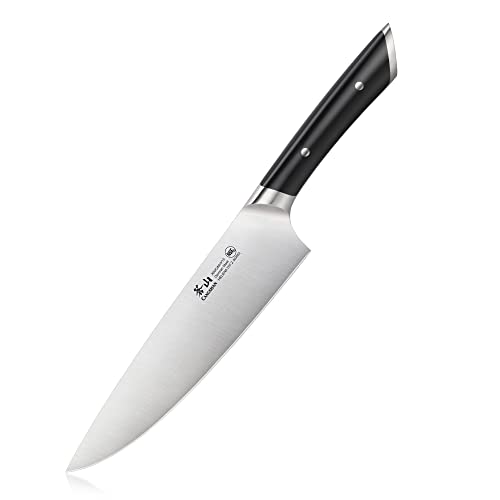
Not everyone needs a block. This is the knife from the set above on its own, and it’s the one I’d buy to find out whether the slim Cangshan handle suits your hand.

Six knives and shears in a walnut block, with no steak knives padding the count. The N1 is the best-looking forged set I know at its level, and you do pay a little extra for that design.

For cooks who want a harder, Japanese-style edge without leaving the brand. Layered X-7 steel at 60 HRC, a 16 degree edge and a sheath for drawer storage.

Sandvik 14C28N is the steel I’d choose from Cangshan’s range for edge holding with easy care. A 7″ santoku with dimples and a magnetic ash sheath makes a smart second knife.

Chef Thomas Keller designed this collection, and it’s the most serious steel Cangshan sells. Just a chef’s knife and a paring knife in a small walnut block, which is all a careful cook needs.
What Cangshan Does Well
Design you notice on the counter
Cangshan’s lines have won design awards (the TC series lists a 2018 Red Dot award), and you can see why. The handles are slimmer than a typical triple-riveted German knife, the blocks come in walnut or acacia, and the newer lines use matching sheaths. If looks matter to you, few brands at this level try as hard.
Honest steel names
Each line names its steel: German X50CrMoV15, Swedish Sandvik 14C28N, the in-house X-7 Damascus, and Damasteel RWL34 powder steel in the Thomas Keller collection. Cangshan also publishes hardness for most lines and sharpens its blades to 16 degrees per side, a little more acute than the classic German angle. That makes it easier to compare a Cangshan line with knives from other brands.
A real lifetime warranty
Cangshan covers its knives against defects for the lifetime of the original purchaser. Wood blocks and boards get one year. That’s in line with Wüsthof and Victorinox.
What Cangshan Does Badly
Too many lines with similar names
N1, S1, L, L1, TN1, TC, TS, HELENA, HAKU, KITA, KURO, ALPS, Sanford: many of them use the same German steel at the same hardness and differ mostly in handle shape and color. My biggest gripe is that a buyer can’t tell from the name what they’re paying for. The table below sorts it out.
No sharpening service
Shun sharpens its knives for free; Cangshan doesn’t advertise anything similar, and its warranty excludes damage from “non-recommended” sharpening. Plan on a whetstone or a careful honing routine. My guide on how to sharpen Cangshan knives covers the 16 degree angle.
Older lines disappear
Cangshan retires and renames lines often, and single knives from older series can be hard to replace. If you’re building a collection over time, start with a current line like HELENA rather than a discontinued one.
Cangshan Lines Compared
| Line | Steel | Hardness (HRC) | Style | Best for |
|---|---|---|---|---|
| HELENA | German X50CrMoV15 | 58 ±2 | Forged, slim Western handle | Most home cooks |
| N1 | German X50CrMoV15 | 58 ±2 | Forged, sculpted bolster | Design-led German set |
| TC | Swedish Sandvik 14C28N | 59 ±2 | Forged, with wood sheaths | Better edge holding, no block |
| HAKU | X-7 Damascus, 67 layers | 60 ±2 | Forged, with sheaths | Japanese-style sharpness |
| Thomas Keller Signature | Damasteel RWL34 powder steel | 61 ±2 | Forged, bolster-free blade | Premium, careful cooks |
1. Cangshan HELENA 12-Piece Knife Block Set: Best Overall
Who it’s for: a first good set, a wedding gift, or anyone replacing a mismatched drawer of knives in one go.
HELENA is the line I’d steer most people toward, because it’s current, easy to add to later and uses the dependable German steel that forgives a bit of rough handling. Every knife is forged and full tang, sharpened to 16 degrees per side, and the handles are slimmer than the chunky triple-riveted style many German sets still use. It was also on Oprah’s Favorite Things list in 2023, which is part of why it’s the Cangshan set you’ll see most often.
Twelve pieces sounds like a lot, but here the count is honest: seven of them are the chef’s knife, santoku, bread knife, utility knife, paring knife, shears and honing steel, and the other four are steak knives. I usually tell readers piece count is marketing, and this set gets close to the minimum I’d want.
My reservation is the wood. The acacia block only has a one-year warranty, and German steel at 58 HRC needs regular honing to stay sharp. Use the steel in the block every few cooking sessions.
Key specs
- Pieces: 8″ chef’s, 7″ santoku, 8″ bread, 5″ serrated utility, 3.5″ paring, four 5″ steak knives, 9″ forged shears, 8″ honing steel, acacia block
- Steel: German X50CrMoV15, 58 ±2 HRC, 16 degree edge
- Forged, full tang
- Lifetime warranty against defects (block: one year)
Pros
- Covers every everyday job
- Slim, comfortable handles
- Current line, easy to add to later
Cons
- Needs regular honing
- Hand wash only: dishwasher damage isn’t covered
My verdict: the Cangshan set I’d buy. Skip it if you already own good steak knives and want fewer, harder blades instead.
2. Cangshan HELENA 8″ Chef’s Knife: Best Chef’s Knife
Who it’s for: cooks who want one Cangshan knife, or a test drive before buying the set.
The HELENA chef’s knife is the same knife that sits in the 12-piece block. The blade has a classic Western curve, so it rocks through herbs and garlic, and the wide heel gives you room for knuckle clearance when you chop. It’s a forged German knife, but the slim handle and 16 degree edge make it feel a little lighter on its feet than the heavyweights.
Where it falls behind is edge life. X50CrMoV15 is tough and easy to hone, not a steel that stays sharp for months. If that matters more to you than toughness, look at the HAKU or TC picks below.
Key specs
- Blade: 8″, German X50CrMoV15 steel, 58 ±2 HRC
- Edge: 16 degrees per side
- Forged, full tang
- Lifetime warranty against defects
Pros
- Rocks and chops well
- Tough, forgiving steel
- Matches the HELENA sets
Cons
- Edge needs frequent honing
- No sheath included
My verdict: a safe, attractive chef’s knife. If you prefer a thinner, harder blade, go straight to the HAKU.
3. Cangshan N1 8-Piece Knife Block Set: Best Compact Block
Who it’s for: cooks who already have steak knives and want a smaller, design-led block.
The N1 is the line that made Cangshan’s name, with a sculpted bolster that flows into the handle instead of the usual squared-off German shape. I named this the best-looking forged set in my best knife sets under $200 guide, and I still think so. The steel is the same German X50CrMoV15 at 58 HRC as HELENA, so you’re choosing on looks and handle feel.
It has the same seven working pieces as the HELENA set minus the steak knives: chef’s knife, santoku, bread knife, serrated utility, paring knife, shears and honing steel. That’s exactly the kit I’d want. The trade-off is that you pay a little extra for the design compared with plainer German sets.
Key specs
- Pieces: 8″ chef’s, 7″ santoku, 8″ bread, 5″ serrated utility, 3.5″ paring, 9″ forged shears, 8″ honing steel, walnut block
- Steel: German X50CrMoV15, 58 ±2 HRC
- NSF certified, forged, full tang
- Lifetime warranty against manufacturer defects
Pros
- No filler pieces
- Striking walnut block and bolster design
Cons
- You pay partly for looks
- Sculpted bolster makes full-length sharpening fussier
My verdict: the Cangshan block for a kitchen where looks count. If you need steak knives too, the HELENA set is better value.
4. Cangshan HAKU 8″ Chef’s Knife: Best Damascus Line
Who it’s for: cooks who like the chef’s knife shape but want a harder, sharper edge.
HAKU uses Cangshan’s own X-7 steel in 67 layers, hardened to 60 HRC and hand-sharpened to 16 degrees. That’s two points harder than the German lines, which means a finer edge that lasts longer between sharpenings. The layered pattern is mostly looks; the steel itself decides how it cuts.
The catch with harder steel is the same here as with any Japanese-style knife: twist it in a squash or hit a bone and the edge can chip. It also comes with a sheath, which I like for drawer storage, so you don’t need a block to keep the edge safe.
Key specs
- Blade: 8″, X-7 Damascus steel, 67 layers, 60 ±2 HRC
- Edge: 16 degrees, hand-sharpened
- Sheath included
- Lifetime warranty against defects
Pros
- Holds an edge longer than the German lines
- Sheath for safe storage
Cons
- Edge may chip on bones or if you pry with it
- X-7 is Cangshan’s own steel, so it’s hard to compare with named steels
My verdict: Cangshan’s best single knife for sharpness. If you’re rough on knives, the HELENA is the safer choice.
5. Cangshan TC 7″ Santoku with Wood Sheath: Best Swedish Steel
Who it’s for: vegetable-heavy cooks and anyone who keeps knives in a drawer.
Sandvik 14C28N is a fine-grained Swedish stainless that sits between German and Japanese steel: harder than X50CrMoV15 (59 HRC here), but still easy to look after. The TC line pairs each blade with a magnetic ash wood sheath, so you can skip the block entirely. Cangshan claims it holds an edge up to five times longer than its German steel; I’d treat the number as marketing, but the direction is right.
The santoku has oval dimples to stop slices sticking and a flatter edge for push cuts and chopping. It suits cooks who chop and push cut more than they rock.
Key specs
- Blade: 7″, Swedish 14C28N steel, 59 ±2 HRC, oval dimples
- Handle: 5.5″, full tang, forged
- Magnetic carbonized ash wood sheath
- NSF certified; lifetime warranty against manufacturer defects
Pros
- Best steel for easy care in Cangshan’s range
- Sheath means no block needed
Cons
- Blunt santoku tip limits detail work
- TC line is older, fewer pieces available
My verdict: the Cangshan knife I’d give a vegetable lover. Rockers should pick a chef’s knife instead.
6. Cangshan Thomas Keller 3-Piece TAI Block: Best Premium
Who it’s for: careful cooks who want Cangshan’s best steel and only need two knives.
The Thomas Keller Signature Collection is Cangshan’s top line, designed with the chef behind The French Laundry. The blades are Damasteel RWL34, a Swedish powder steel, hardened to 61 HRC and hand polished. Powder steels have a very fine, even grain, which is why they take a keen edge and hold it well.
This small set is just an 8″ chef’s knife and a 3.5″ paring knife in a compact walnut block, which I think is the smartest way into the line. The bolster-free blade lets you sharpen the whole edge, heel included. As with HAKU, the harder steel means no bones, no frozen food and no glass boards.
Key specs
- Pieces: 8″ chef’s knife, 3.5″ paring knife, TAI walnut block
- Steel: Damasteel RWL34 powder steel, 61 ±2 HRC
- Handle: contoured polymer, ambidextrous; stainless end cap
- NSF certified; lifetime warranty against manufacturer defects
Pros
- Best steel Cangshan sells
- Two knives you’ll actually use
- Whole edge can be sharpened
Cons
- Hard steel chips if misused
- Costs much more than the HELENA chef’s knife
My verdict: the premium Cangshan for cooks who look after their knives. For everyday abuse, stick with HELENA.
Cangshan vs Other Brands
Cangshan vs Wüsthof
Wüsthof is the safer long-term buy: made in Solingen, Germany, with a track record going back generations and a line structure that rarely changes. Cangshan’s German lines use the same type of steel with slimmer handles and more design flair. I go through Wüsthof’s lines in my Wüsthof knives review.
Cangshan vs Shun
Shun is Japanese-made with harder VG-MAX steel and a free sharpening service, both points Cangshan can’t match. Cangshan’s German lines are tougher and more forgiving; its HAKU and Thomas Keller lines compete on sharpness. If you want a Japanese knife from a Japanese maker, see my Shun knives review.
Cangshan vs Dalstrong
Both are design-led brands that sell knives made in China, and with both you pay partly for presentation. Cangshan’s naming is more confusing, but its steel and hardness are clearly stated on every line I picked.
FAQ
Are Cangshan knives good?
Yes, for most home cooks. Cangshan uses named steels, forged full-tang blades and a lifetime warranty. They aren’t heirloom knives from a historic maker, and there’s no sharpening service, but the HELENA and N1 lines are solid German-style knives. My short answer is in are Cangshan knives good?
Where are Cangshan knives made?
In Yangjiang, China, a city with a long history of knife making. The brand was founded by Henry Liu, who partnered with a Yangjiang manufacturer. The steel itself comes from several sources: German X50CrMoV15, Swedish Sandvik 14C28N and Damasteel RWL34.
Which Cangshan knife set is best?
For most people, the HELENA 12-piece block, because it covers every job with no real filler. If you don’t need steak knives, the N1 8-piece block is the better-looking, smaller choice.
Can Cangshan knives go in the dishwasher?
No. Cangshan asks you to hand wash and dry them, and its warranty excludes damage from dishwasher use, rust from improper care and prolonged exposure to water.
What angle are Cangshan knives sharpened to?
Cangshan sharpens most of its lines to 16 degrees per side. Keep that angle when you sharpen, ideally on a whetstone, because the warranty excludes damage from non-recommended sharpening tools.
Is Cangshan a good knife brand compared to German brands?
It’s a good mid-level brand. The German-steel lines match the steel type of Wüsthof and ZWILLING but not their history or their factories in Germany. For the differences between the two traditions, see my German vs Japanese knives guide.
Final Verdict
Cangshan makes attractive, honestly specified knives that suit cooks who care about how their kitchen looks. Start with the HELENA 12-piece block if you’re buying a whole set, or its 8″ chef’s knife if you want one knife. For a harder edge, the HAKU chef’s knife is the brand’s best single blade, and the Thomas Keller block is the one to buy if you want Cangshan’s best steel and plan to look after it.
Still comparing brands? My best knife sets guide puts Cangshan next to the other brands I recommend.

Gary Portman founded knivesadvice.com in 2019. He learned to cook in his family’s kitchen as a kid and has used kitchen, pocket and outdoor knives ever since, from paring and fillet knives to survival blades he carries camping and hiking. He writes the site’s buying guides, brand reviews and sharpening how-tos to help readers find the right knife for the job. More about Gary.