
Here’s a fact that surprises people: the paring knife is the one kitchen knife where spending more rarely gets you a better cut. The blade is tiny, the work is light (peeling an apple, hulling strawberries, deveining shrimp), and most of it happens in your hand rather than on a board. What matters is a thin, sharp blade and a handle you can steer with your fingertips.
That’s why my top pick is the Victorinox Swiss Classic 3.25-inch, a knife that costs very little and does the job as well as anything. If you want a paring knife that matches a forged German set, get the WÜSTHOF Classic 3.5-inch, and tomato lovers should add the serrated Victorinox.
My Top 7 Paring Knife Picks

I’d happily own three of these and never think about paring knives again. The blade is thin enough to follow the curve of a potato, the textured handle grips wet fingers, and it’s cheap enough that losing one in a picnic basket isn’t a tragedy.

This is the paring knife for people who like a solid, forged feel even in a small blade. It’s stiffer than the Victorinox, so it’s better at scoring and trimming, and it lines up perfectly with a WÜSTHOF chef knife.

A paring knife is the safest way to own hard Japanese steel, because peeling and coring almost never stress the edge. This Shun stays razor sharp for a long time and is a lovely thing to use.

If you like the look and weight of a forged, riveted knife but not the price, this is the one. It even comes with a blade guard, which a drawer-stored paring knife badly needs.

Tomatoes, kiwis, plums, citrus: anything with a slick skin and a soft middle. The tiny serrations bite through the skin instead of squashing the fruit, and they stay working long after a straight edge would slip.
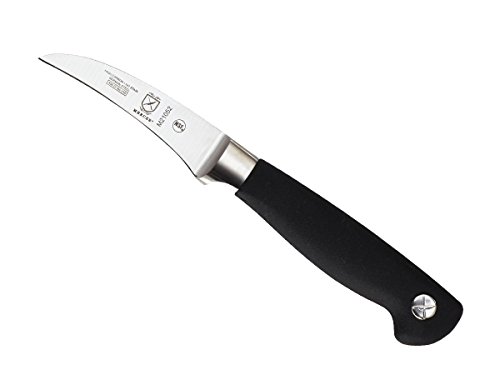
The curved blade wraps around round fruit and vegetables, which makes peeling and garnishing faster. A specialist tool, but a cheap one, with Mercer’s grippy Genesis handle.

For lunches, picnics, camping or a crowded drawer, the locking sheath is the whole point. The soft OXO handle is comfortable, and the sheath protects both the edge and your fingers.
Paring Knives Compared
| Knife | Blade | Edge | Handle | Best for |
|---|---|---|---|---|
| Victorinox Swiss Classic | 3.25″, thin, stamped | Straight | Textured synthetic | Everyday peeling and trimming |
| WÜSTHOF Classic | 3.5″, forged | Straight | Synthetic, triple riveted | Owners of forged German knives |
| Shun Classic | 3.5″, VG-MAX | Straight, 16 degrees | D-shaped Pakkawood | Long-lasting sharpness |
| Cuisinart Triple Rivet | 3.5″, forged, full tang | Straight | Riveted synthetic | Forged feel on a budget |
| Victorinox Serrated | 3.25″ | Serrated | Textured synthetic | Tomatoes and soft fruit |
| Mercer Genesis Peeling | 3″, curved | Straight, bird’s beak | Non-slip synthetic | Peeling round produce, garnishes |
| OXO Good Grips | 3.5″ | Straight | Soft non-slip | Packed lunches, picnics, drawers |
1. Victorinox Swiss Classic 3.25-Inch Paring Knife: Best Overall
Who it’s for: pretty much everyone, from first kitchens to cooks who already own expensive chef knives.
I’ve recommended this little Victorinox on more than one list on this site, and I’ll keep doing it, because it’s the rare case where the cheapest serious option is also the best. The blade is very thin, which is exactly what you want for in-hand work: it follows the contour of an apple or a potato without tearing off a thick strip of flesh, and it slips under the skin of a mango with no fuss.
The handle is the other half of the story. It’s textured and shaped to sit in your palm while your thumb guides the food, and it stays grippy when your hands are wet from washing produce. The spear point is fine enough for coring strawberries and scoring tomatoes for blanching.
What you give up is stiffness. The thin blade flexes a little, so it’s not the knife for prying out a stubborn avocado pit or cutting through anything hard. And it looks like a tool rather than a showpiece. Victorinox says it’s dishwasher safe, but hand washing keeps the edge sharp longer, so that’s what I’d do.
Key specs
- Blade: 3.25-inch straight edge, spear point, stainless steel
- Handle: textured, non-slip even when wet, ergonomic shape
- NSF approved; dishwasher safe per Victorinox
Pros
- Thin blade peels with very little waste
- Grippy handle for wet hands
- Costs very little, so you can own more than one
Cons
- Blade flexes under heavy pressure
- Plain, utilitarian look
My verdict: buy this first, whatever else you own. Only skip it if you want a paring knife that matches a forged set.
2. WÜSTHOF Classic 3.5-Inch Paring Knife: Best German
Who it’s for: cooks who own or want WÜSTHOF Classic knives and prefer a stiff, solid paring knife.
Next to the Victorinox, the WÜSTHOF feels like a different class of tool. It’s forged, full tang and triple riveted like the rest of the Classic line, so it has real weight and almost no flex. That stiffness makes it better at board work: trimming the fat off a pork chop, scoring bread dough, cutting a shallot into fine dice.
I also like it as a low-risk test. If you’re wondering whether WÜSTHOF Classic handles suit your hand, a paring knife is the cheapest way into the line, and you’ll use it daily either way. My full WÜSTHOF knives review covers the rest of the range.
The honest downside is that it doesn’t peel any better than the Victorinox, which costs far less. You’re paying for build, balance and longevity, not for a sharper cut. The thicker blade also takes a bit more off when you peel round fruit.
Key specs
- Blade: 3.5-inch forged high-carbon stainless steel
- Handle: full tang, triple-riveted synthetic
- Part of WÜSTHOF’s Classic series; made in Solingen, Germany
Pros
- Stiff blade for precise trimming and board work
- Durable forged build that lasts decades
- Matches a WÜSTHOF chef knife in feel
Cons
- Costs much more than the Victorinox for similar peeling
- Thicker blade, slightly more waste on round fruit
My verdict: the paring knife for forged-knife fans and WÜSTHOF owners. If you just need something to peel with, the Victorinox does that equally well.
3. Shun Classic 3.5-Inch Paring Knife: Best Japanese
Who it’s for: cooks who want the sharpest, longest-lasting edge, or who’d like to try Shun without buying a big knife.
Hard Japanese steel has one weakness: it can chip when twisted or knocked against bone. A paring knife barely ever meets those situations, which is why I think it’s the perfect small Shun. Peeling, coring and fine slicing let the VG-MAX steel do what it’s good at, holding a very keen 16 degree edge for a long time.
It cuts beautifully. Strawberries hull cleanly, shallots slice into see-through rings, and the Damascus-clad blade looks the part. The D-shaped Pakkawood handle is comfortable in a pinch grip, though it’s a little large for some people in a small knife.
It still needs some care: hand wash it, keep it off glass boards, and sharpen it on a stone or ceramic rod, not a pull-through. Shun’s free sharpening service for the original owner is a real plus here. More on the brand in my Shun knives review.
Key specs
- Blade: 3.5-inch; VG-MAX steel core under 68 Damascus layers
- Edge: 16 degrees
- Handle: D-shaped Pakkawood, left- or right-handed use
- Handcrafted in Japan; free sharpening and honing service
Pros
- Keenest, longest-lasting edge on this list
- Low chipping risk for paring tasks
- Beautiful finish
Cons
- Expensive for a small knife
- Needs stones or a ceramic rod for upkeep
- Handle feels bulky to some in a knife this small
My verdict: a luxury, but a sensible one, and the gentlest introduction to Japanese steel. Skip it if you want a knife you can toss in the sink.
4. Cuisinart Triple Rivet 3.5-Inch Paring Knife: Best Forged Budget
Who it’s for: anyone who likes the weight of a forged, riveted knife but wants to spend very little.
Cuisinart’s Triple Rivet line is the reason I take the brand seriously at the budget end. It’s forged with a full tang, an extra-wide bolster and stainless rivets, so this paring knife feels much more substantial than its price suggests. It sits between the light Victorinox and the solid WÜSTHOF in feel.
The included blade guard is a bigger deal than it sounds. Paring knives tend to rattle around loose in drawers, which chips edges and cuts fingers. This one comes ready to store safely.
Cuisinart doesn’t publish the steel grade or hardness, so expect it to dull faster than the premium picks: hone it often. The lifetime warranty covers defects, not wear. I cover the brand’s lines in my Cuisinart knives review.
Key specs
- Blade: 3.5-inch forged blade of high-carbon stainless, full tang
- Extra-wide safety bolster; stainless steel rivets
- Blade guard included; lifetime warranty
Pros
- Forged, riveted build for very little money
- Comes with a blade guard
- Comfortable, balanced handle
Cons
- Steel grade not published; dulls faster
- Thicker than ideal for fine peeling
My verdict: the cheapest way to get a forged paring knife that feels solid. Choose the Victorinox instead if peeling is your main job.
5. Victorinox Swiss Classic 3.25-Inch Serrated Paring Knife: Best Serrated
Who it’s for: anyone who slices a lot of tomatoes, stone fruit, citrus or kiwis.
A straight-edged paring knife only grips a tomato skin while it’s truly sharp. Let it dull a little and it skates across the surface and squashes the fruit. The fine serrations on this Victorinox catch the skin no matter what, and they keep doing it for a long time between sharpenings.
It’s the same handle and thin blade as my top pick, which makes it a natural pair: straight edge for peeling, serrated for slicing soft fruit. Victorinox covers defects for life, and it’s made in Switzerland.
Serrations aren’t for peeling, though; they tear rather than glide along the skin. And when it finally dulls, it needs a narrow ceramic rod rather than a regular sharpener.
Key specs
- Blade: 3.25-inch serrated (wavy) edge, spear point
- Handle: contoured Swiss Classic, sure grip when wet
- Made in Switzerland; lifetime warranty against defects
Pros
- Bites through slick skins without crushing
- Stays useful long after a straight edge dulls
- Costs very little
Cons
- Poor for peeling
- Harder to sharpen at home
My verdict: a cheap, useful second paring knife. Buy it alongside a straight-edged one, not instead.
6. Mercer Culinary Genesis 3-Inch Peeling Knife: Best Bird’s Beak
Who it’s for: cooks who peel lots of round produce, or like to cut garnishes.
A bird’s beak (or tourné) knife has a short blade that curves downward like a claw. That curve hugs round shapes, so peeling an apple, an orange or a potato takes fewer, longer strokes. It’s also the classic tool for cutting the seven-sided “tourné” potatoes of French cooking and for small garnishes.
The Mercer Genesis is a good, inexpensive way to try the shape. It’s forged from high-carbon German steel, has the same non-slip handle as Mercer’s chef knives, and Mercer lists it for peeling, garnishing, deveining shrimp and removing seeds.
The downside is that it’s a specialist. The curved edge is awkward on a cutting board, so it can’t replace a straight paring knife. Mercer also says hand wash only.
Key specs
- Blade: 3-inch curved peeling/tourné blade, forged high-carbon German steel
- Handle: ergonomic, non-slip with wet hands
- Hand wash only
Pros
- Fastest peeler for round produce
- Great for garnishes and seeds
- Forged at a low price
Cons
- Useless on a cutting board
- Curved edge is trickier to sharpen
My verdict: a fun, cheap add-on if you peel a lot. Most people should buy a straight paring knife first.
7. OXO Good Grips 3.5-Inch Paring Knife: Best With a Sheath
Who it’s for: anyone packing fruit for work, school lunches, picnics or camping, and kitchens without a knife block.
Taking a bare paring knife out of the house is asking for a cut finger. The OXO solves that with a sheath that locks onto the blade, so it can sit in a lunch bag or a picnic basket safely. OXO describes it as lightweight and compact for exactly that use.
The soft, non-slip Good Grips handle is comfortable and familiar if you own other OXO tools. It’s a straightforward paring knife that slices apples, cheese and sandwiches well.
It isn’t the sharpest or most refined knife on this list, and OXO doesn’t publish much about the steel. For the job it’s meant for, that’s fine.
Key specs
- Blade: 3.5-inch stainless steel
- Locking sheath for storage and transport
- Soft, non-slip Good Grips handle
Pros
- Safe to carry with the locking sheath
- Comfortable handle
- Light and compact
Cons
- Little published detail about the steel
- Not as keen as the premium picks
My verdict: the paring knife to keep in your bag. In the kitchen, I’d still reach for the Victorinox.
Choosing a Paring Knife: What Actually Matters
A thin blade beats a fancy one
Thin blades peel and core better because they follow curves and waste less food. That’s why inexpensive stamped knives often beat forged ones at paring. Choose a forged blade only if you want stiffness for trimming and board work. I weigh exactly this trade-off in WÜSTHOF vs Victorinox.
3 to 4 inches is the right length
A 3 to 3.5-inch blade gives the most control for in-hand peeling; 4 inches adds reach for board work like halving limes or trimming meat. Anything shorter is a specialist peeling knife.
Straight, serrated or bird’s beak?
Start with a straight edge: it does the most jobs and is easiest to sharpen. Add a serrated paring knife if you slice lots of tomatoes and soft fruit, and a bird’s beak only if you peel round produce in volume.
The handle should suit fingertip control
Most paring work happens in the air, guided by your thumb and fingertips. Choose a handle that is grippy when wet and slim enough to turn easily. Textured synthetic handles are the safest; large D-shaped or heavy handles can feel clumsy on a tiny blade.
Store it properly
Paring knives get lost and damaged in drawers more than any other knife. Give yours a slot in the knife block, a spot on a magnetic strip, or a guard. Starting from scratch? Most of the sets in my best knife sets under $100 include a decent paring knife.
FAQ
What is a paring knife used for?
A paring knife is used for small, precise jobs: peeling fruit and vegetables, coring apples and tomatoes, hulling strawberries, deveining shrimp, trimming and scoring. Many of these jobs are done in your hand rather than on a board.
What is the difference between a paring knife and a utility knife?
A paring knife has a 3 to 4-inch blade for in-hand and detail work; a utility knife is longer (usually 5 to 6 inches) and sits between a paring knife and a chef knife for slicing sandwiches, cheese and small vegetables on a board.
Do I need an expensive paring knife?
No. A thin, inexpensive paring knife like the Victorinox peels as well as premium knives. Paying more makes sense for a forged feel, a matching set or longer edge retention.
Should a paring knife be serrated?
Your main paring knife should have a straight edge, because it peels better and sharpens easily. A serrated paring knife is a useful second knife for tomatoes, citrus and soft fruit.
Can you sharpen a paring knife?
Yes. Straight-edged paring knives sharpen on a whetstone, guided sharpener or pull-through like any other knife; their small size makes them quick. Serrated ones need a narrow ceramic rod.
Final Verdict
The Victorinox Swiss Classic 3.25-inch is the paring knife I’d recommend to almost everyone: thin, grippy and cheap enough to buy two. Owners of forged German knives will feel more at home with the WÜSTHOF Classic 3.5-inch, and the Shun Classic 3.5-inch is the best small way into Japanese steel.
Filling out the rest of your kitchen? See my picks for the best kitchen knives under $100, or my best kitchen knives for one knife per job at any budget.

Gary Portman founded knivesadvice.com in 2019. He learned to cook in his family’s kitchen as a kid and has used kitchen, pocket and outdoor knives ever since, from paring and fillet knives to survival blades he carries camping and hiking. He writes the site’s buying guides, brand reviews and sharpening how-tos to help readers find the right knife for the job. More about Gary.