
For most people, the best bowie knife is the KA-BAR USMC. It isn’t the biggest or the fanciest, but it’s the one design on this list that has been worked hard for over 80 years and is still made the same way: a 7-inch clip point of 1095 carbon steel, a stacked leather handle and a straight crossguard.
The thing to watch with bowies is that many are built to look dramatic, not to cut. A 14-inch blade in soft steel with a rat-tail tang makes a fine wall decoration and a poor camp knife. Every knife below has a proper tang, a steel I’d trust outdoors and a sheath you can wear. If you want a bowie that’s tamer to carry, the Buck 119 Special is the classic alternative.
My Top 6 Bowie Knife Picks

The most famous working bowie in America for a reason: tough 1095 Cro-Van, a 7-inch blade that chops and slices, and a leather handle that’s comfortable for hours. If you only buy one, buy this one.

A 6-inch clip point in easy-care 420HC stainless, made in the USA since the 1940s. Less blade to manage than the KA-BAR, and a polished classic look that has made it a favorite gift.
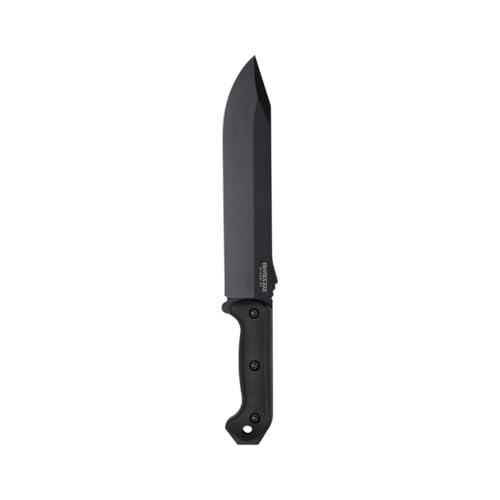
A 9.25-inch slab of 1095 Cro-Van that chops like a small hatchet. It’s the bowie I’d pick for clearing brush and splitting kindling at a base camp.

An old-style frontier pattern with an S-shaped guard, hardwood handle and 1085 carbon steel blade. It looks the part and still works as a real knife.

A 5.6-inch clip point with a full tang, sawcut handle and leather sheath for very little money. A sensible first bowie-style knife or a spare for the truck.

The bowie shape shrunk to a tiny neck or pocket fixed blade. It won’t chop anything, but it’s a fun, practical everyday cutter.
Bowie Knives Compared
| Knife | Blade | Steel | Handle | Guard | Best for |
|---|---|---|---|---|---|
| KA-BAR USMC | 7″ clip point | 1095 Cro-Van carbon | Stacked leather | Straight steel | All-round outdoor use |
| Buck 119 Special | 6″ clip point, full tang | 420HC stainless | Phenolic | Aluminum | Hunting camp, gifts |
| KA-BAR Becker BK9 | 9.25″ clip point, full tang | 1095 Cro-Van carbon | Grivory | Integral | Chopping, brush |
| Cold Steel 1917 Frontier | Clip point | 1085 carbon | Hardwood | S-shaped | Traditional style |
| Old Timer 15OT Deerslayer | 5.6″ clip point, full tang | High carbon stainless | Sawcut Delrin | Finger choil | Budget, backup |
| CRKT Minimalist Bowie | About 2″ clip point | High carbon stainless | Resin-infused fiber | None | Everyday carry |
1. KA-BAR Full Size USMC (Straight Edge): Best Overall
Who it’s for: anyone who wants one big, dependable clip point for camping, hunting camp and the truck, with real history behind it.
The US Marine Corps adopted this knife in 1942, and KA-BAR has been making it in Olean, New York, ever since. Plenty of knives borrow its shape; few balance chopping and slicing as well. The 7-inch blade is 1095 Cro-Van, a carbon steel with a little chromium and vanadium added, with a 20-degree edge that favors durability over pure sharpness.
The handle is made of stacked leather washers, which sounds old-fashioned until you hold it: it’s warm in cold weather, comfortable for long work and grippier than polished wood when your hands are damp. The leather sheath matches the look. At about 12 inches overall, it’s a full-size knife, but it never feels clumsy.
Leather has drawbacks. The handle can rot or shrink if you leave it soaking wet, and a leather sheath stretches over time. The carbon blade needs drying and a little oil after wet days too. If you work in constant rain, the Buck’s stainless steel is easier to live with.
Key specs
- Blade: 7″ clip point, 1095 Cro-Van carbon steel, 20° edge angle
- Overall length: 11.875″
- Handle: stacked leather, straight steel crossguard
- Leather sheath; made in USA
Pros
- Proven, balanced all-round design
- Tough steel that sharpens easily
- Comfortable leather grip
Cons
- Leather handle and sheath need care when wet
- Carbon steel rusts if neglected
My verdict: the bowie knife I’d buy first. Choose the Buck 119 if you want stainless steel and a shorter blade.
2. Buck 119 Special: Best Mid-Size
Who it’s for: hunters and campers who want a classic clip point that’s easy to look after, and anyone shopping for a gift.
Buck introduced the 119 in 1942, and it has stayed in the catalog because it’s a well-judged size. The 6-inch clip point is long enough for camp chores and quartering game, yet shorter and lighter (7.5 ounces) than the KA-BAR. It’s a bit long for field dressing a deer, but as a camp and hunting-lodge knife it’s excellent.
The blade is 420HC stainless, which Buck heat treats well. It doesn’t hold an edge as long as harder steels, but it resists rust and comes back quickly on a rod or stone. The full tang runs into a black phenolic handle with palm swells, and the aluminum guard and pommel keep the weight down while giving it that polished look. It’s handcrafted in the USA with Buck’s Forever Warranty.
The handle is smooth, so it’s less secure than rubber with bloody or wet hands. The leather sheath is basic, with a simple snap strap. And the clip point’s fine tip is more fragile than a drop point if you pry with it.
Key specs
- Blade: 6″ clip point, 420HC stainless, full tang
- Overall length: 10.5″; weight 7.5 oz
- Handle: phenolic with aluminum guard and pommel
- Genuine leather sheath; made in USA; Buck Forever Warranty
Pros
- Stainless steel, low maintenance
- Manageable size and weight
- Classic looks, lifetime warranty
Cons
- Smooth handle when wet
- Fine tip isn’t for prying
My verdict: the easiest bowie to own. Pick the KA-BAR if you want more blade and don’t mind caring for carbon steel.
3. KA-BAR Becker BK9 Combat Bowie: Best Chopper
Who it’s for: base campers, landowners and anyone who wants a big knife that can stand in for a hatchet.
The BK9 is what a bowie looks like when it’s designed as a working tool first. The 9.25-inch clip point has a flat saber grind and enough weight up front to chop kindling, limb small branches and clear brush. It’s 1095 Cro-Van like the KA-BAR USMC, with a black epoxy powder coat against rust.
The full tang is covered with Grivory, a glass-filled nylon that’s grippy and nearly indestructible, and the scales unbolt if you’d like to fit Micarta or wood. The nylon sheath has a Kydex insert for safety and a front pouch for a sharpener or fire steel.
It’s heavy and long. On a belt it gets in the way when you sit or climb into a vehicle, and it’s too much knife for food prep or small carving. Think of it as a knife for the truck, the cabin or the canoe, not the hiking trail.
Key specs
- Blade: 9.25″ clip point, 1095 Cro-Van carbon steel, flat saber grind
- Black epoxy powder coat; full tang
- Handle: Grivory (glass-filled nylon), replaceable
- Nylon sheath with Kydex insert and front pouch
Pros
- Chops far better than shorter bowies
- Very tough full-tang build
- Practical sheath with a pouch
Cons
- Heavy and awkward to wear all day
- Too big for fine work
My verdict: the bowie to buy for heavy camp work. For a knife you’ll actually carry, stay with the 7-inch KA-BAR.
4. Cold Steel 1917 Frontier Bowie: Best Traditional Bowie
Who it’s for: buyers who love the 1800s frontier look but still want a knife that can do outdoor work.
If your picture of a bowie comes from westerns, this is the closest knife here. It has the big S-shaped guard that protects your hand on both sides, a slim, flat pistol-grip handle in hardwood, and a leather sheath with blued steel fittings. Cold Steel says the flat handle profile resists twisting in your hand and keeps the edge aligned, which matters on a long blade.
The blade is 1085 high carbon steel with a black finish. 1085 is a simple, tough carbon steel, close to the 1095 used by KA-BAR, and it takes an edge easily.
Carbon steel and wood both need care: wipe the blade dry, oil it now and then, and don’t leave the handle wet. The guard catches on clothing and gear more than a straight one does. And it’s a statement piece; it’s not a knife for discreet carry.
Key specs
- Blade: clip point, 1085 high carbon steel, black finish
- Overall length: 12.25″
- Handle: hardwood, modified pistol grip; S-shaped guard
- Leather sheath with blued steel fittings
Pros
- Authentic frontier styling
- Excellent hand protection from the guard
- Tough, easy-to-sharpen carbon steel
Cons
- Wood and carbon steel need upkeep
- S-guard snags on gear
My verdict: the best bowie for collectors who also want to use their knife. For pure outdoor work, the KA-BAR is more practical.
5. Old Timer 15OT Deerslayer: Best Budget
Who it’s for: first-time buyers, young outdoors people and anyone who wants a cheap bowie-style knife they won’t mind scratching.
Old Timer has sold traditional outdoor knives for decades, and the Deerslayer is a small bowie pattern at a very low price. The 5.6-inch clip point is high carbon stainless with a full tang, and the black sawcut Delrin handle has a finger choil and thumb jimping so your hand stays put.
It comes with a brown leather belt sheath and is covered by Old Timer’s lifetime warranty. At 7.7 ounces and 10.5 inches overall, it’s in the same size class as the Buck 119.
You can tell where the money was saved. The steel grade isn’t named, the fit and finish are simpler, and the sawcut handle looks plain next to the Buck’s. The cheap bowies I’d avoid are no-name 14-inch blades in soft steel. Elk Ridge also sells plenty of good-looking budget bowies, and as I said in my Elk Ridge knives review, they suit light use and display better than hard work; the Deerslayer is the one I’d actually use.
Key specs
- Blade: 5.6″ clip point, high carbon stainless, full tang
- Overall length: 10.5″; weight 7.7 oz
- Handle: sawcut Delrin, finger choil and thumb jimping
- Leather belt sheath; Old Timer lifetime warranty
Pros
- Costs very little
- Full tang and leather sheath
- Lifetime warranty
Cons
- Steel grade not stated
- Plainer fit and finish
My verdict: the bowie-style knife to buy on a small budget. If you can stretch, the Buck 119 is a clear step up.
6. CRKT Minimalist Bowie: Best Compact
Who it’s for: people who like the bowie shape but want something they can wear every day without drawing looks.
The Minimalist series is CRKT’s line of tiny fixed blades, and the bowie version gives you the clip point profile on a blade of about two inches. Your fingers wrap around a short, contoured handle of resin-infused fiber, which gives you a lot more control than you’d expect from something so small.
The high carbon stainless blade is bead blasted to cut glare and is easy to sharpen. The thermoplastic sheath can hang from your neck, sit inside a waistband or ride on a belt, depending on how you set it up.
It’s not a camp knife. It won’t chop, baton or handle anything bigger than opening packages, cutting cord and slicing an apple. Bigger hands may find the handle too short. Treat it as a fun everyday cutter rather than a replacement for a real bowie. If you want a light knife for the trail, my best knives for backpacking are better choices.
Key specs
- Blade: about 2″ clip point, high carbon stainless, bead blast finish
- Handle: resin-infused fiber
- Thermoplastic sheath with several mounting options
- Very light
Pros
- Easy to carry every day
- Secure grip for its size
- Flexible sheath options
Cons
- No heavy-duty use
- Short handle for large hands
My verdict: a great little extra knife. Don’t buy it as your only outdoor blade.
What Makes a Good Bowie Knife
A real tang, not a stub
Choose a bowie with a full tang or a long, solid hidden tang (the KA-BAR’s runs through the leather handle to the pommel). Cheap display bowies often have a short threaded tang that can snap the first time you chop.
Blade length that matches the job
A 6 to 7-inch blade is the most useful size: it chops, slices and still fits on a belt. Nine inches and more is for chopping and camp work, though a kukri chops harder still. Under 6 inches, you’re closer to a hunting knife.
Steel you can maintain
Carbon steels like 1095 and 1085 take hard knocks and sharpen quickly, but they rust if you don’t dry and oil them. Stainless like 420HC needs almost no care. My carbon vs stainless steel guide explains which suits you.
A guard that protects your hand
A crossguard stops your hand sliding onto the edge when you thrust or chop. Straight guards are easier to carry; S-guards protect more but snag.
A sheath worth wearing
A big blade needs a sheath that holds it firmly. Leather is classic but stretches; nylon with a hard insert or a molded sheath holds its shape better.
Check local laws
Many states and cities limit carrying large fixed blades or knives with a double edge. Laws vary, so check yours before wearing a bowie in public.
FAQ
What is a bowie knife?
A bowie knife is a large fixed-blade knife with a clip point, usually with a crossguard. The style is named after Jim Bowie, who made a big knife famous after the 1827 Sandbar Fight in Louisiana; the original design is often credited to his brother Rezin.
What is the best bowie knife?
The KA-BAR USMC is the best bowie knife for most people: tough 1095 Cro-Van steel, a 7-inch blade and a proven design. The Buck 119 Special is the best stainless alternative, and the Old Timer Deerslayer is the best budget pick.
Is the KA-BAR a bowie knife?
Yes, the KA-BAR USMC is a bowie-style knife: a large clip point fixed blade with a crossguard. It’s often called a combat or fighting utility knife because of its military history.
What size should a bowie knife be?
A 6 to 7-inch blade is the best all-round size. Blades of 8 to 10 inches chop better but are heavy to carry, and anything bigger is mostly for display.
Are bowie knives good for survival?
A well-made bowie can be a good survival knife, especially for chopping. The clip point tip is weaker than a drop point, though, so most survival instructors prefer a 4 to 6-inch drop point like the knives in my bushcraft knife guide.
Final Verdict
The KA-BAR USMC is the bowie knife I’d recommend first: proven, tough and comfortable in the hand. The Buck 119 Special is the easy-care stainless choice, and the Becker BK9 is the one to pick when you need a big chopper.
Want something cheaper and lighter for a backup? My Glock field knife review covers a tough, inexpensive clip point, and my best knife makers list explains why Buck has lasted so long.

Gary Portman founded knivesadvice.com in 2019. He learned to cook in his family’s kitchen as a kid and has used kitchen, pocket and outdoor knives ever since, from paring and fillet knives to survival blades he carries camping and hiking. He writes the site’s buying guides, brand reviews and sharpening how-tos to help readers find the right knife for the job. More about Gary.