
The knife most people picture when they hear “hunting knife” is a big clip point with a brass guard and a seven-inch blade, in other words a bowie knife. That’s a great knife to hang on a wall. In the field, it’s clumsy. Field dressing a deer is close, careful work: opening the hide without puncturing the gut, cutting around the pelvis, freeing the windpipe deep inside the chest cavity. A blade of three to four and a half inches does all of it better, because you can control the tip.
The other thing a hunting knife has to do is stay in your hand when it’s wet, cold and bloody. Smooth wood and polished resin look lovely in a catalog, but textured rubber or a high-friction polymer is safer when the work gets messy. Steel comes after that: easy-to-sharpen stainless like 420HC or 12C27 that you can touch up on a small rod in camp beats a premium steel you can’t sharpen until you’re home.
Put those together and my pick is the Buck 692 Vanguard: a 4 1/4-inch drop point, full tang, rubber handle. On a budget, the Morakniv Companion does the same job for very little.
My Top 6 Hunting Knife Picks

A classic Buck drop point with a modern grip. It has the size, the full tang and the guard I want for deer and elk, and the textured rubber handle doesn’t turn slick when your hands are wet.
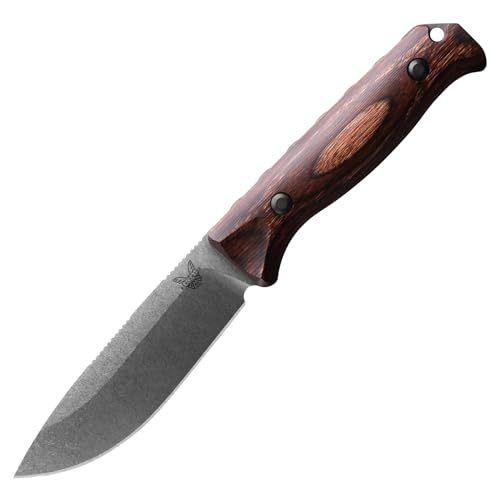
A beautifully made skinner in S30V that will go a whole season without much touching up. Benchmade also resharpens it for free, which suits a premium hunting knife.
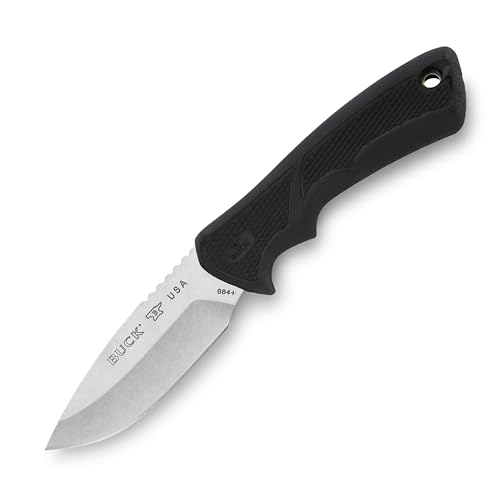
Under 3 ounces, made in the USA, with a grippy rubber handle and finger grooves. The 3 1/4-inch drop point is just right for whitetails, and it costs much less than the 692.

When the edge dulls, you swap in a fresh blade instead of sharpening. Many hunters carry one of these alongside a fixed blade for skinning and caping, where a scalpel-sharp edge pays off.

Swedish 12C27 steel, a high-friction handle and a bright orange color that’s easy to find in leaves. It costs very little and does real work.

The upswept blade and pointed tip make long, clean skinning strokes easy. A design hunters have bought for decades, with a full tang and a leather sheath.
Hunting Knives Compared
| Knife | Blade | Steel | Handle | Weight | Best for |
|---|---|---|---|---|---|
| Buck 692 Vanguard | 4 1/4″ drop point, full tang | 420HC | Textured rubber | 6.6 oz | Deer, elk, all-round |
| Benchmade Saddle Mountain Skinner | Drop point | CPM S30V | Stabilized wood | Not stated | Long seasons, gift |
| Buck 684 BuckLite Max II | 3 1/4″ drop point, full tang | 420HC | Dynaflex rubber | 2.8 oz | Whitetails, light packs |
| Outdoor Edge RazorLite | 3.5″ replaceable | Stainless blades | Orange TPR rubber | Not stated | Skinning, caping |
| Morakniv Companion | 4.1″, 2 mm thick | Sandvik 12C27 | High-friction polymer | 3.9 oz with sheath | Budget, backup |
| Old Timer Sharpfinger | 3.3″ upswept | High carbon stainless | Sawcut Delrin | 3.1 oz | Skinning |
1. Buck 692 Vanguard (Rubber Handle): Best Overall
Who it’s for: deer and elk hunters who want one sturdy fixed blade to field dress, skin and quarter.
The Vanguard is Buck’s answer to “what should a hunting knife be?”, and the 692 version gets it right. The 4 1/4-inch drop point is long enough to reach up into the chest cavity and short enough for close work around the pelvis. The point is lowered toward the edge, which makes it less likely to nick the gut or the bladder while you open the belly.
A full tang, a brass guard and a deep choil give it strength and keep your fingers off the edge. The reason I picked the 692 over the better-known wood-handled 192 is the handle: textured rubber that stays secure when wet or cold. Buck’s 420HC is easy to sharpen and resists rust, and the knife is handcrafted in the USA with Buck’s Forever Warranty.
At 6.6 ounces, it’s not light, and the nylon sheath is practical rather than pretty. If you hunt in the mountains and count every ounce, look at the BuckLite Max II further down.
Key specs
- Blade: 4 1/4″ drop point, 420HC stainless, full tang
- Overall length: 8 1/2″; weight 6.6 oz
- Handle: textured rubber, brass guard and pommel
- Nylon sheath; made in USA; Buck Forever Warranty
Pros
- Ideal size and point for big game
- Grippy handle in wet or cold weather
- Strong full-tang build
Cons
- Heavy for a 4-inch knife
- Plain nylon sheath
My verdict: the hunting knife I’d recommend first. If you want the classic look and don’t mind a smoother grip, the wood-handled 192 is the same knife.
2. Benchmade Saddle Mountain Skinner (CPM S30V): Best Premium
Who it’s for: hunters who go out often, process several animals a season and want a knife to keep for life.
Benchmade designed the Saddle Mountain Skinner for big game, and it shows in the shape: a broad drop point with plenty of belly for skinning strokes and a fine tip for detail work. CPM S30V holds an edge far longer than 420HC, so you’re less likely to need a sharpener halfway through a hide.
The stabilized wood handle is handsome and comfortable, and Benchmade’s LifeSharp service means you can send it in for a factory edge whenever you want. It comes with a leather sheath that has a belt loop and snap strap.
The handle is my reservation. It’s contoured, but it’s still wood, and it’s smoother than rubber when you’re working inside a deer. S30V also takes longer to sharpen on a field rod. If you buy it, keep your hands and the handle as clean and dry as you can while you work.
Key specs
- Blade: drop point, CPM S30V stainless
- Handle: stabilized wood, ergonomic
- Leather sheath with belt loop and snap strap
- LifeSharp lifetime resharpening
Pros
- Long edge life through a full skinning job
- Excellent skinning shape
- Free factory resharpening
Cons
- Wood handle is smoother when wet
- S30V is slower to sharpen in camp
My verdict: the hunting knife to buy once and hand down. Budget-minded hunters lose almost nothing in the field with the Buck 692.
3. Buck 684 Small BuckLite Max II: Best Lightweight
Who it’s for: whitetail hunters, backcountry hunters watching their pack weight, and first-time hunters.
The small BuckLite Max II is my favorite value knife in Buck’s hunting range, which I go through model by model in my Buck knives review. The 3 1/4-inch drop point is the right size for whitetails and antelope, the tang runs the full length of the handle, and at 2.8 ounces you’ll forget it’s on your belt.
The Dynaflex rubber handle has finger grooves and jimping on top for your thumb, and Buck says it stays secure in wet conditions, which is exactly what you want. Like the Vanguard, it’s 420HC steel, handmade in the USA and covered by the Forever Warranty.
The polyester sheath is basic, and a 3 1/4-inch blade can feel short inside a big elk. For deer-size game, it’s all the knife you need.
Key specs
- Blade: 3 1/4″ drop point, 420HC stainless, full tang
- Overall length: 7 1/2″; weight 2.8 oz
- Handle: Dynaflex textured rubber, finger grooves, jimping
- Polyester sheath; made in USA
Pros
- Very light for a full-tang knife
- Grippy, secure handle
- Great value
Cons
- Basic sheath
- Short for elk and moose
My verdict: the knife I’d give a new deer hunter. Elk hunters should step up to the Vanguard.
4. Outdoor Edge RazorLite 3.5-Inch: Best Replaceable Blade
Who it’s for: hunters who hate sharpening, skinning and caping specialists, and anyone processing several animals in a row.
Replaceable-blade knives changed hunting knives for a lot of people. Instead of resharpening a dull edge with bloody hands, you pop in a fresh, factory-sharp blade and keep going. The RazorLite comes with six 3.5-inch blades, folds with a lockback, and has a bright orange rubber handle that’s both grippy and easy to spot on the ground.
It’s a brilliant skinning and caping knife. Outdoor Edge’s rubber handles came up in my best boning knives for deer guide for the same reason: they hold on when everything is slippery.
The thin blades are made for slicing, not prying. Twist one against a joint or bone and it can snap, so keep a sturdier fixed blade for the heavy work, and handle spent blades carefully when you change them.
Key specs
- Blade: 3.5″ replaceable stainless blades (6 included)
- Lock: lockback folder
- Handle: orange TPR rubber, textured
- Camo nylon belt sheath
Pros
- Always razor sharp, no sharpening
- Very grippy, easy-to-find handle
- Light and compact
Cons
- Thin blades can break if twisted
- Replacement blades are an ongoing cost
My verdict: a superb second knife for skinning. Pair it with a fixed blade rather than relying on it alone.
5. Morakniv Companion, Stainless (Orange): Best Budget
Who it’s for: new hunters, hunters on a budget, and anyone who wants a spare knife in the truck or pack.
I’ve recommended Morakniv knives in my best bushcraft knives guide, and the Companion earns a place here too. The 4.1-inch blade is Sandvik 12C27 stainless, thin at 2 mm, which helps it slice cleanly through hide and meat. The high-friction handle has a finger guard and stays secure in all weather.
The orange version is the one I’d pick for hunting. Set a dark knife down in the leaves while you work and you can lose it in seconds; bright orange is easy to find.
It’s not built like the Buck. The tang only runs partway into the handle, the plastic sheath is basic, and the blade is too thin for splitting a pelvis. For opening and gutting a deer, though, it works very well.
Key specs
- Blade: 4.1″, Sandvik 12C27 stainless, 2 mm thick
- Overall length: 8.5″; weight 3.9 oz with sheath
- Handle: high-friction polymer with finger guard
- Plastic sheath with belt clip
Pros
- Costs very little
- Thin, sharp, easy to resharpen
- Bright color, grippy handle
Cons
- Partial tang, not for heavy prying
- Basic sheath
My verdict: the best cheap hunting knife I know of. Buy two and keep one in the truck.
6. Old Timer Sharpfinger: Best Skinner
Who it’s for: hunters who skin their own animals and want a dedicated, inexpensive skinning knife.
The Sharpfinger has been a hardware-store and sporting-goods staple for decades, and its shape explains why. The blade curves upward to a sharp point, giving you a long, curved edge for sweeping skinning strokes and a precise tip for working around legs and the head.
The 3.3-inch blade is high carbon stainless and runs full tang into a sawcut Delrin handle. The thumb rise and finger choil give a secure grip, and it comes with a brown leather belt sheath.
The upswept blade is less handy for opening the belly than a drop point, and the leather sheath soaks up blood and needs drying. Think of it as a second knife for the skinning shed rather than your only blade.
Key specs
- Blade: 3.3″ upswept, high carbon stainless, full tang
- Overall length: 7.1″; weight 3.1 oz
- Handle: sawcut Delrin, thumb rise and finger choil
- Leather belt sheath; Old Timer lifetime warranty
Pros
- Excellent skinning shape
- Inexpensive
- Light, full tang
Cons
- Not ideal for gutting
- Leather sheath needs care after use
My verdict: the best skinning knife for the money. Pair it with a drop point for field dressing.
How to Pick a Hunting Knife That Works in the Field
Blade length: 3 to 4.5 inches
Choose a blade of 3 to 4.5 inches for deer-size game. It’s long enough to reach inside the body cavity and short enough to control the tip. Longer blades, like a survival knife, are for camp chores, not dressing game.
Drop point first, skinner second
A drop point is the best all-round hunting blade: the lowered tip is less likely to puncture organs while you open the animal. A skinner with an upswept edge is better for removing the hide. Clip points have finer tips but pierce more easily, which is a risk when gutting.
A handle that grips when wet
Pick a textured rubber or high-friction handle. Blood, fat and cold hands make smooth wood, bone and polished resin slippery, and a slip with a sharp knife is how most field injuries happen.
Steel you can sharpen in camp
Stainless steels like 420HC and 12C27 sharpen quickly on a small rod or stone and resist rust in damp weather. Premium powder steels last longer between sharpenings but take more effort to bring back. My carbon vs stainless steel guide explains the trade-offs.
Fixed blade or folder
A fixed blade is stronger and easier to clean; a folding knife is easier to carry. Most hunters are best served by a fixed blade as the main knife, with a replaceable-blade folder as a backup. If you prefer a traditional folding hunter, the Buck 110 in my best folding knives under $100 guide is the classic.
How to Field Dress a Deer: The Basic Steps
- Put on gloves and lay the deer on its back, head slightly uphill.
- Make a shallow cut through the hide from the pelvis toward the breastbone, with the blade edge up and two fingers lifting the skin away from the organs.
- Cut around the anus to free the lower intestine, and tie it off if you can.
- Open the chest, reach up and cut the windpipe and esophagus as high as you can.
- Roll the organs out, cutting the diaphragm and any connective tissue as you go.
- Drain and cool the carcass quickly. Back home, a boning knife takes over for butchering.
FAQ
What is the best hunting knife for deer?
A fixed-blade drop point with a 3 to 4.5-inch blade and a grippy handle is best for deer. My top pick is the Buck 692 Vanguard; the Buck 684 BuckLite Max II is a lighter, cheaper option.
What size hunting knife do I need?
For deer, a 3 to 4-inch blade is enough. Elk and moose hunters often prefer 4 to 4.5 inches. Blades over 5 inches are harder to control during field dressing.
Do I need a gut hook?
No. A gut hook can unzip the hide quickly without cutting the organs, but many hunters find it hard to sharpen and awkward to use. Careful cutting with a drop point, edge up, does the same job.
Is a fixed blade better than a folding knife for hunting?
A fixed blade is stronger, has no pivot to clog and cleans up more easily, so I prefer it as the main hunting knife. A folding knife is lighter and easier to carry, which makes it a good backup.
What steel is best for a hunting knife?
Stainless steel that’s easy to sharpen, such as 420HC or 12C27, is best for most hunters. It resists rust and you can restore the edge in camp. Premium steels like S30V last longer but take more effort to sharpen.
Final Verdict
The Buck 692 Vanguard is the hunting knife I’d recommend first: the right size, a drop point that’s easy to control, and a handle that stays grippy when things get messy. The Buck 684 BuckLite Max II is the lighter, cheaper choice for whitetails, and the Benchmade Saddle Mountain Skinner is the premium knife to keep for life.
Spending most of your time in camp rather than processing game? My best knives for backpacking are lighter all-rounders.

Gary Portman founded knivesadvice.com in 2019. He learned to cook in his family’s kitchen as a kid and has used kitchen, pocket and outdoor knives ever since, from paring and fillet knives to survival blades he carries camping and hiking. He writes the site’s buying guides, brand reviews and sharpening how-tos to help readers find the right knife for the job. More about Gary.