
A santoku is the knife for cooks who chop straight down instead of rocking. Its flat edge lands on the board from heel to tip, the dropped tip keeps your fingers clear, and the shorter blade feels nimble on a small cutting board. My pick is the MAC Professional 6.5″ santoku: thin, light, made in Japan and less fussy than most Japanese knives. For a tough, inexpensive first santoku, the Mercer Millennia 7″ is hard to beat.
My Top 7 Santoku Knife Picks
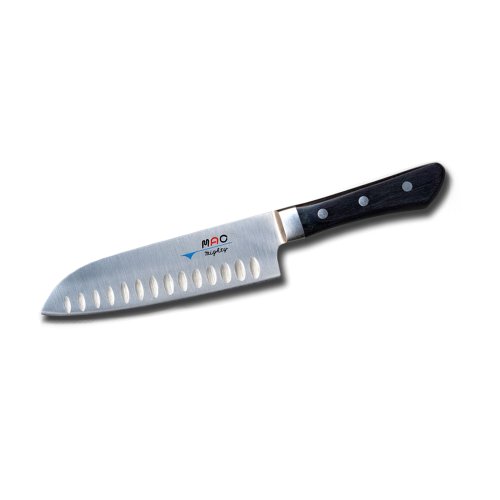
A thin, hard Japanese blade on a Western handle, with dimples that help potato and cucumber slices fall away. It’s the santoku I’d buy for myself if I could only have one.

A forged German-steel santoku with one of the grippiest handles you can buy. Heavier than the MAC and much harder to damage.

A plain, light restaurant-kitchen knife that costs very little and cuts well. A cheap, low-stakes trial of the santoku shape.

Hard VG-MAX steel, a hammered finish that releases wet slices and a rounded walnut-toned handle. The most pleasant santoku here to use every day.

A santoku with a gently curved belly, so cooks who rock their knife don’t have to change habits. Made in ZWILLING’s German factory.

A small santoku for apartment boards, quick snacks and smaller hands. It fills the gap between a paring knife and a full-size main knife.

Blade and handle in one piece of stainless steel, so there’s no wood or seam to look after. Light, sharp and distinctive.
Santoku Knives Compared
| Knife | Blade | Construction | Handle | Made in | Best for |
|---|---|---|---|---|---|
| MAC Professional MSK-65 | 6.5″, dimpled, 2.5 mm | Japanese steel, sub-zero tempered | Pakkawood, riveted | Japan | Most home cooks |
| Mercer Genesis 7″ | 7″ | Forged German steel | Santoprene | Not stated | Rough kitchens, wet hands |
| Mercer Millennia 7″ | 7″, Granton | Stamped Japanese steel | Textured polymer | Not stated | First santoku, low budget |
| Shun Premier 7″ | 7″, hammered | VG-MAX core, 68-layer Damascus | Pakkawood, contoured | Japan | Careful cooks, vegetable prep |
| ZWILLING Pro 7″ Rocking | 7″, curved belly | Forged, ice hardened | Polymer | Germany | Cooks who rock-chop |
| WÜSTHOF Gourmet 5″ | 5″, hollow edge | Laser cut (stamped) | Polypropylene | Germany (Solingen) | Small boards, small hands |
| Global G-80 7″ | 7″, hollow ground | CROMOVA 18 stainless | Stainless steel, dimpled | Japan | Low-maintenance, light knife |
1. MAC Professional 6.5″ Santoku (MSK-65): Best Overall
Who it’s for: home cooks who want a properly sharp Japanese santoku without the fragility of the hardest, thinnest blades.
MAC is a Japanese maker with a big following among restaurant cooks, and the Professional line is the reason. The blade is 2.5 mm at the spine, thin enough to glide through an onion without wedging, but not so thin that it feels like it might snap on a sweet potato. MAC sub-zero tempers the steel, which helps the edge last between sharpenings.
The 6.5 inch length surprises people who expect 7. In practice it’s a benefit: the shorter blade is quicker around a cutting board and easier to control for anyone used to a paring knife. The dimples along the side break the suction that makes slices of potato and cucumber cling to the blade.
My reservation is the usual one for Japanese steel: it’s harder than a German knife, so bones, frozen food and glass boards can chip it. Hand wash it, keep it off the bone and it will reward you.
Key specs
- Blade: 6.5 inches with dimples, 2.5 mm thick
- Steel: sub-zero tempered Japanese steel
- Handle: riveted Pakkawood, Western style
- Made in Japan; hand wash only
Pros
- Thin, sharp blade that glides through vegetables
- Dimples help release sticky slices
- Compact length, very easy to control
Cons
- Can chip if used on bone or frozen food
- Shorter than a typical 7 inch santoku
My verdict: the best balance of Japanese sharpness and everyday toughness here. Rough-and-ready cooks should look at the Mercer Genesis instead.
2. Mercer Culinary Genesis 7″ Santoku: Best Value Forged
Who it’s for: cooks who like a solid, weighty knife, families who share one knife, and anyone with wet or greasy hands half the time.
The Genesis is a German-style forged knife wearing a santoku shape. It’s precision forged from high-carbon German steel, so it feels substantial in the hand and shrugs off the occasional twist that would chip a Japanese blade. Mercer’s Genesis handle is soft-touch Santoprene, and on a slippery board it’s one of the grippiest kitchen handles I know.
The trade-off is weight and thickness. It won’t slice a tomato as cleanly as the MAC or Shun, and you’ll want to hone it more often because softer steel rolls rather than chips. That’s an easy habit with a honing rod.
Key specs
- Blade: 7 inches, taper-ground edge
- Steel: high-carbon German steel, precision forged
- Handle: Santoprene, non-slip
- Hand wash only
Pros
- Very grippy handle, wet or dry
- Tough steel forgives mistakes
- Forged knife at a modest price
Cons
- Thicker and heavier than Japanese santoku
- Needs honing more often
My verdict: buy it if your knife leads a hard life. If you want effortless slicing more than toughness, spend more on the MAC.
3. Mercer Culinary Millennia 7″ Granton Santoku: Best Budget
Who it’s for: first apartments, culinary students, vacation rentals and anyone unsure whether a santoku suits them.
The Millennia is stamped from a single sheet of high-carbon Japanese steel and fitted with a textured handle, the kind of knife you’ll find on restaurant prep lines because it works and nobody worries if it gets knocked around. The Granton edge, those oval hollows above the edge, adds small air pockets that help slices drop away.
It’s light and noticeably thinner than the Genesis, so it cuts vegetables easily. What you give up is refinement: the handle is utilitarian, the balance is blade-forward and the edge wants more frequent touch-ups than the premium picks. For a knife this inexpensive, I don’t hold any of that against it.
Key specs
- Blade: 7 inches, Granton edge
- Steel: one-piece high-carbon Japanese steel (stamped)
- Handle: textured with finger points
- Hand wash recommended
Pros
- Very low cost for a capable knife
- Light, thin blade cuts vegetables well
- Textured handle grips when wet
Cons
- Plain, utilitarian looks
- Edge dulls faster than premium steel
My verdict: the low-risk way to try the santoku shape. If you end up loving it, upgrade to the MAC later and keep this one as a spare.
4. Shun Premier 7″ Santoku: Best Premium
Who it’s for: careful cooks who prep a lot of vegetables and want a knife they enjoy picking up.
Of all the Shun Premier knives, the santoku is the one where the upgrade over Shun Classic makes the most sense. The hammered tsuchime finish isn’t just decoration: those small dents reduce the drag of wet slices of zucchini and apple, which is exactly what a santoku spends its life cutting. The contoured Pakkawood handle is rounder than the Classic’s D shape and suits more hands, including left hands. I compare the two lines in Shun Premier vs Classic.
Inside, it’s VG-MAX steel clad in 68 layers of Damascus, sharpened to 16 degrees per side and made in Japan. Shun also sharpens its knives free for the original owner. Chipping is the gripe Shun owners raise most often, and the rules follow from it: no bones, no frozen food, no glass boards, and a whetstone rather than a pull-through.
Key specs
- Blade: 7 inches, hammered tsuchime finish
- Steel: VG-MAX core clad in 68 Damascus layers; 16 degrees per side
- Handle: contoured Pakkawood, either hand
- Made in Japan; free sharpening from Shun
Pros
- Very sharp, holds its edge a long time
- Hammered finish helps release wet food
- Comfortable handle for most hands
Cons
- Chips if misused
- The most expensive knife here
My verdict: the santoku to buy if you’ll treat it well. Busy family kitchens are better served by the Mercer Genesis or the ZWILLING.
5. ZWILLING Pro 7″ Rocking Santoku: Best for Rock Chopping
Who it’s for: cooks who like the santoku’s height and blunt tip but rock their knife like a chef’s knife.
A traditional santoku is a poor rocker: its flat edge slaps the board instead of rolling. ZWILLING solved that with a version that has a gentle curve toward the tip. You still get the wide blade for scooping and the sheepsfoot-style tip, but you can mince herbs and garlic with the rocking motion most Western cooks learned first.
The Pro line is ZWILLING’s forged, made-in-Germany line, with a curved bolster designed for the pinch grip and an ice-hardened FRIODUR blade. It’s heavier than the Japanese picks and the polymer handle is smooth rather than grippy. I’ve covered the brand in are ZWILLING knives good.
Key specs
- Blade: 7 inches, curved rocking profile
- Steel: SIGMAFORGE one-piece forged high-carbon stainless, FRIODUR ice hardened
- Handle: polymer, curved bolster for pinch grip
- Made in Germany
Pros
- Rocks like a chef’s knife, chops like a santoku
- Tough German steel
- Bolster encourages a safe pinch grip
Cons
- Heavier than Japanese santoku
- Smooth handle when wet
My verdict: the best santoku for people who don’t want to relearn how they chop. Push-cutters will be happier with the MAC.
6. WÜSTHOF Gourmet 5″ Hollow Edge Santoku: Best Compact
Who it’s for: small kitchens, people with smaller hands, and anyone who wants a second knife for quick jobs.
A 5 inch santoku is the knife you reach for when the chef’s knife feels like too much: slicing a single shallot, a few mushrooms, a block of cheese, an apple for lunch. It’s big enough to chop properly and small enough to work on a cutting board the size of a dinner plate.
The Gourmet line is WÜSTHOF’s laser-cut range, made in Solingen and covered by the same limited lifetime warranty as its forged knives. No bolster means the whole edge is easy to sharpen, and the hollow-edge dimples help with sticky foods. The handle is plain polypropylene that resists heat and fading. I go through how it differs from WÜSTHOF’s forged line in WÜSTHOF Classic vs Gourmet.
Key specs
- Blade: 5 inches, hollow edge
- Steel: high-carbon stainless, laser cut
- Handle: synthetic polypropylene
- Made in Solingen, Germany; limited lifetime warranty
Pros
- Compact without feeling like a toy
- Whole edge easy to sharpen
- WÜSTHOF warranty and quality
Cons
- Too short for big squash or cabbage
- Plain, lightweight feel
My verdict: a great second knife or a main knife for very small kitchens. As your only knife for big cooking days, it’s too short.
7. Global G-80 7″ Hollow Ground Santoku: Best All-Steel
Who it’s for: cooks who want a light, sharp Japanese knife with no wooden handle to dry and oil.
Global knives look like nothing else in a knife block: blade and handle are all stainless steel, with a dimpled pattern on the handle for grip. Global makes them in Japan from its own CROMOVA 18 stainless, and the blade is thin with a keen edge. The G-80 is the 7 inch santoku with hollow-ground scallops on the blade.
Globals are love-or-hate, and the handle is the reason. Some people find the steel handle balanced and easy to clean; others find it slippery with wet or oily hands and too thin for a big grip. If you can, hold one before buying.
Key specs
- Blade: 7 inches, hollow ground
- Steel: CROMOVA 18 stainless
- Handle: stainless steel with dimple pattern
- Made in Japan
Pros
- Light and very sharp
- No wood or seams to look after
- Distinctive, modern design
Cons
- Steel handle gets slippery when wet
- Thin handle for large hands
My verdict: a lovely santoku if the handle suits you. If you’ve never held a Global, the MAC is the safer buy.
What Makes a Good Santoku
Match the shape to how you cut
Buy a santoku if you chop with an up-and-down or forward push motion. The flat edge meets the board fully on every stroke, which gives clean cuts through vegetables. If you rock your knife, either choose a rocking santoku like the ZWILLING Pro or a chef’s knife; I explain the difference in santoku vs chef’s knife.
Length: 7 inches for most, 5 for small kitchens
Most santoku are 6.5 to 7 inches, enough for an onion, a cabbage half or a chicken breast. A 5 inch santoku suits small boards and small hands and makes a good second knife. Go longer than 7 and you’re better off with a chef’s knife or gyuto.
Japanese or German steel
Japanese santoku (MAC, Shun, Global) are thinner and harder: they slice more cleanly and stay sharp longer, but can chip. German-style santoku (Mercer Genesis, ZWILLING, WÜSTHOF) are thicker and softer: they forgive rough use and need honing more often. Choose by how gently you treat a knife, not by which sounds better.
Granton edge or plain
Granton or hollow-edge dimples create small air pockets that help wet, starchy food release. They help a little with potatoes and cucumbers and don’t hurt anything else. Don’t pay much extra for them, and don’t avoid a good knife without them.
Handle and grip
A textured synthetic handle is the safest on a wet board. Pakkawood is comfortable and smart but smoother. Bare steel, like Global’s, is the most slippery. If you’ll cut with damp hands most of the time, pick the Mercer handles.
How to Get the Most From a Santoku
Use a pinch grip (thumb on one face of the blade, bent index finger on the other, just ahead of the handle), and push the knife forward and down through the food rather than chopping straight down. Keep the guiding hand in a claw so the flat of the blade rides your knuckles. Turn the blade over and use the spine to scoop food off the board so the edge stays sharp. I go through grip, cuts and what not to cut in how to use a santoku knife.
Santoku Knife FAQ
What is a santoku knife used for?
A santoku is an all-purpose kitchen knife for slicing, dicing and mincing vegetables, boneless meat and fish. Its name is often translated as “three virtues”, usually taken to mean meat, fish and vegetables. It replaces a chef’s knife for cooks who prefer chopping to rocking.
Should I buy a santoku instead of a chef’s knife?
Only if you chop more than you rock. Its flat edge and blunt tip suit push cuts and chopping. A chef’s knife has a curved belly and a sharp point for rocking and tip work. Choose by how you cut.
What size santoku should I buy?
Seven inches for most home cooks. A 5 to 5.5 inch santoku suits small hands, small boards or a second knife. Very large hands or big boards may prefer a longer chef’s knife instead.
Are the dimples on a santoku necessary?
No. Granton dimples help sticky, starchy food fall off the blade a little more easily, but a plain santoku cuts just as well. Treat them as a small bonus, not a deciding factor.
Can a santoku cut meat?
Yes, boneless meat, chicken and fish. Don’t use it on bones or frozen food, especially a hard Japanese santoku, because the thin edge can chip.
Should I get a santoku or a nakiri?
A santoku is the better first buy because it handles meat and fish as well as vegetables and has a usable tip. A nakiri is a vegetable specialist with a dead-flat edge; see my comparison of nakiri vs santoku.
Final Verdict
For most cooks, the MAC Professional 6.5″ santoku is the one to buy: thin and sharp like a Japanese knife, sturdy enough for everyday use. If your knives get treated roughly, the forged Mercer Genesis is the tougher choice, and if you just want to try the shape for very little money, the Mercer Millennia is a capable start.
If you’re also deciding between a santoku and a vegetable specialist, have a look at my best nakiri knife guide.

Gary Portman founded knivesadvice.com in 2019. He learned to cook in his family’s kitchen as a kid and has used kitchen, pocket and outdoor knives ever since, from paring and fillet knives to survival blades he carries camping and hiking. He writes the site’s buying guides, brand reviews and sharpening how-tos to help readers find the right knife for the job. More about Gary.