
Sets come with a block; good knives often don’t. Buy a chef’s knife here, a bread knife there, a Japanese petty as a gift, and you end up with a drawer of loose blades and nowhere to put them. An empty knife block solves that, but only if it fits the knives you actually own. If a block won’t fit, at least put an edge guard on every knife that goes in a drawer.
That’s where most block shopping goes wrong. A classic slotted block has fixed slot sizes, so a wide santoku or a long slicer may not go in at all. Universal blocks use parallel slats or plastic bristles that take almost any blade. In-drawer blocks hide everything and free up the counter, and magnetic stands skip slots entirely. Each type suits a different kitchen, so I’ve picked the best of each.
For most people my pick is the KITCHENDAO XL Acacia Universal Knife Block: any blade shape up to its length limit, plus spots for shears and a honing rod. If you own a matching set of German knives, the WÜSTHOF 17-Slot Acacia Knife Block is the classic way to store them.
My Top 6 Knife Block Picks

Parallel slots on two levels keep edges apart and take almost any blade shape, with dedicated spaces for shears and a sharpening rod. The easiest home for a mixed collection.
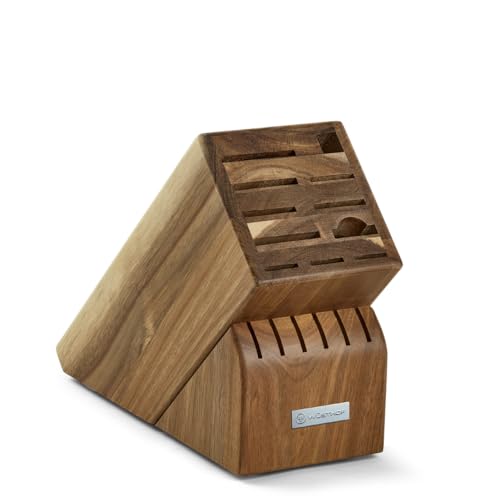
Seventeen angled slots with the sizes published, from steak knives to a big chef’s knife and shears. A proper home for a growing set of German knives.

Sixteen slots plus a honing steel spot in a bamboo tray that lives in a drawer. The counter stays clear and the blades stop rattling against each other.

A wide acacia stand with magnets on both faces, so any knife hangs flat with nothing to slide into. It even comes with a small whetstone.

Removable plastic bristles in a two-tier acacia block. Push knives in anywhere, then pull the bristles out to wash them.

A narrow bamboo block for four knives, a honing steel and shears. Ideal for a small Japanese set or a tight corner of the counter.
Knife Blocks Compared
| Block | Type | Capacity | Material | Best for |
|---|---|---|---|---|
| KITCHENDAO XL | Universal, parallel slots | Up to 16 knives, blades to 8.6″ | Acacia | Mixed collections |
| WÜSTHOF 17-Slot | Classic slotted | 17 slots, sizes published | Acacia | Matching German sets |
| Utoplike In-Drawer | In-drawer tray | 16 knives + honing steel | Bamboo | Clear counters, households with kids |
| HOSHANHO Magnetic | Magnetic stand | Both faces, any blade | Acacia | Wide or long knives, display |
| ENOKING Bristle | Universal, bristles | Two tiers | Acacia, plastic bristles | Easy cleaning, odd shapes |
| Shun Slimline | Slim slotted | 4 knives + steel + shears | Bamboo | Small sets, small kitchens |
1. KITCHENDAO XL Acacia Universal Knife Block: Best Overall
Who it’s for: anyone with a mixed bag of knives from different brands who wants them on the counter, organized and protected.
A universal block has one job: take whatever you put in it. This one does it with rows of parallel slots on two levels instead of a few fixed holes. Narrow paring knives, wide santokus and odd Japanese shapes all slide in, and because the slots run side by side, the edges don’t touch each other. KITCHENDAO says it holds up to 16 knives, depending on size, and adds separate spaces for kitchen scissors and a sharpening rod.
I also like two small details. There are ventilation openings underneath so knives put away slightly damp can dry instead of sitting in a closed slot, and anti-slip feet keep the block still when you pull a knife out.
The limit is length. KITCHENDAO rates it for knives up to 8.6 inches, which covers most chef’s knives and santokus but not a 10-inch chef’s knife, a long bread knife or a slicer. If your collection includes long blades, the magnetic block further down has no length limit at all.
Key specs
- Type: universal block with double-deck parallel slots
- Capacity: up to 16 knives (depending on size), blades up to 8.6 inches
- Extra slots for scissors and a sharpening rod
- Acacia wood, ventilation openings, anti-slip feet
Pros
- Fits almost any blade shape
- Edges kept apart
- Room for shears and a honing rod
Cons
- Too short for 10-inch and longer blades
- Larger footprint than a slim block
My verdict: the block I’d buy for a collection that doesn’t match. If your longest knife is over 8.6 inches, choose the magnetic block instead.
2. WÜSTHOF 17-Slot Acacia Knife Block: Best Slotted Block
Who it’s for: cooks building a set of German knives one piece at a time, and anyone who wants the traditional angled block on the counter.
The best thing about this block is that WÜSTHOF tells you exactly what fits. It lists the slot sizes: one 2.25-inch slot for a large chef’s knife, two 2-inch slots for chef’s and Asian-style knives, three 1.5-inch slots for bread and other long knives, nine 1-inch slots for steak and paring knives, and a shaped slot for kitchen shears. Most empty blocks give you a slot count and nothing else, so you only find out at home that your santoku is too wide.
The slots are angled for easy reach, the feet are non-skid, and acacia is a hard, good-looking wood. WÜSTHOF is a family-owned Solingen maker with over two centuries behind it, and the block is clearly designed around its own knives. I’ve written about those in my WÜSTHOF knives review, but any knife with matching widths fits.
Fixed slots have the usual drawbacks. They’re harder to clean than a bristle block, and nine steak-knife slots is a lot if you don’t own steak knives. Dry knives fully before putting them away.
Key specs
- 17 slots, including 1 at 2.25″, 2 at 2″, 3 at 1.5″, 9 at 1″ and a shear slot
- Acacia wood, angled slots
- Non-skid feet
- Sold without knives
Pros
- Slot sizes published, so you know what fits
- Room for a growing collection
- Classic look that suits any German set
Cons
- Fixed slots are hard to clean inside
- Many small slots go unused without steak knives
My verdict: the right block if your knives are mostly German and you like the classic look. For mixed or very wide blades, a universal block is more forgiving.
3. Utoplike Bamboo In-Drawer Knife Block: Best In-Drawer
Who it’s for: small kitchens with no counter to spare, homes with young children, and anyone who wants knives out of sight.
An in-drawer block gives you the protection of a block with none of the counter clutter. Utoplike’s bamboo tray holds 16 knives in two rows: eight slots for steak-knife sized pieces and eight for longer knives, with a middle slot for a honing steel. The handles sit on an angled support with finger grooves, so you can grab a knife without fishing for it, and long blades don’t shoot out the back when the drawer slams shut.
Check your drawer before ordering, because this is the one block where size is make or break. Utoplike says the drawer needs an inside space larger than 17.1 inches deep and 12.7 inches wide, with more than 2.3 inches of height. A lot of shallow cutlery drawers fail on height.
The trade-off with any drawer block is reach: you open a drawer every time you want a knife. It’s also not the place for a big cleaver. But for keeping blades safe and the counter clear, nothing beats it.
Key specs
- Capacity: 16 knives plus 1 honing steel
- Size: 16.6 x 12.2 x 1.8 inches
- Needs a drawer larger than 17.1″ deep x 12.7″ wide, over 2.3″ tall
- Moso bamboo, angled handle support
Pros
- Clears the counter completely
- Blades protected and out of children’s sight
- Large capacity
Cons
- Needs a deep, wide and tall enough drawer
- Not for cleavers or very wide blades
My verdict: the best block for clear counters, provided your drawer is big enough. Measure first, then buy.
4. HOSHANHO Double-Sided Magnetic Knife Block: Best Magnetic Block
Who it’s for: owners of long or wide knives (slicers, cleavers, big gyutos), and anyone who wants to display their knives rather than hide them.
A magnetic block is a block with no slots: a board with strong magnets hidden inside, so knives hang flat against the wood. That makes it the only block type with no limit on blade width or length. A 12-inch slicer and a Chinese cleaver hang beside a paring knife, and because nothing slides into a dark slot, there’s nowhere for moisture or crumbs to collect.
HOSHANHO makes this one larger than most at 14 by 10 inches, so both faces hold a good number of knives, and the 4.5-inch base has a non-slip pad to keep it steady. It ships with a small whetstone as a bonus, which is handy for touch-ups even if it won’t replace a proper sharpening stone.
The downsides are visibility and footprint. Your knives are on show, which is great with a nice set and less great with a mismatched one, and the stand needs space around both sides. Put knives on spine first so the edge never meets the wood.
Key specs
- Size: 14 x 10 inches, 4.5-inch base with non-slip pad
- Double-sided hidden magnets
- Acacia wood
- Includes a whetstone
Pros
- No limit on blade length or width
- Nothing hidden inside to clean
- Shows off good knives
Cons
- Knives always on display
- Needs space around both faces
My verdict: the block for long, wide or beautiful knives. Choose a slotted or bristle block if you’d rather keep blades covered.
5. ENOKING Acacia Universal Knife Block with Bristles: Best Bristle Block
Who it’s for: cooks who want a universal block they can actually clean, and anyone with unusual blade shapes.
Bristle blocks are packed with thin plastic rods. You push a knife in anywhere and the rods close around the blade, so there are no slots to match and no fixed sizes. The common complaint about bristle blocks is hygiene, because crumbs and moisture get trapped between the rods. ENOKING’s answer is to make the bristle inserts removable, so you can lift them out and wash them.
The block is acacia with a two-tier design that gives more room for a larger collection, and a non-slip base keeps it steady. It suits chef’s knives, santokus, bread knives and small knives together.
Bristles have their own habits. Very thin, flexible blades can wander as you push them in, and a knife put away wet will leave water in the bristles. ENOKING doesn’t publish a maximum blade length, so measure your longest knife against the block’s height once it arrives before you count on a 10-inch blade fitting.
Key specs
- Type: universal bristle block, two tiers
- Removable plastic bristle inserts for washing
- Acacia wood, non-slip base
Pros
- Any blade shape goes anywhere
- Bristles come out for cleaning
- Room for a larger collection
Cons
- No published maximum blade length
- Wet knives leave moisture in the bristles
My verdict: the universal block for people who care about cleaning. If your knives are long, a magnetic block is safer.
6. Shun Slimline 6-Slot Knife Block: Best Slim Block
Who it’s for: owners of a small set of good knives (say a chef’s knife, a utility knife, a paring knife and a santoku) with limited counter space.
Most people use three or four knives, so a 17-slot block is often mostly empty holes. Shun’s Slimline is made for the small, deliberate collection: two 1.3-inch slots, two 2.1-inch slots, plus spaces for a honing steel and kitchen shears. It’s narrow enough to tuck beside the stove or the coffee machine.
It’s made of bamboo, which is hard, stain resistant and easy to wipe, and the clean shape matches Shun’s own knives. Japanese knives in general deserve a block or a guard rather than a drawer, since their harder edges can chip when they knock against other metal. My best Japanese knife sets guide has small sets that fit a block like this well.
Four knife slots is the whole capacity, so this isn’t a block to grow into. And the 2.1-inch slots fit most chef’s knives and santokus, but check very wide gyutos or a nakiri before relying on it.
Key specs
- Slots: two 1.3″, two 2.1″, plus honing steel and shears spaces
- Material: bamboo
- Holds up to 6 pieces
Pros
- Small footprint
- Right-sized for a core set
- Stain-resistant bamboo
Cons
- Only four knife slots
- Very wide blades may not fit
My verdict: the neat answer for a small, good set. If you keep buying knives, start with the WÜSTHOF or a universal block instead.
Choosing the Right Type of Knife Block
Universal or slotted
Choose a universal block if your knives come from different brands; choose a slotted block if they match. Slotted blocks look tidy and keep each knife in its own place, but a slot that’s too narrow simply won’t take a wide blade. Universal blocks (parallel slats or bristles) take nearly anything, at the cost of a less traditional look.
Check blade length and width
Measure your longest and widest knives before buying. Blocks fail on long bread knives and slicers, and on wide santokus, nakiris and cleavers. If a maker publishes slot widths or a maximum blade length, compare them with your knives; if they don’t, leave a margin or choose a magnetic block.
Counter, drawer or wall
A countertop block keeps knives within reach, an in-drawer block clears the counter, and a magnetic strip uses the wall. Counter blocks are the most convenient while cooking; drawer blocks are best with children around. I compare all the storage options in my guide to storing kitchen knives.
Cleaning and drying
Every block works best with knives that go in clean and completely dry. Slots and bristles hold moisture, which can mark blades and grow mold over time. Look for removable bristles or ventilation openings, and turn a slotted block upside down now and then to shake out crumbs.
Self-sharpening blocks
Self-sharpening blocks have ceramic honing slots built in, but they’re sold with matching knives, not empty. If keeping edges sharp matters more to you than storing knives you already own, read whether self-sharpening knife blocks are worth it first.
FAQ
Are knife blocks sanitary?
They are if you only put clean, dry knives in them. Problems start when wet or dirty knives go into closed slots, where moisture and food particles sit unseen. Choose a block with removable bristles or open ventilation, and clean it every few months.
Do knife blocks dull knives?
Not much, if you slide knives in on their spine side. Dragging the edge along the bottom of a slot every time does wear it slowly. For horizontal or upside-down slots, rest the blade on its flat side.
Can any knife fit in a universal knife block?
Most kitchen knives fit, but not all. Universal blocks still have a height limit, so check the maximum blade length before buying if you own a 10-inch chef’s knife or a long bread knife.
How do you clean a knife block?
Empty it, shake out crumbs, and clean the slots with a narrow brush and warm soapy water, then let it dry completely, upside down, before putting knives back. Pull out removable bristles and wash them separately. Never soak a wooden block.
Is a knife block or a magnetic strip better?
A block is better if you want blades covered and no drilling; a magnetic strip is better if counter space is short and your knives are long or wide. Many cooks use both: a strip for daily knives and a block or drawer insert for the rest.
Final Verdict
For a collection of mixed knives, the KITCHENDAO XL Acacia Universal Knife Block is the most flexible and the best buy, as long as your blades are 8.6 inches or shorter. Matching German knives look and fit best in the WÜSTHOF 17-Slot Acacia block with its published slot sizes. And if the counter is already full, the Utoplike in-drawer block keeps sixteen knives safe and completely out of the way.
Still putting together the knives themselves? My best knife sets come with their own blocks, and my self-sharpening knife sets keep the edges honed too.

Gary Portman founded knivesadvice.com in 2019. He learned to cook in his family’s kitchen as a kid and has used kitchen, pocket and outdoor knives ever since, from paring and fillet knives to survival blades he carries camping and hiking. He writes the site’s buying guides, brand reviews and sharpening how-tos to help readers find the right knife for the job. More about Gary.