
Put a Japanese chef’s knife next to a German one and the difference is obvious before you cut anything. The Japanese blade is thinner, the steel is harder, and the edge is ground to a narrower angle. That’s why it glides through an onion instead of wedging it apart, and why it stays sharp for longer between sharpenings.
The same hardness is also the catch. Hard steel is less forgiving: twist it in a squash, hit a chicken bone or chop on a glass board and the edge can chip. A Japanese set rewards cooks who use a wooden or soft plastic board, wash by hand and keep a cheap German knife around for the rough jobs. Most of the sets below are made in Japan; the one budget exception is clearly marked.
My pick is the Shun Premier 3-Piece Starter Set, three beautiful, very sharp knives with free sharpening from Shun. For far less money, the Tojiro DP 2-Piece Chef’s Set gives you a made-in-Japan VG10 chef’s knife and paring knife.
My Top 7 Japanese Knife Set Picks
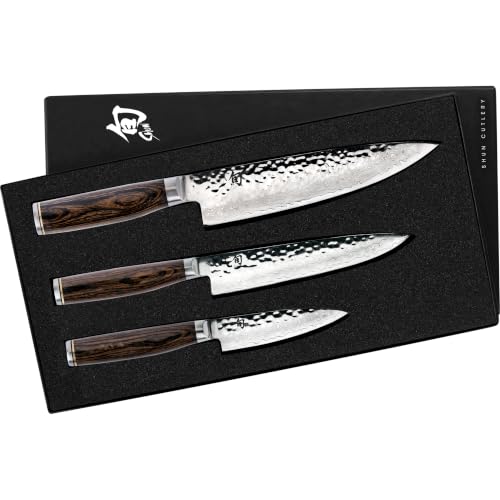
If someone asks me for one Japanese set that feels special every time they pick it up, this is it. The hammered blades look stunning, the edges are razor sharp, and the three knives cover almost everything. Shun’s free sharpening service takes the worry out of keeping them that way.

This is the set I’d recommend to a cook who wants real Japanese performance without paying for looks. Tojiro puts a VG10 core in a plain, sturdy knife, and the chef’s knife and paring knife are the two you’d use every day anyway.

MAC knives are famous for how thin they are, and that thinness makes carrots and hard apples feel easy. This set also includes a long bread knife, which most Japanese starter sets leave out. It’s a set for cooks who care about the cut more than the decoration.

For someone who wants a complete Japanese kitchen in one order, I’d pick this block. You get five knives including a santoku and bread knife, all with hammered VG10 blades and tough micarta handles, made in Seki, Japan.

Global’s seamless steel knives are a design icon, and this block is the neat way to own a full set of them. It includes a bread knife and a vegetable knife, and there are no joints or rivets for food to hide in.

If you cook a lot of vegetables, this set swaps the Western chef’s knife for a santoku and a nakiri. Those two flat-edged shapes are what make Japanese prep feel different, and Shun’s Classic line is the one I’d start with.

Kai is Shun’s parent company, and Luna is its budget line. It’s the cheapest way I know into a set from a Japanese knife maker, with soft-grip handles and free sharpening from Kai. Just know the steel is German stainless, not Japanese.
Japanese Knife Sets Compared
| Set | Knives | Steel | Handle | Storage | Best for |
|---|---|---|---|---|---|
| Shun Premier 3-Piece | Chef 8″, utility 6.5″, paring 4″ | VG-MAX, 68-layer Damascus | Pakkawood | None | A special everyday set |
| Tojiro DP 2-Piece | Chef 8.25″ (210mm), paring 4″ | VG10 core, 60 HRC | Micarta, triple rivet | None | Best value from Japan |
| MAC Chef Series 3-Piece | Chef 8″ dimpled, paring 5″, bread 10.5″ | Molybdenum stainless | Pakkawood | None | Very thin blades |
| Enso HD 7-Piece | Chef 8″, santoku 6.5″, utility 6″, paring 4″, bread 9″ | VG10, 37-layer, 61 HRC | Micarta | Birch block | A complete Japanese block |
| Global Teikoku 5-Piece | Chef 8″, bread 8.5″, vegetable 5.5″, utility 4.25″ | Cromova 18 stainless | Stainless steel | Teikoku block | Seamless all-steel design |
| Shun Classic Japan 3-Piece | Santoku 7″, nakiri 6.5″, paring 3.5″ | VG-MAX, 68-layer Damascus | Pakkawood | None | Vegetable-heavy cooking |
| Kai Luna 3-Piece | Chef 8″, utility 6″, paring 3.5″ | German 1.4116 stainless | Soft-grip resin | Sheaths | Trying Japanese style cheaply |
1. Shun Premier 3-Piece Starter Set: Best Overall
Who it’s for: cooks who want their first serious Japanese knives, or a gift for someone who loves to cook.
I have a soft spot for Shun, and the Premier line is the one that shows off what the brand does best. Each blade has a VG-MAX steel core wrapped in 68 layers of Damascus cladding, with a hammered (tsuchime) finish that helps food fall away from the blade. The 16-degree edges come very sharp, and the contoured Pakkawood handles are comfortable in either hand.
The three knives are well chosen: an 8-inch chef’s knife for most of your cutting, a 6.5-inch utility knife for sandwiches, herbs and small jobs, and a 4-inch paring knife. Shun handcrafts the knives in Japan and offers free sharpening and honing, a perk I value more than any spec once a knife starts to dull. If you’re torn between Shun’s two main lines, I compare them in Shun Premier vs Classic.
Chipping is the problem Shun owners raise most, and it applies here too. These are precise knives: no bones, no frozen food, no twisting through hard squash. There’s also no block, so plan for a magnetic strip or in-drawer tray.
Key specs
- Includes: 8″ chef’s, 6.5″ utility, 4″ paring
- Blades: VG-MAX core, 68 layers of Damascus cladding, hammered tsuchime finish, 16-degree edge
- Handles: contoured Pakkawood, for left- and right-handed users
- Handcrafted in Japan; free sharpening and honing from Shun
Pros
- Exceptionally sharp out of the box
- Gorgeous hammered finish
- Free sharpening service
Cons
- Hard edges can chip if misused
- No storage included
- Expensive for three knives
My verdict: the Japanese set I’d buy if I wanted to love my knives, not just use them. If you’re hard on your tools, get the Kai Luna or a German set instead.
2. Tojiro DP 2-Piece Chef’s Knife Set: Best Value
Who it’s for: practical cooks who want a made-in-Japan VG10 chef’s knife and don’t need Damascus patterns or a block.
Tojiro is a long-standing knife maker from Japan’s Niigata region, and the DP line has a strong following among cooks who want serious steel at a fair price. This set pairs the DP gyuto, an 8.25-inch (210mm) Japanese chef’s knife, with a 4-inch paring knife. Between them, they handle most kitchen cutting.
The blades use a three-layer construction: a full VG10 steel core sandwiched between two layers of rust-resistant stainless steel. That core is hardened to 60 HRC and ground to a 12-degree edge, so it’s thin and keen. The handles are Micarta, triple riveted to a full tang, which gives the knives a more Western feel than you might expect.
The look is plain, and the handle won’t win design awards. Like every hard Japanese blade on this list, it needs a decent board and gentle use. Tojiro backs the set with a lifetime warranty.
Key specs
- Includes: 8.25″ (210mm) chef’s knife (F-808), 4″ (100mm) paring knife (F-848)
- Blades: 3-layer clad, VG10 core, 60 HRC, 12-degree edge
- Handles: Micarta, full tang, triple riveted
- Made in Japan; lifetime warranty
Pros
- VG10 core at a sensible price
- Durable full tang Micarta handles
- Lifetime warranty
Cons
- Plain looks
- Only two knives, no storage
My verdict: the best performance per dollar among Japanese sets. Pay more only if looks and extra knives matter to you.
3. MAC Chef Series 3-Piece Starter Set: Best Thin Blades
Who it’s for: cooks who prep lots of hard vegetables and fruit and want the least wedging possible, plus anyone who needs a bread knife in the box.
MAC takes a different route from the Damascus crowd. There’s no pattern and no layered cladding, just a very thin, fully tapered blade made from a stain-resistant molybdenum steel alloy. The chef’s knife starts as 2.5mm stock, the paring knife as 2.0mm, and both are tapered from spine to edge. In use, that means a carrot splits cleanly instead of cracking, which is why I named the MAC Chef the thin-blade pick in my best chef knives under $100 guide too.
This set gives you the dimpled 8-inch chef’s knife, a dimpled 5-inch paring knife and a 10.5-inch bread knife from MAC’s Superior series. The dimples break the suction on potatoes and apples. The Pakkawood handles are upswept to leave room for your knuckles above the board. MAC handcrafts the knives in Seki, Japan, and gives a 25-year warranty against manufacturing defects.
The price of that thinness is fragility. Twist a MAC through a frozen block or bone and you’ll chip it. The plain finish also won’t impress anyone who wants the hammered look.
Key specs
- Includes: 8″ dimpled chef’s (TH-80), 5″ dimpled paring (TH-50), 10.5″ bread knife (SB-105)
- Blades: stain-resistant molybdenum alloy, 2.5mm chef / 2.0mm paring stock, fully tapered
- Handles: Pakkawood, upswept for knuckle clearance
- Handcrafted in Seki, Japan; 25-year warranty against manufacturing defects
Pros
- Very thin, efficient blades
- Bread knife included
- Comfortable upswept handles
Cons
- Thin edges chip if twisted
- Plain appearance
My verdict: the set for cooks who judge a knife by how it cuts a carrot. Skip it if you want a showpiece on the counter.
4. Enso HD 7-Piece Knife Block Set: Best Full Block
Who it’s for: cooks who want every everyday knife in Japanese style, stored in one block, without buying piece by piece.
Most Japanese sets are small starter sets. Enso’s HD block is the exception I’d recommend: a 4-inch paring knife, 6-inch utility knife, 6.5-inch santoku, 8-inch chef’s knife and 9-inch bread knife, plus take-apart shears and a six-slot birch block. That’s a full kitchen, with both a chef’s knife and a santoku so you can see which shape you prefer.
The blades are VG10 with 37 layers of stainless Damascus and a hammered finish, hardened to 61 HRC and hand-ground to about 12 degrees. They’re double bevel, so they work for left- and right-handed cooks. The black canvas Micarta handles with three steel rivets are tougher and grippier than polished wood. Enso makes the knives in Seki City, Japan, with a lifetime warranty.
At 61 HRC these are among the hardest blades here, so the usual Japanese rules apply strictly: wooden or soft boards, hand washing, no bones. The block also has no spare slots for future knives.
Key specs
- Includes: 4″ paring, 6″ utility, 6.5″ santoku, 8″ chef’s, 9″ bread, take-apart shears, 6-slot birch block
- Blades: VG10, 37-layer hammered Damascus, 61 HRC, about 12 degrees, double bevel
- Handles: black canvas Micarta, three stainless rivets
- Handcrafted in Seki City, Japan; lifetime warranty
Pros
- Complete set with block, santoku and bread knife
- Hard, keen VG10 edges
- Durable, grippy Micarta handles
Cons
- Very hard steel needs careful use
- No spare slots in the block
My verdict: the Japanese block I’d choose to equip a whole kitchen at once. Small-set buyers get more polish per dollar from Shun or Tojiro.
5. Global Teikoku 5-Piece Knife Block Set: Best All-Steel Set
Who it’s for: cooks who love modern design and want light, hygienic knives with no handle joints to clean around.
Global’s one-piece stainless look has barely changed in decades, and it still turns heads. This block holds four of the most useful shapes in the range: the 8-inch chef’s knife, a bread knife (8.5 inches), a 5.5-inch vegetable knife and a 4.25-inch utility knife. The blades are Cromova 18 stainless steel, Global’s own alloy.
The handles are the whole point. They’re stainless steel, dimpled for grip, with no gaps or rivets, so they’re easy to keep clean. They’re also the reason I always tell people to hold a Global before buying one. Some cooks find them perfectly balanced; others find bare steel slick once their hands are wet or oily. If you like the idea but want a smaller start, my best knife sets under $200 list includes Global’s 3-piece set.
The block itself is the Teikoku design, which looks sharp on a modern counter. Global’s steel is slightly softer than the VG10 sets here, so it’s a little more forgiving, but the same care rules still apply.
Key specs
- Includes: 8″ chef’s, 8.5″ bread, 5.5″ vegetable, 4.25″ utility, Teikoku knife block
- Blades: Cromova 18 stainless steel
- Handles: seamless stainless steel, dimpled
Pros
- Seamless, hygienic design
- Includes bread and vegetable knives
- Light and easy to handle
Cons
- Steel handles can feel slippery
- No small paring knife
My verdict: the set for design lovers who’ve held a Global and liked it. If you haven’t, try one first.
6. Shun Classic 3-Piece Japan Starter Set: Best Asian Shapes
Who it’s for: vegetable-heavy cooks, and anyone who already owns a chef’s knife and wants true Japanese shapes next to it.
Most “Japanese” sets are really Western shapes in Japanese steel. This one isn’t. It gives you a 7-inch hollow-ground santoku, a 6.5-inch nakiri and a 3.5-inch paring knife. The santoku and nakiri both have flatter edges than a chef’s knife, so you chop with a straight up-and-down motion rather than rocking. On a pile of cabbage, carrots or herbs, that’s quick and precise. I go deeper into the nakiri shape in my guide to the best nakiri knife.
Classic is Shun’s original line, with the same VG-MAX core and 68-layer Damascus cladding as the Premier, but with a smooth finish and D-shaped Pakkawood handles. The santoku’s hollow-ground scallops reduce sticking on starchy food. Shun handcrafts these in Japan as well.
The flat edges that make this set great for vegetables make it worse for rocking through herbs or carving a roast, so it’s a complement to a chef’s knife rather than a full replacement. And as with all Shun knives, keep them away from bones and hard boards.
Key specs
- Includes: 7″ hollow-ground santoku, 6.5″ nakiri, 3.5″ paring
- Blades: VG-MAX core, 68 layers of Damascus cladding, 16-degree edge
- Handles: D-shaped Pakkawood, for left- and right-handed users
- Handcrafted in Japan
Pros
- Real Japanese vegetable shapes
- Very fast, clean chopping
- Beautiful Damascus blades
Cons
- No Western chef’s knife
- Expensive for three knives
My verdict: the set I’d hand to someone whose cutting board is mostly vegetables. Everyone else should start with the Premier set above.
7. Kai Luna 3-Piece Set: Best Budget
Who it’s for: cooks on a tight budget who want to try a Japanese brand, or a first set for a student.
Kai is a Japanese company with a long history in blades and the parent of Shun, and I’ve reviewed the brand in my Kai knives review. The Luna line is its affordable option: an 8-inch chef’s knife, a 6-inch utility knife and a 3.5-inch paring knife, each with a matching sheath.
To be clear about what you’re buying: the steel is high-carbon DIN 1.4116, a German stainless steel, not a Japanese one. That makes these knives softer and more forgiving than everything else on this list, and easy to resharpen. The Japanese touch is in the 16-degree edge, the half-hammered blade design and Kai’s free sharpening and honing support. The molded handles with soft-grip overlays stay secure when wet.
If you want hard Japanese steel, this isn’t it. Treat it as a cheap, friendly introduction to the brand and the thinner Japanese edge angle.
Key specs
- Includes: 8″ chef’s, 6″ utility, 3.5″ paring, matching sheaths
- Blades: high-carbon DIN 1.4116 stainless steel, 16-degree edge, half hammered finish
- Handles: molded resin with soft-grip overlays
- Free sharpening and honing from Kai
Pros
- Very affordable
- Grippy handles, sheaths included
- Forgiving, easy-to-sharpen steel
Cons
- German steel, not Japanese
- Won’t hold an edge like VG10
My verdict: a sensible first step for small budgets. If you’re sure you want real Japanese steel, save for the Tojiro.
How to Pick a Japanese Knife Set
Decide if Japanese style suits how you cook
Choose Japanese if you mostly cut vegetables, fish and boneless meat on a wooden or soft board. Choose German style if you break down chickens, chop hard squash or let knives rattle around in the sink. I lay out the full comparison in German vs Japanese knives.
Steel and hardness
Harder steel holds an edge longer but chips more easily. VG10 and VG-MAX (Shun, Tojiro, Enso) sit around 60 to 61 HRC and take a very fine edge. Global’s Cromova 18 and Kai Luna’s German steel are a little softer and more forgiving. Damascus layers are mostly about looks and stain resistance; the core steel does the cutting.
Shapes in the set
Look for at least one main knife you’ll enjoy every day. A gyuto (Japanese chef’s knife) rocks and slices like a Western chef’s knife, while santoku and nakiri blades have flatter edges for straight chopping. If you’re unsure, a set with a gyuto is the safer start.
Handles
Micarta and textured resin (Tojiro, Enso, Kai) grip best when wet. Pakkawood (Shun, MAC) looks warmer and feels smooth. Global’s all-steel handles split opinion, so hold one first if you can.
Small set or full block
Two or three excellent knives cover most cooking, and they cost less than a block of the same quality. Pick a full block like the Enso only if you really want every shape matched. Otherwise, a starter set plus a magnetic strip is the smarter route.
Caring for Japanese Knives
Hand wash and dry Japanese knives straight after use; never put them in the dishwasher. Cut on wood or soft plastic, not glass, stone or bamboo boards. Hone gently with a fine ceramic rod and sharpen on whetstones rather than pull-through sharpeners, which are too coarse for thin edges. Store blades on a magnetic strip, in a block or with guards so the edges don’t knock against other tools. Shun and Kai also offer free sharpening if you’d rather not do it yourself.
FAQ
Are Japanese knife sets worth the money?
Yes, if you cut on a good board and wash by hand. You get thinner, harder blades that cut more cleanly and stay sharp longer than most German knives. If you’re rough on knives, the extra cost buys you edges that chip instead.
Can Japanese knives cut through bone?
No. Hard, thin Japanese edges can chip on bone, frozen food or hard rinds. Keep a softer German knife or a cleaver for those jobs and let the Japanese knives do the precise work.
Are Japanese knife sets good for beginners?
They can be, as long as the beginner is willing to hand wash and use a proper board. The Kai Luna is the most forgiving starting point here, and Global’s softer steel is a little more forgiving than the VG10 sets. A beginner who’s hard on knives is better off with a German-style set first.
Do left-handed cooks need special Japanese knives?
Not for these sets. They have double-bevel edges like Western knives, so they work in either hand. Traditional single-bevel knives such as the yanagiba are the ones that come in left- or right-handed versions.
How often do Japanese knives need sharpening?
For most home cooks, sharpening once or twice a year is enough, with light honing in between. Hard steel holds its edge longer than German knives, so you’ll sharpen less often, but do it on whetstones.
Final Verdict
The Shun Premier 3-Piece Starter Set is the Japanese knife set I’d buy first: three stunning, razor-sharp knives with Shun’s free sharpening behind them. For the most cutting performance per dollar, the Tojiro DP 2-Piece Chef’s Set is hard to beat. And if you want a whole Japanese kitchen in one block, go with the Enso HD 7-Piece.
Not sure Japanese is right for you? Compare German, Japanese and French sets side by side in the knife sets I recommend at every price.

Gary Portman founded knivesadvice.com in 2019. He learned to cook in his family’s kitchen as a kid and has used kitchen, pocket and outdoor knives ever since, from paring and fillet knives to survival blades he carries camping and hiking. He writes the site’s buying guides, brand reviews and sharpening how-tos to help readers find the right knife for the job. More about Gary.