
Most people searching for KA-BAR want one knife: the USMC knife the Marines adopted in 1942. It’s still made in Olean, New York, and it’s still a good, tough utility knife. But it isn’t the best camp knife the company sells, and that surprises a lot of buyers. KA-BAR also makes the Becker camp knives, a few folders and some odd little utility knives, and several of them suit modern outdoor use better than the famous one.
For history and all-round use, my pick is the KA-BAR USMC Straight Edge with the leather handle. If you want a knife for splitting kindling and camp chores, I’d steer you to the Becker BK2 instead: shorter, much thicker and nearly impossible to break.
My Top 6 KA-BAR Picks

The original pattern with a 7 inch 1095 Cro-Van blade, stacked leather handle and leather sheath. It’s the KA-BAR that made the name, and it’s still a capable outdoor knife.

The same classic shape with a rubbery Kraton handle and a hard sheath. That’s the version I’d choose for rain, boats and hands that are often wet.

A quarter inch thick slab of 1095 Cro-Van with a 5.25 inch drop point. It splits wood, scrapes, carves and shrugs off abuse that would snap thinner knives.
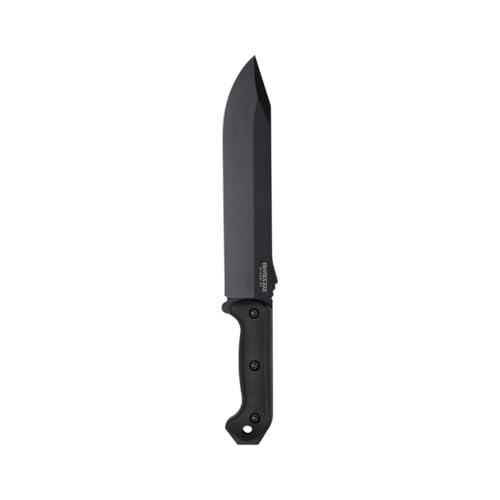
A 9.25 inch blade built to chop. It’s a big camp tool for clearing brush and processing firewood, not something to wear all day.

A light lockback with a 3 inch D2 blade designed by Bob Dozier. The bright handle makes it easy to find in the woods.

A 3 inch blade and handle forged from a single piece of steel, in a hard sheath. A small, almost indestructible knife for a pack, truck or toolbox.
What KA-BAR Does Well
A true American classic, still made in Olean
The company began as Union Cutlery in the late 1890s and moved to Olean, New York, where KA-BAR still makes its USMC knives. The Marine Corps adopted the knife in 1942, and the pattern has barely changed since. Since 1996 KA-BAR has belonged to the same parent company as Cutco, which I cover in my Cutco knives review. That puts the USMC knife on my list of the best American-made knives.
Tough 1095 Cro-Van steel
Most KA-BAR fixed blades use 1095 Cro-Van, a carbon steel with a little chromium and vanadium added, heat treated to roughly 56 to 58 HRC. That’s on the softer, tougher side: the edge rolls before it chips, and it’s easy to bring back on a simple stone. A coated finish on most models helps keep rust off.
The Becker line
The Becker knives, designed by Ethan Becker, are KA-BAR’s camp and outdoor tools: thick blades, Grivory or Ultramid handles you can swap for Micarta, and simple shapes. Among people who use knives hard outdoors, the BK2 has a reputation as one of the toughest fixed blades you can buy without spending a lot.
What KA-BAR Does Badly
Leather needs care
The stacked leather handle on the classic USMC is comfortable and looks great, but it soaks up water and blood, and it can shrink or rot if you put the knife away wet. The leather sheath has the same problem. If your knife will live in damp conditions, choose a Kraton handle and a hard sheath.
Weight and thickness
KA-BAR builds for strength, so many models are heavy and thick behind the edge. The BK2 weighs about a pound, and none of the big fixed blades are fine slicers. For food prep or detailed carving, a thinner knife does a better job.
Sheaths that owners grumble about
The complaint I hear most about Becker knives is the stock sheath: bulky, plastic-lined nylon that some owners replace with an aftermarket Kydex or leather sheath. The knives are better than what they come in.
Not every KA-BAR is made in the USA
The USMC knives and Beckers are made in Olean, but KA-BAR’s folders and some smaller knives are made overseas. The Dozier Folding Hunter, for example, is made in Taiwan. Check the listing if country of origin matters to you.
KA-BAR Lines Compared
| Line / model | Blade | Steel | Handle | Country | Best for |
|---|---|---|---|---|---|
| USMC 1217 (leather) | 7″ clip point | 1095 Cro-Van | Stacked leather | USA | Classic all-round utility |
| USMC 1213 (Kraton) | 7″ clip point | 1095 Cro-Van | Kraton G | USA | Wet weather, low care |
| USMC Short | 5.25″ clip point | 1095 Cro-Van | Leather or Kraton | USA | Hiking and hunting |
| Becker BK2 Companion | 5.25″ drop point | 1095 Cro-Van | Ultramid | USA | Camp chores, batoning |
| Becker BK7 | 7″ clip point | 1095 Cro-Van | Grivory | USA | Larger camp knife |
| Becker BK9 | 9.25″ clip point | 1095 Cro-Van | Grivory | USA | Chopping, brush clearing |
| Becker BK16 | 4.4″ drop point | 1095 Cro-Van | Grivory | USA | Lighter hiking knife |
| Dozier Folding Hunter | 3″ drop point | D2 | Zytel | Taiwan | Light folding carry |
| Wrench Knife | 3″ drop point | 425 stainless (forged) | One-piece steel | Listing does not say | Pack, truck or toolbox |
1. KA-BAR USMC Straight Edge, Leather Handle: Best KA-BAR Overall
Who it’s for: people who want the real KA-BAR, whether for camping, a vehicle kit, a gift for a Marine or simply a piece of history that still works.
This is the knife the brand is built on: a 7 inch clip point blade in 1095 Cro-Van, a straight crossguard, a stacked leather handle and a brown leather sheath stamped with the USMC emblem. It’s 11.875 inches overall, with a 20 degree edge per the listing, and it balances nicely in the hand for a knife of its size.
As a working tool it’s a good all-rounder. The long blade can chop light wood, cut rope and handle general camp jobs, and the clip point gives you a fine tip for detail work. The relatively soft steel is forgiving and quick to sharpen.
My reservation is the leather. Kept dry and treated now and then, it lasts decades. Left wet in a pack, the handle swells and the sheath stays damp against the blade. That’s why the Kraton version below exists, and why the clip point tip isn’t my choice for prying.
Key specs
- Blade: 7 inch clip point, 1095 Cro-Van carbon steel, about 56 to 58 HRC
- Overall length: 11.875 inches; edge angle: 20 degrees (listing)
- Handle: stacked leather with steel guard and pommel
- Sheath: leather
- Made in Olean, New York, USA
Pros
- The classic, proven pattern
- Tough steel that sharpens easily
- Comfortable leather grip
Cons
- Leather handle and sheath don’t like water
- Clip point tip is weaker than a drop point
- Heavy for a belt knife on long hikes
My verdict: the KA-BAR to own if you want one. Choose the Kraton version if your knife will often get wet.
2. KA-BAR 1213 USMC, Kraton Handle, Hard Sheath: Best for Wet Weather
Who it’s for: boaters, hunters and campers who want the USMC shape without babying a leather handle.
The 1213 keeps the 7 inch black clip point blade of the classic but swaps the stacked leather for Kraton G, a grippy rubber-like material, and the leather sheath for a hard polymer one. Both shrug off rain, blood and river water, and you can clean them with soap and a brush.
Kraton also grips better than leather when your hands are cold or wet, which matters more than looks on a knife you’ll actually use. The hard sheath holds the knife securely and won’t trap moisture against the blade the way wet leather can.
The trade-off is character: it looks more modern and less like the knife from old photos. The hard sheath is also bulkier and less quiet than leather.
Key specs
- Blade: 7 inch clip point, 1095 Cro-Van, black coated finish
- Handle: Kraton G
- Sheath: hard polymer
- Made in Olean, New York, USA
Pros
- Handle and sheath ignore water
- Better grip with wet or cold hands
- Easy to clean after hunting or fishing
Cons
- Less classic look than the leather version
- Hard sheath is bulkier
My verdict: the practical USMC knife. Choose the leather version only if heritage matters more than low maintenance.
3. KA-BAR Becker BK2 Companion: Best Camp Knife
Who it’s for: campers who want one fixed blade for splitting kindling, making feather sticks and general camp abuse.
The BK2 is short and absurdly thick: a 5.25 inch drop point blade about a quarter inch thick, in 1095 Cro-Van, with Ultramid handle scales. The drop point puts a strong tip in line with the handle, and the flat grind still cuts reasonably well for something so stout.
Its strength is batoning, which means hitting the spine with a piece of wood to split small logs. That’s hard on knives, and the BK2 is famous for taking it. Becker also designed the handle to be swapped, so owners often fit Micarta scales.
The cost of that toughness is weight: around a pound, which is a lot to carry for the blade length. It’s a poor slicer, and the stock sheath is the usual Becker complaint. If you want a lighter knife that carves better, the Mora-style knives in my bushcraft knife guide do that job well.
Key specs
- Blade: 5.25 inch drop point, 1095 Cro-Van, about 0.25 inch thick, flat grind, powder coat
- Overall length: about 10.5 inches; weight: about 1 lb
- Handle: Ultramid scales (replaceable)
- Designed by Ethan Becker; made in Olean, New York, USA
Pros
- Very hard to break
- Strong drop point tip
- Replaceable handle scales
Cons
- Heavy for its size
- Too thick for fine slicing
- Stock sheath is bulky
My verdict: the best KA-BAR for camp work. Skip it if you count ounces or mostly cut food.
4. KA-BAR Becker BK9 Combat Bowie: Best for Chopping
Who it’s for: base campers, hunters with a vehicle and anyone who wants a big knife to chop instead of carrying a hatchet.
Despite the “combat” in its name, the BK9 is really a camp chopper: a 9.25 inch clip point blade in 1095 Cro-Van with a flat saber grind, a full tang and a Grivory handle. The length and weight up front give it real chopping power on small limbs and brush.
The sheath is nylon with a Kydex stiffener inside and a front pouch, handy for a small sharpener or a fire steel. That’s a nicer setup than the BK2’s.
It’s a big knife to wear, and in most places a 9 inch blade on your belt draws attention. For a backpacking trip I’d carry a smaller knife and a folding saw; the light knives in my backpacking knife guide suit that better.
Key specs
- Blade: 9.25 inch clip point, 1095 Cro-Van, flat saber grind, black epoxy powder coat
- Handle: Grivory (glass-filled nylon), full tang
- Sheath: nylon with Kydex stiffener and front pouch
- Made in Olean, New York, USA
Pros
- Real chopping power
- Full tang and tough steel
- Good sheath with a pouch
Cons
- Too big for everyday carry
- Clumsy for small, careful cuts
- Local carry rules may limit a blade this long
My verdict: a great chopper for camp. Not the knife to wear all day on a trail.
5. KA-BAR Dozier Folding Hunter, Blaze Orange: Best KA-BAR Folder
Who it’s for: hunters and hikers who want a light, inexpensive folder from a name they trust.
Bob Dozier is a well-known custom knifemaker, and this folding hunter is his design: a 3 inch drop point in D2 steel at about 57 to 59 HRC, a hollow grind, a lockback and dual thumb studs for one-hand opening. The Zytel handle keeps it around 2.4 ounces, and the clip is reversible.
D2 holds an edge longer than 1095, and the drop point is a good shape for field dressing and everyday chores. The blaze orange handle is practical: it’s easy to find if it falls in leaves, and it’s a safe color to carry in hunting season.
It feels plasticky next to aluminum or G10 folders, and it’s made in Taiwan rather than Olean. If you want a more refined folder, compare it with the knives in my best folding knives under $100.
Key specs
- Blade: 3 inch drop point, D2 steel, about 57 to 59 HRC, hollow grind
- Lock: lockback; dual thumb studs; reversible pocket clip
- Handle: blaze orange Zytel; weight about 2.4 oz
- Designed by Bob Dozier; made in Taiwan
Pros
- Very light
- Good edge-holding steel
- Easy to find in the field
Cons
- Plastic handle feels basic
- Not made in the USA like the fixed blades
My verdict: a smart, light hunting folder. Buy it for function, not for feel.
6. KA-BAR Wrench Knife, Black: Best Small Fixed Blade
Who it’s for: anyone who wants a small, tough fixed blade for a toolbox, glovebox, tackle box or pack.
The Wrench Knife is forged from one piece of steel, blade and handle together, with a handle shaped like an old wrench. Retailers list it as 425 stainless, a simple steel that resists rust and sharpens easily. The 3 inch blade suits everyday cutting: cord, tape, packaging, fishing line.
The forging leaves a rough, hammered look that varies from knife to knife, and this version has a black coating. It comes in a hard plastic sheath.
The bare steel handle is the drawback. It’s slippery when wet and cold in winter; wrapping it with paracord helps. And it’s a utility knife, not a slicer, so don’t expect it to cut tomatoes cleanly.
Key specs
- Blade: 3 inch, forged in one piece with the handle; 425 stainless steel (retailers)
- Finish: black coating
- Sheath: hard plastic
Pros
- One-piece construction, nothing to come loose
- Small and easy to stash
- Rust-resistant steel
Cons
- Bare steel handle is slippery and cold
- Rough forged finish isn’t for everyone
My verdict: a fun, nearly unbreakable little knife. Skip it if you want a comfortable everyday carry knife.
KA-BAR vs Other Outdoor Brands
KA-BAR vs ESEE
ESEE’s knives use similar 1095 steel with Micarta handles and better sheaths, and the brand backs them with a famous guarantee. They cost more. The BK2 is the budget answer to an ESEE-6: heavier, cheaper and just as hard to break.
KA-BAR vs Ontario
Ontario Knife Company, another New York maker, is better known for machetes and its own military fixed blades. For a big camp knife with history, I’d choose a KA-BAR; for a machete, Ontario.
KA-BAR vs Glock
The Glock field knife is lighter, cheaper and has a better locking sheath. The KA-BAR USMC is heavier and chops better, and it’s made in the USA. I compare the two in my Glock knife review.
How to Care for 1095 Cro-Van
Leave 1095 Cro-Van wet and it rusts, especially on the edge where the coating is gone. Wipe the blade dry after use, oil it lightly before it goes back in the drawer, and never store it in a wet sheath. A gray or blue patina on the edge is normal and helps protect the steel. My carbon vs stainless steel guide explains why carbon steel behaves this way.
For leather handles, keep them dry and treat them occasionally with a leather conditioner. Kraton, Grivory and Ultramid just need soap and water.
FAQ
Are KA-BAR knives made in the USA?
The USMC knives and the Becker fixed blades are made in Olean, New York. Some folders and smaller knives are made overseas, like the Dozier Folding Hunter, which is made in Taiwan. Check the listing for the model you want.
Who owns KA-BAR?
KA-BAR Knives has been part of Cutco Corporation, the Olean-based company behind Cutco kitchen knives, since 1996.
What does KA-BAR mean?
The company’s own story is that the name came from a fur trapper’s letter saying he had used his knife to “kill a bear,” which was hard to read and came across as “ka bar.” The company adopted it as a trademark in the 1920s.
Is a KA-BAR good for survival and camping?
Yes, though the Becker BK2 is the better camp knife than the classic USMC because it’s thicker, has a stronger drop point tip and a synthetic handle. The USMC is a good all-rounder with more history.
What is the difference between the 1217 and 1213?
Both are the classic 7 inch USMC pattern in 1095 Cro-Van. The 1217 has a stacked leather handle and leather sheath; the 1213 has a Kraton handle and a hard sheath, which is better in wet conditions.
Final Verdict
KA-BAR still makes its classic knives in the USA, and they’re still worth buying. The USMC with the leather handle is the one I’d pick for history and all-round use. Choose the Kraton 1213 if your knife will get wet, and the Becker BK2 if camp chores and toughness come first.
For other fixed blades I like for the outdoors, see my best knife makers list.

Gary Portman founded knivesadvice.com in 2019. He learned to cook in his family’s kitchen as a kid and has used kitchen, pocket and outdoor knives ever since, from paring and fillet knives to survival blades he carries camping and hiking. He writes the site’s buying guides, brand reviews and sharpening how-tos to help readers find the right knife for the job. More about Gary.