
Cheese ruins knives in a quiet way. Soft cheese clings to a solid blade and tears, while an aged parmesan needs something you can push into the block and twist, not slice. One kitchen knife can’t do both jobs well, which is why cheese knives come in odd shapes with holes, forks and short stubby points.
My pick for most cheese boards is the BOSKA Copenhagen 3-piece set: one knife for soft cheese, one for hard and one that handles everything in between, each knife cast as one solid piece of stainless steel. If you only want one knife, the holed Zyliss cheese knife covers the most ground for very little money.
My Top 7 Cheese Knife Picks

Three shapes that cover soft, semi-hard and hard cheese, made by a Dutch company that has done nothing but cheese tools for generations. One-piece steel means no handle to crack or come loose.

Four cheese knives, a fork and a spreader, so every cheese on a full board gets its own tool and guests stop using the brie knife on the cheddar.

A holed, gently serrated blade with a forked tip. If you buy one cheese knife and nothing else, this shape handles brie to aged cheddar.

Large holes stop soft cheese sticking, and it’s a proper WÜSTHOF blade with a riveted handle. The upgrade pick for people who serve a lot of brie and camembert.

For thin, even slices off a block of cheddar, gouda or swiss. A plane does this better than any knife, and this one is a single solid piece with nothing to bend.

A short, stout point for breaking hard aged cheese into chunks instead of fighting it with a thin blade. Very little money for a tool nothing else replaces.
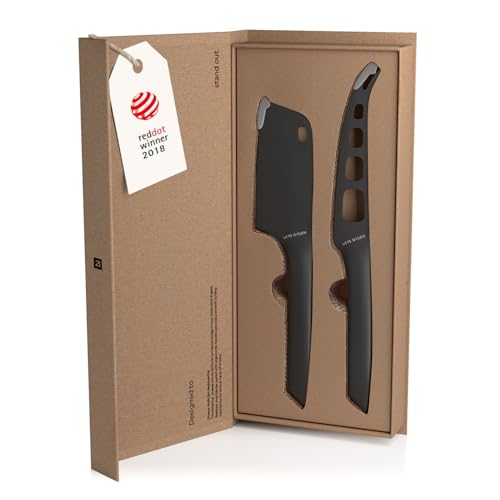
A soft-cheese knife and a small cheese cleaver in matte black steel, packed in a magnetic gift box. The set I’d bring to a host who already owns everything.
Cheese Knives Compared
| Pick | Type | Pieces | Material | Dishwasher | Best for |
|---|---|---|---|---|---|
| BOSKA Copenhagen | Soft, hard and all-round knives | 3 | One-piece stainless steel | Yes (per listing) | Most cheese boards |
| ICOSA Living Harvest | Knives, fork and spreader | 6 | Stainless blades, full tang | Not stated | Big boards, gifts |
| Zyliss Cheese Knife | Holed serrated knife, forked tip | 1 | Stainless blade, wheat straw handle | Not stated | One knife for everything |
| WÜSTHOF Gourmet 5″ | Holed soft cheese knife | 1 | High carbon stainless, riveted handle | No, hand wash | Brie, camembert |
| BOSKA Monaco+ | Cheese plane | 1 | One-piece stainless steel | Not stated | Thin slices off a block |
| Swissmar Barcelona | Parmesan knife | 1 | Stainless steel | Not stated | Parmesan, aged cheese |
| LARS NYSØM Edge | Soft knife and cheese cleaver | 2 | Stainless steel handles | No | Gifts, modern tables |
1. BOSKA Copenhagen 3-Piece Cheese Knife Set: Best Overall
Who it’s for: anyone putting together a cheese board who wants the right shape for every cheese without a drawer full of tools.
BOSKA has been making cheese tools in the Netherlands since 1896, and the Copenhagen set is a good summary of what they’ve learned. You get three knives: a soft cheese knife with a narrow, open blade so brie has less metal to cling to, a hard cheese knife with a short pointed blade you push into firm cheese, and an all-round knife for the semi-hard middle ground like gouda and cheddar.
Each knife is cast in one piece of stainless steel. I like that for a serving tool: there’s no wooden handle to crack, no rivets to collect cheese, and the listing says the set is dishwasher safe. They look clean on a board, too, which matters when the knives sit out all evening.
My reservation is grip. Smooth steel handles get slippery when they’re greasy from a buttery cheese, so these are for serving and portioning, not heavy cutting of a whole wheel.
Key specs
- Pieces: soft cheese knife, hard cheese knife, all-round cheese knife
- Material: stainless steel, cast in one piece
- Care: dishwasher safe per listing
- Maker: BOSKA Holland, cheese tools since 1896
Pros
- Covers soft, semi-hard and hard cheese
- One-piece build is easy to clean
- From a specialist cheese tool maker
Cons
- Bare steel handles get slick with fatty cheese
- No spreader or fork in the set
My verdict: the set I’d recommend to most people who serve cheese a few times a month. If you want a spreader and fork as well, the ICOSA set covers a bigger board.
2. ICOSA Living Harvest 6-Piece Set: Best Charcuterie Board Set
Who it’s for: hosts who build big boards with several cheeses, cured meats and spreads, and anyone shopping for a wedding or housewarming gift.
A board with five cheeses and one knife ends with blue cheese smeared on the goat cheese. The Harvest set solves that with six pieces: four different cheese knives, a cheese fork and a spreader. Put one by each cheese and the flavors stay separate.
The listing describes full-tang stainless steel construction, which makes the pieces feel more solid than the flimsy six-piece sets that flood this category. It comes in a gift box, which is half the reason people buy it.
Smaller knives mean less leverage. They’re right for serving, not for cutting a big block of aged cheese into pieces before guests arrive; use a kitchen knife or the parmesan knife for that.
Key specs
- Pieces: 4 cheese knives, 1 cheese fork, 1 spreader
- Build: stainless steel, full metal tang (per listing)
- Packaging: gift box
Pros
- A tool for every cheese on a full board
- Includes a fork and spreader
- Gift-ready packaging
Cons
- Small knives, not for prepping big blocks
- Dishwasher use not stated, so hand wash to be safe
My verdict: the best set for large boards and gifting. For a smaller table, the three BOSKA knives are simpler.
3. Zyliss 5-Inch Cheese Knife: Best Budget Single Knife
Who it’s for: people who want one cheese knife in the drawer for weeknight snacks and the odd party.
If I could only have one cheese knife, it would be this shape. The holes through the blade cut down the surface that soft cheese can stick to, the wavy serrated edge bites through rinds and firmer cheese, and the forked tip lifts each slice onto a plate or cracker. That’s three jobs in one cheap tool.
Zyliss says it handles soft, semi-soft and firm cheese, and that matches what the design is built for. The handle is made partly from wheat straw to cut plastic use, and it’s light in the hand.
What it can’t do is hard aged cheese. Parmesan and old gouda need a stubby point you can lever with, and a 5-inch serrated blade will only skate across them.
Key specs
- Blade: 5-inch stainless steel, gently serrated, perforated
- Tip: forked for serving
- Handle: wheat straw composite
- For: soft, semi-soft and firm cheese
Pros
- Holes reduce sticking
- Forked tip serves as well as cuts
- Costs very little
Cons
- Not for parmesan or other hard aged cheese
- Light handle feels less solid than a riveted knife
My verdict: the cheese knife for people who only want one. Pair it with the Swissmar parmesan knife and you’ve covered nearly every cheese.
4. WÜSTHOF Gourmet 5-Inch Cheese Knife: Best for Soft Cheese
Who it’s for: cheese lovers who serve a lot of brie, camembert and other soft cheese, and want a knife that matches their kitchen knives.
Soft cheese is the hardest to serve neatly. A solid blade drags the paste with it and leaves a smeared wedge. This WÜSTHOF has large holes cut through the blade, which leave air pockets between the cheese and the steel so slices fall away cleanly. It’s the same idea as the Zyliss, done with better materials.
It’s from WÜSTHOF’s Gourmet line: a laser-cut stamped blade of high-carbon stainless steel and a triple-riveted synthetic handle that stays put in a greasy hand. The company has made knives in Solingen, Germany, for over 200 years, and the knife carries a limited lifetime warranty. My WÜSTHOF Classic vs Gourmet comparison explains how the Gourmet line differs from the forged Classic.
Two catches: WÜSTHOF says hand wash only, and it costs more than the other single knives here.
Key specs
- Blade: 5-inch high-carbon stainless steel, large holes
- Handle: triple-riveted synthetic polypropylene
- Made in Solingen, Germany; limited lifetime warranty
- Care: hand wash only
Pros
- Holes release soft cheese cleanly
- Secure riveted handle
- Made by a top German knife maker
Cons
- Hand wash only
- Costs more than the Zyliss for a similar shape
My verdict: the soft cheese knife to buy if you already own WÜSTHOF or want one tool that lasts decades. For occasional use, the Zyliss does the same job.
5. BOSKA Monaco+ Cheese Slicer: Best Cheese Plane
Who it’s for: anyone who eats block cheese on sandwiches and crackers, and households where cheese gets sliced daily.
A cheese plane is a flat paddle with a slot and a sharp edge. You draw it across the top of a block and it shaves off a thin, even slice. It’s a Scandinavian and Dutch breakfast staple, and for semi-hard cheese like gouda, cheddar and swiss it’s faster and neater than any knife.
The Monaco+ is made in one solid piece of stainless steel with no moving parts, so there’s nothing to bend or loosen. BOSKA puts a quilted texture on the surface to reduce friction and stop slices sticking, and says it works from cheddar up to parmesan.
A plane works best on a block with a flat top, so it’s less useful on a round of soft cheese. It’s a slicer, not a serving knife, and I’d keep it next to the cheese drawer rather than on the party board.
Key specs
- Type: handheld cheese plane
- Material: one-piece stainless steel, quilted non-stick surface
- For: semi-hard and hard block cheese
Pros
- Thin, even slices every time
- Solid build, nothing to bend
- Faster than a knife for daily slicing
Cons
- No use on soft cheese
- Needs a block with a flat face
My verdict: the best tool for everyday block cheese, and the one people are surprised to use more than any knife. Skip it if your cheese is mostly soft.
6. Swissmar Barcelona Parmesan Knife: Best for Parmesan
Who it’s for: anyone who buys wedges of parmesan, pecorino or aged gouda and wants rough chunks instead of grated cheese.
Parmesan isn’t sliced in Italy; it’s broken. The cheese has a natural grain, and a short, pointed, almond-shaped blade pushed in and twisted splits it along that grain into rustic chunks. That’s exactly what this knife is for.
Swissmar keeps the blade short for control (the whole knife is 7.2 inches) and gives it a sand-blasted handle that won’t slip. It’s simple and solid, and it costs very little for a tool that does a job no regular knife does safely. Using a thin chef’s knife to pry at parmesan is how tips snap.
It’s a one-trick tool. On soft or semi-hard cheese it just tears.
Key specs
- Length: 7.2 inches overall, short pointed blade
- Material: stainless steel, sand-blasted handle
- For: parmesan, pecorino, Cheshire and other hard cheese
Pros
- Breaks hard cheese cleanly along its grain
- Saves your kitchen knives from prying
- Costs very little
Cons
- Useless on soft cheese
- Smooth steel needs a dry hand
My verdict: the cheapest upgrade to any cheese board that includes an aged cheese. If your board never has one, skip it.
7. LARS NYSØM Edge 2-Piece Set: Best Gift Set
Who it’s for: gift buyers, and hosts who want cheese knives that look as good as the board.
LARS NYSØM is a design-led brand, and this set is mostly about looks: two matte black stainless steel pieces with clean lines, presented in a box with a magnetic lid. You get a knife for soft cheese and a small cheese cleaver for hard cheese, so between them they cover a basic board.
The listing says the stainless blades are extra-hardened and the handles suit left-handers as well as right-handers. That’s a fair claim for a symmetrical design like this.
The practical downside is care: LARS NYSØM says the knives are not dishwasher safe. For a gift that’s fine, but if you want tools you can throw in after a party, choose the BOSKA set.
Key specs
- Pieces: soft cheese knife, cheese cleaver for hard cheese
- Material: stainless steel with stainless handles, black finish
- Care: not dishwasher safe
- Packaging: gift box with magnetic closure
Pros
- Striking, modern design
- Covers soft and hard cheese
- Handsome gift packaging
Cons
- Hand wash only
- Only two pieces
My verdict: the cheese knife gift I’d pick for a design lover. For daily practicality, BOSKA wins, and for a bigger kitchen gift, my best knife sets guide has ideas.
Which Cheese Knife for Which Cheese
Soft cheese (brie, camembert, fresh goat)
Use a thin blade with holes or a very narrow, open blade. Soft cheese sticks to flat metal, and holes leave air gaps so slices fall away. The WÜSTHOF Gourmet and Zyliss do this best; the BOSKA soft cheese knife works too.
Semi-hard cheese (cheddar, gouda, swiss)
Use a cheese plane for thin slices or an all-round cheese knife for cubes and wedges. These cheeses cut cleanly, so the choice is about the shape you want on the plate.
Hard aged cheese (parmesan, pecorino, aged gouda)
Use a short, stubby parmesan knife or a small cheese cleaver. Push the point in and twist so the cheese breaks along its grain. Never pry with a thin kitchen knife; the tip can snap.
Crumbly and blue cheese (stilton, feta, gorgonzola)
Use a small knife with a forked tip or a spreader. These cheeses fall apart under pressure, so serving is more about scooping than cutting, and a dedicated knife keeps blue mold from spreading to the other cheeses.
How to Choose a Cheese Knife
Set or single knife?
Buy a set if you serve two or more cheeses at once; a single holed knife is enough if you cut cheese for yourself. Sets keep flavors separate on a board, and that’s their real value.
One-piece steel or a riveted handle?
One-piece steel is easiest to clean and often dishwasher safe, but it’s slick when greasy. Riveted handles grip better and suit heavier cutting. For serving, either is fine; for prepping big blocks, I prefer a handle.
Holes, serrations and forks
Holes stop soft cheese sticking, gentle serrations get through rinds, and a forked tip lets you serve without a second tool. A knife with all three, like the Zyliss, is the most useful single cheese knife you can own.
Don’t forget the board
Cut on wood or soft plastic, never on slate, glass or marble. Hard surfaces dull any edge fast, including the cheap ones. Many serving boards look lovely and quietly ruin the knives used on them.
FAQ
What is a cheese knife with holes for?
The holes stop soft cheese sticking to the blade. They leave air pockets between the cheese and the steel, so slices of brie or camembert fall away cleanly instead of smearing.
Do I need a special knife for parmesan?
Yes, if you want chunks rather than grated cheese. A short, pointed parmesan knife breaks hard cheese along its grain, while a thin kitchen knife tends to stick and can snap at the tip when you pry.
Can I use a regular kitchen knife for cheese?
For semi-hard cheese like cheddar, a sharp paring or utility knife works fine, like the ones in a decent knife set under $100. Soft cheese sticks to its solid blade and hard aged cheese can damage its thin edge, which is where cheese knives earn their place.
Are cheese knives dishwasher safe?
Some are. One-piece stainless steel sets like the BOSKA Copenhagen are listed as dishwasher safe, while the WÜSTHOF and LARS NYSØM knives should be washed by hand. Check each maker’s instructions; if you want kitchen knives that can go in the machine, see my dishwasher-safe knife sets.
How many cheese knives do I need for a cheese board?
One per cheese is ideal, so flavors don’t mix. For a typical board of three cheeses (soft, semi-hard and hard), a three-piece set like the BOSKA Copenhagen covers it.
Final Verdict
For most cheese boards, the BOSKA Copenhagen set is the one I’d buy: three well-chosen shapes from a specialist, easy to clean and good-looking on the table. The Zyliss holed knife is the best single knife if you only want one, and the ICOSA Harvest set is the pick for hosts who build big boards or want a gift that’s ready to wrap.
For the rest of your kitchen, see my best kitchen knives under $100.

Gary Portman founded knivesadvice.com in 2019. He learned to cook in his family’s kitchen as a kid and has used kitchen, pocket and outdoor knives ever since, from paring and fillet knives to survival blades he carries camping and hiking. He writes the site’s buying guides, brand reviews and sharpening how-tos to help readers find the right knife for the job. More about Gary.