
A cut-resistant glove is the cheapest safety gear in any kitchen or tackle box, and the most misunderstood. It doesn’t make your hand knife-proof. A knit glove stops a blade sliding across your skin, which is how most kitchen cuts happen: a mandoline, a slipping fillet knife, an oyster knife that skids off the hinge. A point pushed straight in can still go through the knit.
The ratings confuse people too. In the US, gloves are graded A1 to A9 under ANSI/ISEA 105, with A9 the highest. Many kitchen gloves are sold as “Level 5”, which usually refers to the older European EN388 scale that tops out at 5, so it’s not the same thing as ANSI A5. Either way, the glove goes on the hand that holds the food, not the hand that holds the knife.
For most people I recommend the NoCry Premium Cut Resistant Glove: food safe, ambidextrous, machine washable and thin enough to feel what you’re holding. When you want the highest knit rating, the Schwer SlicePro A9 is the step up, and for boning and butchering a Schwer chainmail glove adds real protection against points.
My Top 6 Cut-Resistant Glove Picks

The glove I’d hand to any home cook who owns a mandoline or a sharp fillet knife. Snug, food safe, washable and rated at the top of the EN388 scale, with a limited lifetime warranty.

ANSI A9 in a thin knit glove, thanks to stainless steel wire wound with high-strength fibers. No glass fiber, so it doesn’t itch on long sessions.
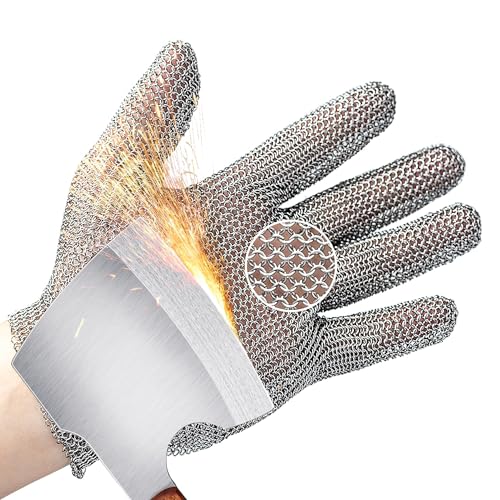
Welded 316L stainless rings that stop points as well as edges. The glove for boning, breaking down game and heavy shucking.

The same idea as the Premium with tiny grip dots on the palm, so slimy fish, wet onions and smooth squash don’t squirt away.

A real cut glove in a child’s size, for the first whittling project, the first fish cleaned or helping out in the kitchen.

A9 cut rating with a waterproof, oil-proof nitrile coating. For sharpening, carving, rope work and boat chores, not for food.
Cut-Resistant Gloves Compared
| Glove | Type | Cut rating | Food safe | Best for |
|---|---|---|---|---|
| NoCry Premium | Knit | EN388 Level 5 | Yes | Everyday kitchen prep, mandolines |
| Schwer SlicePro A9 | Knit with steel wire | ANSI A9 | Yes | Maximum knit protection |
| Schwer PM5201 chainmail | 316L stainless rings | ANSI A9 | Yes | Boning, butchering, heavy shucking |
| NoCry Grip Microdots | Knit with grip dots | EN388 Level 5 | Yes | Fish and slippery food |
| NoCry Kids | Knit, XS | EN388 Level 5 | Yes | Children 8 to 12 |
| Schwer PM3202 | Knit, 3/4 nitrile coated | ANSI A9 | Not sold as food grade | Workshop, carving, boat work |
1. NoCry Premium Cut Resistant Gloves: Best Overall
Who it’s for: home cooks, anglers and oyster lovers who want one comfortable glove for everyday knife and mandoline work.
NoCry is the name I see recommended most often for kitchen cut gloves, and the reasons are practical. The knit is thin enough that you can still feel the skin of a tomato or the edge of a fish fillet, it’s ambidextrous so you can wear it on whichever hand holds the food, and it goes in the washing machine after you’ve handled raw meat or fish.
It carries EN388 Level 5 cut resistance and an ANSI 105 rating, and NoCry covers it with a limited lifetime warranty. For the jobs that cause most kitchen injuries (mandoline slicing, peeling, grating, filleting) that’s the right level of protection without the stiffness of heavier gloves.
Two things to know. NoCry doesn’t print the ANSI A-level in the listing, so if your workplace requires a specific A-rating, the Schwer A9 is the safer buy. And like every knit glove, it stops slices, not stabs: when shucking, I’d still hold the oyster in a folded towel as well.
Key specs
- Cut rating: EN388:2016 Level 5, ANSI 105-2016 rated
- Food safe, ambidextrous
- Machine washable
- Limited lifetime warranty
Pros
- Thin and dexterous
- Fits either hand
- Easy to wash after raw meat or fish
Cons
- ANSI A-level not stated in the listing
- Not stab resistant
My verdict: the cut glove most kitchens should have in the drawer. Step up to the Schwer A9 only if you need a documented top rating.
2. Schwer SlicePro A9 (PR1501-G): Best High-Rated Knit
Who it’s for: people who process a lot of fish or game, use a mandoline daily, or just want the highest knit rating available.
A9 is the top of the ANSI scale, and getting there in a knit glove takes metal. Schwer winds stainless steel wire together with ultra-high-strength fibers, which is why this glove resists a sliding blade far better than fiber alone while still flexing like fabric. It’s food-grade certified and contains no glass fiber, a detail that matters if fiberglass-core gloves make your hands itch.
That rating makes sense for long, repetitive jobs where fatigue causes slips: filleting a cooler of fish, slicing a big batch on a mandoline, or trimming a whole brisket. Schwer also reinforces the knitting for durability, which counts when a glove gets washed after every session.
The steel wire makes it a touch stiffer than the NoCry, and A9 still doesn’t mean stab proof. This listing is size M; check the size chart, because a loose glove is clumsy and easier to catch with a blade.
Key specs
- Cut rating: ANSI A9
- Stainless steel wire with ultra-high-strength fibers
- Food-grade certified, no glass fiber
- Reinforced knitting
Pros
- Highest ANSI cut level
- No itchy glass fiber
- Still flexible enough for fine work
Cons
- A little stiffer than fiber-only gloves
- Points can still get through the knit
My verdict: the knit glove for heavy users. Casual cooks will find the NoCry more comfortable and protective enough.
3. Schwer A9 Metal Mesh Chainmail Glove (PM5201): Best Chainmail
Who it’s for: hunters breaking down game, home butchers and anyone boning meat with a pointed knife.
Chainmail is what butchers have worn for generations, and for a good reason: the interlocked rings catch a knife’s point before it reaches your skin, which a knit glove can’t promise. That matters most with boning work, where the tip is working toward your other hand around joints and bone. This Schwer glove uses individually welded 316L stainless rings, a grade chosen for its corrosion resistance in wet, salty work.
It’s a five-finger, reversible design, so one glove fits either hand, and an adjustable stainless wrist clasp keeps it snug and is easier to clean than a fabric cuff. If you break down your own deer, it pairs naturally with the knives in my boning knife for deer guide.
Chainmail is heavier and less nimble than knit, and you’ll feel less through it. It’s also sold as a single glove, not a pair, and it needs scrubbing and drying after every use.
Key specs
- Cut rating: ANSI A9
- Welded 316L stainless steel rings
- Five-finger, reversible, fits either hand
- Adjustable stainless wrist clasp
- Food grade; this listing is size L
Pros
- Resists points as well as edges
- Corrosion-resistant steel
- Easy-to-clean metal cuff
Cons
- Heavier and less dexterous
- Single glove
My verdict: the only glove here I’d trust around a boning knife’s point. For slicing and mandolines, a knit glove is more pleasant to wear.
4. NoCry Cut Resistant Gloves with Grip Microdots: Best Grip
Who it’s for: anglers cleaning fish and cooks who handle slippery food.
A cut glove only helps if the food stays put. Plain knit can slide on wet fish skin or a peeled onion, and a slipping fish is exactly how fillet knife accidents start. These NoCry gloves add tiny grip dots to the palm, which hold smooth, wet surfaces much better.
The knit is a blend of ultra-high molecular weight polyethylene, fiberglass and spandex, rated at the top of the EN388 scale, food safe and machine washable on cool. NoCry also suggests them for woodworking, where the dots help hold a carving block. If you fillet often, my fish fillet knife guide covers the other half of the setup.
The fiberglass core can bother sensitive skin, and grip dots wear over time. Like the Premium, the listing doesn’t give an ANSI A-level.
Key specs
- Cut rating: EN388 Level 5
- Grip microdots on the palm
- UHMWPE, fiberglass and spandex knit
- Food safe, ambidextrous, machine washable on cool
Pros
- Much better hold on wet, slippery food
- Snug, flexible fit
- Works for carving and woodworking too
Cons
- Fiberglass core can itch
- Dots wear with heavy use
My verdict: the best glove for fish cleaning. If grip isn’t an issue, the plain Premium is a little more comfortable.
5. NoCry Kids Cutting Gloves (XS, 8 to 12): Best for Kids
Who it’s for: parents teaching a child to whittle, clean fish or help with kitchen prep.
I learned to use knives in the family kitchen as a kid, and I’d have liked one of these. An adult glove on a child’s hand is worse than useless: the loose fingertips flop around, catch the blade and make the child clumsy. This NoCry glove is sized XS for roughly 8 to 12 year olds, snug and stretchy, so it protects without getting in the way.
It carries the same top EN388 cut level as NoCry’s adult gloves, is food grade and ambidextrous, and goes in the washing machine. NoCry pitches it at whittling, fishing and wood carving, which is exactly where most kids first hold a sharp blade.
A glove is a backup, not a lesson. Kids still need to learn to cut away from their body and keep the holding hand out of the blade’s path. And they outgrow XS quickly.
Key specs
- Size: XS, for ages about 8 to 12
- Cut rating: EN388 Level 5
- Food grade, ambidextrous
- Machine washable
Pros
- Properly sized for children
- Same protection level as adult gloves
- Good for whittling and fishing
Cons
- Outgrown quickly
- Not stab resistant
My verdict: the glove to buy with a child’s first pocket knife or fishing trip. Teach good habits alongside it.
6. Schwer ProGuard A9 Double-Dipped (PM3202): Best Coated Work Glove
Who it’s for: people who sharpen, carve, cut rope and handle sharp tools outside the kitchen.
Not every knife job involves food. Sharpening on a stone, carving spoons, cutting line on a boat or cleaning up a workshop all put a blade near your hand, often with oil, water or grime in the mix. This Schwer glove pairs an A9 cut rating with a double-dipped nitrile coating over three quarters of the hand, which keeps water and oil out and grips well when everything is slick.
It’s also rated level 5 for abrasion and level 4 for puncture, more than the kitchen gloves here, and the 18 gauge knit stays light and flexible. The fingertips work on a touchscreen, which is handy on a boat or a job site.
It isn’t sold as food grade, so keep it out of the kitchen and away from fish you plan to eat. The coating also makes it warmer than an open knit. This listing is size L.
Key specs
- Cut rating: ANSI A9
- Abrasion level 5, puncture level 4
- 3/4 double-dipped nitrile coating, water and oil proof
- 18 gauge knit, touchscreen fingertips
Pros
- Top cut rating plus wet grip
- More puncture and abrasion resistance
- Touchscreen compatible
Cons
- Not for food prep
- Warmer than open knit
My verdict: the glove for knife work in the shop and on the water. For anything that ends up on a plate, choose one of the food-safe picks.
Choosing a Cut-Resistant Glove
Read the rating correctly
Look for an ANSI/ISEA 105 rating from A1 to A9; A4 and up suits sharp kitchen knives and mandolines, A9 is the maximum. “Level 5” on a package usually means the older EN388 scale, where 5 is the top. Both are useful, but they aren’t the same numbers.
Knit or chainmail
Choose knit for slicing, peeling, mandolines and filleting, because it’s light and you can feel the food. Choose chainmail for boning and butchering, where a point may come toward your hand.
Food safe for the kitchen
Only use gloves sold as food safe or food grade for food. Coated work gloves belong in the shop.
Fit snug
A glove should fit like a second skin. Loose fingertips catch blades and make you clumsy, which defeats the point.
Glass fiber or not
Some knit gloves get their strength from a fiberglass core. If your skin is sensitive, look for steel-wire or “no glass fiber” gloves like the Schwer SlicePro.
How to Use a Cut Glove Safely
Wear the glove on the hand that holds the food, and keep a good grip on the knife with your bare hand. For raw meat and fish, many cooks pull a disposable nitrile glove over the cut glove so it stays clean. Keep using a safe hold, like the claw grip in my guide to holding a knife for chopping, because the glove is the backup, not the technique.
When shucking, hold the oyster in a folded towel on top of the glove, as I explain in my oyster knife guide. Wash knit gloves after every use, let them dry fully, and replace any glove with cuts, holes or worn patches.
FAQ
Do cut-resistant gloves actually work?
Yes, against slicing cuts, which are the most common kitchen injuries. A good knit glove stops a sliding blade, a mandoline or a grater from cutting your skin. They don’t reliably stop a knife point pushed straight in; only chainmail does that well.
What level of cut-resistant glove do I need for kitchen knives?
For home kitchen knives and mandolines, ANSI A4 or higher, or EN388 Level 5 on the older scale, is a sensible minimum. A9 is worth it for long sessions of filleting or butchering.
Which hand should wear the cut glove?
The hand that holds the food, since that’s the one in the blade’s path. Some butchers and fish processors wear one on both hands, but most cooks keep the knife hand bare for grip.
Are cut-resistant gloves stab proof?
No, knit gloves aren’t. Their fibers resist a sliding edge but a point can slip between them. Stainless chainmail gloves give much better protection against points.
Can you wash cut-resistant gloves?
Most knit ones go in the washing machine, usually on a cool cycle; check the label. Chainmail gloves are scrubbed with hot soapy water and dried. Never put a damp glove away.
Can kids use cut-resistant gloves?
Yes, and they should when learning to whittle or prep food, but only in a child’s size. A loose adult glove makes cutting more dangerous.
Final Verdict
For most kitchens and tackle boxes, the NoCry Premium is the glove I’d buy: comfortable, food safe and easy to wash. The Schwer SlicePro A9 is the upgrade when you want the top ANSI rating in a knit, and the Schwer chainmail glove is the one to wear when a boning knife’s point is working toward your hand.
Shopping for knives to go with the gloves? My knife for cutting meat guide matches the right blade to each meat job.

Gary Portman founded knivesadvice.com in 2019. He learned to cook in his family’s kitchen as a kid and has used kitchen, pocket and outdoor knives ever since, from paring and fillet knives to survival blades he carries camping and hiking. He writes the site’s buying guides, brand reviews and sharpening how-tos to help readers find the right knife for the job. More about Gary.