
Ask ten anglers which fillet knife is best and you’ll get ten answers, mostly about brands. I care more about two things: a blade thin and flexible enough to follow the rib cage instead of cutting through it, and a handle you can still hold when it’s covered in slime. Get those right and almost any fish comes off the frame cleanly.
For most people I’d start with the Rapala Fish ‘n Fillet 7-inch, the birch-handled knife that has lived in tackle boxes for generations and still does the job. If you fillet at the kitchen sink rather than the dock, the Victorinox Fibrox 8-inch fillet knife is the one I’d buy.
My Top 6 Fish Fillet Knife Picks

If a friend who fishes a few weekends a year asked me what to buy, this is the knife I’d name. The 7-inch blade suits walleye, bass, crappie and trout, and it comes with a sheath and a little sharpener. Nothing fancy, and that’s exactly why it has lasted.
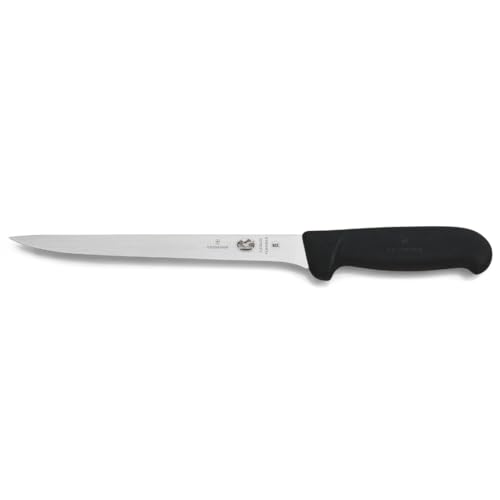
For fish that arrives from the market or gets filleted at home, I prefer this Victorinox. The textured handle holds when wet, the blade is long enough for a whole side of fish, and it goes in the dishwasher, which a birch handle never should.

This is the plain white-handled knife you see in fish markets, and I picked it for anyone who wants a good blade for very little money. Narrow, flexible and easy to sharpen, it’s also the one I’d keep as a spare in the boat.

I chose the Buck for people who don’t want a long fixed blade rattling around the tackle bag. It folds to about 7 inches, locks open with a lockback, and Buck backs it with its lifetime warranty.

Small fish need a short, nimble blade, and this Mora is the one I’d hand to someone who mostly cleans perch, bluegill and stream trout. Sandvik stainless steel and a grippy handle at a fair price.

If you want a forged kitchen fillet knife that will last decades, this is my choice. It’s thin and flexible like a fillet knife should be, but with the weight and finish of a German chef’s knife.
Fish Fillet Knives Compared
| Knife | Blade | Type | Handle | Best for |
|---|---|---|---|---|
| Rapala Fish ‘n Fillet | 7″ | Fixed, sheath and sharpener | Birch | Most anglers |
| Victorinox Fibrox Fillet | 8″ | Fixed | Fibrox (textured) | Kitchen filleting |
| Dexter-Russell P94812 | 7″ | Fixed | Polypropylene | Tight budgets, spares |
| Buck 220 Silver Creek | 6.5″ | Folding, lockback | Rubber overmold | Tackle bags |
| Morakniv Companion Fish Fillet | 6.1″ | Fixed, sheath | Friction grip polymer | Panfish and trout |
| WÜSTHOF Classic Fillet | 7″ | Fixed, forged | Polypropylene, riveted | Buy-it-once kitchen knife |
1. Rapala Fish ‘n Fillet 7-Inch: Best Overall
Who it’s for: freshwater anglers who want one dependable fillet knife for the dock, the cleaning station and the cabin.
There are flashier fillet knives on this page, and I still put the Rapala first. It’s been around for decades for a simple reason: the thin Swedish stainless blade flexes nicely along the backbone, the birch handle is shaped to sit in your fist, and the whole kit (knife, sheath, sharpener) costs very little.
I like the 7-inch size best for an all-rounder. It’s long enough to run the full length of a 3 or 4 pound walleye or bass in one pass, and short enough that you can still steer the tip around the rib cage of a crappie. The 4 and 6-inch versions are better for tiny panfish, and Rapala’s 9-inch is for bigger fish, but 7 inches is the one I’d pick if you only own one.
My reservation is the handle. Varnished birch looks great and grips well when dry, but it doesn’t love soaking in a sink, and it should never go in the dishwasher. Rinse it, dry it, and it will last. The included sharpener is basic: fine for touching up the edge at the lake, not a substitute for a proper sharpener at home.
Key specs
- Blade: 7-inch full-tang stainless steel, flexible
- Handle: reinforced birch
- Includes sheath and single-stage sharpener
Pros
- The most versatile length for freshwater fish
- Thin, flexible blade that follows the bones
- Sheath and sharpener in the box
- Classic, comfortable handle shape
Cons
- Wood handle needs drying and can’t go in the dishwasher
- The included sharpener is only a quick fix
My verdict: the safe choice for anyone who cleans their own catch. Skip it only if you want a dishwasher-safe handle or fish mostly in salt water.
2. Victorinox Fibrox 8-Inch Fillet Knife: Best for the Kitchen
Who it’s for: home cooks who buy whole fish or fillet sides of fish at the counter and want a kitchen knife, not a fishing knife.
A kitchen fillet knife lives a different life from a dock knife. It gets washed with everything else, dropped in a block or a drawer, and pulled out for fish, but also for skinning a chicken breast or trimming a pork tenderloin. For that life I’d buy this Victorinox over anything with a wooden handle, and it doubles as a decent trimmer (see my guide to the best knife for trimming meat if that’s a big part of your cooking).
The Fibrox handle is the reason. It’s textured, non-slip even when wet, and it’s dishwasher safe and NSF approved, which is why you see Victorinox all over restaurant kitchens. The 8-inch flexible blade has enough length to skin a full side of salmon or cod in long strokes, and it’s straight-edged, so it lies flat against the cutting board when you run it under the skin.
What I’d change: there’s no sheath, so you’ll want a blade guard if it goes in a drawer, and 8 inches feels long on small trout. For those, the Morakniv further down is the better tool.
Key specs
- Blade: 8-inch flexible stainless steel, straight edge
- Handle: textured Fibrox, non-slip when wet
- Dishwasher safe, NSF approved
Pros
- Handle that grips well when wet
- Long enough to skin a whole side of fish
- Easy care, dishwasher safe
- Also useful for trimming meat and poultry
Cons
- No sheath or blade guard included
- A bit long for small panfish and trout
My verdict: the fillet knife I’d keep in a kitchen. Anglers who carry their knife to the water should look at the Rapala or the Buck instead.
3. Dexter-Russell 7-Inch Narrow Fillet Knife (P94812): Best Budget
Who it’s for: anyone who wants a capable fillet knife for very little money, or a second knife for the boat, the camp or the cleaning shed.
Dexter-Russell knives are what a lot of fish markets and processors use, and the white Basics line is their no-frills version. You get a narrow, flexible 7-inch blade in high-carbon stainless steel and a textured polypropylene handle, and that’s it. No sheath, no box worth keeping, no story.
I like it because it does the core job well. The narrow blade is easy to steer around the rib cage, the steel is soft enough that a quick pass on a hone or a pull-through brings it back, and the handle holds up to bleach and hot water. It’s the knife I’d keep as a spare so that a lost or broken knife never ends a fishing trip.
The trade-offs are plain: the stamped blade feels light and a little cheap, and it keeps its edge for a shorter time than the WÜSTHOF, so you’ll touch it up more often.
Key specs
- Blade: 7-inch narrow, flexible, high-carbon stainless steel
- Handle: textured polypropylene, slip-resistant when wet
Pros
- Very low cost for a proper fillet knife
- Narrow blade is easy to steer
- Easy to sharpen
- Handle tolerates hot water and sanitizing
Cons
- No sheath included
- Needs sharpening more often than forged knives
- Looks and feels utilitarian
My verdict: buy it if price matters most or you want a spare. If you want something that feels special in the hand, spend more.
4. Buck 220 Silver Creek Folding Fillet Knife: Best Folding
Who it’s for: kayak, canoe and shore anglers who want a full-size fillet blade that folds away safely.
Few folding fillet knives come from a brand with Buck’s record, and that’s why it’s my folding pick. The 6.5-inch blade is 420J2 stainless with a titanium coating for corrosion resistance, and a lockback holds it open firmly. Closed, it’s about 7.25 inches long, small enough for a tackle bag or a jacket pocket.
Buck got the safety details right. There’s a stainless steel guard between handle and blade, the handle has a rubber overmold that grips when wet, and there’s a large lanyard loop so you can tie it to your bag or your wrist. Buck’s lifetime warranty is one of the best in the business.
Any folding fillet knife has one weak spot, and this one too: slime and scales get into the pivot and the handle channel. Open it and rinse it after every trip. And 420J2 is a soft, very rust-resistant steel, so it dulls sooner than harder steels.
Key specs
- Blade: 6.5-inch 420J2 stainless steel, titanium coated, flexible
- Lock: lockback; about 7.25 inches closed
- Handle: glass-reinforced polypropylene with TPE rubber overmold, stainless guard
- Weight: 6 oz; Buck lifetime warranty
Pros
- Folds away, nothing sharp exposed in your bag
- Very good corrosion resistance
- Grippy handle with a real guard
- Excellent warranty
Cons
- The pivot needs cleaning after every use
- Soft steel needs touching up often
My verdict: the folding fillet knife I’d trust. If you have room for a sheath, a fixed blade is still easier to clean.
5. Morakniv Companion Fish Fillet Knife 6.1-Inch: Best for Panfish and Trout
Who it’s for: anglers who mostly clean small fish: perch, bluegill, crappie, stream trout and the like.
Long fillet knives are clumsy on small fish. You end up holding the blade halfway down and fighting the tip. A blade around 6 inches is easier to control on a fish that fits in your palm, and the Morakniv is my favorite in that size.
The blade is Sandvik 12C27 stainless, a Swedish steel that takes a keen edge and resists rust well. It’s 1.9 mm thick, so it’s thin but not floppy. The handle has a soft friction grip and a finger guard, it doesn’t absorb fish odor, and the plastic sheath has a belt clip and drains easily. Mora has built its name on simple knives that work, and this one fits that mold.
Where it falls short: 6.1 inches is too short to make a clean single pass on a big walleye or a pike, and the plastic sheath is functional rather than nice.
Key specs
- Blade: 6.1-inch Sandvik 12C27 stainless steel, 1.9 mm thick
- Overall length: 10.6 inches; 3.5 oz with sheath
- Handle: ergonomic polymer with soft friction grip and finger guard
- Polymer sheath with detachable belt clip
Pros
- Nimble size for small fish
- Good stainless steel for the price
- Grippy, odor-resistant handle
- Light sheath with a belt clip
Cons
- Too short for large fish
- Basic plastic sheath
My verdict: if your stringer is mostly panfish and trout, this is the knife. Anyone who keeps big walleye or pike should go longer.
6. WÜSTHOF Classic 7-Inch Fillet Knife: Best Premium
Who it’s for: cooks who fillet fish often in the kitchen and want a forged knife that matches the rest of their WÜSTHOF set.
I’ve written about WÜSTHOF a lot on this site (my WÜSTHOF knives review covers the whole range), and the Classic line is the one I recommend most. This fillet knife is forged from a single blank of high-carbon stainless and tempered to 58 HRC (Rockwell hardness, a measure of how hard the steel is). That’s soft enough to roll rather than chip if you hit a bone, and you can hone it straight again.
The blade is thin and flexible, narrow enough to run along the backbone and lift the skin off in one pull. Compared with the Victorinox it feels more solid and more balanced, and it holds its edge longer. It’s made in Solingen, Germany, and WÜSTHOF gives it a limited lifetime warranty.
Two things to know before you spend this much. It’s a kitchen knife: hand wash only, no sheath, not built for a bucket on the dock. And like every Classic knife it has a full bolster at the heel, which makes sharpening the last bit of the edge harder over the years.
Key specs
- Blade: 7-inch forged high-carbon stainless steel, thin and flexible
- Hardness: 58 HRC; Precision Edge Technology (PEtec)
- Handle: full tang, triple-riveted polypropylene, full bolster and finger guard
- Made in Solingen, Germany; limited lifetime warranty
Pros
- Forged quality and good balance
- Holds an edge longer than the stamped picks
- Steel rolls instead of chipping near bone
- Durable synthetic handle
Cons
- Hand wash only, no sheath
- Full bolster complicates sharpening over time
- Costs much more than the Dexter-Russell
My verdict: the fillet knife for a serious home cook. For the boat or the dock, I wouldn’t risk it; the Rapala is the better tool there.
How I’d Match a Fillet Knife to Your Fish
Blade length: match it to the fish
Choose a blade a little longer than the fillet is wide, so one pass runs from head to tail. My rough guide: 4 to 6 inches for panfish and small trout, 7 inches for walleye, bass and most freshwater fish, 8 to 9 inches for pike, large trout and salmon, and 9 inches or more for big saltwater fish. If you only buy one, 7 inches covers the most.
Flex: more for small fish, less for big ones
A flexible blade bends along the backbone and over the ribs, so it wastes less meat on small, delicate fish. Large, firm fish push back harder, and a very floppy blade wanders. That’s why saltwater fillet knives are often stiffer. For general freshwater use, a medium flexible blade like the Rapala’s is the right middle ground.
Grip comes before steel
A handle that grips when wet matters more than the steel. Fish are slimy, your hands get cold, and a slipping knife is how most fillet table cuts happen. Textured rubber or Fibrox-style handles are the safest; varnished wood is fine if you keep it dry. A finger guard is worth having.
Fixed or folding
Fixed blades are easier to clean and stronger; folding ones are easier to carry. If the knife lives in a boat box with a sheath, buy a fixed blade. If it rides in a pocket or a small bag, a locking folder like the Buck is safer than a loose fixed blade.
Stainless steel, always
Buy stainless for fish. Fillet knives live in water, slime and salt, and carbon steel rusts quickly in that life. Softer stainless steels are easy to resharpen at the lake; harder ones hold an edge longer but need more care. If you fish the coast, my guide to the best fillet knife for saltwater fish covers the extra corrosion resistance you’ll want.
Manual or electric
A manual knife is the better choice for most anglers: more control, less waste, nothing to charge. If you clean big limits of crappie, walleye or perch every week, an electric knife saves real time; I compare them in my best electric fish fillet knives guide.
How to Fillet a Fish in Five Steps
- Cut behind the gill plate down to the backbone, angling the blade toward the head so you keep the meat behind the collar.
- Turn the blade toward the tail and run it along the backbone with the flat of the blade riding on the bones. Let the flex do the work; don’t force it.
- Go over or around the rib cage. On small fish, slice over the ribs and cut the rib section away later. On bigger fish, follow the ribs with the tip.
- Stop just before the tail, flip the fillet over skin side down, and hold the tail end.
- Remove the skin by running the blade between skin and meat, edge angled slightly down toward the skin, while you pull the skin in the opposite direction.
Keep the knife sharp throughout. A dull fillet knife tears the meat and slips, and slipping is far more dangerous than a sharp edge.
FAQ
What size fillet knife is best for most fish?
A 7-inch blade is the best all-round size. It’s long enough for walleye, bass and trout and still nimble on smaller fish. Go shorter (4 to 6 inches) for panfish and longer (8 to 9 inches or more) for salmon, pike and saltwater species.
What knife is best for cutting out cod cheeks?
Use a short, pointed knife, such as a 6-inch fillet knife or a small boning knife. Cod cheeks sit in a shallow pocket below the eye, and you need a sharp tip to cut around them and lift them out. A long fillet blade is clumsy here, which is why I’d reach for the Morakniv.
Is a fillet knife the same as a boning knife?
No. A fillet knife is thinner, longer and more flexible, made for removing fillets and skin from fish. A boning knife is shorter and usually stiffer, made for separating meat from bone in beef, pork and poultry. Some 6-inch “boning and fillet” knives sit in between. I explain the differences in my boning vs fillet knives comparison.
Can a fillet knife go in the dishwasher?
Only if the maker says so. The Victorinox Fibrox is dishwasher safe; wooden handles like the Rapala’s and forged knives like the WÜSTHOF should be washed by hand. Even then, hand washing keeps any edge sharp longer.
How do I keep a fillet knife sharp?
Hone it before each session and sharpen it when honing stops helping. A fillet knife’s thin edge dulls quickly on scales and bones, so a couple of passes on a hone or a small pull-through sharpener between fish make a big difference. Rinse and dry the blade after use to protect the edge and the steel.
Final Verdict
The Rapala Fish ‘n Fillet 7-inch is still the fillet knife I’d recommend first: right size, right flex, and a sheath and sharpener in the box. Home cooks are better served by the dishwasher-safe Victorinox Fibrox 8-inch, and anyone who wants a buy-it-once kitchen knife should look at the WÜSTHOF Classic 7-inch.
Fishing for something specific? My guide to the best fillet knife for salmon covers long blades and salmon slicers, and if you also hunt, my boning knife for deer guide covers the knife for game. To open an oyster, a fillet knife is the wrong tool entirely: my best oyster knife guide covers the blunt, stiff blades that job needs.

Gary Portman founded knivesadvice.com in 2019. He learned to cook in his family’s kitchen as a kid and has used kitchen, pocket and outdoor knives ever since, from paring and fillet knives to survival blades he carries camping and hiking. He writes the site’s buying guides, brand reviews and sharpening how-tos to help readers find the right knife for the job. More about Gary.