
A fixed blade sounds like overkill for everyday carry until you think about what a folder actually is: a blade, a pivot, a lock and a handle with a slot in it, all of which can collect lint, work loose or fail. A small fixed blade has none of that. It’s out and cutting the moment it leaves the sheath, it’s stronger for its size than any folder, and it rinses clean under a tap.
The catch is carry. A fixed blade lives in a sheath, so the sheath decides whether the knife rides around your neck, inside a pocket, upright on a belt or sideways behind your hip (scout carry). The best small fixed blades are short enough, at 2 to 4 inches, to disappear in one of those spots. Laws on carrying fixed blades are often stricter than for folders, so check yours first.
My pick is the ESEE Izula-II: a tough little 1095 knife with Micarta scales and a molded sheath that converts between neck, belt and pocket carry. On a tight budget, the CRKT Minimalist is the neck knife I’d start with.
My Top 7 Fixed Blade EDC Picks

A 2.63 inch blade on a 6.75 inch knife that weighs 3.2 ounces, with Micarta scales that fill your hand and a molded sheath with a clip plate. Small enough for every day, tough enough to pry a staple or split a twig, from a brand that stands behind its knives.

A 2.16 inch drop point with finger grooves that make the tiny G10 handle surprisingly secure. Light enough to hang around your neck all day and costs very little.

A pocket-size Mora with a chunky, high-friction handle and a symmetrical sheath. It whittles, opens packages and cuts cord with the same easy manners as the full-size Companion.

A 2.75 inch clip point in AEB-L, a fine-grained stainless that sharpens to a razor edge and shrugs off sweat. Small, light and bright enough to find in a bag.
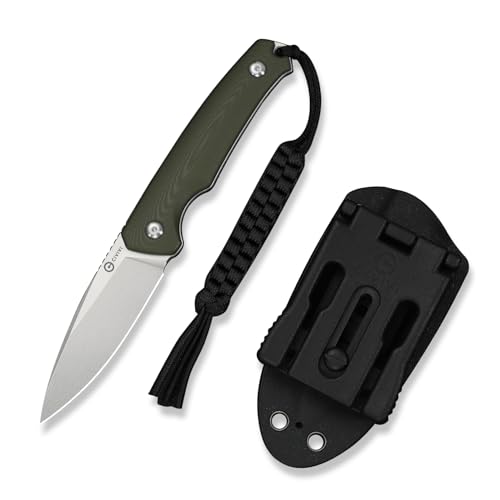
A full tang 2.99 inch drop point with a flat grind and a Kydex sheath on a T-clip that rides tidily on a belt. A modern EDC fixed blade that slices like a good folder.

A 3.02 inch wharncliffe: a straight edge with the point at the bottom, the best shape I know for boxes, tape and straps. A utility knife without the replaceable blades.

When 3 inches feels too small, the Harpoon gives you nearly 4 inches of D2 in a slim, textured G10 handle. The biggest knife here that still makes sense for daily carry.
Fixed Blade EDC Knives Compared
| Knife | Blade | Steel | Handle | Sheath | Best carry |
|---|---|---|---|---|---|
| ESEE Izula-II | 2.63″ drop point | 1095, 55 to 57 HRC | Micarta | Molded, clip plate | Neck, belt, pocket |
| CRKT Minimalist Drop Point | 2.16″ drop point | High carbon stainless | G10 | Thermoplastic | Neck |
| Morakniv Eldris | 2.3″ | Swedish stainless | High-friction polymer | Symmetrical polymer | Pocket, pack |
| Kizer Beaver 2 | 2.75″ clip point | AEB-L | G10 | Kydex | Neck, pocket |
| CIVIVI Altus | 2.99″ drop point | 14C28N | G10, full tang | Kydex, T-clip | Belt |
| CRKT S.P.E.W. | 3.02″ wharncliffe | High carbon stainless | G10 | Thermoplastic | Belt, pocket |
| Kizer Harpoon | 3.84″ drop point | D2 | G10 | Kydex | Belt |
1. ESEE Izula-II (1095, Black Micarta): Best Overall
Who it’s for: anyone who wants one small fixed blade they can carry daily and also trust on a hike or a camping trip.
The original Izula is a skeleton knife with a bare steel handle, made to hang around your neck. The Izula-II adds Micarta scales (a hard, grippy composite of resin and canvas or linen) and a slightly fuller handle, which turns it into a knife you can actually work with for more than a few cuts. The blade is 2.63 inches of 1095 carbon steel at 55 to 57 HRC, the knife is 6.75 inches overall, and it weighs 3.2 ounces without the sheath.
ESEE’s molded sheath comes with a clip plate, so you can wear it on a belt, clip it inside a pocket or a pack strap, or run a cord through it for neck carry. ESEE builds its knives in the USA and is known for a lifetime guarantee that covers even knives owners have broken. For a knife meant to be used hard every day, that matters.
The trade-offs come from the steel and the size. 1095 is hard to break and quick to sharpen, yet it isn’t stainless; the coating protects the flats, while the edge needs a wipe and a little oil. The 2.63 inch blade is short for food prep, and the thick handle with scales is a little heavy for all-day neck carry.
Key specs
- Blade: 2.63 inch, 1095 high carbon steel, 55 to 57 HRC, coated
- Overall length: 6.75 inches; weight: 3.2 oz without sheath
- Handle: black Micarta scales
- Molded sheath with clip plate
- Made in USA; ESEE lifetime guarantee
Pros
- Very tough for its size
- Sheath converts between neck, belt and pocket
- Famous guarantee
Cons
- Carbon edge rusts if neglected
- Short blade for food
- Heavy for a neck knife once scales are on
My verdict: the small fixed blade I’d carry if I could only own one. If you want something lighter around your neck, take the CRKT Minimalist or the Kizer Beaver 2.
2. CRKT Minimalist Drop Point (2384K): Best Budget
Who it’s for: first-time fixed blade carriers, and anyone who wants a neck knife they won’t mind losing.
The Minimalist is about as small as a useful knife gets: a 2.16 inch drop point blade on a stubby handle with deep finger grooves. Those grooves are the clever part. Your fingers lock into them, so even with three fingers on the handle the knife feels planted rather than slippery. G10 scales add grip in wet hands.
The blade is a high carbon stainless steel with a black stonewash finish that hides scratches and ages well. The thermoplastic sheath has mounting options, so you can hang it from a cord, attach it to a pack strap or tuck it into a pocket. It’s light enough to forget it’s there, which is the whole point of a neck knife.
The small size is also the limit. Big hands will only get two or three fingers on it, and the blade is too short for anything bigger than opening packages, cutting cord and slicing an apple. CRKT doesn’t name the steel on the listing, so expect average edge life.
Key specs
- Blade: 2.16 inch drop point, high carbon stainless, black stonewash
- Handle: G10 with finger grooves
- Thermoplastic sheath with mounting options
Pros
- Very light, easy neck carry
- Finger grooves give a secure grip
- Costs very little
Cons
- Too small for large hands
- Steel grade not stated
My verdict: the cheapest good way to find out whether fixed blade carry suits you. If it does, the Izula-II or the Altus is the upgrade.
3. Morakniv Eldris (Stainless, 2.3 Inch): Best for Outdoor Errands
Who it’s for: gardeners, hikers, anglers and anyone whose everyday carry leans outdoors.
The Eldris is what Morakniv makes when you ask for a full-size Mora that fits in a pocket. The blade is only 2.3 inches long and 0.08 inches thick, in recycled Swedish stainless steel, but the barrel-shaped handle is fat and grippy, with a soft friction coating and a finger guard. That handle is why it works so much better than its size suggests: you hold it like a big knife.
The knife is 5.6 inches overall and weighs about 80 grams with its sheath, per Morakniv. The sheath is symmetrical, so lefties can use it too, and Morakniv sells a fire kit and a belt loop that add on to it. It won the Scandinavian Outdoor Award in 2016.
The Eldris isn’t the most discreet knife here: the handle is thick and the sheath is bulky in a trouser pocket. It’s better in a jacket, a pack’s hip belt pocket or a tackle box. And the basic sheath has no clip, so the belt loop is close to a must for belt carry.
Key specs
- Blade: 2.3 inch (59 mm), 0.08 inch thick, Swedish stainless steel
- Overall length: 5.6 inches (143 mm); about 80 g with sheath
- High-friction polymer handle with finger guard
- Symmetrical polymer sheath (fire kit and belt loop sold separately)
Pros
- Full-size grip in a tiny knife
- Stainless and easy to sharpen
- Ambidextrous sheath
Cons
- Thick handle, bulky in a pocket
- Sheath needs an add-on for belt carry
My verdict: the small fixed blade I’d keep in a hiking jacket. For carry under city clothes, the slimmer Kizer Beaver 2 is easier to live with.
4. Kizer Beaver 2 (AEB-L, Olive and Orange G10): Best Neck Knife
Who it’s for: people who want a neck knife with a better steel and a more complete handle than the Minimalist.
Neck knives live against your skin, under a shirt, in sweat and rain. That’s why I like the steel choice here. AEB-L is a stainless steel with a very fine grain, so it takes a keen, smooth edge, sharpens easily and resists rust far better than 1095. Kizer pairs it with a 2.75 inch clip point blade, whose fine, controllable tip is good for splinters, tape and detail cuts.
The G10 handle is olive with an orange layer, which helps you find the knife in a bag or in the grass, and it rides in a Kydex sheath. Kizer, from China’s knife-making hub of Yangjiang, has a reputation for clean fit and finish for the money, and the Beaver 2 is a good example.
Clip points have thinner tips that can snap if you pry with them, so keep it to cutting. And the Kydex sheath, like most, can rattle a little or wear a mark on a dark shirt over time.
Key specs
- Blade: 2.75 inch clip point, AEB-L stainless
- Handle: olive green and orange G10
- Kydex sheath
Pros
- Rust-resistant steel for sweaty neck carry
- Fine tip for detail work
- Bright accent makes it easy to find
Cons
- Tip too fine for prying
- Kydex can wear clothing
My verdict: the neck knife I’d buy for daily wear. If you want maximum toughness over edge quality, the Izula-II is the harder-wearing choice.
5. CIVIVI Altus (14C28N, G10): Best for Belt Carry
Who it’s for: folding-knife fans moving to a fixed blade who want the same slicing feel, worn on a belt.
The Altus is CIVIVI’s take on a modern EDC fixed blade, and it feels like the brand’s folders without the pivot. The 2.99 inch drop point is Sandvik 14C28N with a flat grind, a thin, slicey profile that handles food and packaging cleanly. The full tang G10 handle is contoured for a comfortable grip, and the jimped spine (small grooves under your thumb) adds control.
The Kydex sheath uses a T-clip, which slides over a belt and holds the knife close to your body. It’s a tidy, low-profile setup for jeans or work pants. CIVIVI backs its knives with lifetime service against defects and a US service center.
A T-clip is belt-only, so the Altus is less flexible than the Izula-II’s sheath; you’ll need a different sheath for neck or pocket carry. And with 14C28N, edge retention is good rather than outstanding.
Key specs
- Blade: 2.99 inch drop point, Sandvik 14C28N, flat grind
- Full tang; contoured G10 handle, jimped spine
- Kydex sheath with T-clip
- CIVIVI lifetime service against defects, US service center
Pros
- Slices like a good folder
- Rust-resistant steel
- Neat, low-profile belt carry
Cons
- Sheath is belt-only
- Edge life only average
My verdict: the best fixed blade for people who already love modern folders. If you need neck carry, pick the Kizer Beaver 2 instead.
6. CRKT S.P.E.W. (2388): Best Wharncliffe
Who it’s for: warehouse and retail workers, movers and anyone who opens a lot of boxes.
On a wharncliffe, the edge runs dead straight and the spine curves down to meet it at the point. That puts the tip right in line with the edge, so you can score tape, slit shrink wrap and break down boxes with the precision of a box cutter, and the straight edge never rolls off the cardboard the way a curved belly can.
The S.P.E.W. gives you 3.02 inches of that shape in high carbon stainless with a bead blast finish that cuts glare, on a slim G10 handle. Its thermoplastic sheath has several mounting options for belt, bag or pocket carry, and the knife costs very little.
The same straight edge that’s perfect for boxes is clumsy for food and whittling; a drop point is the better all-rounder. And like the Minimalist, the steel isn’t named, so expect to touch up the edge often if you cut cardboard all day.
Key specs
- Blade: 3.02 inch wharncliffe, high carbon stainless, bead blast finish
- Handle: G10
- Thermoplastic sheath with mounting options
Pros
- Ideal shape for boxes and tape
- Precise, controllable point
- Good value
Cons
- Awkward for food and carving
- Unnamed steel dulls on cardboard
My verdict: the fixed blade to replace a box cutter. For general cutting, go with the Altus or the Izula-II.
7. Kizer Harpoon (D2, 3.84 Inch): Best Larger Blade
Who it’s for: people who carry on a belt every day and want a blade long enough for food, rope and outdoor jobs.
At 3.84 inches, the Harpoon’s drop point is the longest blade in this guide, and it starts to cross from EDC into camp knife territory. That length makes it far better for slicing a sandwich, trimming a rope or carving a stick than the 2 to 3 inch knives above. Kizer uses D2 steel with a satin finish, a good balance of edge life and toughness for the money.
The G10 handle is textured for grip and has a subtle curve along the back that fills the hand, and it rides in a Kydex sheath. Kizer offers lifetime service against defects.
Because D2 sits halfway between carbon and stainless steel, it can pick up rust spots after a damp day in the sheath, and it’s slower on the stone than AEB-L or 14C28N. The bigger size also means it’s harder to carry discreetly, and in some places a blade this long falls under stricter carry rules.
Key specs
- Blade: 3.84 inch drop point, D2 steel, satin finish
- Handle: textured G10
- Kydex sheath
- Kizer lifetime service against defects
Pros
- Longest, most versatile blade here
- Good edge life from D2
- Comfortable, grippy handle
Cons
- Can spot if stored wet
- Harder to carry discreetly
My verdict: the right knife if a 3 inch blade always feels too small. For discreet daily carry, stick with the Izula-II or the Altus.
How to Carry a Fixed Blade Every Day
Neck carry
Neck carry suits knives with blades under 3 inches and handles that weigh very little, like the CRKT Minimalist and the Kizer Beaver 2. The knife hangs upside down in its sheath on a cord or chain, under or over your shirt. Use a breakaway cord or a ball chain so it can’t choke you if it snags, and make sure the sheath holds the knife firmly with a click.
Pocket carry
Some sheaths clip inside a pocket so only the handle shows, like a folder. Pick a slim knife and a sheath with a sturdy clip, because the sheath must stay put when you draw the knife.
Belt carry: vertical or scout
A belt is the most comfortable place for knives over 3 inches. Vertical carry is the classic; scout carry holds the knife horizontally behind the hip, so it’s hidden under a shirt and doesn’t dig in when you sit. T-clips, belt loops and clip plates decide which you can do.
Check your local laws
Carry rules for fixed blades vary much more than for folders: some places limit blade length, others ban concealed fixed blades entirely, including neck knives under a shirt. Check the rules where you live and where you travel; this isn’t legal advice.
What I Look For in a Fixed Blade EDC Knife
Blade length: 2 to 4 inches
Under 3 inches is easy to carry discreetly and handles packages, cord and food. Up to 4 inches adds real outdoor ability but needs a belt. Beyond that, you’re carrying a camp or survival knife, not an EDC knife.
A handle you can fully grip
Small fixed blades often skimp on handle length. Look for finger grooves, a choil or a fat handle like the Eldris’s that lets three or four fingers hold on. A handle that’s too short is the most common reason people stop carrying a small fixed blade.
Steel: stainless for close carry
Knives worn against the body get sweaty. Stainless steels like AEB-L and 14C28N are the low-care choice; carbon steel like 1095 is tougher but needs wiping and oiling. My carbon vs stainless steel guide goes into the details.
The sheath matters as much as the knife
Kydex and molded sheaths hold the knife securely with a click and rinse clean; leather looks nice but stays wet. Make sure the sheath fits the way you want to carry, or that a clip plate or aftermarket sheath is available.
Fixed Blade or Folder for EDC?
A folder is still the easier daily carry for most people: it hides in a pocket, it’s legal in more places and it looks less alarming in an office. A small fixed blade wins on strength, speed and cleaning, and it has no lock to fail. If you mostly open packages in town, my EDC knives under $100 and folding knives under $100 are the better place to start. If your days take you outdoors, a small fixed blade earns its place, and my backpacking knives guide shows how one fits into a light kit.
FAQ
Is a fixed blade good for everyday carry?
Yes, a small fixed blade is a great everyday carry knife if your local laws allow it. It’s stronger than a folder, deploys instantly and is easy to clean. The main challenge is finding a sheath and carry position that’s comfortable all day.
What is a neck knife?
A neck knife is a small fixed blade, usually under 3 inches, that hangs upside down in its sheath from a cord or chain around your neck. The sheath holds the knife by friction or a click until you pull it out. The CRKT Minimalist and Kizer Beaver 2 are good examples.
Are neck knives safe?
Neck knives are safe when the sheath holds the knife firmly and you use a breakaway cord or ball chain. Test the retention by shaking the sheath upside down. Keep the blade small and the handle light so it doesn’t swing around.
What is scout carry?
Scout carry means wearing a fixed blade horizontally on your belt, usually behind your hip, with the handle toward your dominant hand. It hides the knife under a shirt and is more comfortable when sitting than vertical carry. You’ll need a sheath that mounts horizontally.
Is it legal to carry a fixed blade knife?
It depends on where you are. Many places treat fixed blades more strictly than folders, with limits on blade length or on carrying them concealed. Check your state, country and city rules before carrying one; this isn’t legal advice.
How long should an EDC fixed blade be?
Between 2 and 4 inches is the practical range for an EDC fixed blade. About 2.5 to 3 inches is the sweet spot for discreet carry, while 3.5 to 4 inches is better for outdoor work.
Final Verdict
The ESEE Izula-II is my favorite fixed blade for everyday carry: tiny, tough, US-made and backed by one of the best guarantees in knives. If you want a lighter neck knife with a rust-resistant steel, the Kizer Beaver 2 is the one to wear. And for belt carry with the feel of a good folder, the CIVIVI Altus slices beautifully.
Planning to carry it outdoors as well? My bushcraft knife guide picks up where these small blades leave off.

Gary Portman founded knivesadvice.com in 2019. He learned to cook in his family’s kitchen as a kid and has used kitchen, pocket and outdoor knives ever since, from paring and fillet knives to survival blades he carries camping and hiking. He writes the site’s buying guides, brand reviews and sharpening how-tos to help readers find the right knife for the job. More about Gary.