
The best ulu for most kitchens is The Ulu Factory’s Alaskan Ulu: a 6-inch stainless crescent blade with a wooden handle above it, made in Anchorage. You press it down and rock it instead of sawing back and forth, which puts your whole arm behind the cut instead of your wrist.
That rocking motion is why this whole family of knives exists. An Inuit ulu, an Italian mezzaluna, a pizza rocker and a one-handed adaptive knife all work the same way, and each one suits a different cook. If you mince herbs more than anything, choose the Fante’s double mezzaluna. If your grip is weak or you cook with one hand, the North Coast Medical T-handle rocker knife is the one I’d start with.
My Top 7 Ulu and Rocker Knife Picks
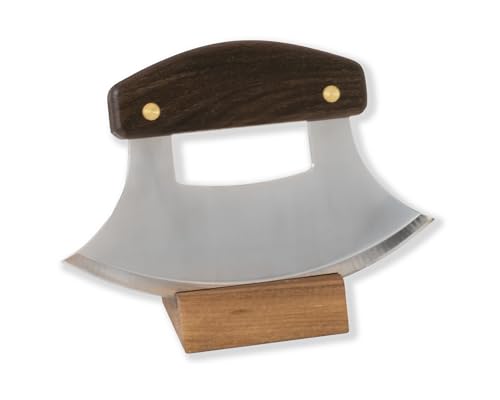
A traditional Alaskan shape from a maker in Anchorage, with a walnut stand so the curved blade doesn’t roll around a drawer. Chops, minces and slices cheese with one hand.

The ulu paired with a hollowed wooden bowl cut to its curve. Nuts, herbs and salad stay in the bowl instead of scattering across the counter.

Two beechwood handles and a long Italian blade for rocking through a pile of vegetables. The classic two-handed chopper.
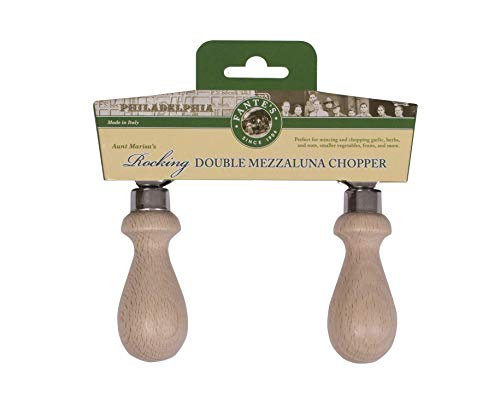
Twin blades cut parsley, basil and garlic twice as fast as one. Small enough to rock on a board the size of a plate.

One press cuts a large pizza straight across without dragging the toppings. A wheel can’t do that.

A thick, ribbed T-handle and a curved stainless blade that cuts food on a plate with one hand and no fork. Built for weak grip, arthritis or stroke recovery.
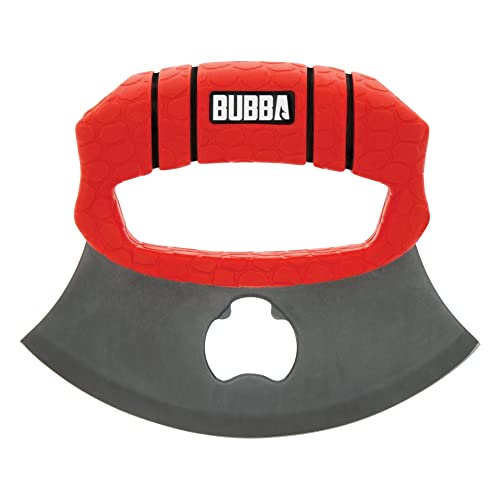
A full-tang ulu with BUBBA’s non-slip grip and a sheath, for fish cleaning and camp cooking. The tough, wet-hands version of the Alaskan classic.
Ulu and Rocker Knives Compared
| Knife | Type | Blade | Handle | Hands | Best for |
|---|---|---|---|---|---|
| The Ulu Factory Alaskan Ulu | Ulu | 6″ stainless | Wood, above blade | One | Everyday chopping and slicing |
| The Ulu Factory Ulu and Bowl Set | Ulu with bowl | Stainless, one-sided bevel | Birch and walnut | One | Nuts, herbs, salads |
| Fante’s Mezzaluna | Mezzaluna | 9.5″ stainless | Beechwood, two | Two | Big piles of vegetables |
| Fante’s Double Mezzaluna | Double mezzaluna | 2 x 5.5″ stainless | Beechwood, two | Two | Herbs and garlic |
| KitchenStar Pizza Rocker | Pizza rocker | 16″ stainless | Steel, one piece | Two | Pizza and flatbread |
| North Coast Medical Rocker Knife | Adaptive rocker | 4.5″ stainless | Ribbed T-handle | One | Weak grip, one-handed eating |
| BUBBA Ulu | Outdoor ulu | 5.75″ wide, coated | Non-slip grip | One | Fish, game, camp |
1. The Ulu Factory Alaskan Ulu with Stand: Best Ulu Overall
Who it’s for: home cooks who want to try an ulu, and anyone looking for a useful gift with a story behind it.
The ulu (say “oo-loo”) has been used by Native peoples of the Arctic for centuries, for everything from skinning seals to cutting food. The Ulu Factory, based in Anchorage, makes the version most people picture: a crescent stainless blade with a wooden handle set directly above it, so your hand pushes straight down through the cut.
I like it because it’s a genuinely different way to cut, not a gimmick. Rocking the blade across a cutting board chops onions, nuts and herbs quickly, and pressing straight down slices cheese, pizza and cooked meat cleanly. The maker points out it suits people with weaker hands or the use of one hand, and that fits the design: there’s no wrist twist and no need to hold the food with a fork.
My reservations: a 6-inch curved blade can’t do everything a chef’s knife does. It won’t peel, it struggles with long slices of a roast, and sharpening a curve takes a little practice. It earns a place next to your main knife rather than instead of it. If rocking appeals to you, a curved chef’s knife does it too (my santoku vs chef’s knife guide explains which shapes rock and which push).
Key specs
- Blade: 6 inches, stainless steel, crescent shape
- Handle: wood, mounted above the blade
- Includes: walnut stand and instruction booklet
- Maker: The Ulu Factory, Anchorage, Alaska
Pros
- Downward pressure, little wrist strain
- Fast chopping with a rocking motion
- Stand keeps the blade safe and on display
Cons
- Not a replacement for a chef’s knife
- Curved edge takes practice to sharpen
- Wood handle needs hand washing
My verdict: the ulu to buy first. If you’ll mostly chop small things like nuts, get the bowl set below instead.
2. The Ulu Factory Ulu and Chopping Bowl Set: Best Ulu With Chopping Bowl
Who it’s for: cooks who chop nuts, herbs, garlic or chopped salads often, and gift buyers who want the full set.
An ulu works best with a bowl whose curve matches the blade. Rocking inside the bowl keeps food gathered under the edge, so you chop everything evenly instead of chasing pieces across a flat board. This set pairs the ulu with a matching wooden bowl and a separate stand, all made by The Ulu Factory in Anchorage.
One detail worth knowing: the blade is sharpened on one side only, in the traditional Alaska Native fashion. That makes it very easy to touch up (you sharpen the beveled side and just remove the burr from the flat side), but it also means you should keep the flat side flat.
The downside is care. Birch and walnut need hand washing and an occasional oiling, and the bowl is only about 8 inches across, so it’s for small batches.
Key specs
- Blade: stainless steel, single-sided bevel
- Woods: Alaskan birch and American walnut
- Includes: ulu, matching chopping bowl, stand
- Size: about 8 x 8 x 1.5 inches
- Made in Anchorage, Alaska, USA
Pros
- Bowl keeps food under the blade
- One-sided bevel is simple to sharpen
- Made in the USA; a lovely gift
Cons
- Small bowl, small batches
- Wood needs hand washing and oil
My verdict: the best ulu setup for nuts and herbs. If you’ll rock on a regular board, the plain ulu with stand is enough.
3. Fante’s Mezzaluna, 9.5-Inch: Best Mezzaluna
Who it’s for: cooks who chop big batches of vegetables for soups, salsas and stir fries.
Mezzaluna means “half moon” in Italian, and this one comes from Italy: a 9.5-inch stainless blade with a beechwood handle at each end. You hold both handles and rock side to side for soft food, or press up and down for denser things like carrots or chocolate.
I prefer the two-handed design for volume work. Both hands stay on top of the blade, well away from the edge, and the long blade covers a lot of board in each rock. It’s a safe tool for anyone nervous about a big chef’s knife.
What you give up: it’s a single-purpose tool that takes drawer space, and the beech handles should be oiled now and then with mineral oil, as Fante’s suggests. It’s also too long to rock in a small chopping bowl.
Key specs
- Blade: 9.5 inches, stainless steel
- Handles: beechwood, two
- Size: 9.85 x 1.37 x 5.9 inches
- Care: hand wash, oil handles occasionally
- Made in Italy
Pros
- Long blade for big batches
- Both hands safely on the handles
- Simple, classic Italian design
Cons
- Single-purpose, takes drawer space
- Too long for a small chopping bowl
My verdict: the mezzaluna for cooks who chop a lot at once. If you mostly do herbs, the double blade below is quicker.
4. Fante’s Double Mezzaluna, 5.5-Inch: Best for Herbs
Who it’s for: anyone who minces parsley, basil, cilantro or garlic most days.
Two parallel 5.5-inch blades mean every rock makes two cuts, so a handful of herbs turns into a fine mince in seconds. It’s the same Italian build as the single mezzaluna, with beechwood handles at both ends.
I’d buy this one over the long single blade if herbs are your main job. The short blades suit a small board and give you good control.
The catch: food gets stuck between the two blades, so cleaning takes a moment with a brush, and the small blades aren’t for big vegetables.
Key specs
- Blades: two, 5.5 inches each, stainless steel
- Handles: beechwood, two
- Care: hand wash, oil handles occasionally
- Made in Italy
Pros
- Twice the cuts per rock
- Compact for small boards
- Very quick for garlic and herbs
Cons
- Food sticks between the blades
- Too small for big vegetables
My verdict: the fastest herb tool here. Skip it if you rarely cook with fresh herbs.
5. KitchenStar 16-Inch Pizza Rocker: Best Pizza Rocker
Who it’s for: pizza nights, homemade flatbreads and anyone tired of wheels that drag the cheese.
A pizza rocker is a long, gently curved blade you press and rock once across the whole pie. The KitchenStar is 16 inches of 304 stainless steel in one piece, with a protective cover. Because it cuts straight down, the toppings stay where they are.
I think a rocker is better than a wheel for thick or loaded pizzas, deep crusts and anything where a wheel tends to skid. It also cuts focaccia, quesadillas and brownies in neat lines. The one-piece build has no gaps for food to hide in.
Two cautions. It’s a long, sharp blade, so always use the cover in the drawer. The listing calls it dishwasher safe, but a long edge rattling against plates in a rack goes dull fast, so I’d rinse it by hand.
Key specs
- Blade: 16 inches, 304 stainless steel
- Construction: one piece, no seams
- Includes: protective blade cover
- Care: listed as dishwasher safe
Pros
- Cuts a large pizza in one press
- Keeps toppings in place
- Easy to clean one-piece design
Cons
- Long blade needs careful storage
- Too big for small pizzas or small kitchens
My verdict: the best upgrade from a pizza wheel. Not worth it if you rarely make or order large pizzas.
6. North Coast Medical Big Grip T-Handle Rocker Knife: Best One-Handed Rocker Knife
Who it’s for: people with arthritis, limited grip, Parkinson’s, or one usable hand after a stroke.
A one-handed rocker knife lets you cut food on a plate without holding it down with a fork. This one has a 4.5-inch curved stainless blade under a big, ribbed T-handle that flexes to whatever grip your hand can manage. You rock it across the food and the curve does the cutting.
I picked it over the smaller vertical-grip rocker knives because of the handle size and the included blade cover. North Coast Medical is a long-standing supplier of therapy and daily-living aids, and the non-slip handle is designed to stay secure in a weak or wet hand. It’s dishwasher safe and can be sharpened with a standard sharpener.
It’s a table and light kitchen knife, not a prep knife. It won’t cut through a big roast or hard squash, and the short blade suits plate-sized portions.
Key specs
- Blade: 4.5 inches, curved stainless steel
- Handle: non-slip ribbed T-handle
- Includes: safety blade cover
- Care: dishwasher safe; sharpen with a standard sharpener
Pros
- Cuts with one hand, no fork needed
- Big grip for weak or painful hands
- Blade cover for safe storage
Cons
- Short blade for small portions only
- Not a food prep knife
My verdict: the rocker knife I’d suggest for anyone struggling with a regular knife and fork. For one-handed chopping on a board, the Alaskan ulu is the better tool.
7. BUBBA Ulu Knife: Best Outdoor Ulu
Who it’s for: anglers, hunters and campers who want an ulu for fish, game and camp food.
The ulu started as an outdoor knife, and BUBBA’s version takes it back outside. It has a TiN-coated full-tang blade 5.75 inches wide, BUBBA’s non-slip grip handle, a sheath, and a bottle opener built in. The grip is the main reason to buy it: fish slime and blood make most handles slippery, and BUBBA built its name on handles that don’t slip.
I’d use it for portioning fillets (for the filleting itself, a flexible blade from my saltwater fillet knife guide does better), cutting bait, slicing camp vegetables and cutting cord. The curved edge is safer to rock through food on a camp table than a pointed knife.
The trade-offs: BUBBA’s warranty is limited to one year, and the coating will wear at the edge with sharpening. It’s also less elegant in a home kitchen than a wooden ulu.
Key specs
- Blade: 5.75 inches wide, TiN-coated, full tang
- Overall height: 5 inches
- Handle: BUBBA non-slip grip
- Extras: sheath, integrated bottle opener
- Warranty: limited 1 year
Pros
- Non-slip handle for wet hands
- Sheath for tackle box or pack
- Full tang build
Cons
- Only a one-year warranty
- Coating wears with sharpening
My verdict: the ulu for the boat and the campsite. For the kitchen, the Alaskan wooden ulu feels nicer to use.
Which Rocking Knife Fits Your Kitchen
Ulu or mezzaluna?
An ulu is used with one hand, pressing down from a handle above the blade. A mezzaluna has handles at both ends and needs two hands. The ulu is more versatile (it slices as well as chops); the mezzaluna is faster for big batches and keeps both hands far from the edge.
Single or double blade
A double mezzaluna minces herbs and garlic faster. A single blade is better for vegetables, nuts and anything that would jam between two blades. Most cooks only need one; choose by what you chop most.
Bowl or board
Ulus work best in a matching curved bowl, which keeps food under the edge. Mezzalunas and pizza rockers need a flat board big enough for the whole blade. Never rock on a countertop: it dulls the edge and marks the surface.
Grip strength
Rocking knives need less grip and wrist twist than a chef’s knife because you press down rather than saw. If grip is a real problem, an adaptive T-handle rocker is the most comfortable option. If you just want to work faster with healthy hands, learning a good pinch grip and rocking motion with a chef’s knife also helps (see my how to hold a knife for chopping guide).
How to Use an Ulu
Hold the handle with your fingers wrapped around it and your thumb on top. Set the middle of the blade on the food and rock it forward and back, pressing gently, letting the curve cut. For slicing, set the blade down and press straight through. Keep your other hand flat on top of the food, well behind the blade, or out of the way entirely.
For a pile of herbs or nuts, use a bowl or keep pushing the food back into a pile with the flat of the blade. Clean and dry the blade after use, and store it on its stand or with a cover. My guide to storing kitchen knives has more ideas for keeping awkward shapes safe.
FAQ
What is an ulu knife used for?
An ulu is used for chopping, mincing and slicing: herbs, nuts, vegetables, cheese, pizza and cooked meat. Traditionally Arctic peoples also used it to skin and clean animals and cut hides. Its rocking motion needs less grip and wrist strength than a straight knife.
What’s the difference between an ulu and a mezzaluna?
An ulu has one handle above the blade and is used with one hand. A mezzaluna has a handle at each end and is used with two. Both are curved blades that you rock instead of saw.
Is a rocker knife good for arthritis?
Yes, for many people. Pressing down and rocking puts less strain on the wrist and fingers than gripping and sawing. A large, non-slip handle like the North Coast Medical T-handle helps most.
How do you sharpen an ulu?
Follow the curve with a small handheld stone, rod or the ulu maker’s sharpener, working from one end to the other. If the blade is sharpened on one side, like The Ulu Factory’s, sharpen only the beveled side and remove the burr with a light pass on the flat side. Pull-through sharpeners don’t handle the curve well.
Can an ulu cut pizza?
Yes. Press it straight down and rock, slice by slice. For large pizzas a long pizza rocker is quicker, since it crosses the whole pie in one press.
Is an ulu dishwasher safe?
Wooden-handled ulus are not: hand wash and dry them. Some synthetic-handled rocker knives are listed as dishwasher safe, but hand washing keeps any edge sharp longer.
Final Verdict
The Ulu Factory’s Alaskan Ulu with stand is my pick for most kitchens: simple, sharp, and easy on the wrist. Herb lovers should get the Fante’s double mezzaluna, and anyone with a weak grip or one usable hand should start with the North Coast Medical T-handle rocker knife.
If you’re filling out a kitchen beyond rocking knives, see my best kitchen knives under $100, and if you’re torn between straight-edged choppers, my nakiri vs santoku comparison.

Gary Portman founded knivesadvice.com in 2019. He learned to cook in his family’s kitchen as a kid and has used kitchen, pocket and outdoor knives ever since, from paring and fillet knives to survival blades he carries camping and hiking. He writes the site’s buying guides, brand reviews and sharpening how-tos to help readers find the right knife for the job. More about Gary.