
The best wood carving knife for a beginner is not a pocket knife, and it’s not a craft knife with snap-off blades. Both can whittle, but a folding blade can close on your fingers under pressure, and a thin hobby blade flexes and snaps in green wood. A carving knife is a short, fixed blade with a stiff spine and a handle shaped for long sessions of controlled cuts.
There are three basic shapes. A sloyd knife has a blade around 3 inches long and does most of the work: roughing out, shaping, making long paring cuts. A detail knife is shorter and pointier, for eyes, feathers, lettering and tight corners. A hook knife has a curved blade for hollowing out spoon bowls and cups. Most carvers start with a sloyd, add a detail knife, and buy a hook knife the day they carve their first spoon.
My pick for a first knife is the BeaverCraft C4s Sloyd Knife, which does almost everything a beginner needs and comes with a leather sheath. For detail work, the Morakniv Wood Carving 120 is the classic.
My Top 5 Wood Carving Knife Picks

A 3-inch high carbon blade with a long, narrow shape and curving point that roughs, shapes and gets into tight spots. Oak handle, cowhide sheath. The one knife I’d give someone starting out.

A short, stiff laminated steel blade on an oiled birch handle. Carvers have been using this pattern for decades for spoons, figures and fine detail.

A curved high carbon blade for hollowing spoon bowls, kuksa cups and small bowls. Ready to use out of the box and made for right-handed carvers.

A cutting knife, a detail knife and a roughing knife in 1095 high carbon steel with ash handles, made in Pennsylvania. Three shapes that cover most whittling projects.
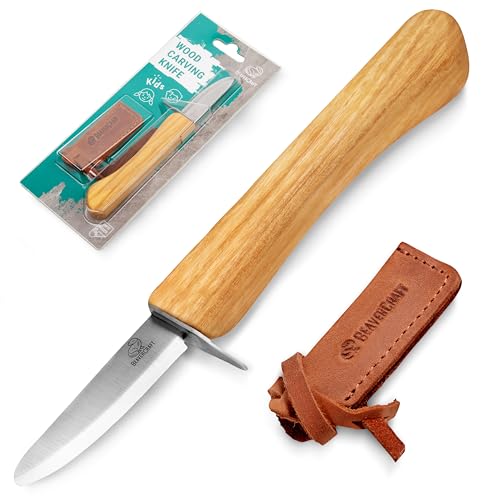
A rounded tip, a finger guard and a small handle sized for children, with a leather sheath. The safest way I know to hand a young carver a real blade.
Wood Carving Knives Compared
| Knife | Type | Blade | Handle | Best for |
|---|---|---|---|---|
| BeaverCraft C4s | Sloyd | 3″, 1066 high carbon steel | Oak | First knife, all-round whittling |
| Morakniv 120 | Detail | 2.4″, laminated steel | Oiled birch | Fine detail, figures, spoons |
| BeaverCraft SK1 | Hook | Curved, high carbon steel | Oak | Spoons, cups, bowls |
| Flexcut KN500 | Set of 3 | 1095 high carbon steel | Ash | Beginners who want every shape |
| BeaverCraft C1 Kid | Kids’ whittler | Rounded tip | Small, with guard | Children and scouts |
1. BeaverCraft C4s Sloyd Knife with Leather Sheath: Best Overall
Who it’s for: beginners who want one knife to learn on, and carvers who want a reliable roughing and shaping knife.
BeaverCraft is a maker that specializes in carving tools, and the C4s is its all-round sloyd knife. The blade is long and narrow with a curving point, which is the shape you want for a first knife: the straight section does long shaving cuts down a stick, and the point gets into the inside of a curve or the crook of a branch.
The steel is 1066 high carbon steel. Carbon steel is the traditional carving choice because it takes a very keen edge and is easy to bring back on a strop, which you’ll do often when carving. The oak handle is finished with linseed oil and shaped to fill the hand, and the cowhide sheath means the knife can live in a bag without cutting through it.
The downside of carbon steel is rust. Green wood is wet and some woods are acidic, so wipe the blade dry after each session and oil it lightly every so often. Expect it to darken with use: that grey patina is harmless and slows further rust. My carbon vs stainless steel guide covers the trade-off in more depth.
Key specs
- Type: sloyd carving knife
- Blade: 3 inches, 1066 high carbon steel, narrow with curving point
- Handle: oak, linseed oil finish
- Cowhide leather sheath included
Pros
- One shape handles most whittling jobs
- Carbon steel is easy to strop sharp
- Sheath included
Cons
- Carbon blade rusts if left wet
- Point is too broad for very fine detail
My verdict: the first carving knife I’d buy. Add the Morakniv 120 later if you get into faces and fine detail.
2. Morakniv Wood Carving 120: Best Detail Knife
Who it’s for: carvers moving on to figures, faces, chip details and spoon finishing.
The Morakniv 120 is one of the best-known carving knives in the world, and the design hasn’t needed to change. The blade is short, 2.4 inches, and 2.7 mm thick, so it stays stiff when you push it into a tight cut instead of bending. Short blades are easier to control close to the tip, which is where detail work happens.
The steel is laminated: a hard core sandwiched between softer layers. That gives a keen, long-lasting edge with some toughness, and the Scandi-style bevel is easy to sharpen because you lay the whole bevel flat on the stone. Morakniv makes its knives in Mora, Sweden, a knife-making town since the 1800s, and the oiled birch handle is the plain, comfortable kind you can hold for hours. The 120 carries Morakniv’s limited lifetime warranty, and the brand is the outdoor value pick in my best knife makers roundup.
The laminated blade has a carbon steel core, so like the BeaverCraft it needs wiping dry after carving green wood. And at 2.4 inches it’s slower for roughing out a blank than the BeaverCraft sloyd. It earns its place as the finishing knife you reach for after the sloyd.
Key specs
- Blade: 2.4 inches (60 mm), 2.7 mm thick, laminated steel
- Overall knife length: 6.5 inches (165 mm)
- Handle: oiled birch
- Limited lifetime warranty
Pros
- Stiff, controllable short blade
- Easy-to-sharpen Scandi bevel
- Classic design from a trusted Swedish maker
Cons
- Carbon core needs drying after use
- Slow for heavy roughing
My verdict: the detail knife I’d add once you’re hooked. As a first and only knife, the sloyd is more versatile.
3. BeaverCraft SK1 Spoon Carving Hook Knife: Best Hook Knife
Who it’s for: anyone who wants to carve a wooden spoon, a kuksa cup or a small bowl.
You can shape the outside of a spoon with a straight knife, but you can’t hollow the bowl. That’s what a hook knife is for: the curved blade scoops out wood in smooth, controlled cuts, working across the grain. BeaverCraft’s SK1 is a straightforward first hook knife, made with a high carbon steel blade sharpened and polished at the factory so you can start straight away.
The oak handle has an ergonomic shape, which matters with hook knives because you use a lot of thumb and wrist pressure. BeaverCraft says the tool is predictable for beginners and suits experienced carvers too.
Two things to know before ordering. This SK1 is the right-handed version, and hook knives are handed: a left-handed carver needs the left-handed model. And sharpening a curved blade is harder than a straight one; a rolled-up strip of sandpaper or a leather strop wrapped around a dowel does the job. My guide to stropping a knife explains the basic motion.
Key specs
- Type: hook knife for spoons, kuksa cups and bowls
- Blade: curved high carbon steel, sharpened and polished
- Handle: oak, ergonomic shape
- Right-handed version
Pros
- Makes spoon carving possible
- Ready to use out of the box
- Comfortable oak handle
Cons
- Handed: buy the correct side
- Curved edge is harder to sharpen
My verdict: the hook knife to start spoon carving with. Pair it with the sloyd and you have the classic two-knife spoon kit.
4. Flexcut KN500 Starter Set of 3 Carving Knives: Best Starter Set
Who it’s for: beginners who’d rather buy three matched knives at once, and anyone carving small figures and ornaments.
Flexcut has made carving, whittling and printmaking tools in Erie, Pennsylvania since 1992, and this set is the simplest way into its range. The set gives you a cutting knife for general shaping, a detail knife for fine work and a roughing knife for taking off wood quickly. Those three shapes cover nearly every small whittling project, from a simple bird to a chess piece.
The blades are 1095 high carbon steel, a simple steel that sharpens easily and takes a fine edge. The ash handles are shaped for a firm grip. Flexcut promises sharp, edge-holding blades out of the box, which is exactly what beginners need: a dull carving knife is harder to control and more likely to slip than a sharp one.
The blades are smaller than a sloyd, so the set is slower for roughing out large pieces or spoons, and there’s no hook knife. It also doesn’t include a strop, and you’ll want one, because keeping three knives keen is part of the hobby. For figure carving and ornaments, though, it’s a complete kit.
Key specs
- Contents: cutting knife, detail knife, roughing knife
- Blades: 1095 high carbon steel
- Handles: ash hardwood, ergonomic
- Made in Erie, Pennsylvania, USA
Pros
- Three useful shapes in one box
- Made in the USA
- Easy-to-sharpen carbon steel
Cons
- No hook knife or strop
- Small blades for big roughing jobs
My verdict: the best all-in-one start for figure whittling. If spoons are your goal, buy the sloyd and hook knife instead.
5. BeaverCraft C1 Kid Whittling Knife: Best for Kids
Who it’s for: children learning to whittle with an adult, scouts, and nervous adult beginners.
Two easy ways to get hurt whittling are a slip onto the blade and a stab from the point. BeaverCraft designs the C1 Kid around both: a guard stops small hands sliding forward onto the edge, and the tip is rounded so it can’t stab. The handle is compact so a child’s hand can actually wrap around it, which gives more control than an adult knife held at the end. For a folder a child can carry, see my first pocket knife for kids guide.
It’s still a real, sharp knife, and that’s the point. Children learn good habits, like cutting away from the body and keeping the other hand behind the blade, much better with a sharp tool than with a blunt one they have to force. A leather sheath comes with it, so the knife goes away safely when the lesson ends.
The rounded tip limits what it can do. There’s no point for detail work or getting into tight inside curves, so a keen young carver will outgrow it. For first lessons, though, I’d rather a child learned on this than on a grown-up’s pocket knife.
Key specs
- Rounded safety tip
- Guard keeps fingers off the blade
- Compact handle sized for children
- Genuine leather sheath
Pros
- Designed for safe first lessons
- Real cutting edge teaches proper technique
- Sheath included
Cons
- No point for detail work
- Children outgrow it quickly
My verdict: the right first knife for a young carver, always with an adult nearby. Move up to the C4s sloyd once they cut safely.
Choosing Your First Carving Knife
Fixed blade over folding
Choose a fixed blade for carving. Carving puts steady pressure on the blade, and a folding knife without a strong lock can close on your fingers. Fixed blades are also stiffer and more comfortable for long sessions.
Blade length: 1.5 to 3 inches
Short blades give the control carving needs. About 3 inches suits a sloyd for roughing and general shaping; 1.5 to 2.5 inches suits detail work. Longer knives are for camp jobs, not carving; a small fixed blade like those in my bushcraft knife guide can whittle, but a dedicated carving knife does it better.
Carbon steel and a flat bevel
Most carving knives use high carbon steel with a single flat (Scandi) bevel, and that’s the combination to look for. Carbon steel takes a keen edge and strops back fast; the flat bevel rests on the wood, guiding the cut, and is easy to sharpen. Just keep carbon blades dry.
A handle you can hold for an hour
Comfort matters more than looks. Carving uses a lot of grip and thumb pressure, so look for a handle thick enough to fill your hand without sharp corners. Oak, birch and ash are all common and comfortable.
Budget for a strop and a glove
Plan to buy a leather strop and a cut-resistant glove with your first knife. Carvers strop every 20 to 30 minutes to keep the edge keen, and a glove on the hand holding the wood prevents most beginner cuts.
Safe Whittling Basics
Always cut away from your body and keep the hand holding the wood behind the edge. For more control, use the thumb-push cut: hold the knife in one hand and push the back of the blade with the thumb of the other, taking small, shallow slices. Small cuts are safer and give a cleaner surface than big ones.
Start with soft, straight-grained wood such as basswood or green branches; hard, dry wood makes you push harder and slip more. Sit down, rest your elbows, and stop when you’re tired. Most whittling cuts happen at the end of a long session, when the knife is dull and the hands are sore.
FAQ
What is the best knife for whittling for beginners?
A fixed-blade sloyd knife with a blade around 3 inches is the best first whittling knife. The BeaverCraft C4s is my pick: it handles roughing, shaping and most details. Add a detail knife or hook knife later as your projects need them.
What is the difference between a sloyd knife and a detail knife?
A sloyd knife has a longer blade, around 3 inches, for roughing out and shaping. A detail knife has a shorter, pointier blade, about 1.5 to 2.5 inches, for fine cuts and tight spaces. Most carvers own both.
Can I use a pocket knife for whittling?
Yes, for simple projects, but a fixed-blade carving knife is safer and more comfortable. A pocket knife without a lock can fold on your fingers, and small handles get tiring. If you use one, choose a locking blade and take small cuts.
What wood is best for whittling?
Basswood is the classic beginner wood: soft, even and easy to cut cleanly. Green (freshly cut) wood like birch or willow is also easy to carve, which is why spoon carvers use it. Avoid hard, dry woods like oak until your technique and edge are good.
How do I keep a carving knife sharp?
Strop it often on leather with a polishing compound, about every 20 to 30 minutes of carving. Only go back to a sharpening stone when stropping no longer restores the edge; my knife sharpener guide covers stones and guided systems. Keep the bevel flat on the strop to avoid rounding it.
Final Verdict
For a first carving knife, the BeaverCraft C4s Sloyd Knife is my choice: one versatile carbon steel blade, a comfortable oak handle and a sheath. The Morakniv Wood Carving 120 is the detail knife to add as your skill grows, and the BeaverCraft SK1 hook knife opens the door to spoon carving. If you’d rather start with a matched trio for figures, the Flexcut KN500 set is made in the USA and arrives ready to carve.
Want one knife that carves at camp as well as at home? My best knives for backpacking guide covers small fixed blades that whittle well on the trail.

Gary Portman founded knivesadvice.com in 2019. He learned to cook in his family’s kitchen as a kid and has used kitchen, pocket and outdoor knives ever since, from paring and fillet knives to survival blades he carries camping and hiking. He writes the site’s buying guides, brand reviews and sharpening how-tos to help readers find the right knife for the job. More about Gary.