

Chicago Cutlery has been around since 1930, when it started out sharpening knives for the butchers and meatpacking plants of Chicago. It later made knives for the meat industry and, decades on, moved into home kitchens. Plenty of American families still have a block of its walnut-handled knives on the counter, and that long history is a big part of why people trust the name today.
The brand you buy now is a different business. Chicago Cutlery is owned by Corelle Brands (the Pyrex and Corelle family), and its current knives are inexpensive stainless sets aimed at everyday home cooks. The listings don’t name a country of origin, and retailers say production is overseas. Owners who grew up with the older knives often say the new ones don’t feel the same. Judged as what they are, though, the current sets are decent value: comfortable handles, full collections and a built-in sharpener in the bigger blocks.
So who is it for? A first apartment, a rental, a family kitchen where knives get rough treatment, or anyone who wants a complete block without a big spend. Skip it if you cook a lot and want a knife that holds its edge for months. My pick is the Insignia Triple Rivet Poly 18-piece set; on a small budget, the Halsted 14-piece is the one to get.
My Top 6 Chicago Cutlery Picks
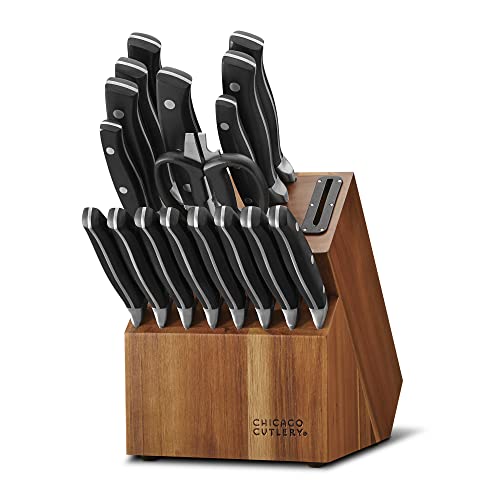
Seventeen knives and shears in an acacia block with a sharpener built into it. Grippy black handles and a complete set for a family kitchen: the Chicago Cutlery I’d buy.
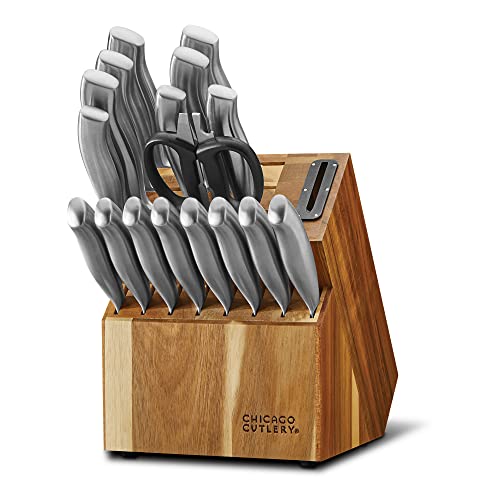
The same Insignia idea with brushed stainless handles that match modern appliances, plus shears with a bottle opener. For people who care how the block looks.

Chef’s, bread, santoku, utility, paring and peeling knives plus six steak knives in a compact block. A full kitchen for very little money.

An 8-inch chef’s knife, a serrated utility knife and a paring knife, no block. The three knives you actually use, for less than many single knives.

Two 4-piece sets of the classic walnut-handled steak knives with brass rivets and full tangs. The look people remember from their parents’ table.

A 10-inch honing rod with a walnut handle. Five strokes a side before cooking keeps any of these knives cutting longer between sharpenings.
What Chicago Cutlery Does Well
Complete sets for little money
Chicago Cutlery is mainly a set brand. Most of its collections come in a block with a chef’s knife, bread knife, santoku, utility and paring knives plus steak knives, so one purchase covers a whole kitchen. For a first home that’s the main appeal.
Comfortable, easy-care handles
The current collections use contoured polymer or stainless handles that are comfortable and need no oiling. The Walnut Tradition line keeps the classic wooden handle with brass rivets for people who want the traditional look.
Stain-resistant steel that’s easy to touch up
Chicago Cutlery quotes a “26 degree Taper Grind” edge on most of its knives. The steel is a forgiving stainless that resists rust and stains, and because it’s on the softer side it takes an edge back quickly on a honing rod or simple sharpener.
Built-in sharpeners in the bigger blocks
The Insignia blocks have a sharpening slot built into the acacia wood. It’s handy for people who would never buy a separate sharpener. Use it lightly: a few gentle pulls are enough, and too much pressure removes more steel than needed. I’ve written about whether self-sharpening knife blocks are worth it if you’re on the fence.
What Chicago Cutlery Does Badly
Edges don’t last long
The softer steel that makes these knives easy to sharpen also makes them dull faster than WÜSTHOF, Victorinox or any Japanese brand. If you cook every day, expect to hone often and sharpen every few months.
Not the knives people remember
Many people buy Chicago Cutlery because their parents’ set lasted decades. The older knives, made when the brand was American-made, have a loyal following. Today’s sets are good budget knives, not heirlooms, and owners who expect the old quality are the ones most likely to be disappointed.
Confusing collections
Insignia, Insignia Steel, Insignia2, Malden, Avondale, Halsted, Belmont, Armitage, Fusion, Essentials, Walnut Tradition: the range is long and the names say little about the knives. Some listings even mix up details between collections. Count the pieces and read the contents before you buy.
Filler in the big sets
Eighteen pieces sounds generous, but around half are usually steak knives. If you don’t need eight steak knives, a smaller set or a few separate knives is better value. My guide on which knives usually come in a knife set helps you decide which ones you really use.
Chicago Cutlery Collections Compared
| Collection | Handle | Block | Sharpener | Care | Best for |
|---|---|---|---|---|---|
| Insignia Triple Rivet Poly | Black polymer, triple rivets | Acacia | Built into block | Hand wash recommended | Family kitchens, full set |
| Insignia Steel | Contoured stainless | Acacia | Built into block | Hand wash recommended | Modern-looking kitchens |
| Halsted (PrepSystem Lite) | Contoured polymer | Compact modular wood | None | Hand wash recommended | Tight budgets, small counters |
| Essentials | Polymer, triple rivets | Rubberwood (block sets) | None | Dishwasher or hand (per listing) | Starter knives, dishwasher users |
| Walnut Tradition | Walnut, brass rivets, full tang | Sold mostly as single knives and small sets | Matching steel | Hand wash and dry right away | Classic look, steak knives |
1. Chicago Cutlery Insignia Triple Rivet Poly 18-Piece: Best Chicago Cutlery Set
Who it’s for: families and new homeowners who want one block that covers everything.
Insignia is Chicago Cutlery’s main collection, and this triple-rivet version is the one I’d choose. You get 17 knives and a pair of shears in an acacia wood block, with a sharpener built into the block itself. The black polymer handles are curved to fill the hand and grip well even when wet, which matters more in a busy kitchen than any steel spec.
Acacia is also a step up from the rubberwood used on cheaper sets: denser, nicer to look at and more resistant to moisture. The built-in sharpener means the knives get at least some maintenance in homes where nobody would buy a separate tool.
My reservation is the piece count. A good share of those 17 knives are steak knives, and nobody needs every specialist knife here. Still, as a complete, grippy, easy-care set, it’s the best Chicago Cutlery offers.
Key specs
- Pieces: 17 knives, kitchen shears, acacia block
- Blades: stainless steel, 26-degree Taper Grind edge
- Handles: black polymer, triple rivets, contoured
- Sharpener: built into the block
Pros
- Complete set in one buy
- Grippy, comfortable handles
- Acacia block with built-in sharpener
Cons
- Many steak knives you may not need
- Soft steel needs frequent touch-ups
- Large block for small counters
My verdict: the Chicago Cutlery block for a kitchen that needs every knife on day one. If you only need the core knives, the Essentials trio does it for much less.
2. Chicago Cutlery Insignia Steel 18-Piece: Best Stainless Handles
Who it’s for: people who want their knife block to match stainless appliances.
This is the Insignia set with brushed stainless steel handles instead of black polymer. The blades, the acacia block and the built-in sharpener are the same idea; what changes is the look and the feel in the hand. The shears also include a bottle opener.
Stainless handles look sleek and never crack or fade, and they’re easy to wipe clean. The trade-off is grip: smooth metal turns slick under raw chicken juice or oil, and that’s the one thing I’d never ignore on a knife. If you often handle raw chicken or fish, choose the polymer version above.
Key specs
- Pieces: 18, including an 8-inch chef’s knife, shears with bottle opener and an acacia block
- Blades: stainless steel, 26-degree Taper Grind edge
- Handles: contoured stainless steel
- Sharpener: built into the block
Pros
- Clean, modern look
- Handles won’t crack, fade or stain
- Built-in sharpener
Cons
- Steel handles slip when greasy
- Same soft blades as the polymer set
- Lots of steak knives
My verdict: buy it for the looks if your cooking is mostly vegetables and simple meals. For grip, the polymer Insignia wins.
3. Chicago Cutlery Halsted 14-Piece: Best Budget Block
Who it’s for: students, renters and anyone setting up a kitchen on a tight budget.
The Halsted set packs a lot into a small footprint: an 8-inch chef’s knife, 8-inch serrated bread knife, 7-inch santoku, 5.5-inch utility knife, 3.5-inch paring knife, 2.75-inch peeling knife and six 4.5-inch steak knives, in a compact wooden block. It’s part of Chicago Cutlery’s PrepSystem Lite range, so the block can sit alongside other sets from the same system.
For the money, the selection is excellent: you get a santoku alongside the chef’s knife, plus a real bread knife. The handles are contoured polymer, comfortable for everyday prep.
Expect budget knives, though. The blades are thin and need regular honing, and there’s no built-in sharpener here. Pair it with the honing steel further down and they’ll serve a first kitchen well.
Key specs
- Includes: 8″ chef’s, 8″ serrated bread, 7″ santoku, 5.5″ utility, 3.5″ paring, 2.75″ peeling, six 4.5″ steak knives, compact block
- Blades: stainless steel, 26-degree Taper Grind edge
- Handles: contoured polymer
- Block: modular wooden PrepSystem Lite block
Pros
- Full range of knives for very little money
- Compact block
- Both chef’s knife and santoku
Cons
- No sharpener
- Thin blades dull quickly
- Feels lighter and simpler than Insignia
My verdict: the best Chicago Cutlery block on a tight budget. If you can stretch, the Insignia is the more durable set.
4. Chicago Cutlery Essentials 3-Piece: Best Starter Trio
Who it’s for: anyone who wants the three knives that do most of the work, and no block.
As I keep saying in my set guides, a home cook reaches for the same few knives every day, and this set is just those: an 8-inch chef’s knife, a 4.75-inch serrated utility knife for tomatoes and bread rolls, and a 3.5-inch paring knife. No block, no steak knives, no filler.
The Essentials handles are triple-riveted polymer with a metal tang, simple and sturdy. Chicago Cutlery’s listing says these can go in the dishwasher, which makes them a practical choice for a busy household or a second kitchen at a cabin or RV. Hand washing will still keep them sharper for longer.
You’ll need somewhere safe to store them, such as a drawer insert or magnetic strip, because loose knives in a drawer dull quickly and cut fingers.
Key specs
- Includes: 8″ chef’s knife, 4.75″ serrated utility knife, 3.5″ paring knife
- Blades: stainless steel, 26-degree Taper Grind edge
- Handles: polymer, triple rivets, metal tang
- Care: dishwasher or hand wash (per listing)
Pros
- Only the knives you’ll actually use
- Dishwasher-friendly per the maker
- Very little money
Cons
- No storage included
- No bread knife for large loaves
- Basic feel and finish
My verdict: the smartest Chicago Cutlery buy for small kitchens. If you want a full block with a similar dishwasher-friendly approach, the Essentials 15-piece is in my dishwasher-safe knife sets guide.
5. Chicago Cutlery Walnut Tradition B144 Steak Knives: Best Steak Knives
Who it’s for: anyone who wants classic, wood-handled steak knives for the dinner table.
Walnut Tradition is the line most people picture when they hear “Chicago Cutlery”: warm walnut handles, triple brass rivets and full tangs. This listing gives you two 4-piece B144 sets, eight steak knives in total, enough for a family dinner with guests.
The blades are high-carbon stainless with the 26-degree Taper Grind edge, and the full tangs give them a solid, balanced feel that cheap stamped steak knives lack. The wooden handles look great on the table but need hand washing and drying straight away; soaking them dries out the wood.
If you want steak knives you can put in the dishwasher, these aren’t them. Otherwise, they’re a good-looking, honest set at a sensible cost.
Key specs
- Includes: two 4-piece B144 sets (8 steak knives)
- Blades: high-carbon stainless steel, 26-degree Taper Grind edge
- Construction: full tang, triple brass rivets
- Handles: walnut
- Care: hand wash and dry immediately
Pros
- Classic look that suits any table
- Full tang and brass rivets feel solid in the hand
- Eight knives in one order
Cons
- Wood handles need hand washing
- Walnut darkens and dries without care
- Soft steel needs regular honing
My verdict: the Chicago Cutlery I’d put on a dinner table. Dishwasher households should look elsewhere.
6. Chicago Cutlery Walnut Tradition 10-Inch Sharpening Steel: Best Add-On
Who it’s for: anyone who owns soft-steel knives, Chicago Cutlery or otherwise.
Despite the name, a sharpening steel doesn’t remove much metal. It’s a honing rod: it straightens the edge, which bends over with use, so the knife cuts like new again. Softer stainless like Chicago Cutlery’s bends easily and straightens easily, which makes a steel the most useful accessory you can buy for these knives.
This one is 10 inches long, long enough for an 8-inch chef’s knife, with a walnut handle to match Walnut Tradition knives. A handful of light alternating strokes before you cook is all it takes.
A honing rod won’t fix a truly dull edge. When honing stops working, it’s time for a proper sharpener; my best knife sharpener guide covers the options.
Key specs
- Type: honing steel (stainless steel rod)
- Length: 10 inches
- Handle: walnut
- Model: CL38WP
Pros
- Keeps soft-steel knives cutting longer
- Long enough for chef’s knives
- Matches the Walnut Tradition look
Cons
- Doesn’t sharpen a dull edge
- Wood handle needs hand washing
My verdict: the cheapest upgrade for any Chicago Cutlery set. Buy it with the knives.
Chicago Cutlery vs Cuisinart, Victorinox and Cutco
Chicago Cutlery vs Cuisinart
Both sell affordable block sets. Cuisinart leans on colorful and stainless designs with many sets under one name; Chicago Cutlery has the longer history and the classic Walnut Tradition line. Quality is similar, so choose by the handles and the contents you prefer. My Cuisinart knives review covers its best sets.
Chicago Cutlery vs Victorinox
Victorinox Fibrox knives cost more than Chicago Cutlery’s budget sets but hold an edge longer and have some of the grippiest handles in any kitchen. If you can buy a few Victorinox knives instead of a big Chicago Cutlery block, I would.
Chicago Cutlery vs Cutco
Cutco is made in the USA and sold at a much higher price with a strong warranty. It’s a very different product: Cutco is a lifetime purchase, Chicago Cutlery a practical budget set.
FAQ
Is Chicago Cutlery a good brand?
Yes, for budget knife sets. You get complete collections, comfortable handles and stain-resistant steel for little money. Serious cooks will want harder steel that holds an edge longer.
Where are Chicago Cutlery knives made?
The current listings don’t state a country of origin, and retailers say production is overseas. Older Chicago Cutlery knives, especially vintage Walnut Tradition, were made in the USA.
Who owns Chicago Cutlery?
Chicago Cutlery is a brand of Corelle Brands, the American housewares company that also owns Pyrex and Corelle.
Are Chicago Cutlery knives dishwasher safe?
Some are: the Essentials listing says its knives can go in the dishwasher. Walnut Tradition knives must be hand washed. For any knife, hand washing keeps the edge sharp longer.
How do you sharpen Chicago Cutlery knives?
Hone them often with a steel, and use the block’s built-in sharpener or a simple manual sharpener when honing stops working. The soft steel sharpens quickly, so light pressure is enough.
Are old Chicago Cutlery knives worth keeping?
Yes. Vintage American-made Chicago Cutlery knives, especially Walnut Tradition, are well loved for a reason. A good sharpening and some mineral oil on the handles often brings them back to life.
Final Verdict
Chicago Cutlery today is a practical budget brand with a famous name. Buy it for a complete, comfortable set at a low cost, not for top-tier steel. The Insignia Triple Rivet Poly 18-piece is my overall pick, the Halsted is the best on a tight budget, and the Essentials trio is the smart buy for a small kitchen.
Still deciding? My guides to the best knife set under $100 and the best knife set under $200 compare Chicago Cutlery with other brands.

Gary Portman founded knivesadvice.com in 2019. He learned to cook in his family’s kitchen as a kid and has used kitchen, pocket and outdoor knives ever since, from paring and fillet knives to survival blades he carries camping and hiking. He writes the site’s buying guides, brand reviews and sharpening how-tos to help readers find the right knife for the job. More about Gary.