
Opinel knives are good, and the plain Opinel No.08 is one of the best knives you can buy for very little money. It’s a simple French folder with a thin, very sharp blade, a beech handle and a twisting lock ring. Nothing about it is tactical, and that’s the charm.
What you should know before buying: the wood can swell when it gets soaked, the blade takes two hands to open, and there’s no pocket clip. If those sound like deal breakers, a modern clip folder suits you better. If not, start with the No.08 in stainless with its sheath, or the No.08 Carbone if you like an edge that’s quick to sharpen and don’t mind some care.
My Top 7 Opinel Picks

The classic size in rust-resistant Sandvik 12C27, plus a belt sheath that solves the “no clip” problem. If you buy one Opinel, make it this one.

The same knife in XC90 carbon steel. It gets scary sharp on a stone and darkens with use, which is exactly why many owners prefer it.

A longer blade for camp cooking, picnics and slicing bread or sausage. Too big for a jeans pocket, just right for a pack or a kitchen drawer.
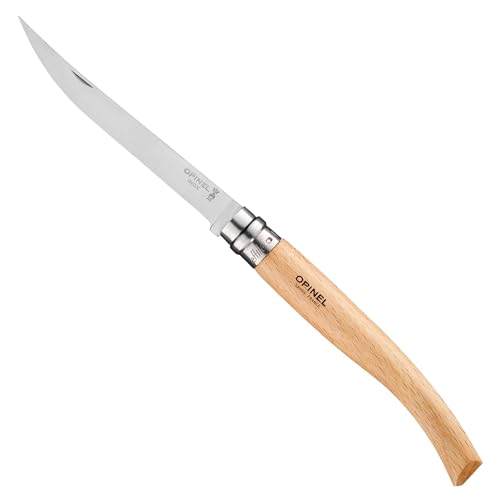
A slim, flexible folding fillet blade that tucks into a tackle bag. One of the few folding fillet knives I’d trust with a whole fish.

A real locking knife with a rounded tip, so a child can learn to whittle and slice without a sharp point. A great first knife for a supervised camping trip.

A curved blade to cut stems and a brush in the handle to clean caps on the spot. Narrow purpose, but foragers love it.

Paring knife, serrated paring knife, curved vegetable knife and a peeler. The small knives most kitchens reach for daily, in the same 12C27 steel.
What Opinel Does Well
Thin, sharp blades
An Opinel blade is ground very thin behind the edge. That’s why it slices apples, cheese, rope and cardboard so cleanly, better than many thicker folders that cost far more. Thin steel isn’t for prying, but for cutting it’s hard to beat.
A choice of stainless or carbon
Most sizes come in Inox (Sandvik 12C27 modified stainless) or Carbone (XC90 carbon steel). Stainless shrugs off damp weather and kitchen use; carbon takes a keener edge more easily and builds a gray patina. My carbon vs stainless steel guide goes deeper into that choice.
Easy to sharpen
Both steels sharpen quickly on a basic stone or rod, and the plain, flat-ground blade has no recurve or serrations to fight. Owners who have never sharpened a knife often learn on an Opinel.
The Virobloc lock
The Virobloc is a steel ring around the bolster. Twist it one way and the blade is locked open; twist it back on a closed knife and it can’t swing open in a bag. It’s simple, and it works, as long as you remember to turn it. My folding knife lock types guide compares it with liner, frame and back locks.
Heritage you can still buy cheaply
Opinel has made knives in Savoie, in the French Alps, since 1890, and the No.08 design has barely changed. Few brands with that much history still sell their best-known knife at an everyday price.
What Opinel Does Badly
Wood swells when soaked
This is the complaint I see most from Opinel owners. Leave the knife wet, or wash it under a running tap, and the beech handle can swell until the blade is hard to open. It goes back to normal once it dries. Keep it dry, and never put it in the dishwasher.
Two-handed opening, no clip
There’s no thumb stud and no flipper. You pinch the nail notch to pull the blade out, then twist the ring. There’s no pocket clip either, so the knife rides loose in a pocket unless you add a sheath.
Carbon steel needs care
The Carbone blades rust if you leave them wet or acidic. Wipe them after cutting fruit or onions and add a drop of oil now and then. If that sounds like a chore, buy Inox.
Not a hard-use knife
The thin blade and wood handle aren’t made for batoning, prying or stabbing into hard material. For that kind of work, a fixed blade from my bushcraft knife guide is the better tool.
Opinel Lines Compared
| Line | Steel | Blade | Handle | Best for |
|---|---|---|---|---|
| Classic Inox (No.06 to No.12) | Sandvik 12C27 modified stainless | Plain, sizes from small to large | Beech (other woods available) | Everyday carry, picnics, camping |
| Classic Carbone | XC90 carbon steel | Plain | Beech | People who sharpen and like patina |
| Effile | Stainless | Slim, flexible fillet blade | Beech, olive or padouk | Filleting fish |
| My First / Outdoor Junior | Sandvik 12C27 modified stainless | Rounded tip | Varnished wood or plastic | Children learning knife skills |
| Mushroom knife | Sandvik 12C27 modified stainless | Curved | Beech with brush | Foraging |
| Les Essentials | Sandvik 12C27 modified stainless | Small kitchen blades | Wood | Paring, peeling, small prep |
| Parallele | X50CrMoV15 stainless | Full-size kitchen knives | Beech | Fans of the brand’s look in the kitchen |
1. Opinel No.08 Inox with Sheath: Best Opinel Overall
Who it’s for: anyone who wants one light, cheap, very sharp folder for walks, picnics, camping and odd jobs.
The No.08 is Opinel’s flagship size: a 3.35-inch blade that’s long enough to slice a baguette sandwich and short enough to stay handy in a pocket. In Inox it laughs at damp air and juicy fruit, which is why I’d pick it over carbon for most people.
This listing adds a faux-leather sheath made in France. That fixes the biggest annoyance of the knife, the missing clip, and it also protects the wood from rain when you carry it on a belt or pack strap.
My reservation is the same as for every Opinel: it opens with two hands, and the lock only works when you twist the ring. Get into that habit from day one.
Key specs
- Blade: 3.35″ (8.5 cm), Sandvik 12C27 modified stainless
- Open length: 7.5″
- Handle: beech wood
- Lock: Virobloc ring
- Faux-leather sheath included (also fits No.07, No.09 and some Effile sizes)
Pros
- Thin blade that slices beautifully
- Stainless steel needs little care
- Sheath solves the no-clip problem
- Very light
Cons
- Two-handed opening
- Wood handle can swell when wet
My verdict: the Opinel I’d hand to almost anyone. Skip it only if you need a one-hand opener for work.
2. Opinel No.08 Carbone: Best Carbon Steel
Who it’s for: people who enjoy sharpening, like a knife that changes color with use, and will wipe it dry.
Opinel’s Carbone version is the one traditionalists swear by. XC90 carbon steel takes a very keen edge on a stone with little effort, and it gradually turns gray and mottled as it meets food and sweat. That patina also helps slow down rust.
It’s also the version I’d keep in a picnic basket or kitchen drawer for cheese, sausage and bread at the table, where it gets used and wiped often.
The catch is care. Leave it wet after cutting a lemon and you’ll see orange spots by the next day. A quick wipe and a drop of food-safe oil now and then is all it takes, but you do have to do it.
Key specs
- Blade: 3.35″ (8.5 cm), XC90 carbon steel
- Open length: 7.5″
- Handle: beech wood
- Lock: Virobloc ring
Pros
- Easiest Opinel to get razor sharp
- Develops a protective patina
- Classic look
Cons
- Rusts if left wet or acidic
- Can taste metallic on acidic fruit until the patina builds
- No sheath or clip
My verdict: buy it if sharpening is part of the fun. Buy the Inox if you just want to cut things and forget about it.
3. Opinel No.10 Inox: Best Bigger Folder
Who it’s for: campers who cook outdoors, picnic fans and anyone with big hands.
The No.10 stretches the blade to 3.92 inches and the closed knife to about 5 inches. That extra length makes it a real slicing tool for camp meals: onions, salami, a loaf of bread, a steak off the grill. Opinel itself pitches it as a folding steak knife you can keep in a drawer.
I like it as the “camp kitchen” Opinel to keep in the cook box while a No.08 lives in your pocket. The bigger handle also fills larger hands better than the No.08.
The downside is bulk. It’s too long to carry comfortably in a front pocket every day, and it isn’t sold here with a sheath.
Key specs
- Blade: 3.92″, Sandvik 12C27 modified stainless
- Closed length: about 5″
- Handle: beech wood
- Lock: Virobloc ring
Pros
- Long blade for food prep
- Fills larger hands
- Stainless steel
Cons
- Too big for everyday pocket carry
- No sheath included
My verdict: the best Opinel for cooking outdoors. As a pocket knife, the No.08 is the smarter size.
4. Opinel Effile No.12 Folding Fillet Knife: Best for Fishing
Who it’s for: anglers who want a fillet knife that folds into a tackle bag or vest.
The Effile (“slim”) line takes the Opinel handle and puts a thin, flexible fillet blade in it. The No.12 has a 4.9-inch blade, long enough for trout, perch, bass and smaller saltwater fish. Opinel updated the line with a straighter back and slimmer profile for 2024.
Folding fillet knives are usually a compromise, but this one bends nicely along the backbone and the stainless blade copes with wet work. Rinse it and let the handle dry open after fishing so the wood doesn’t swell.
For big salmon or offshore fish you want a longer fixed fillet knife; my best fish fillet knives guide has those.
Key specs
- Blade: 4.9″, stainless, slim and flexible
- Overall length: 11″
- Handle: beech wood
- Lock: Virobloc ring
Pros
- Flexible blade for following bones
- Folds away safely in a bag
- Light
Cons
- Too short for large fish
- Wood handle in a wet job needs drying
My verdict: a lovely trout and panfish knife for the tackle bag. Keep a fixed blade for big catches.
5. Opinel My First No.07: Best for Kids
Who it’s for: parents who want to teach a child knife skills with a real, sharp knife.
The My First Opinel is a No.07 with one key change: a rounded tip. The edge is properly sharp, so it whittles sticks and slices fruit for real, but there’s no point to stab or slip into a finger. It also has the Virobloc ring, which teaches kids to lock the blade every time.
The age at which a child is ready for a knife is up to the parent. Whatever the age, I’d start with supervised whittling, always cutting away from the body.
Key specs
- Blade: No.07 size, Sandvik 12C27 modified stainless, rounded tip
- Handle: varnished wood (natural or colors)
- Lock: Virobloc ring
Pros
- Sharp enough to be useful
- Rounded tip lowers the risk
- Teaches the locking habit
Cons
- Small hands may find the ring stiff
- Rounded tip can’t pierce or bore holes
My verdict: the first knife I’d give a child, with an adult close by.
6. Opinel No.08 Mushroom Knife: Best for Foraging
Who it’s for: mushroom hunters and gardeners who want one tool to cut and clean.
This No.08 has a short, curved stainless blade for cutting stems at the base and a brush on the end of the handle to sweep dirt and needles off caps before they go in the basket. Cleaning in the woods means far less grit in the kitchen.
It’s a specialist. The curved blade is awkward for general jobs, so it won’t replace a regular Opinel. If you forage often, though, it’s a pleasure to own.
Key specs
- Blade: curved, Sandvik 12C27 modified stainless
- Handle: beech wood with integrated brush
- Lock: Virobloc ring
Pros
- Cut and brush in one tool
- Stainless for damp ground
Cons
- Poor all-purpose knife
- No sheath or clip
My verdict: a smart buy for regular foragers, a curiosity for everyone else.
7. Opinel Les Essentials 4-Piece Kitchen Set: Best Kitchen Set
Who it’s for: cooks who want good small knives for peeling, coring and tomatoes without spending much.
The set has a plain paring knife, a micro-serrated paring knife for tomatoes and kiwis, a curved bird’s beak vegetable knife and a stationary peeler. These are the small tools that do most of the fiddly work in a kitchen, and Opinel makes them in the same 12C27 stainless as its folders.
They’re light and thin, which is ideal for peeling but means they don’t feel substantial. Hand wash them and dry the wood handles, just like the folders.
Key specs
- Pieces: paring knife, serrated paring knife, curved vegetable knife (3″), peeler
- Steel: Sandvik 12C27 stainless
- Handles: wood
Pros
- Four genuinely useful small tools
- Thin, sharp blades
- Serrated knife handles tomatoes well
Cons
- Light, simple handles
- No full-size knives included
My verdict: a cheap, cheerful upgrade for the small-knife drawer. It won’t replace a chef’s knife.
Opinel vs Other Brands
Opinel vs Victorinox Swiss Army knives
A Swiss Army knife gives you tools: scissors, screwdrivers, a can opener. An Opinel gives you a better single blade, longer and thinner, with a lock. Pick by whether you need the tools.
Opinel vs Morakniv
Both are cheap European classics with great steel for the money. A Mora is a fixed blade with a sheath and a grippy handle, built for carving and wet work; an Opinel folds into a pocket. For the woods I’d lean Mora, for daily carry and picnics Opinel.
Opinel vs modern budget folders
Kershaw, Civivi and similar brands give you a pocket clip, a thumb stud or flipper and a liner lock. They’re more convenient day to day. The Opinel cuts at least as well, weighs less and has more character. If convenience wins for you, pick a clip folder; if you want the simplest good knife, stay with Opinel.
FAQ
Are Opinel knives good?
Yes. Opinel knives are thin, sharp and very good value, with decent Sandvik stainless or carbon steel. Their limits are the wood handle, which can swell when soaked, two-handed opening and no pocket clip.
Where are Opinel knives made?
Opinel makes its knives in the Savoie region of the French Alps, where the company has been based since 1890.
Which Opinel size should I buy?
The No.08 is the best all-round size for most adults. Choose the No.06 or No.07 for a small pocket or a child, and the No.10 or No.12 for camp cooking and big hands.
Should I buy an Opinel in carbon or stainless?
Buy stainless (Inox) if you want a knife that needs almost no care. Buy carbon (Carbone) if you like sharpening and will wipe the blade dry; it gets sharper more easily but rusts if neglected.
How do you fix an Opinel blade that’s stuck?
A stuck blade almost always means the wood has swollen. Let the knife dry completely at room temperature, open, and it will free up. Some owners also sand the inside of the slot very lightly, but drying is the first fix.
Can you put an Opinel in the dishwasher?
No. Heat and water swell the wood and can loosen the ring. Rinse it by hand, dry it, and let it air out open for a while.
How do you sharpen an Opinel?
Use a whetstone, a ceramic rod or a guided sharpener at a steady angle (around 20 degrees per side is a common choice), and work along the whole edge to the tip. My guide on how to sharpen a pocket knife walks through it step by step.
Final Verdict
Opinel makes the best cheap folder there is for slicing, as long as you accept its old-fashioned quirks. Get the No.08 Inox with sheath as your first one, the No.08 Carbone if you want to learn to sharpen, and the No.10 for the camp kitchen.
Heading out on a long trail? My best knives for backpacking guide shows how the Opinel stacks up against ultralight folders and small fixed blades.

Gary Portman founded knivesadvice.com in 2019. He learned to cook in his family’s kitchen as a kid and has used kitchen, pocket and outdoor knives ever since, from paring and fillet knives to survival blades he carries camping and hiking. He writes the site’s buying guides, brand reviews and sharpening how-tos to help readers find the right knife for the job. More about Gary.