
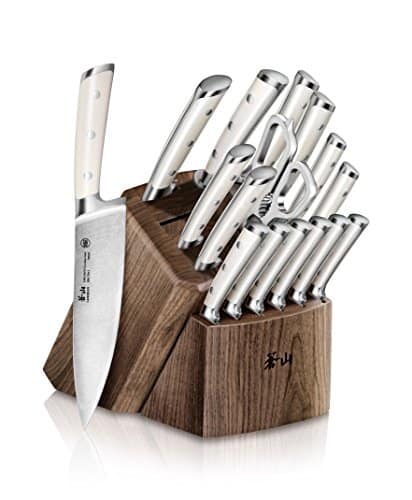
Ask which is better, German or Japanese knives, and you’ll get a strong answer from both camps. I don’t think either one wins. They’re built on two different ideas: German knives use softer, tougher steel and a thicker blade that shrugs off rough work, while Japanese knives use harder steel and a thinner edge that cuts more cleanly but asks for more care.
So the useful question is how you treat a knife. If it goes through chicken joints, gets tossed in the sink and meets the odd frozen bag, buy German. If you mostly slice vegetables, fish and boneless meat and you’ll hand wash and use a wooden board, a Japanese blade will feel sharper for longer. My pick for most cooks is the WÜSTHOF Classic 8″ Chef’s Knife; for the Japanese side, the Global G-2.
German vs Japanese Knives at a Glance
| Feature | German knives | Japanese knives |
|---|---|---|
| Typical steel | X50CrMoV15 and similar stainless | VG10, SG2, Mo/V stainless, carbon steels |
| Hardness | About 56 to 58 HRC | About 58 to 63 HRC |
| Blade | Thicker, heavier, often a full bolster | Thinner, lighter, often no bolster |
| Edge angle | Wider, traditionally around 20 degrees per side | Narrower, about 15 degrees per side or less |
| Profile | Curved belly for rocking | Flatter for push cuts and slicing |
| Handle | Riveted Western handle | Western (yo) or Japanese wa handle |
| Upkeep | Frequent honing, occasional sharpening | Hone gently, sharpen on whetstones |
| Weak spot | Edge dulls sooner | Edge can chip |
My German and Japanese Knife Picks
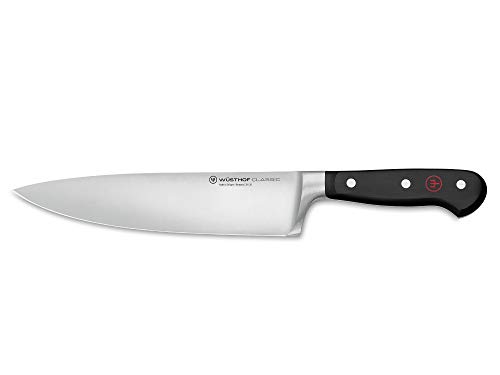
If you want to know what a German knife is, this is the reference. Forged in Solingen, full bolster, heavy enough to power through squash, and tough enough that a careless week won’t ruin it.

The Japanese counterpoint: light, thin and very sharp, with the one-piece steel handle that made Global famous. It shows the difference from the WÜSTHOF the moment you pick it up.
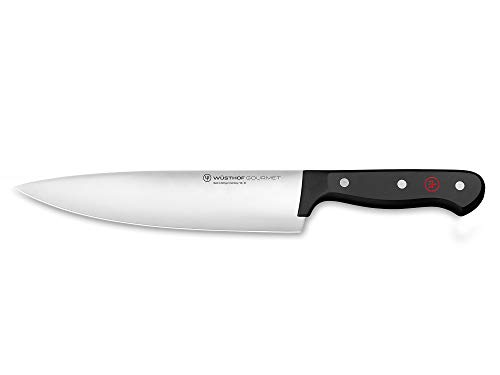
A lighter, laser-cut version of the German recipe, made in Solingen too. It’s how I’d try German steel without paying for a forged blade.

Hard VG10 steel from a long-standing Japanese maker in a plain Western handle. It’s the easiest way I know to feel a real Japanese edge.
What Makes a Knife German?
German kitchen knives come from the Solingen tradition: forged stainless steel, a full tang, a thick bolster where blade meets handle and a curved edge built for rocking. The steel is usually X50CrMoV15 or something close, hardened to about 56 to 58 HRC (HRC is the Rockwell hardness scale; higher means harder).
That softer steel is the point. It bends a little instead of chipping, so it survives bones, hard rinds and careless storage. The price is an edge that dulls sooner, which is why German knives come with a honing steel: a few strokes before cooking realign the edge. Most German makers have also moved to narrower edges than they used to, so a modern German knife is sharper out of the box than its reputation suggests.
What Makes a Knife Japanese?
Japanese kitchen knives use harder steel, often 60 HRC or more, ground much thinner behind the edge. That lets the maker sharpen to a narrower angle, so the knife glides through an onion instead of wedging it apart, and the edge stays keen for longer.
Hard and thin also means brittle. Twisting the blade, hitting a bone, cutting frozen food or using a glass board can chip a Japanese edge. Traditional Japanese knives like the yanagiba and usuba are single-beveled specialists, but the Japanese chef’s knife, the gyuto, is double-beveled and made for Western kitchens. My best gyuto knife guide covers the shape in depth.
The Differences That Matter in the Kitchen
Steel hardness decides edge life and toughness
Harder steel holds an edge longer but chips; softer steel dulls sooner but rolls back into line with a steel. Neither is better. It depends on whether you’d rather hone often or baby the edge.
Edge angle decides how sharp it feels
A narrower edge cuts with less force. Japanese knives are usually sharpened to about 15 degrees per side or less; German knives were traditionally around 20, and many now sit in between. That gap is most of what people mean when they say Japanese knives are sharper.
Weight changes how you cut
A German chef’s knife lets its weight do some of the work, which helps on dense vegetables. A Japanese knife is lighter and relies on its edge, which feels nimble for long prep sessions but gives less help on a butternut squash.
The bolster affects sharpening
A full German bolster protects your fingers and adds balance, but it gets in the way when you sharpen the heel of the blade. Most Japanese knives have a half bolster or none, so the whole edge can be sharpened.
Care is different, not harder
Both styles should be hand washed and dried. German knives want a honing steel; Japanese knives prefer a ceramic rod or a whetstone, and a pull-through sharpener made for German knives can damage a hard Japanese edge.
Which One Should You Buy?
Buy German if you’re hard on knives
If you break down chickens, cut through rinds and don’t want to think about your knife, German steel is the safer choice. It’s also what I’d buy for a first good knife.
Buy Japanese if you love clean, thin slices
If most of your cooking is vegetables, fish and boneless meat, and you’re happy to hand wash and cut on wood or soft plastic, a Japanese knife will make prep feel easier.
Or own one of each
Plenty of cooks keep a Japanese knife for precise work and a German one for rough jobs. That’s how I’d set up a kitchen if I wanted both feels. For a budget version, my best chef knives under $100 guide covers German, Japanese and Swiss options.
The German and Japanese Chef’s Knives I Recommend
I’ve picked a premium and a value knife from each tradition, all around 8 inches, so you can compare like with like.
1. WÜSTHOF Classic 8″ Chef’s Knife: Best German Chef’s Knife
Who it’s for: cooks who want one tough, do-everything knife that will last decades.
The Classic is WÜSTHOF’s best-selling line and, to me, the purest example of the German style. It’s forged from one piece of stainless steel, tempered to 58 HRC, with a full bolster, a triple-riveted synthetic handle and a curved belly that rocks smoothly. At 8.5 oz it has real heft, and that weight helps on carrots, squash and big onions.
What I’d warn you about is the bolster: it runs to the heel, so after years of sharpening you’ll want it ground back. And next to the Global, the edge feels a little less keen. I compare the WÜSTHOF lines in detail in my WÜSTHOF knives review.
Key specs
- Blade: 8″, forged high-carbon stainless steel, 58 HRC
- Handle: 5″, synthetic, full tang, triple riveted; full bolster
- Weight: 8.5 oz
- Made in Solingen, Germany
Pros
- Very tough, forgiving edge
- Weight helps on dense food
- A few strokes on a steel bring the edge back
Cons
- Heavy for long prep sessions
- Full bolster complicates sharpening the heel
My verdict: the German knife I’d buy once and keep. If you want light and razor-thin, pick the Global instead.
2. Global G-2 8″ Chef’s Knife: Best Japanese Chef’s Knife
Who it’s for: cooks who want a light, sharp Japanese knife in a Western chef’s knife shape.
The G-2 is one of the best-known Japanese chef’s knives in Western kitchens. The blade is molybdenum/vanadium stainless steel, and the handle is hollow stainless steel with a dimpled grip, so the whole knife is one smooth piece of metal. It’s light and balanced, and the thin edge glides through tomatoes and onions in a way the WÜSTHOF can’t match.
The handle is the reason I tell people to hold one first. It’s slim and turns slippery once your fingers are oily or wet, and some cooks never get used to it. If that worries you, the Tojiro below has a conventional handle.
Key specs
- Blade: 8″ (20 cm), molybdenum/vanadium stainless steel
- Handle: stainless steel, dimpled for grip
- Lightweight, balanced
- Lifetime warranty against defects and breakage
Pros
- Light and very sharp
- Seamless, hygienic all-steel build
- Whole edge sharpenable
Cons
- Steel handle slips when greasy
- Slim grip doesn’t suit large hands
My verdict: the classic Japanese answer to the WÜSTHOF. Hold one first if you can; if the handle suits you, you’ll love it.
3. WÜSTHOF Gourmet 8″ Chef’s Knife: Best Value German
Who it’s for: cooks who want a German-made knife without paying for forging.
The Gourmet line is laser-cut (stamped) from sheet steel rather than forged, with a polypropylene handle and no heavy bolster. It still comes from WÜSTHOF in Solingen, and it still behaves like a German knife: tough, easy to hone, happy with rough work. It’s lighter than the Classic, which some cooks prefer.
Forged vs stamped doesn’t change how sharp a knife cuts; it changes weight and balance. My hesitation is the brand premium: you pay a little for the WÜSTHOF name compared with plainer stamped knives. My WÜSTHOF Classic vs Gourmet comparison goes deeper.
Key specs
- Blade: 8″, laser-cut stamped stainless steel
- Handle: synthetic polypropylene
- Made in Solingen, Germany
- Limited lifetime warranty
Pros
- Lighter than forged German knives
- Tough, low-fuss steel
Cons
- Less heft for dense vegetables
- You pay partly for the name
My verdict: a sensible German knife for a modest outlay. If you want weight and balance, the Classic is worth the step up.
4. Tojiro DP 21cm Gyuto: Best Value Japanese
Who it’s for: cooks curious about Japanese steel who want a familiar handle.
Tojiro is a long-standing maker from Niigata, and the DP gyuto is its flagship. It has a hard VG10 edge in a Western-style handle with rivets and a small bolster, so it feels familiar to anyone coming from German knives. The 21 cm (8.2″) blade is the length I’d recommend to most home cooks.
It’s plain to look at, and VG10 asks for the usual Japanese care: no bones, no twisting, a whetstone rather than a pull-through sharpener. For Japanese knives in other shapes, see my best Japanese knife sets guide.
Key specs
- Blade: 21 cm (8.2″), VG10 steel
- Handle: Western style
- Made in Japan, hand made
- Lifetime warranty (per listing)
Pros
- Real Japanese edge with a familiar handle
- Good length for most boards
Cons
- Plain looks
- VG10 chips if misused
My verdict: the easiest way into Japanese knives. If you’re rough on blades, the WÜSTHOF Gourmet is the safer value pick.
How to Look After Each Style
- Hone German knives often. A few light strokes on a steel before cooking keep the softer edge straight.
- Use a ceramic rod or whetstone on Japanese knives. Hard edges respond better to fine abrasives than to a ribbed steel.
- Cut on wood or soft plastic. Glass, stone and ceramic boards dull every knife and chip hard ones.
- Hand wash and dry right away. Dishwashers knock edges against racks, whichever steel you own.
FAQ
Are Japanese knives better than German knives?
Not overall. Japanese knives are sharper and hold an edge longer; German knives are tougher and more forgiving. The better knife is the one that suits how you cook and how you care for it.
What is the difference between Japanese and German knife angles?
Japanese knives are usually sharpened to about 15 degrees per side or less, German knives traditionally to around 20 degrees per side. Many modern German knives now sit closer to the Japanese side. Sharpen each knife to its maker’s angle.
Is German steel good for knives?
Yes. German stainless steels like X50CrMoV15 are tough, resist rust well and are easy to hone. They don’t hold an edge as long as harder Japanese steels, so plan to hone often.
Is Japanese steel harder than German steel?
Usually, yes. Japanese kitchen knives are often around 60 HRC or above, German knives around 56 to 58 HRC. Harder steel holds a finer edge but is more likely to chip.
Are Japanese knives more expensive than German knives?
Not as a rule. Both traditions range from budget to premium, and the brand and construction (forged or stamped, handmade or factory) matter more than the country.
Which is better for a beginner?
A German knife, in most cases. It tolerates mistakes like twisting, bones and the occasional dishwasher run far better than a hard Japanese edge.
Final Verdict
If I could keep only one, I’d take the WÜSTHOF Classic 8″ for its toughness and the way it handles any job. Cooks who prize sharpness and look after their knives will be happier with the Global G-2, as long as the steel handle suits them. On a tighter budget, the WÜSTHOF Gourmet and the Tojiro DP gyuto make the same choice for less.
Still choosing a blade shape as well as a steel? My santoku vs chef’s knife comparison covers that decision.

Gary Portman is the founder and main author of Knivesadvice.com. With his extensive knowledge and experience, he is committed to assisting people in choosing the perfect knife for their needs. Through his articles, Gary shares valuable insights on various aspects of knives. With his expertise, readers can make informed decisions and find a knife that is tailored to their preferences and requirements. You can find more info about Gary here.