
HexClad knives are good-looking, sharp, well-finished Damascus knives that cost what a Shun or Miyabi costs, without the track record or the published core steel those brands give you. If you already cook on HexClad pans and want a matching set, or you’re buying a gift where looks count, they’re a fair choice. If you want the most cutting performance for the money, look elsewhere.
If you do buy HexClad, start with the HexClad 8″ Damascus chef’s knife.
My Top 6 HexClad Picks

The one HexClad knife worth owning if you only buy one: a thin, sharp 12-degree edge, a 67-layer Damascus blade and a Pakkawood handle. Handles almost every job in the kitchen.

Chef’s, bread, boning, utility and paring knives plus a honing rod. A sensible line-up with no filler knives, if you want the whole matching collection.
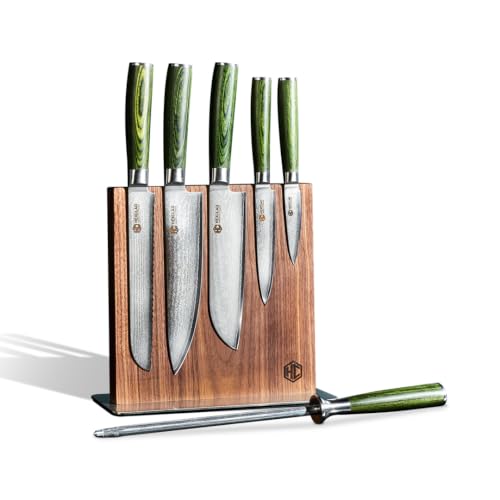
The same five knives and rod, plus a 13-inch magnetic walnut block. The block is the right way to store thin Damascus blades, so this is the set I’d choose.

A flatter, shorter-tipped alternative to the chef’s knife for chopping vegetables with an up-and-down motion. Good for cooks who find an 8-inch blade too much.
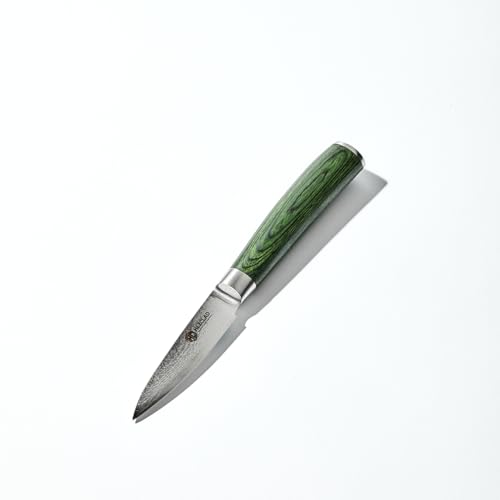
The cheapest way to try HexClad’s steel and handle. Peeling, trimming, deveining shrimp: the small jobs a chef’s knife is clumsy at.

Four full-tang Damascus steak knives with dark Pakkawood handles. A showy table set for people who like the look as much as the cut.
What HexClad Does Well
Sharp out of the box
HexClad sharpens its knives to a 12-degree edge, which is thin by Western standards and closer to Japanese practice. That makes them glide through tomatoes, onions and herbs with very little pressure. HexClad lists the blades at 60 HRC (Rockwell hardness), hard enough to hold that thin edge for a good while with regular honing.
Good looks and a consistent family
Every knife in the main line shares the same 67-layer Damascus pattern, full tang and Pakkawood handle, so a set looks like a set. If you care how knives look on a magnetic strip or the counter, HexClad delivers. The magnetic walnut block is attractive too.
A sensible set line-up
The 6-piece set includes the five knives most home cooks actually use plus a 9-inch honing rod, with no filler like a dozen steak knives or kitchen shears. That’s better thinking than many bigger blocks.
Lifetime warranty against defects
HexClad covers its cutlery for life against manufacturer’s defects. Read the exclusions, though: dishwasher damage, cutting on hard surfaces, rust and dull blades aren’t covered.
What HexClad Does Badly
It doesn’t name the core steel
This is my main complaint. On a Damascus kitchen knife, the cutting is done by the hard core steel in the middle; the 67 layers around it are mostly for looks and some stain resistance. Brands like Shun and Miyabi tell you exactly which core steel you’re getting. HexClad’s Amazon listings only say “Japanese Damascus steel”, and retailers disagree on what the core is. At this price, I want the steel named.
You pay for the name and the look
HexClad is best known for its hybrid nonstick pans and its partnership with Gordon Ramsay, and the knives carry some of that brand premium. For similar money you can buy a Shun or Miyabi with a known steel, a long history and, in Shun’s case, free sharpening. For much less, a Victorinox or Mercer cuts very nearly as well, just without the pattern; my best knife set under $200 guide has full sets that do the job for far less.
Hand wash only, and careful use
A thin, hard 12-degree edge is a precise tool. Twist it through a joint, hack at a frozen block or slice on a glass or stone board and the edge may chip, and it must never go in the dishwasher. If your household treats knives roughly, a softer German knife is the better buy.
Sizes run a little short
The “8-inch” chef’s knife has a 7.5-inch blade according to HexClad’s own listing, and the “7-inch” santoku has a 6.7-inch blade. Not a big deal, but worth knowing if you’re replacing a true 8-inch knife.
HexClad Knives Compared
| Product | What you get | Blade | Handle | Best for |
|---|---|---|---|---|
| 8″ chef’s knife | 1 knife | 7.5″ blade, 67-layer Damascus | Pakkawood, full tang | Everyday cooking |
| 6-piece set | 5 knives + 9″ honing rod | 67-layer Damascus | Pakkawood, full tang | A complete matching kit |
| 7-piece set with block | 6-piece set + 13″ magnetic walnut block | 67-layer Damascus | Pakkawood, full tang | Kit plus proper storage |
| 7″ santoku | 1 knife | 6.7″ blade, 67-layer Damascus | Pakkawood, full tang | Vegetables, smaller hands |
| 3.5″ paring knife | 1 knife | 3.2″ blade, 67-layer Damascus | Pakkawood, full tang | Peeling and trimming |
| Espresso steak set | 4 steak knives | 67-layer Damascus | Dark Pakkawood, full tang | The dinner table |
HexClad’s Amazon listings don’t say where the knives are made or name the core steel.
1. HexClad 8″ Damascus Chef’s Knife (Pakkawood): Best HexClad Knife
Who it’s for: HexClad cookware owners and anyone who wants one handsome Damascus chef’s knife.
If you buy one HexClad knife, make it this one. A chef’s knife does most of the work in any kitchen, and this one has the thin 12-degree edge and fairly flat profile that make vegetables and boneless proteins easy. The Pakkawood handle (wood veneers bonded with resin) is smooth and stable, and the full tang gives it a balanced, solid feel.
The listing gives a 7.5-inch blade on a 12.8-inch knife with a 5.2-inch handle, so it’s a touch shorter than a classic 8-inch chef’s knife. That suits small boards and smaller hands well.
My reservation is the price-to-information ratio. You’re paying premium money without being told the core steel or where it’s made. If that matters to you, my best Damascus chef knives guide lists options that name both.
Key specs
- Blade: 7.5 inches, 67-layer Japanese Damascus, 12-degree edge
- Handle: 5.2-inch Pakkawood, full tang
- Overall length: 12.8 inches
- Care: hand wash only, regular honing recommended
Pros
- Very sharp, thin edge
- Attractive and well balanced
- Lifetime warranty against defects
Cons
- Core steel not named
- Thin edge dislikes bone and frozen food
My verdict: a nice chef’s knife if you want the HexClad look. If you only care about the cut, a known-steel Japanese knife is the better use of the money.
2. HexClad 6-Piece Damascus Knife Set (Green): Best HexClad Set
Who it’s for: cooks setting up a kitchen who want one matching collection and already have somewhere to store it.
Inside the box: chef’s and bread knives (both 8 inches), a 6-inch boning knife, a 5-inch utility, a 3.5-inch parer and a 9-inch honing rod. That’s a smart, no-waste line-up: the chef’s knife for most jobs, the bread knife for crusty loaves and tomatoes, the boning knife for chicken and trimming, and the paring knife for small work.
Including a honing rod is a good touch. Thin 12-degree edges stay sharp longest when you straighten them often, and HexClad recommends frequent honing. Just use light pressure on a hard blade like this.
What it doesn’t include is storage. Damascus blades shouldn’t rattle loose in a drawer, so budget for a magnetic strip, a block or edge guards, or buy the 7-piece set instead.
Key specs
- Includes: 8″ chef’s, 8″ bread, 6″ boning, 5″ utility, 3.5″ paring, 9″ honing rod
- Blades: 67-layer Japanese Damascus, 12-degree edge
- Handles: Pakkawood, full tang, green version
- Care: hand wash only
Pros
- Useful knives only, no filler
- Honing rod included
- Consistent look across the set
Cons
- No block or storage included
- Expensive for a set whose steel isn’t named
My verdict: a well-chosen set if you’re committed to HexClad. Add proper storage straight away, or pick the 7-piece. For other premium sets, see my best Japanese knife sets.
3. HexClad 7-Piece Damascus Set With Magnetic Block: Best Set With Storage
Who it’s for: buyers who want the full HexClad kit on display and stored the right way.
This is the 6-piece set with HexClad’s 13-inch magnetic walnut block added. A magnetic block is the kindest way to store thin, hard blades: no slots for edges to drag through, no drawer contact. The walnut face is soft on the edges and looks good on a counter.
The block stands on its own on a padded stainless base, so there’s no drilling. It also shows off the Damascus pattern, which is half the point of buying HexClad. If you’d only buy the knives and then shop for storage anyway, this saves a step.
The downside is the obvious one: it’s the most expensive way into HexClad, and the block takes counter space a wall strip wouldn’t.
Key specs
- Includes: 8″ chef’s, 8″ bread, 6″ boning, 5″ utility, 3.5″ paring, 9″ honing rod, 13″ magnetic walnut block
- Blades: 67-layer Japanese Damascus, 12-degree edge
- Handles: Pakkawood, full tang, green version
- Block: free-standing walnut, padded stainless base
Pros
- Storage that protects thin edges
- Everything matches out of the box
- No wall mounting needed
Cons
- The priciest HexClad option here
- Uses counter space
My verdict: the HexClad set I’d choose, because storage matters with blades this thin. If you already own a magnetic strip, save money with the 6-piece.
4. HexClad 7″ Damascus Santoku Knife: Best for Vegetables
Who it’s for: cooks who chop more vegetables than they rock-cut herbs, or who find an 8-inch chef’s knife unwieldy.
The santoku comes from Japan as a general kitchen knife, with a flatter edge and a dropped, rounded tip. It suits a straight up-and-down chopping motion rather than the rocking motion a curved chef’s knife encourages. HexClad’s version has a 6.7-inch blade on a 12.2-inch knife with a 4.5-inch handle.
The shorter blade and blunt tip make it feel less intimidating, which is why I often suggest a santoku to people who are nervous with a big chef’s knife. The thin 12-degree edge helps with clean cuts through onions and peppers.
It’s not the knife for rocking through herbs, and the short tip is less useful for fine point work. If you’re unsure which shape you prefer, my santoku vs chef’s knife comparison explains the difference.
Key specs
- Blade: 6.7 inches, 67-layer Japanese Damascus
- Handle: 4.5-inch Pakkawood, full tang
- Overall length: 12.2 inches
- Care: hand wash only
Pros
- Easy, controlled chopping
- Less intimidating than a chef’s knife
- Same look as the rest of the line
Cons
- Poor for rocking cuts
- Not included in either HexClad set
My verdict: a good second knife, or a first one for straight choppers. Buy the chef’s knife first if you rock-cut.
5. HexClad 3.5″ Damascus Paring Knife: Best Small Knife
Who it’s for: people curious about HexClad who’d rather start small, and gift buyers.
The paring knife is the low-risk way to see whether you like HexClad’s handle and edge. Its 3.2-inch blade handles peeling, hulling strawberries, deveining shrimp and trimming small items where a big knife is clumsy.
The 4.4-inch Pakkawood handle is generous for a paring knife, which helps people with larger hands. The 7.7-inch overall length keeps it nimble.
Honestly, a paring knife is where premium steel matters least: it does short, light jobs and gets sharpened easily. A Victorinox paring knife cuts very nearly as well. You’re buying the look and a matching piece.
Key specs
- Blade: 3.2 inches, 67-layer Japanese Damascus
- Handle: 4.4-inch Pakkawood, full tang
- Overall length: 7.7 inches
- Care: hand wash only
Pros
- Cheapest way into HexClad
- Roomy handle for a paring knife
- Nice gift
Cons
- Premium steel adds little on a paring knife
- Also included in both sets
My verdict: buy it as a gift or a taste of HexClad. If you’re getting a set, skip it, since both sets include it.
6. HexClad 4-Piece Damascus Steak Knife Set (Espresso): Best Steak Knives
Who it’s for: hosts who want steak knives that look as good as the rest of the table.
These four steak knives share the main line’s 67-layer Damascus blades and full-tang construction, with darker Espresso Pakkawood handles. HexClad says the handles have anti-shrinking treatment for longer life.
Steak knives live a hard life: plates, dishwashers, kids. A Damascus steak knife on ceramic plates will dull like any other, and these must be hand washed. If your steak knives go in the dishwasher, these are the wrong choice.
For a dinner-party set you look after, they’re handsome. For everyday family use, I’d pick something cheaper and tougher from my best knife sets list.
Key specs
- Includes: 4 steak knives
- Blades: 67-layer Damascus
- Handles: Espresso Pakkawood, full tang
- Care: hand wash only
Pros
- Striking on the table
- Matches the HexClad knife line
- Solid full-tang build
Cons
- Not dishwasher safe
- Only four knives in the set
My verdict: a showpiece set for careful owners. Families who load the dishwasher should look elsewhere.
HexClad vs Other Premium Brands
HexClad vs Shun
Shun, made in Seki, Japan by Kai, names its VG-MAX core steel, has a long track record and offers free sharpening for original owners. For similar money, I’d choose Shun over HexClad for a single knife. My Shun knives review covers its lines.
HexClad vs Dalstrong
Both are marketing-heavy brands selling striking knives. Dalstrong’s Shogun line at least names AUS-10V steel and costs less. HexClad’s knives look calmer and the set line-up is more sensible. If you want a showy knife on a budget, Dalstrong; if you want the HexClad match, HexClad.
HexClad vs a plain Victorinox or Mercer
A Victorinox Fibrox or Mercer Genesis chef’s knife cuts nearly as well for daily cooking, survives rough handling better and costs much less. You give up the pattern and the luxury feel. Most cooks would be better served by the plain knife plus a good sharpener.
FAQ
Are HexClad knives good?
Yes, they’re sharp, well finished and attractive, with a 12-degree edge and 60 HRC blades. The catch is value: they cost as much as established Japanese brands but don’t name the core steel or where they’re made.
Are HexClad knives worth the money?
For HexClad cookware fans and gift buyers, yes. For cooks who want the best cutting performance for the money, no: Shun, Miyabi or a plain Victorinox give you more for the price.
Are HexClad knives dishwasher safe?
No. HexClad says to hand wash only, and its warranty excludes dishwasher damage. Wash, dry and put them away right after use.
What steel are HexClad knives made of?
HexClad describes them as 67-layer Japanese Damascus steel at 60 HRC. It doesn’t name the core steel on its Amazon listings, and retailers give different answers, so I can’t confirm it.
Do HexClad knives have a warranty?
Yes, a lifetime warranty against manufacturer’s defects. It doesn’t cover misuse, dishwasher use, rust, dulling or cutting on hard surfaces.
Final Verdict
HexClad makes attractive, sharp Damascus knives with a sensible set line-up, but you’re paying premium money for the look and the name rather than a named, proven steel. Want HexClad? Then the 8-inch chef’s knife is my buy; the 7-piece set with the magnetic block is the best full kit, and the paring knife is a nice gift or a low-risk taste.
If you’d rather compare it with knives that name their steel, my Dalstrong vs Shun comparison is a good place to start.

Gary Portman founded knivesadvice.com in 2019. He learned to cook in his family’s kitchen as a kid and has used kitchen, pocket and outdoor knives ever since, from paring and fillet knives to survival blades he carries camping and hiking. He writes the site’s buying guides, brand reviews and sharpening how-tos to help readers find the right knife for the job. More about Gary.