
Most people think of Damascus as a special kind of steel, the stuff of old swords. On a modern chef’s knife it is something simpler: a hard core steel sandwiched between dozens of thin layers of softer stainless steel, forge welded together and then etched so the layers show as ripples. The core forms the cutting edge. The layers protect it, add some stain resistance and make the knife beautiful.
That matters when you shop, because the pattern alone tells you very little. Two knives can look identical while one has a top Japanese core and the other has a cheap steel with a pattern laser printed on top. So for every knife here I looked at what sits under the pattern first: the core steel, how hard it is, who makes it and how the handle fits a home cook. Looks came second, even though they are the reason most people want a Damascus knife in the first place.
My pick is the Shun Classic 8″ Chef’s Knife, with its VG-MAX core, 68 layers and free sharpening from Shun. If you want the look for far less money, the Kyoku Shogun 8″ gives you a VG10 core and a hammered Damascus blade.
My Top 6 Damascus Chef Knife Picks

This is the Damascus chef’s knife I’d point most people to first. The VG-MAX core gets very sharp, the 68 layers give it that rippled look without being flashy, and Shun will sharpen it for free when it dulls. It comes from the line Shun calls its original, and it still feels like the reference point.
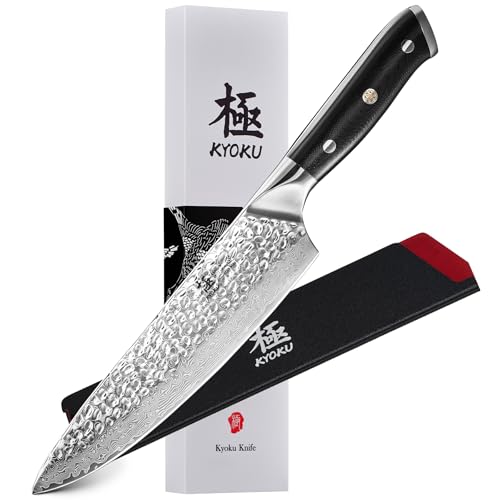
Kyoku is the brand I’d suggest to someone who wants a VG10 core and a real Damascus finish without paying Shun prices. It comes with a sheath and a case, so it’s ready to gift straight out of the box.
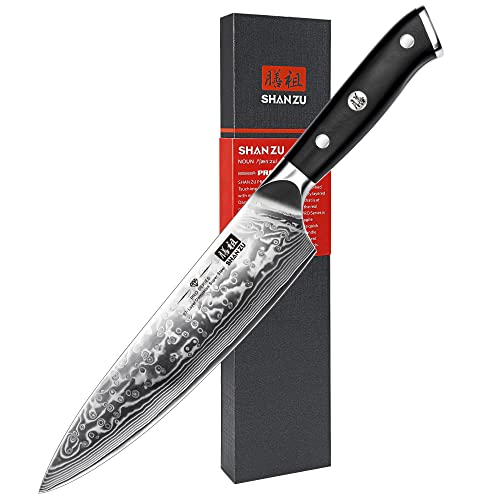
If you mainly want to see whether you like a Damascus knife, this is a low-risk way to find out. SHAN ZU says the 67 layers are folded and forged rather than etched on, and the G10 handle shrugs off water better than most cheap wood handles.

Enso combines Damascus layers with a hammered surface, and those little dimples help food fall away from the blade. It’s handcrafted in Seki, Japan, and for a made-in-Japan VG10 knife it’s priced fairly.
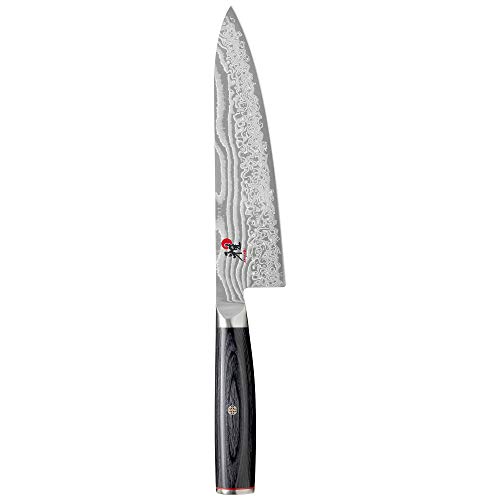
For cooks who want a thinner, more delicate blade than the Shun, I’d look at Miyabi. The Kaizen II has a fine FC61 core and an edge honed to between 9.5 and 12 degrees per side, which makes it feel quick and precise through onions and herbs.

This is the one to buy if the knife is also meant to be a centerpiece. The SG2 powder steel core and 100-layer flower pattern are stunning, and the Karelian birch handle makes every knife look a little different.
Damascus Chef Knives Compared
| Knife | Core steel | Layers | Edge angle | Handle | Best for |
|---|---|---|---|---|---|
| Shun Classic 8″ | VG-MAX | 68 | 16 degrees | D-shaped Pakkawood | Most home cooks |
| Kyoku Shogun 8″ | VG10 | 67, hammered | 8 to 12 degrees | Fiberglass (G10) | Damascus on a budget |
| SHAN ZU 8″ | 10Cr15MoV, 62 HRC | 67 | 15 degrees | G10 | Trying Damascus cheaply |
| Enso HD 8″ | VG10, 61 HRC | 37, hammered | About 12 degrees | Canvas micarta | Food release, made in Japan |
| Miyabi Kaizen II 8″ | FC61, 61 HRC | 48 | 9.5 to 12 degrees | Black Pakkawood | A thin, precise blade |
| Miyabi Birchwood SG2 8″ | SG2 powder steel | 100, flower pattern | 9.5 to 12 degrees | Karelian birch | A showpiece knife |
1. Shun Classic 8″ Chef’s Knife: Best Overall
Who it’s for: home cooks who want one excellent Japanese Damascus knife and plan to look after it.
Shun describes the Classic as the original Japanese cutlery line brought to the United States, and the 8-inch chef’s knife is still the one I’d hand to someone who asks what a good Damascus knife feels like. Shun clads a VG-MAX core in 68 layers of Damascus steel, then sharpens the edge to 16 degrees per side. That’s noticeably keener than a typical German knife, but not so thin that it feels fragile in normal use.
What wins me over is that the pattern here is honest. It is subtle, closer to wood grain than to a swirl of contrasting colors, and it sits on top of a steel that holds an edge for a long time. The D-shaped Pakkawood handle locks into the hand nicely. It works in either hand too, despite the D shape, and Shun’s free sharpening and honing service means you can send it back when it finally dulls. I go into Shun’s lines in more detail in my Shun knives review.
The weakness is the usual one for hard Japanese steel: chipping. It is the complaint I see most from Shun owners, and it nearly always comes from bones, frozen food, twisting the blade in squash or chopping on glass. Treat it as a precise tool and keep a cheap, softer knife for the rough jobs.
Key specs
- Blade: 8″, VG-MAX core with 68 layers of Damascus cladding
- Edge: 16 degrees per side
- Handle: D-shaped Pakkawood, suits left- and right-handed cooks
- Handcrafted in Japan; free sharpening and honing from Shun
Pros
- Very sharp, long-lasting edge
- Understated, elegant Damascus pattern
- Free sharpening service is a real long-term perk
Cons
- Hard steel can chip if misused
- Costs far more than the budget Damascus knives here
- Pakkawood needs hand washing and quick drying
My verdict: the safest premium Damascus chef’s knife to buy. Skip it only if you’re hard on knives or want a flashier pattern.
2. Kyoku Shogun 8″ Chef Knife: Best Value
Who it’s for: cooks who want a VG10 Damascus knife for much less than the big Japanese names, or a good-looking gift.
The Shogun series is Kyoku’s flagship, and this 8-inch knife has the specs that matter: a VG10 core, which is a well-proven Japanese stainless steel, wrapped in 67 layers with a hammered finish. Kyoku sharpens it with the traditional three-step Honbazuke method to a very acute 8 to 12 degrees per side. That is sharper than the Shun out of the box, though a thinner edge also needs a lighter touch.
I also like the practical extras. The fiberglass handle with its mosaic pin doesn’t mind water or heat the way wood can, and the knife ships with a sheath and a case. If you store knives loose in a drawer, that sheath alone saves the edge.
My reservation is the brand. Kyoku is a newer, online-first name, so you don’t get the long track record or the free sharpening service that Shun and Kai offer. Kyoku states that the steel is made in Japan, but it doesn’t say the knife itself is, so I wouldn’t buy it expecting a made-in-Seki knife at a discount.
Key specs
- Blade: 8″, VG10 core with 67 layers of hammered Damascus
- Edge: 8 to 12 degrees per side, Honbazuke sharpened
- Handle: fiberglass (G10) with mosaic pin
- Includes sheath and case
Pros
- VG10 core at a mid-range price
- Water-resistant handle
- Sheath and case included
Cons
- Very thin edge needs careful use
- Newer brand without a sharpening service
My verdict: the best balance of real core steel, looks and price on this list. Buy the Shun instead if a long brand history matters to you.
3. SHAN ZU 8″ Damascus Chef Knife: Best Budget
Who it’s for: anyone curious about Damascus knives who doesn’t want to spend much finding out.
Cheap Damascus knives are where fake patterns live, so I was picky here. SHAN ZU is one of the few budget brands that spells out what you get: a 10Cr15MoV core hardened to 62 HRC (the Rockwell hardness scale, where higher means harder and better edge holding), and 67 layers that the company says are folded and forged rather than laser etched. 10Cr15MoV is a Chinese stainless steel, not a Japanese premium steel, but at this price it’s a sensible choice.
The G10 handle is a quiet advantage. It’s a fiberglass composite that doesn’t swell, crack or soak up water, which matters more on a cheap knife than people expect, because cheap wooden handles are usually the first part to fail. The blade is 2.2mm thick and the knife weighs about 9.5 ounces, so it feels more substantial than the Japanese knives above.
What you give up is refinement. The edge needs touching up sooner than VG10 or VG-MAX would, the fit and finish is a step below the Japanese brands, and SHAN ZU’s warranty runs 12 months rather than a lifetime. If you care more about the cut than the pattern at this budget, a plain blade can be the better buy; my best chef knives under $100 guide covers those.
Key specs
- Blade: 8″ long, 2.2mm thick, 67 layers
- Core: 10Cr15MoV, 62 HRC
- Edge: 15 degrees
- Handle: G10, 5.3″; weight about 9.5 oz (270 g)
- 12-month warranty
Pros
- Real layered blade at a budget price
- Tough, water-resistant G10 handle
- Heft suits cooks who like a solid knife
Cons
- Core steel dulls sooner than premium Japanese steels
- Heavier than the Japanese picks
- Short warranty
My verdict: the Damascus knife I’d recommend as an experiment or a starter. If you already know you love the style, spend a bit more on the Kyoku.
4. Enso HD 8″ Chef’s Knife: Best Hammered Finish
Who it’s for: cooks who want a made-in-Japan VG10 knife and do a lot of slicing where food tends to stick.
Enso’s HD series pairs a VG10 core with 37 layers of Damascus and a hammered (tsuchime) surface. Fewer layers than the others here doesn’t mean a worse knife; layer count is mostly about the look, and the core does the cutting. The hammered dimples are the practical part. They create small air pockets so slices of potato or cucumber are less likely to cling to the blade.
The rest of the build is quietly sensible. The blade is hardened to 61 HRC and hand ground to about 12 degrees, and the canvas micarta handle has three rivets and a steel end cap. Micarta is a resin composite that stays grippy when damp and doesn’t need oiling, which I prefer to wood on an everyday knife. Enso makes these knives in Seki City, Japan, and backs them with a lifetime warranty.
The downside is that it looks more workmanlike than elegant. The hammered pattern hides most of the Damascus ripple, so if the swirling pattern is the reason you’re buying, the Shun or the Miyabi Birchwood will please you more.
Key specs
- Blade: 8″ (200mm), VG10 core, 37-layer hammered Damascus
- Hardness: 61 HRC; edge hand ground to about 12 degrees
- Handle: black canvas micarta, triple riveted with end cap
- Weight: 7.9 oz; spine 2mm at the heel
- Handcrafted in Seki City, Japan; lifetime warranty
Pros
- Hammered finish helps food release
- Made in Japan at a fair price
- Low-maintenance micarta handle
Cons
- Damascus pattern is mostly hidden by the hammering
- Plainer looking than the other premium picks
My verdict: the Damascus knife for people who care more about how it cuts than how it looks on the wall. Pick something else if the pattern is the point.
5. Miyabi Kaizen II 8″ Chef’s Knife: Best Thin Japanese Profile
Who it’s for: experienced home cooks who like a light, thin blade and use a good cutting board.
Miyabi is ZWILLING’s Japanese brand, and the Kaizen II shows the mix well: a traditional thin Japanese profile with German-style heat treating behind it. The core is FC61, a steel with very fine carbides, which helps it take a crisp edge and hold it. It’s hardened to 61 HRC with ZWILLING’s ice-hardening process (FRIODUR) and wrapped in 48 layers of Damascus steel.
The edge is where this knife stands apart. Miyabi hand hones it with the three-step Honbazuke method to 9.5 to 12 degrees, which is thinner than the Shun. In practice that makes onions, herbs and tomatoes feel almost effortless. The black Pakkawood handle with its mosaic pin is comfortable, though it’s a Western-style handle rather than a traditional Japanese one. If you want to know how Miyabi’s lines differ, I cover them in my Miyabi knives review.
That thin edge is also the reason I’d keep it away from beginners who chop hard or scrape the board with the edge. It rewards a gentle slicing motion.
Key specs
- Blade: 8″, FC61 core with 48 layers of Damascus steel
- Hardness: 61 HRC, FRIODUR ice hardened
- Edge: 9.5 to 12 degrees, Honbazuke hand honed
- Handle: black Pakkawood with mosaic pin
Pros
- Exceptionally keen, thin edge
- Fine-grained steel holds its sharpness well
- Comfortable Western-style handle
Cons
- Thin edge is unforgiving of rough use
- Western-style handle won’t suit traditionalists
My verdict: the sharpest-feeling knife here for its price. If you’re still learning knife skills, the Shun’s slightly sturdier edge is easier to live with.
6. Miyabi Birchwood SG2 8″ Chef’s Knife: Best Splurge
Who it’s for: a serious cook, or a gift for one, where looks matter as much as performance.
If you picture the perfect Damascus chef’s knife, it probably looks a lot like this. The blade has 100 layers in Miyabi’s flower Damascus pattern around an SG2 core. SG2 is a powder metallurgy steel: it is made from very fine steel powder rather than poured, which gives it a uniform structure, so it can be very hard and still take a remarkably fine edge. Like the Kaizen II, it’s hand honed to 9.5 to 12 degrees using the Honbazuke method and handcrafted in Seki, Japan.
The Karelian birch handle is the finishing touch. Birch burl has a marbled grain, so no two handles look quite the same. It’s lovely, but it is real wood and needs gentler care than the micarta or G10 handles above: hand wash, dry it right away and never leave it soaking.
I’ll be honest about the value. This knife won’t cut a carrot dramatically better than the Kaizen II; most of the extra money buys the steel’s edge retention, the pattern and the handle. For a collector or a special gift, that is fine. For a busy weeknight knife, it’s more than you need.
Key specs
- Blade: 8″, SG2 micro carbide powder steel core, 100-layer flower Damascus
- Edge: 9.5 to 12 degrees, Honbazuke hand honed
- Handle: Karelian birch, 5.39″ long
- Handcrafted in Seki, Japan
Pros
- Stunning blade and handle
- Premium powder steel core
- Very fine edge out of the box
Cons
- The most expensive knife here by a wide margin
- Wood handle needs careful drying
- Thin, hard edge can chip if misused
My verdict: the Damascus knife to buy when you want the best-looking blade in the kitchen. Practical buyers will be just as happy with the Kaizen II.
What Actually Matters in a Damascus Chef Knife
The core steel, not the pattern
The core steel decides how sharp a Damascus knife gets and how long it stays that way. The outer layers barely touch the food at the edge. VG10 and VG-MAX are proven Japanese stainless steels, FC61 is a fine-grained Miyabi steel, and SG2 is a premium powder steel. If a listing talks only about layers and never names the core steel, I move on.
Real layers vs a printed pattern
Real Damascus cladding is made by forge welding layers of different steels together, so the pattern runs through the metal. Some cheap knives instead have a pattern laser etched or printed onto a plain blade, which wears off with scrubbing. Stick with brands that state the core steel and layer count, and be wary of very low prices paired with dramatic swirls.
Layer count
Layer count mostly changes the look. Thirty-seven layers, 67 layers and 100 layers can all make a fine knife. More layers usually means a finer, busier pattern, not a sharper edge.
Hardness and edge angle
Harder steel (around 60 to 62 HRC) holds a thin edge longer but chips more easily, while softer German steel (about 56 to 58 HRC) is tougher and easy to hone. A thinner edge angle, like the 9.5 to 12 degrees on the Miyabis, cuts with less effort but needs a gentler hand. If you’re new to Japanese knives, I explain the trade-off in my guide to German vs Japanese knives.
Handle material
Choose the handle for how you cook. G10 and micarta are composites that ignore water and need no care. Pakkawood is resin-soaked wood that’s comfortable and fairly tough. Natural wood like birch is the prettiest and the most demanding.
Shape and length
An 8-inch (about 210mm) blade suits most home kitchens; it’s long enough for a cabbage and short enough for small boards. All six knives here are Western chef’s knife or gyuto shapes with double-bevel edges, so they work for left- and right-handed cooks. If you’re deciding between gyuto lengths and makers more broadly, see my best gyuto knife guide.
How to Keep a Damascus Blade Looking Its Best
Hand wash with a soft sponge and dry the knife right away. The pattern comes from the way the different steels react to an acid etch, so harsh scouring pads and abrasive cleaners slowly dull the contrast. Never put a Damascus knife in the dishwasher, and don’t leave it wet in the sink.
Cut on wood or soft plastic, not glass, stone or bamboo, which are hard on thin edges. Hone gently with a ceramic rod and sharpen on whetstones rather than a pull-through sharpener. Sharpening only touches the edge bevel, so the pattern on the face of the blade stays. Store the knife on a magnetic strip, in a block or with a blade guard so the edge doesn’t knock against other tools.
FAQ
Are Damascus chef knives better than regular knives?
Not automatically. A Damascus knife cuts as well as its core steel and edge allow, and the layers mostly add looks and some stain resistance. A Damascus knife with a VG10 or SG2 core is excellent; a cheap one with a patterned blade and poor steel is not.
How can I tell if a Damascus knife is real?
Look for a named core steel, a stated layer count and a brand that explains how the blade is made. Real Damascus cladding shows the pattern through the steel, including at the spine. A pattern that looks perfectly printed, wears off when scrubbed or comes on a knife with no stated steel is a warning sign.
Do Damascus knives rust?
The knives on this list use stainless cores and stainless cladding, so they resist rust well, but they can still spot or stain if left wet. Wash, dry and put them away promptly. Traditional carbon steel Damascus knives need even more care.
Does sharpening remove the Damascus pattern?
No. Sharpening grinds only the narrow edge bevel, where the core steel shows as a plain line. The pattern on the sides of the blade stays unless you scour or polish the face of the blade.
Can Damascus chef knives go in the dishwasher?
No. Heat, detergent and knocks against other cutlery dull the edge, can chip hard steel and damage wooden or Pakkawood handles. Every maker on this list recommends hand washing.
What is the best Damascus chef knife for a beginner?
The Shun Classic is my pick for a beginner who will hand wash and use a good board, thanks to its slightly sturdier 16-degree edge and free sharpening. For a beginner on a budget, the SHAN ZU is the least painful way to learn.
Final Verdict
The Shun Classic 8″ Chef’s Knife is the Damascus chef’s knife I’d buy first: a proven VG-MAX core, a restrained pattern and Shun’s free sharpening for the long haul. For a real VG10 Damascus blade at a friendlier price, the Kyoku Shogun 8″ is my value pick. And if you want the knife that turns heads every time it leaves the block, save up for the Miyabi Birchwood SG2.
Prefer to buy a few matching knives at once? My guide to the best Japanese knife sets includes several Damascus options.

Gary Portman founded knivesadvice.com in 2019. He learned to cook in his family’s kitchen as a kid and has used kitchen, pocket and outdoor knives ever since, from paring and fillet knives to survival blades he carries camping and hiking. He writes the site’s buying guides, brand reviews and sharpening how-tos to help readers find the right knife for the job. More about Gary.