
A real automatic knife for under $50 is either a cheap import with a spring that won’t last or a knock-off of a better knife. Amazon doesn’t sell automatics at all, which is why so many “switchblade” listings there turn out to be ordinary folders.
My advice is to spend this budget on a good assisted opener instead: you flick a tab, a spring does the rest, and the blade is open almost as fast as a button knife’s. The one I’d buy is the Kershaw Oso Sweet, a light, plain, well-made knife from a brand with a lifetime warranty. If you want something that also helps in a car emergency, the Smith & Wesson SWMP4LS has a glass breaker and a seatbelt cutter built in.
My Top 5 Assisted Openers Under $50

This is the knife I’d tell someone to buy before anything flashier. A drop point blade that suits almost every job, a textured nylon handle that’s light in the pocket, and a clip you can move to any corner. Nothing fancy, nothing missing.

The Misdirect feels more solid than you’d expect, thanks to a stainless steel handle and a frame lock. The reverse tanto blade has a strong tip for opening boxes and packages.
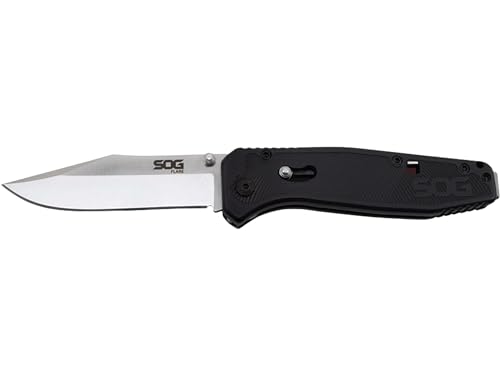
A longer blade for warehouse and job site cutting, in a light glass-reinforced nylon handle you won’t mind getting dirty. SOG’s assisted opening gets it out with one quick push.

This one earns its place for the extras: a glass breaker and seatbelt cutter on a knife that opens with a flick. It’s heavy, so I’d keep it in the glovebox or on a belt rather than in a pocket.

A hooked blade pulls rope, cord and plastic strapping toward the edge instead of letting it slide off. Add a deep-carry clip, and it’s my choice for anyone who cuts line all day.
Automatic or Assisted: What You’re Actually Buying
Automatic (switchblade)
An automatic knife opens fully when you press a button or slide a switch. A spring stored under tension does all the work, and your fingers never touch the blade. Side-opening automatics swing the blade out like a normal folder; OTF (out the front) automatics shoot it straight out of the handle. Both count as switchblades in most laws.
Assisted opening
An assisted opener is a folding knife with a spring or torsion bar that helps it open. You start the blade moving with a flipper tab, thumb stud or kick, and the spring takes over halfway. Kershaw calls its version SpeedSafe, SOG calls it S.A.T. (SOG Assisted Technology), and Smith & Wesson uses M.A.G.I.C. assist. Because you have to push the blade first, the law treats these differently from automatics in many places.
Why assisted wins at this budget
A cheap automatic has to get two hard things right: a spring strong enough to fire the blade every time and a lock tight enough to hold it once it’s out. Under $50, most get neither right for long. An assisted opener from a known brand is a simpler mechanism, so the money goes into a better lock, a warranty and steel that takes an edge. If you can stretch further and don’t need a spring at all, my best folding knives under $100 guide is the next step up.
Well-Known Automatic Knives Worth Knowing
If you decide you want a real automatic, these are names that have earned their reputations. None is sold on Amazon, so I name them without links. All of them cost well beyond this guide’s budget, and the money is in the springs, locks and steel.
- Kershaw Launch series: Kershaw’s own push-button automatics, in sizes from compact to full-size. A familiar choice if you already like Kershaw folders.
- Protech: a US maker best known for its push-button automatics.
- Microtech: the best-known name in OTF automatics, and the brand cheap knock-offs copy most.
- Boker Plus Kalashnikov: a long-running entry-level automatic from Böker’s Boker Plus line.
For OTF knives specifically, my OTF knives under $100 guide explains single vs double action and how to spot a clone.
What Matters in a Fast Opener Under $50
The lock comes first
A knife that opens fast and closes on your fingers is worse than a slow one. Liner locks and frame locks (a strip of the handle that springs behind the blade) are the most common at this level, and a few makers use their own designs, like SOG’s piston lock. If lock types are new to you, my folding knife lock types guide explains each one.
Budget steel is fine if it’s named
Expect 8Cr13MoV or a 4Cr stainless at this level. They don’t hold an edge as long as premium steel, but they sharpen in a few strokes and resist rust. A blade that only says “high carbon stainless” with no grade is a warning sign.
Pick the blade shape for your job
A drop point is the all-rounder. A tanto or reverse tanto has a stronger tip for piercing boxes and plastic. A hawkbill curves toward the edge and holds rope or cord in place while you cut. A partly serrated edge saws through webbing and seatbelts.
Think about how it carries
A fast opener should ride low and stay closed. Look for a deep-carry or reversible clip, and keep heavy knives with tools on them (glass breakers, cutters) for the car or the belt.
Is a Spring Assisted Knife Legal?
Usually more often than an automatic, but not everywhere. US federal law has exempted knives that need hand pressure on the blade to open since 2009, and many states follow the same line, while some cities limit blade length or any locking knife. Other countries can be much stricter. Check the law where you live and where you’re headed; this isn’t legal advice.
Assisted Openers Under $50 Compared
| Knife | Blade | Steel | Handle | Lock | Best for |
|---|---|---|---|---|---|
| Kershaw Oso Sweet | 3″ drop point | 8Cr13MoV | Glass-filled nylon | Liner lock | Everyday carry for most people |
| Kershaw Misdirect | 3″ reverse tanto | 4Cr14 stainless | Stainless steel | Frame lock | Solid feel, boxes and packaging |
| SOG Flare | 3.5″ straight edge | Stainless | Glass-reinforced nylon | Piston lock | Work and job site cutting |
| Smith & Wesson SWMP4LS | 3.6″ serrated clip point | 4034 stainless, black oxide | Aluminum with rubber inlay | Liner lock + safety | Glovebox and emergencies |
| Kershaw Dawnstar | 3.5″ hawkbill | 8Cr13MoV | Glass-filled nylon | Frame lock | Rope, cord, strapping |
1. Kershaw Oso Sweet (3″ Drop Point): Best Overall
Who it’s for: anyone who searched for a cheap automatic and really wants a quick, dependable pocket knife for daily jobs.
The Oso Sweet does the basics well and stops there, which is exactly what I want at this budget. A pull on the flipper and SpeedSafe snaps the 3″ drop point open; a liner lock holds it. The blade shape handles boxes, food, string and the odd splinter equally well.
At 2.8 oz it’s light enough to forget about, and the textured “scale” pattern on the nylon handle gives more grip than its smooth look suggests. The clip moves to all four positions (left or right, tip-up or tip-down), which is rare on a knife this simple and makes it a good choice for lefties.
My reservation: 8Cr13MoV dulls faster than better steels, so plan on a few strokes on a sharpener every couple of weeks if you use it daily. And the plain black handle won’t win any looks contest.
Key specs
- Blade: 3″ drop point, 8Cr13MoV, satin finish
- Handle: glass-filled nylon with textured scale pattern
- Opening: SpeedSafe assisted, flipper
- Lock: liner lock
- Closed 4.1″, overall 7.1″, weight 2.8 oz
- Clip: reversible, four positions
- Kershaw limited lifetime warranty
Pros
- Light and easy to carry daily
- Four-position clip suits left-handers
- Most useful blade shape of the five
Cons
- Budget steel needs frequent touch-ups
- Plain looks
My verdict: If you only buy one knife from this list, buy this one. People who want a tougher tip should look at the Misdirect.
2. Kershaw Misdirect (Reverse Tanto): Best Steel Handle
Who it’s for: buyers who want a knife that feels solid in the hand, mostly for packages, tape and plastic.
The Misdirect is part of Kershaw’s Everyday Starter Series, and it’s a good example of what that series gets right. A bead-blasted stainless steel handle and a frame lock make it feel like a more expensive knife, and the reverse tanto blade has a strong, angled tip that punches into cardboard without snapping.
The trade-offs come with the materials. Steel handles get slippery when wet, and the 4Cr stainless blade is the softest steel on this list, so it needs sharpening more often than the Oso Sweet. The BlackWash finish hides scratches well, which matters on a knife you’ll use as a box cutter.
Carry is flexible enough: tip-up on either side, or tip-down on the right.
Key specs
- Blade: about 3″ reverse tanto, 4Cr14 stainless, BlackWash finish
- Handle: bead-blasted stainless steel
- Opening: SpeedSafe assisted, flipper
- Lock: frame lock
- Overall 7″, weight 3.2 oz
Pros
- Feels solid for very little money
- Strong tip for piercing
- Finish hides wear
Cons
- Softest steel here, dulls quickly
- Smooth steel handle slips when wet
- Reverse tanto is less handy for food
My verdict: A sturdy little box opener that looks the part. If you’ll also cut food or rope, the Oso Sweet is more versatile.
3. SOG Flare (3.5″ Straight Edge): Best Work Knife
Who it’s for: warehouse, construction and job site workers who need a longer blade they won’t baby.
The Flare puts 3.5″ of stainless in a glass-reinforced nylon handle that keeps the weight down. SOG’s assisted opening gets it out with one hand, and SOG’s piston lock holds it open.
The clip is SOG’s low-carry reversible design, so it moves sides for lefties. I’d treat the Flare as a tool, not a showpiece: the nylon handle scuffs, and the stainless blade is a budget grade. Its job is cutting strapping and stretch wrap all day without you worrying about it.
Key specs
- Blade: 3.5″ stainless, straight edge
- Handle: glass-reinforced nylon (GRN)
- Opening: S.A.T. (SOG Assisted Technology)
- Lock: piston lock
- Closed length 4.5″
- Clip: low-carry, reversible
Pros
- Long blade, light handle
- Clip swaps sides for left-handers
- Durable handle for rough work
Cons
- Steel grade not named on the listing
- Handle scuffs and looks utilitarian
My verdict: The best working knife here. For pocket carry around town, the shorter Oso Sweet is easier to live with.
4. Smith & Wesson SWMP4LS (Glass Breaker): Best for the Car
Who it’s for: drivers who want an emergency knife in the glovebox or door pocket, and anyone who wants a safety lock on a fast opener.
This is the only knife here with rescue tools: a glass breaker and a seatbelt cutter. The 3.6″ clip point blade has serrations, which help with webbing and rope. Smith & Wesson’s M.A.G.I.C. assist opens it from the flipper, and a separate safety lock keeps it from opening when you don’t want it to.
The catch is weight. At 7.6 oz it’s the heaviest knife here by a wide margin, and you feel it in a pocket. That’s why I rank it as a car knife: it lives in the vehicle, ready when you need it, and weight doesn’t matter there.
Key specs
- Blade: 3.6″ clip point, serrated, 4034 stainless with black oxide coating
- Handle: aluminum with rubber inlay
- Opening: M.A.G.I.C. assisted, flipper
- Lock: liner lock plus safety lock
- Glass breaker and seatbelt cutter
- Overall 8.6″, weight 7.6 oz
- Limited lifetime warranty
Pros
- Built-in glass breaker and seatbelt cutter
- Safety lock
- Serrations handle webbing and rope
Cons
- Heavy for pocket carry
- Serrations are harder to sharpen at home
My verdict: Buy it for the car, not the pocket. For daily carry, the Oso Sweet or the Flare is the better knife.
5. Kershaw Dawnstar (3.5″ Hawkbill): Best Hawkbill
Who it’s for: anglers, boaters, roofers, gardeners and anyone who spends the day cutting rope, cord, twine or shrink wrap.
A hawkbill blade curves down toward the tip, so whatever you’re cutting gets pulled into the edge instead of sliding off. On cord and plastic strapping that’s a big help, and you cut with a short, controlled pulling stroke instead of sawing.
The Dawnstar adds a frame lock, a circular choil (a notch where your finger can sit close to the edge) and a deep-carry clip that works tip-up from either side. At 3.4 oz it’s light for its size thanks to weight-relieving pockets inside the handle.
The hawkbill shape is poor at slicing food or opening boxes, and it takes a different technique to sharpen. My guide on how to sharpen a hawkbill knife covers that.
Key specs
- Blade: 3.5″ hawkbill, 8Cr13MoV, BlackWash finish, false edge
- Handle: contoured glass-filled nylon with custom backspacer
- Opening: assisted, flipper
- Lock: frame lock
- Overall 7.9″, weight 3.4 oz
- Clip: deep carry, reversible tip-up
Pros
- Best blade here for rope and cord
- Deep-carry clip for either hand
- Light for a 3.5″ blade
Cons
- Poor at slicing and food prep
- Curved edge is harder to sharpen
My verdict: A specialist that’s excellent at its one job. Pair it with a drop point if you also need an all-rounder.
FAQ
What is the best automatic knife under $50?
I don’t recommend any real automatic at this budget: the springs and locks on cheap autos are where corners get cut. For the same money, the Kershaw Oso Sweet opens almost as fast with a flick of the flipper and comes from a brand with a lifetime warranty.
Is a spring assisted knife a switchblade?
No. A switchblade opens from a button or switch with no pressure on the blade. A spring assisted knife needs you to push the blade partway open first. US federal law draws the line there, though state and local laws vary.
What’s a good deep carry assisted knife under $50?
The Kershaw Dawnstar has a deep-carry clip that works from either side. The SOG Flare’s low-carry clip also keeps most of the handle inside the pocket.
Do assisted opening knives wear out?
The spring or torsion bar can eventually weaken or break after years of heavy use, and a gritty pivot slows the action. Keep the pivot clean, and choose a brand with a warranty so a broken spring is a repair, not a new knife.
Can left-handers use these knives?
Most of them. The Oso Sweet’s clip moves to all four positions, the Flare and Dawnstar clips swap sides, and the Misdirect carries tip-up on either side.
Final Verdict
Skip cheap automatics and buy a good assisted opener: it’s nearly as quick, more reliable and legal in more places. The Kershaw Oso Sweet is my pick for most people. The Smith & Wesson SWMP4LS is the one for the car, and the Kershaw Dawnstar is the one for rope and cord.
If you want manual knives that open just as quickly without a spring, see my flipper knives under $50. For something smaller to carry every day, my EDC knives under $100 guide has the most pocket-friendly options.

Gary Portman founded knivesadvice.com in 2019. He learned to cook in his family’s kitchen as a kid and has used kitchen, pocket and outdoor knives ever since, from paring and fillet knives to survival blades he carries camping and hiking. He writes the site’s buying guides, brand reviews and sharpening how-tos to help readers find the right knife for the job. More about Gary.