
Boning knives look almost identical in photos, so people buy on brand or price and then wonder why theirs feels wrong. The detail that actually matters is flex. A flexible blade bends around a chicken’s ribcage or a fish’s spine and peels off thin silverskin. A stiff blade doesn’t budge, which is what you want for pushing between the joints of a pork shoulder or along a beef bone. Semi-stiff sits in the middle and handles a bit of everything.
The second detail is shape. A curved blade rides along bone and under fat in long strokes; a straight blade gives more control at the tip for cutting around joints. Then there’s grip, because deboning is greasy, slow work and a knife that slips is dangerous. Steel comes last: softer Swiss and German blades forgive a knock against bone, while hard Japanese steel can chip.
For most home cooks, I recommend a 6-inch, curved, semi-stiff knife, and the best one is the Victorinox Fibrox Pro 6-inch Curved Boning Knife. If you mostly do poultry and fish, get the flexible Dexter-Russell 1376HBR instead.
My Top 6 Boning Knife Picks

Semi-stiff and curved, it’ll bone a chicken on Sunday and trim a pork loin on Wednesday. The Fibrox handle is about as grippy as handles get, and the knife costs little enough that you won’t baby it.

A culinary-school favorite that costs very little. One-piece Japanese high-carbon steel, a handle with textured finger points, and a curved blade that’s at home on chicken, ham and fish.

Narrow and bendy, so it follows ribcages and backbones closely and leaves very little meat behind. A traditional American butcher’s knife with a rosewood handle and brass rivets.
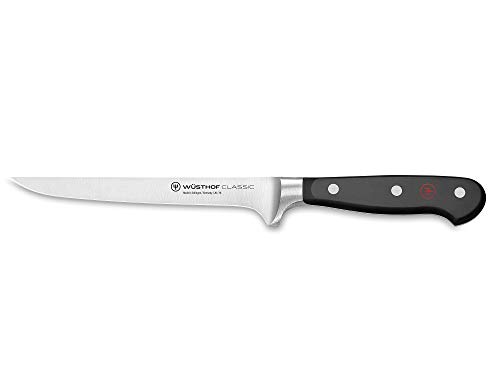
Forged, full tang and hardened to 58 HRC, this is a boning knife you buy once. WÜSTHOF calls it sturdy, and the heavier forged build suits pork and beef, and the riveted Classic handle copes well with fat.

A shorter blade is nimbler in tight joints, like a chicken thigh or a lamb shank. The seamless Four Star handle has no gaps for raw juices to hide in, and the steel is ice-hardened in Germany.

For boneless work, nothing here is sharper: skinning fish, trimming tenderloin, butterflying chicken breasts. The VG-MAX edge glides through, but it doesn’t like hard contact with bone.
Boning Knives Compared
| Knife | Blade | Flex | Handle | Best for |
|---|---|---|---|---|
| Victorinox Fibrox Pro | 6″, curved, stamped | Semi-stiff | Textured Fibrox | All-round home deboning |
| Mercer Millennia | 6″, curved, Japanese high-carbon steel | Not stated | Textured, finger points | Budget, first boning knife |
| Dexter-Russell 1376HBR | 6″, narrow, DEXSTEEL | Flexible | Rosewood, brass rivets | Poultry, fish, silverskin |
| WÜSTHOF Classic | 6″, forged, 58 HRC | Not stated (sturdy) | Riveted synthetic, full tang | Pork and beef |
| ZWILLING Four Star | 5.5″, forged, ice-hardened | Not stated | Seamless polypropylene | Tight joints, small cuts |
| Shun Classic | 6″, curved, VG-MAX, 16 degrees | Not stated | D-shaped Pakkawood | Boneless trimming, fish |
1. Victorinox Fibrox Pro 6-Inch Curved Boning Knife, Semi-Stiff: Best Overall
Who it’s for: home cooks who want one boning knife for chicken, pork, lamb and the occasional beef roast.
If you only own one boning knife, semi-stiff is the flex to get, and this Victorinox is the one I’d choose. It has enough give to follow the curve of a chicken carcass, yet enough spine to push between the joints of a pork shoulder without wobbling. The curved blade lets you take long, smooth strokes along a bone or under a layer of fat.
The Fibrox Pro handle is what keeps it at the top of my list. Deboning means greasy hands for half an hour at a time, and this textured handle stays secure when wet. It’s made in Switzerland, and Victorinox allows the dishwasher; hand washing keeps the edge keener for longer.
It’s a stamped, lightweight knife, so it doesn’t have the solid feel of the forged German picks, and it looks like a commercial tool. If you process deer or other game, my boning knives for deer guide covers that job in detail.
Key specs
- Blade: 6-inch curved, semi-stiff stainless steel
- Handle: Fibrox Pro, non-slip
- Swiss made; dishwasher safe per Victorinox
Pros
- Most versatile flex for home cooks
- Excellent grip with greasy hands
- Costs very little
Cons
- Light, stamped feel
- Plain, commercial look
My verdict: the boning knife I’d recommend to almost anyone. Only specialists need something more specific.
2. Mercer Culinary Millennia 6-Inch Curved Boning Knife: Best Budget
Who it’s for: anyone who needs a boning knife occasionally, or wants a cheap spare for messy jobs.
Mercer’s Millennia line shows up in a lot of culinary-school kits, and it’s easy to see why. This curved boning knife is made from one piece of high-carbon Japanese steel, which Mercer says is easy to maintain and holds its edge well. Mercer lists it for separating meat from bone, deboning chicken, ham and fish, and trimming fat and sinew, which covers most of what home cooks do.
The handle has textured finger points that give a secure, non-slip grip. It’s not as cushioned as the Fibrox, but it’s still one of the grippiest designs you’ll find on a cheap knife, and that matters more than steel once raw poultry has made everything slick.
Mercer doesn’t say how flexible the blade is, so expect a general-purpose feel rather than the bend of a true flexible knife. Mercer also says hand wash only; don’t put it in the dishwasher.
Key specs
- Blade: 6-inch curved, one-piece high-carbon Japanese steel
- Handle: ergonomic, textured finger points, non-slip
- For deboning chicken, ham and fish, trimming fat and sinew
- Hand wash only
Pros
- Very low cost
- Grippy handle
- Easy to sharpen
Cons
- Flex not specified
- Hand wash only
My verdict: the best cheap boning knife I know. If you debone every week, the Victorinox is worth the small step up.
3. Dexter-Russell 1376HBR 6-Inch Flexible Boning Knife: Best Flexible
Who it’s for: cooks who mostly debone poultry and fish, or trim silverskin and sinew.
A flexible boning knife bends to follow the bone instead of cutting into it, which means cleaner carcasses and less wasted meat. The Dexter-Russell 1376HBR is a classic example: a narrow, flexible 6-inch blade that glides around joints and ribcages, and that Dexter-Russell also suggests for filleting thin meats and fish.
It’s a traditional American knife, made in the USA, with Dexter-Russell’s DEXSTEEL high-carbon steel and a rosewood handle fixed with brass rivets. I like its old-school look, and the narrow blade gives very good control at the tip.
Two things to know: the rosewood handle is smoother than a textured plastic one once it’s greasy, and wood needs hand washing and an occasional oiling. And a flexible blade is the wrong tool for heavy pork or beef work, where it will bend when you want it to push. For the difference between this and a fillet knife, see my boning vs fillet knife comparison.
Key specs
- Blade: 6-inch narrow, flexible, DEXSTEEL high-carbon steel
- Handle: rosewood, brass rivets
- Made in the USA
Pros
- Follows bones closely, less waste
- Great on poultry, fish and silverskin
- Classic American butcher’s knife
Cons
- Too bendy for pork and beef joints
- Wood handle is slicker and needs care
My verdict: the boning knife for chicken and fish people. If you also break down pork shoulders, choose a semi-stiff or firm knife.
4. WÜSTHOF Classic 6-Inch Boning Knife: Best German
Who it’s for: cooks who want a forged boning knife that lasts decades, and WÜSTHOF owners.
The Classic line is forged, full tang, and tempered to 58 HRC. That’s a hardness I like near bone: tough enough to resist chipping, and soft enough to hone back quickly if the edge rolls. WÜSTHOF describes this boning knife as sturdy, easy to maneuver and pointed, for removing bones and skinning meat and poultry.
Compared with the light, stamped Victorinox, it’s a heavier and more solid knife, which I prefer for pork shoulder, leg of lamb and beef roasts. The full-tang, triple-riveted handle is the same one used on the rest of the Classic line, comfortable and secure. More about the line in my WÜSTHOF knives review.
It costs a lot more than the Victorinox, and it’s hand wash only. Its sturdier build also makes it less suited to delicate fish and poultry work than a flexible knife.
Key specs
- Blade: 6-inch with a pointed tip; forged high-carbon stainless, 58 HRC
- Handle: full tang, triple riveted
- Made in Solingen, Germany; hand wash only
Pros
- Solid, controlled feel for pork and beef
- Durable, easy-to-hone steel
- Built to last
Cons
- Costs much more than the Victorinox
- Less nimble on fish and poultry
My verdict: the boning knife for people who cook a lot of pork and beef. Poultry lovers should pick a more flexible blade.
5. ZWILLING Four Star 5.5-Inch Boning Knife: Best Compact
Who it’s for: cooks who debone small cuts (chicken thighs, quail, lamb shanks) and want precise control.
A shorter blade sounds like a small difference, but in tight joints it really helps. The 5.5-inch ZWILLING Four Star lets you work right at the tip, around a thigh bone or the ball joint of a leg, with less blade to manage. It’s forged in one piece in ZWILLING’s German factory from its own high-carbon stainless steel and ice-hardened, which ZWILLING says makes the edge start sharper and stay sharper longer.
The handle is the Four Star’s signature: polypropylene permanently bonded to the tang, with no rivets or gaps. That makes it easy to clean, which I value on any knife that handles raw poultry. ZWILLING lists it as dishwasher safe.
The smooth handle isn’t as grippy as Fibrox when greasy, and the short blade is slower for long strokes on big roasts.
Key specs
- Blade: 5.5-inch, single-piece forged, ice-hardened high-carbon stainless steel
- Precision-honed, laser-controlled edge
- Handle: seamless polypropylene, bonded
- Made in Germany; dishwasher safe per ZWILLING
Pros
- Nimble in small joints
- Hygienic seamless handle
- German-made forged quality
Cons
- Smooth handle when greasy
- Short for large cuts
My verdict: a precise little knife for poultry and small joints. For big pork and beef jobs, choose a 6-inch blade.
6. Shun Classic 6-Inch Boning and Fillet Knife: Best Japanese
Who it’s for: careful cooks who mostly trim boneless meat and fish, and Shun fans.
Shun’s boning and fillet knife is the sharpest knife here. The VG-MAX core and 68 layers of Damascus cladding take a 16 degree edge that slides through tenderloin silverskin, salmon skin and chicken breast with almost no effort. The curved blade is designed for meat and fish, and the D-shaped Pakkawood handle suits both hands.
It’s also the one I’d warn you about. Hard Japanese steel can chip if you twist it against bone or lever out a joint, so this knife is best for boneless trimming, skinning and filleting. If you want to remove bones, the softer German and Swiss knives on this list are safer. Pakkawood is comfortable but smoother than Fibrox when greasy.
Shun offers free sharpening for its knives, which helps keep that edge at its best. My Shun knives review explains the brand’s lines and service.
Key specs
- Blade: 6-inch curved, VG-MAX core with 68 Damascus layers
- Edge: 16 degrees
- Handle: D-shaped Pakkawood, left or right hand
- Handcrafted in Japan
Pros
- Sharpest edge on this list
- Superb for boneless trimming and fish
- Beautiful finish
Cons
- Can chip against bone
- Expensive
- Smoother handle when greasy
My verdict: a luxury trimming and fish knife rather than a bone remover. Pair it with a Victorinox if you do both.
How to Pick the Right Boning Knife
Match the flex to the meat
Flexible blades are best for poultry, fish and silverskin; stiff blades are best for pork and beef; semi-stiff covers both reasonably well. If you cook a bit of everything, buy semi-stiff. If your main job is stripping fat and silverskin rather than removing bones, my best knife for trimming meat guide is the better place to start.
Curved or straight?
Curved blades suit long strokes along bones and under fat, which is most deboning and trimming. Straight blades give more control at the tip for cutting around joints. For most cooks, curved is the more versatile shape.
5 or 6 inches?
A 6-inch boning knife suits most home kitchens. Choose 5 to 5.5 inches for small birds and tight joints, or if you have small hands.
Grip first, steel second
Choose a handle that stays secure when greasy: textured synthetic (Fibrox, Millennia) is the safest; riveted synthetic is good; wood and Pakkawood are smoother. A slip with a narrow, pointed blade is a serious cut.
Softer steel is friendlier near bone
German and Swiss steels around 56 to 58 HRC bend rather than chip and hone back quickly. Very hard Japanese steel stays sharper but can chip if it hits bone, so keep it for boneless work.
How to Debone a Chicken Thigh
- Lay the thigh skin side down and find the bone with your fingers.
- Cut along the length of the bone with the tip of the knife, keeping the blade against the bone.
- Scrape the meat away from both sides of the bone with short strokes, keeping the edge angled toward the bone.
- Cut around the joint at each end, lift the bone, and trim any cartilage left behind.
- Hone the knife now and then as you go; a sharp boning knife is safer than a dull one.
FAQ
What is a boning knife used for?
A boning knife is used to remove meat from the bone, separate joints and trim fat, sinew and silverskin. It has a narrow, pointed blade that can follow the shape of the bone.
Should a boning knife be flexible or stiff?
Choose flexible for poultry and fish, stiff for pork and beef, and semi-stiff if you want one knife for everything. Most home cooks are best served by semi-stiff.
What size boning knife is best?
A 6-inch boning knife is best for most kitchens. A 5 to 5.5-inch blade is easier in small joints and for small hands.
Can a boning knife cut through bone?
No. A boning knife cuts around bones and through joints, not through bone. Use a meat cleaver for small bones and a bone saw for large ones.
Is a boning knife the same as a fillet knife?
No. A fillet knife is longer, thinner and more flexible, made for fish. A boning knife is shorter and firmer for meat, though flexible boning knives work on fish too.
How do you sharpen a boning knife?
Sharpen a boning knife on a whetstone at about the same angle as your other kitchen knives, working the curve of the blade in sections, and hone it often while you work. My guide on how to sharpen a boning knife walks through every step.
Final Verdict
The Victorinox Fibrox Pro 6-inch Curved Semi-Stiff Boning Knife is the one I’d recommend to most cooks: versatile flex, a superb grip and a small price. Choose the Dexter-Russell 1376HBR if you mostly bone poultry and fish, or the WÜSTHOF Classic 6-inch for a forged knife built for pork and beef.
Putting together a full meat kit? My best butcher knife sets pair a boning knife with the right breaking knife.

Gary Portman founded knivesadvice.com in 2019. He learned to cook in his family’s kitchen as a kid and has used kitchen, pocket and outdoor knives ever since, from paring and fillet knives to survival blades he carries camping and hiking. He writes the site’s buying guides, brand reviews and sharpening how-tos to help readers find the right knife for the job. More about Gary.