
A camping knife spends more time slicing onions, cutting cord and opening bags of charcoal than doing anything a survival knife is built for. So I’d buy a light, stainless, easy-to-clean blade before a big, heavy one. My pick is the Morakniv Companion Spark: a proven Swedish fixed blade with a fire starter tucked into the sheath. For the camp kitchen, the Opinel No.10 folds up and slices like a small chef’s knife.
My Top 5 Camping Knife Picks

About 4 inches of thin, stainless Scandi blade that whittles tent pegs, cuts cord and slices dinner, plus a magnesium fire starter that clips into the sheath. Bright yellow, so you’ll find it after dark.

A 3.92 inch Sandvik 12C27 blade that’s thin enough to slice tomatoes and cheese, a Virobloc ring that locks it open, and a light beech handle. The camp kitchen folder I’d pack every time.
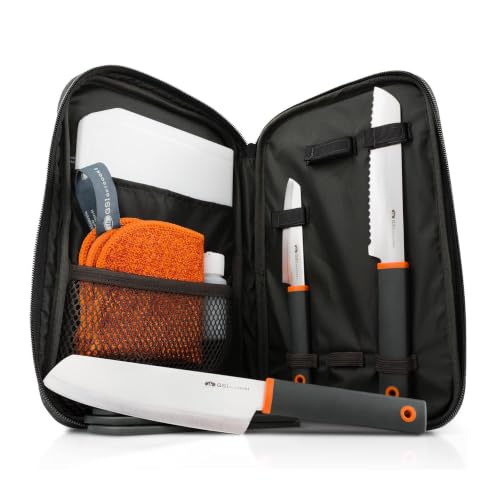
A 6 inch santoku, a 6 inch bread knife and a 4 inch parer, each in a sheath, with a folding cutting board in one zip case. Real kitchen knives for car camping, without raiding your home drawer.

A wood saw, scissors, can and bottle openers and a corkscrew around a decent small blade. It handles all the fiddly campsite jobs a single knife can’t.

A 3.8 inch high flat ground drop point in 1095 carbon steel: thicker and tougher than the Mora for splitting kindling, still a good slicer at the picnic table.
Camping Knives Compared
| Knife | Type | Blade | Steel | Weight | Best for |
|---|---|---|---|---|---|
| Morakniv Companion Spark | Fixed blade + fire starter | About 4″, Scandi grind | 12C27 stainless | 4.5 oz with sheath | All-round camp chores |
| Opinel No.10 Inox | Folding, Virobloc lock | 3.92″ | 12C27 modified stainless | Light | Camp cooking, picnics |
| GSI Santoku Camp Chef Kit | 3 sheathed kitchen knives + board | 6″ santoku, 6″ bread, 4″ paring | Stainless | 25.6 oz packed | Car camping kitchens |
| Victorinox Huntsman | Swiss Army knife, 15 functions | Small main blade | Stainless | 3.4 oz | Saw, scissors, openers |
| Kizer Drop Bear Fix 3 | Fixed blade | 3.8″, high flat grind | 1095 carbon | Medium | Kindling, heavier chores |
1. Morakniv Companion Spark (Stainless, Yellow): Best Overall
Who it’s for: tent and car campers who want one fixed blade for everything around the site, from kindling to cooking.
The Companion is the knife I point most people to for outdoor use (Morakniv is also the brand I named for outdoor value in my best knife makers guide), and the Spark version adds the one thing campers reach for every evening: a way to light the fire. A magnesium alloy fire starter clips into the side of the sheath, rated by Morakniv for about 3,000 strikes. Morakniv lists the blade at 4.1 inches (the title says 3.9) and 0.09 inches thick, in Sandvik 12C27 stainless.
That Scandi grind (one wide, flat bevel down to the edge) is why Moras carve so well. Feather sticks, tent pegs and pot hooks come easily, and the bevel sits flat on a stone, so sharpening it at the picnic table is simple. Stainless steel is the right call for a camp knife that cuts food and gets put away damp. The friction-grip handle has a finger guard, and the whole thing weighs 4.5 ounces with its sheath.
Know its limits. Like most Moras, it has a partial tang, so don’t pound it through logs with a baton; a small folding saw splits firewood far more safely. The plastic sheath works, but it’s basic, and the yellow won’t suit everyone.
Key specs
- Blade: 4.1 inch (per Morakniv), 0.09 inch thick, Sandvik 12C27 stainless, Scandi grind
- Overall length: 9.4 inches; weight with sheath: 4.5 oz
- Friction-grip polymer handle with finger guard
- Sheath with belt clip and magnesium alloy fire starter
- Made in Mora, Sweden
Pros
- Carves and slices very well
- Fire starter always with the knife
- Stainless, low care, easy to sharpen
Cons
- Partial tang, not for hard batoning
- Basic plastic sheath
My verdict: the one knife I’d put in every camping box. If you need something tougher for splitting kindling, the Kizer is the step up.
2. Opinel No.10 Inox: Best Folding Camp Knife
Who it’s for: campers who do most of their cutting at the camp stove and picnic table, and anyone who wants a big folder that slices like a kitchen knife.
The No.10 is the big brother of the classic Opinel No.8: about 5 inches closed with a 3.92 inch blade. That extra length matters at camp. It reaches across a loaf, a block of cheese or a sausage, and the thin blade slices tomatoes and onions far better than any thick outdoor knife. Opinel uses a modified Sandvik 12C27 stainless, so juice and condensation aren’t a problem.
To lock it, you twist the Virobloc ring at the bolster; Opinel has used it since 1955, and it locks the blade open for safe cutting and closed for carry. The beech handle is light and comfortable, and the knife costs very little for something made in Savoie, France, where Opinel has worked since 1890.
The weak point is the wood. If the knife gets soaked (left out in the rain or washed in a basin), the handle can swell and make the blade hard to open. Dry it well and it frees up. It’s also a two-handed opener with no clip, and it’s not built for prying or chopping.
Key specs
- Blade: 3.92 inch, Sandvik 12C27 modified stainless
- Closed length: about 5 inches
- Virobloc locking ring (open and closed)
- Beech wood handle
- Made in France
Pros
- Thin blade slices food beautifully
- Locks open and closed
- Very good value
Cons
- Wood handle swells when soaked
- Two-handed, no pocket clip
- Too delicate for heavy chores
My verdict: the best food knife you can fold into a pocket. Pair it with the Mora and you’ve covered almost every camp job.
3. GSI Outdoors Santoku Camp Chef Kit (6 pc): Best Camp Kitchen Set
Who it’s for: car campers, RV and vanlife cooks, and families who cook real meals at the site.
If you cook more than hot dogs, a proper set of kitchen knives makes camp meals far easier, and this kit keeps them together. You get a 6 inch santoku for chopping, a 6 inch serrated bread knife and a small 4 inch parer, each with its own sheath, plus a folding cutting board, a soap bottle and a dishcloth, all in a zippered ballistic nylon case.
The knives are full tang stainless with rubberized handles that stay grippy with wet or greasy hands. GSI Outdoors has made camp kitchen gear since 1985, and the whole case packs to 11.6 x 7.5 x 2 inches and weighs 25.6 ounces. That’s too heavy for a backpack, but nothing in a car.
Don’t expect premium kitchen knives. The steel isn’t named, the blades are short, and the edges will need a touch-up sooner than your chef’s knife at home. The cutting board is small for big jobs, so a family cook may still want a larger board.
Key specs
- Knives: 6 inch santoku, 6 inch serrated bread knife, 4 inch parer (each sheathed)
- Full tang stainless blades, rubberized handles
- Folding cutting board, soap bottle, dishcloth
- Zippered ballistic nylon case, 11.6 x 7.5 x 2 inches
- Total weight: 25.6 oz
Pros
- Three real kitchen shapes in one case
- Sheaths and board keep everything safe
- Grippy handles for wet hands
Cons
- Too heavy for backpacking
- Unnamed steel, average edge life
- Small cutting board
My verdict: the easiest way to give a camp kitchen proper knives. For a lighter solution, the Opinel No.10 does most of the slicing alone.
4. Victorinox Huntsman Swiss Army Knife: Best Camp Multi-Tool
Who it’s for: campers who want one pocket tool for the small jobs: opening cans and bottles, trimming cord, cutting tape and sawing a branch.
A fixed blade can’t open a can of beans or cut a neat length of moleskin. The Huntsman can. Victorinox describes it as its Officer’s knife plus a wood saw and scissors, with 15 functions in all, including a large and a small blade, can and bottle openers, a corkscrew, screwdrivers, a reamer and a multipurpose hook. It’s 3.6 inches long and weighs 3.4 ounces.
The saw is the star at camp. It cuts green branches for roasting sticks and trims dead limbs for kindling much faster than a knife, and the scissors handle first-aid tape, fishing line and food bags. It’s Swiss made, and the red scales are easy to spot in the grass.
The blades don’t lock, so it’s not a knife for hard cutting, and the main blade is too short for real food prep. At 15 functions it’s also thicker in a pocket than a plain folder.
Key specs
- 15 functions: large and small blades, wood saw, scissors, can opener, bottle opener, corkscrew, screwdrivers, reamer, multipurpose hook
- Length: 3.6 inches (91 mm); weight: 3.4 oz (97 g)
- Red ABS/Cellidor scales
- Swiss made
Pros
- Saw and scissors cover jobs a knife can’t
- Can and bottle openers for camp food
- Compact and easy to find
Cons
- Blades don’t lock
- Main blade too small for cooking
My verdict: the best companion to a fixed blade, not a replacement for one. If you’re cutting weight, the Victorinox Hiker in my backpacking guide drops the scissors.
5. Kizer Drop Bear Fix 3 (1095): Best Sturdy Fixed Blade
Who it’s for: campers who split their own kindling, make feather sticks from tougher wood or just want a thicker, more rugged blade than the Mora.
The Drop Bear Fix 3 is a sturdier camp knife from Kizer, a maker known for clean fit and finish for the money. Its 3.8 inch drop point is 1095 high carbon steel, tough and easy to sharpen, with a high flat grind that keeps it a decent slicer despite the extra strength. Jimping on the spine and a finger choil give you control for carving.
The handle uses a skeletonized tang with cross-shaped hollow screws that come apart with a flathead or Phillips driver and double as paracord points. It ships with a sheath.
1095 is a carbon steel, so this is the one knife in the guide that spots and rusts when it’s put away damp or left with onion juice on it. Wipe it, dry it and oil it lightly before it goes back in the sheath. It’s also heavier than the Mora, and the drop point is less suited to fine carving than a Scandi grind.
Key specs
- Blade: 3.8 inch drop point, 1095 high carbon steel, high flat grind
- Skeletonized tang handle, cross hollow screws
- Spine jimping and finger choil
- Sheath included
Pros
- Tough, easy-sharpening carbon steel
- Slices well for a sturdy knife
- Good control for carving
Cons
- Rusts if not dried and oiled
- Heavier than the Mora
My verdict: the camp knife for rougher work. If you mainly cook and whittle, the lighter Companion Spark is the better buy.
Choosing a Camping Knife
Fixed blade or folder?
Take a fixed blade for chores and a folder or kitchen knife for food. A fixed blade is stronger, easier to clean and safer for carving because it can’t close on your fingers. A thin folder like the Opinel is the better slicer, and a locking one-hand folder from my folding knives under $100 list is handy for packaging and cord. Many campers end up carrying one of each.
About 4 inches is enough
A blade around 3.5 to 4.5 inches handles cord, tinder, kindling and food. Longer knives are heavier and clumsier at the cutting board, and for chopping or splitting, a saw or a hatchet does the job better than any big knife.
Stainless for food and damp
Stainless steel like 12C27 is the low-care choice for a knife that cuts food and lives in a damp tent. Carbon steel (1095) is tougher and sharpens fast, but it rusts unless you dry it every time. My carbon vs stainless steel guide explains the trade-off in detail.
Thin blades cut food better
A thick survival blade wedges and crushes vegetables. For cooking, look for a thin blade with a flat grind or a fine Scandi edge, or bring a dedicated kitchen knife.
A sheath you can wash
Plastic, Kydex and nylon sheaths rinse clean; leather soaks up water and food smells. Bright handles and sheaths are easier to find in leaves and in the dark.
Plain edge over serrations
Serrations tear tomatoes, snag rope and are hard to sharpen at camp. A plain edge does more jobs and comes back with a few strokes on a small stone.
A Simple Camp Knife Kit
For most campsites, I’d pack three things: one fixed blade for chores (the Companion Spark), one food knife (the Opinel No.10 or the GSI kit), and one tool with a saw and scissors (the Huntsman). Add a pocket sharpener (I like the Lansky pocket knife sharpener for its size) and a small cutting board, and you’re covered for a weekend or a week.
If your trips are hike-in rather than drive-in, weight changes everything: my backpacking knives guide has lighter picks. And if you want to carve, build fires and practice woodcraft, my bushcraft knife guide covers knives built for that.
FAQ
What is the best knife for camping?
For most campers, a light stainless fixed blade with a blade of about 4 inches is the best camping knife. The Morakniv Companion Spark is my pick because it carves, slices and comes with a fire starter. Add a folding kitchen knife like the Opinel No.10 for cooking.
What size knife do I need for camping?
A blade of 3.5 to 4.5 inches covers almost every camping task. Smaller knives are fine for food and cord; bigger knives add weight without doing more. Use a saw for wood thicker than your wrist.
Is a survival knife good for camping?
A survival knife works for camping, but it’s often heavier and thicker than you need. Thick blades are poor at slicing food. Unless you plan to baton wood or camp far from help, a lighter camping knife is more pleasant to use.
Should I bring a separate knife for cooking?
Yes, a separate cooking knife is worth it if you cook real meals at camp. It keeps food away from sap, dirt and fish, and a thin kitchen blade slices far better. A big folder like the Opinel No.10 or a camp kitchen set like the GSI kit works well.
How do you clean a knife at a campsite?
Wash the blade with hot water and a drop of biodegradable soap, rinse it, then dry it completely before sheathing. Never store a knife wet, especially carbon steel. Wash away from lakes and streams.
Final Verdict
The Morakniv Companion Spark is the camping knife I’d buy first: light, stainless, a superb carver and always ready to light the fire. The Opinel No.10 is the folder that turns any picnic table into a kitchen, and the Victorinox Huntsman fills in with a saw, scissors and openers.
Want a smaller knife that rides in your pocket between trips? My EDC knives under $100 are built for that.

Gary Portman founded knivesadvice.com in 2019. He learned to cook in his family’s kitchen as a kid and has used kitchen, pocket and outdoor knives ever since, from paring and fillet knives to survival blades he carries camping and hiking. He writes the site’s buying guides, brand reviews and sharpening how-tos to help readers find the right knife for the job. More about Gary.