
Damascus steel is the knife world’s most beautiful marketing word. True Damascus today means pattern-welded steel: two or more steels forged together, folded and etched so the layers show as waves. It can make a great knife or a pretty, mediocre one, and on Amazon it is also printed or laser-etched onto plain steel and sold as the real thing.
What decides the quality is what the layers are made of and who stands behind them. On kitchen knives, a hard core steel such as VG-10 sits in the middle of the Damascus cladding and does the cutting. On pocket and hunting knives, the whole blade is usually Damascus, so you’re buying looks and craftsmanship first, edge holding second.
That’s why every pick below comes from a brand that names its steel or its layers and offers a warranty. My overall choice is the CIVIVI Elementum II Damascus, a small, smooth flipper that’s easy to carry every day. For the kitchen, the Shun Classic 7 inch Santoku is the one I’d buy.
My Top 6 Damascus Knife Picks
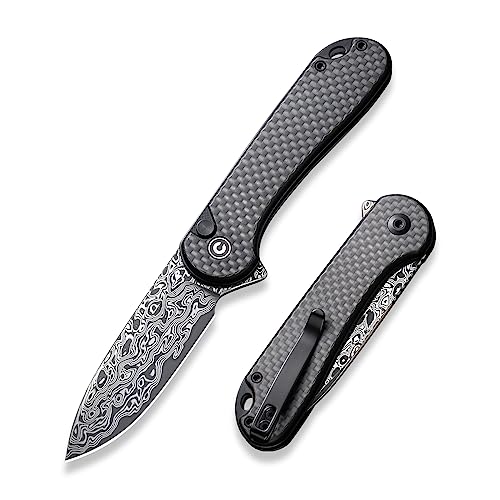
A Damascus knife you’ll actually carry: under 3 inches of blade, a ball bearing flipper that opens with a flick and a button lock. It shows the pattern without being a safe queen.

Hard VG-MAX steel does the cutting while the patterned outer layers protect it, and Shun sharpens it for free. It’s the Damascus knife that earns its place on the cutting board every day.

A full tang 3 inch Damascus clip point with genuine stag bone and a leather sheath. Small enough for caping and fine work, classic enough to hand down.

A US-made Barlow with a sheepsfoot blade folded from 416 layers. The kind of knife that turns a gift into an heirloom.

Real VG-10 core Damascus for the price of an ordinary paring knife. A cheap first taste of Japanese steel before you commit to a bigger knife.
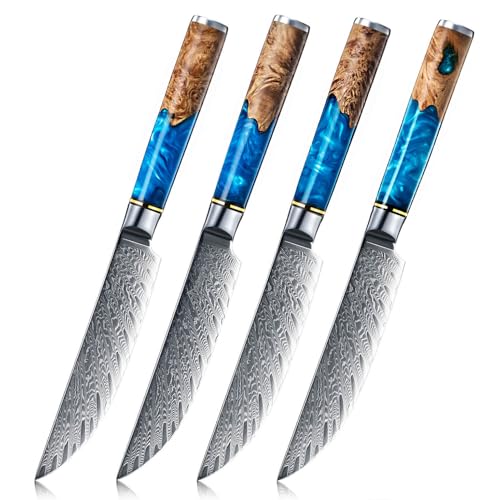
Four straight-edged VG-10 Damascus steak knives with blue resin and wood handles. Made to be noticed at the table.
Damascus Knives Compared
| Knife | Type | Blade | Construction | Handle | Best for |
|---|---|---|---|---|---|
| CIVIVI Elementum II | Folder, flipper | 2.96″ | Damascus blade | Carbon fiber | Everyday carry |
| Shun Classic Santoku | Kitchen | 7″ | VG-MAX core, 68-layer cladding | Pakkawood | Daily cooking |
| Bear & Son 563D | Fixed blade | 3″ clip point | Damascus, full tang | Stag bone | Hunting, small game |
| Bear & Son Barlow | Slipjoint folder | 2 3/4″ sheepsfoot | 416-layer Damascus | White smooth bone | Gifts, traditional carry |
| KYOKU Shogun Paring | Kitchen | 3.5″ | VG-10 core, 67 layers | Fiberglass (G10) | Peeling, small cuts |
| SENKEN Tsunami | Steak set (4) | Straight edge | VG-10, 67 layers | Resin and wood | The dinner table, gifts |
1. CIVIVI Elementum II, Damascus Blade, Carbon Fiber: Best Overall
Who it’s for: anyone who wants a Damascus pocket knife for daily carry, or a gift for someone who appreciates good tools.
CIVIVI is the more affordable sister brand of WE Knife, and the Elementum is its best-known design. This version pairs a 2.96 inch Damascus blade with carbon fiber scales. It opens with a flipper tab on a ceramic ball bearing pivot and locks with a button lock: press the button and the blade drops closed. That makes it easy to use with one hand, left or right.
I chose it as my overall pick because it’s the rare Damascus knife that’s also a sensible everyday tool. The blade is short enough for most places you’d carry a knife, its clip lets it ride deep and out of sight, and the shape is a simple drop point that handles boxes, string and food.
The catch is the steel. CIVIVI’s listing doesn’t name the steels in the Damascus, and a pattern-welded folder blade usually needs sharpening sooner than one in a modern powder steel. Keep it sharp with a fine stone and don’t expect it to outlast a plain steel workhorse.
Key specs
- Blade: 2.96 inch Damascus, drop point
- Opening: flipper on a ceramic ball bearing pivot
- Lock: button lock
- Handle: carbon fiber; deep carry clip
- CIVIVI lifetime service against defects (US service center)
Pros
- Smooth, one-handed opening and closing
- Small and light for daily carry
- Beautiful pattern on a practical shape
Cons
- Damascus steels not named on the listing
- Edge holding below premium plain steels
- Small handle for big hands
My verdict: the best Damascus knife for people who want to use it, not just admire it. If edge life matters most, buy a plain steel folder.
2. Shun Classic 7″ Santoku: Best Damascus Kitchen Knife
Who it’s for: home cooks who want one beautiful Japanese knife for vegetables, fish and boneless meat.
Here’s where Damascus does more than look good. Shun builds this santoku in Japan around a VG-MAX core, wraps it in 68 thin layers of patterned stainless and grinds the edge to 16 degrees per side. The hard core gives a fine, long-lasting edge; the soft outer layers protect it and add a little stain resistance. The pattern is the bonus.
I chose the santoku over Shun’s chef’s knife here on purpose. Its shorter, flatter blade suits cooks who push-cut or tap-chop rather than rock, and it feels nimble on a small board. If you want a full chef’s knife instead, my best Damascus chef knives guide covers those.
The usual Japanese knife cautions apply: VG-MAX is hard and can chip if you twist it, cut bones or use a glass board. Hand wash it. Shun offers free sharpening, which is a real plus, and I go deeper into the brand in my Shun knives review.
Key specs
- Blade: 7 inch santoku
- Steel: VG-MAX core with 68-layer stainless Damascus cladding
- Edge: 16 degrees per side
- Handle: D-shaped Pakkawood (fits either hand)
- Handcrafted in Japan; free sharpening and honing
Pros
- Core steel that really earns the Damascus
- Very sharp out of the box
- Free sharpening service
Cons
- Can chip on bone or frozen food
- Hand wash only
- Flat profile isn’t for rocking cuts
My verdict: the Damascus knife that does the most real work. Cooks who rock their knife should get a chef’s knife instead.
3. Bear & Son 563D Small Hunter, Stag Bone: Best Damascus Hunting Knife
Who it’s for: hunters who want a small, classic fixed blade for caping, small game and light camp work, or as a gift.
Search Amazon for a Damascus hunting knife and you’ll get a wall of unbranded “handmade” listings with no steel details and no warranty. Bear & Son is the alternative: an Alabama knife company that names its Damascus and backs this knife with a limited lifetime warranty. The 563D has a 3 inch Damascus clip point, a full tang, genuine India stag bone scales and a leather sheath, all in 6 3/8 inches overall.
The small size is the point. A 3 inch blade gives you control around eyes and ears when caping and is plenty for squirrels, birds and fish. It’s also light enough to forget on your belt until you need it.
My reservations are care and scale. Damascus and stag both need looking after: dry the blade right away, oil it, and keep the bone out of soaking water. And it’s too small to split wood or quarter an elk on its own.
Key specs
- Blade: 3 inch Damascus steel clip point
- Construction: full tang
- Overall length: 6 3/8 inches
- Handle: genuine India stag bone
- Sheath: leather; limited lifetime warranty
Pros
- Named brand with a warranty, unlike most Damascus hunters
- Precise size for detail work
- Classic stag and Damascus looks
Cons
- Too small for big game processing alone
- Blade and bone need regular care
- Costs more than generic Damascus hunters
My verdict: the Damascus hunting knife I’d trust over the no-name crowd. Buy a larger plain steel knife for heavy work.
4. Bear & Son Barlow, 416-Layer Damascus, White Bone: Best Traditional Pocket Knife
Who it’s for: fans of traditional American pocket knives and anyone shopping for a special gift.
The Barlow is one of the oldest American pocket knife patterns, recognizable by its long bolster. Bear & Son’s Vintage 4th Generation version is made in the USA with a 2 3/4 inch sheepsfoot blade of 416-layer Damascus, nickel silver bolsters and white smooth bone scales. Closed, it’s 4 inches long and weighs 2.9 ounces.
A sheepsfoot has a straight edge and a rounded tip with no point, which makes it a safe, easy blade for opening packages, whittling and cutting cord. With 416 layers, the pattern is fine and dense, almost like wood grain.
Two things to know. It’s a slipjoint, so the blade is held open by spring tension and doesn’t lock. My folding knife lock types guide explains what that means in use. And it opens with a nail nick, so it’s a two-handed knife.
Key specs
- Blade: 2 3/4 inch sheepsfoot, 416-layer Damascus
- Closed length: 4 inches; 7 inches open
- Weight: 2.9 oz
- Handle: white smooth bone, nickel silver bolsters
- Slipjoint, nail nick; made in the USA, limited lifetime warranty
Pros
- US made with a dense, fine pattern
- Safe, useful sheepsfoot blade
- Heirloom look
Cons
- No lock
- Two-handed opening
- White bone shows dirt and wear
My verdict: the Damascus knife I’d give as a milestone gift. Skip it if you need a one-hand working folder.
5. KYOKU Shogun 3.5″ Paring Knife: Best Budget
Who it’s for: cooks curious about Damascus and Japanese steel who don’t want to spend much to try it.
KYOKU’s Shogun series puts a VG-10 core inside 67 layers of Damascus, the same basic construction as far more expensive Japanese knives. This 3.5 inch paring knife is sharpened to 8 to 12 degrees, very acute for a Western knife, so it glides through apple skins, strawberry tops and garlic.
I put it here because a paring knife is the cheapest way into real Damascus, and it’s the knife you’ll reach for many times a day. The fiberglass (G10) handle doesn’t mind water, and the sheath and case keep the edge safe in a drawer.
KYOKU is a newer online brand without a sharpening service, and the knife’s country of manufacture isn’t stated. A thin, acute edge also chips if you pry with the tip. Use it for peeling and trimming, not for opening packages.
Key specs
- Blade: 3.5 inch paring
- Steel: Japanese VG-10 core, 67-layer Damascus
- Edge: 8 to 12 degrees, Honbazuke method
- Handle: fiberglass with mosaic pin; sheath and case
- Lifetime warranty
Pros
- Real VG-10 core Damascus for very little money
- Extremely sharp edge
- Comes with a sheath
Cons
- Thin tip chips if misused
- No sharpening service
- Country of manufacture not stated
My verdict: the best low-risk Damascus knife. Want a whole Damascus kitchen? Start here, then upgrade the chef’s knife.
6. SENKEN Tsunami Damascus Steak Knives, Set of 4: Best Gift Set
Who it’s for: people buying a wedding, housewarming or holiday gift, and hosts who want steak knives guests will talk about.
SENKEN makes these from 67-layer Damascus with a VG-10 steel listing, and the blades are straight-edged, not serrated. A sharp straight edge slices a steak cleanly instead of sawing and tearing it. The blue resin and wood handles make each knife look a little different, and they come in a gift box that doubles as storage.
A set is where Damascus makes the most sense as decoration: steak knives are table pieces, seen by everyone, and they don’t need the toughness of a hunting knife.
The trade-off of straight edges: they dull faster against plates than serrated knives do, so expect to sharpen them a couple of times a year. Keep them out of the dishwasher. The resin handles are bold, so this is a set for people who like color.
Key specs
- Set: 4 steak knives, non-serrated
- Steel: 67-layer Damascus, Japanese VG-10
- Construction: full tang
- Handles: blue resin and natural wood
- Gift box for storage
Pros
- Clean slicing straight edges
- Striking, one-of-a-kind handles
- Gift-ready box
Cons
- Edges dull on ceramic plates
- Hand wash only
- Only four knives in the set
My verdict: the Damascus gift that gets used at every steak dinner. For a quiet, classic table, choose plain wood handles elsewhere.
Real vs Fake Damascus: What to Look For
The pattern should go through the steel
Real Damascus is forged from layers, and the pattern runs through the metal. Fake “Damascus pattern” knives have the design laser-etched or printed on the surface of plain steel. It wears off with use and sharpening. Read listings carefully: “Damascus pattern” or “Damascus style” often means a printed finish.
Look for named steels and layers
Good makers tell you what’s inside: “VG-10 core, 67 layers,” “VG-MAX with 68-layer cladding,” “416-layer Damascus.” Vague listings that only praise the beauty, never the steel, are the ones I skip. On a kitchen knife, the core steel decides how sharp it gets and how long it lasts.
Check the edge line
On a clad kitchen knife, you’ll see a thin, plain band of core steel along the edge, with the pattern above it. That’s normal and a good sign. On a whole-Damascus folder or hunter, the pattern runs right to the edge.
Prefer a brand with a warranty
Damascus is easy to fake and hard to judge from photos. A brand that offers a lifetime warranty or a sharpening service has something to lose if the steel is bad. That alone filters out most of the poor listings.
Caring for a Damascus Knife
Wash by hand, dry right away, and don’t leave it in a sink or a damp sheath. Many Damascus blades include high carbon layers that spot quickly. A thin wipe of mineral oil before storage helps a lot.
Avoid abrasive scrubbers and harsh cleaners: they dull the contrast between the layers. If the pattern fades after years of use, a knife maker can re-etch it. Sharpening on a whetstone doesn’t remove the pattern from the blade face, though it will polish the bevel bright. My carbon vs stainless steel guide explains why some layers rust and others don’t.
FAQ
What is Damascus steel?
Modern Damascus steel is pattern-welded steel: two or more steels forged together, folded into layers and etched in acid so the layers show as a wavy pattern. The original Damascus steel, made in the Middle East centuries ago, was a different crucible steel whose exact method was lost.
Are Damascus knives good?
They can be very good, depending on the steels. A kitchen knife with a hard core such as VG-10 or VG-MAX inside Damascus cladding cuts as well as any Japanese knife. Many cheap Damascus knives are mostly looks, so check the named steel and the brand.
How can you tell if a Damascus knife is real?
Real Damascus shows the pattern through the steel, including on the spine, and the listing names the steels and layers. Fakes usually say “Damascus pattern,” have a perfectly uniform printed design and show no pattern on the spine.
Does Damascus steel rust?
It can. Damascus made with stainless layers resists rust well, but many blades include carbon steel layers that spot if left wet. Dry it after washing and oil it before storage.
Is a Damascus knife worth it?
Worth it if you value the look and buy from a brand that names its steel. For pure cutting performance per dollar, a plain steel knife from the same maker usually wins.
Does layer count matter?
Not much for performance. More layers make a finer pattern; fewer layers make a bolder one. The core steel and heat treatment decide how the knife cuts.
Final Verdict
For a Damascus knife you’ll carry and use every day, the CIVIVI Elementum II is my pick. In the kitchen, the Shun Classic Santoku is the one where the Damascus cladding protects a truly excellent core steel. If you’re buying a gift, the US-made Bear & Son Barlow is the knife that gets passed down.
For more pocket knives in plain steels, see my best folding knives under $100, and for a full set of Japanese kitchen knives, my best Japanese knife sets guide.

Gary Portman founded knivesadvice.com in 2019. He learned to cook in his family’s kitchen as a kid and has used kitchen, pocket and outdoor knives ever since, from paring and fillet knives to survival blades he carries camping and hiking. He writes the site’s buying guides, brand reviews and sharpening how-tos to help readers find the right knife for the job. More about Gary.