
A titanium pocket knife almost always means a titanium handle. Titanium is light, very strong for its weight and essentially rust-proof, so it makes superb frames and scales, especially for frame locks. The blade is still steel, because titanium itself doesn’t hold an edge the way good knife steel does. That’s also why titanium shows up on dive knives, where salt water ruins most steels; my best dive knife guide has the picks.
For most people, my pick is the CJRB Lanky: a titanium handle and a 3.58 inch S90V blade at 1.36 ounces. For a lower-cost entry into titanium, the Spyderco Tenacious Titanium is the one.
My Top 6 Titanium Pocket Knife Picks
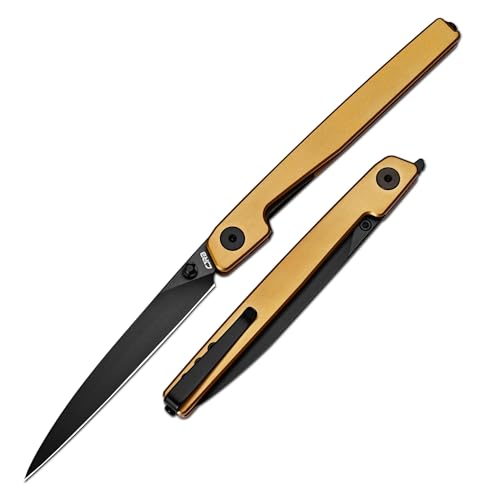
This is what titanium is for: a long, slim knife that weighs about as much as a pen. Jake Diaz’s wharncliffe design, a CPM S90V blade that holds an edge for ages and a liner lock, from a brand I already trust for value.

Spyderco’s long-running Tenacious, rebuilt with solid titanium scales and a frame lock. The steel is the familiar budget 8Cr13MoV, so you’re buying a premium handle on a sensible blade.

Only 0.315 inches thick, with a crossbar lock that works the same in either hand and a 3.18 inch 154CM blade. The nicest pocket feel here.

A Rick Hinderer design built in the USA by Zero Tolerance: titanium frame lock, a lock bar stabilizer, KVT ball bearings and a 3.5 inch CPM 20CV blade. A hard-use knife that happens to be beautiful.

A TC4 titanium utility folder with a zirconia ceramic blade, a button lock and three ways to open it. Built for boxes, tape and packaging, and it never rusts.

The rare knife where the blade is titanium too: one piece of metal with a Kydex sheath, designed by Richard Rogers. Light and rust-proof, but read my notes on edge holding first.
Titanium Pocket Knives Compared
| Knife | Titanium part | Blade | Lock | Best for |
|---|---|---|---|---|
| CJRB Lanky | Handle | 3.58″ CPM S90V, wharncliffe | Liner lock | Light, long-lasting edge |
| Spyderco Tenacious Titanium | Handle (frame) | 3.3″ 8Cr13MoV | R.I.L. frame lock | Entry into titanium |
| Vosteed Raccoon TiSlim | Handle, clip | 3.18″ 154CM | Crossbar lock | Slim carry, either hand |
| Zero Tolerance 0562TI | Handle (frame) | 3.5″ CPM 20CV | Frame lock + stabilizer | Hard use, collectors |
| OKNIFE U1 Ultra | Handle | Zirconia ceramic | Button lock | Boxes and packaging |
| CRKT HangTi | Whole knife | 1.68″ titanium | Fixed blade, Kydex sheath | Rust-proof backup |
1. CJRB Lanky (CPM S90V, Titanium Handle): Best Overall
Who it’s for: office and city carriers who want a long blade in a knife they barely feel, and anyone stepping up to a premium steel.
The Lanky shows off titanium’s best trick. Its 3.58 inch blade is longer than most everyday knives, yet the whole knife weighs 1.36 ounces (38.5 grams), because the titanium handle is thin and the design is slim. The blade is a wharncliffe, a straight edge with a spine that curves down to the tip, which is excellent for boxes, tape and anything you’d cut on a board with a utility knife.
CPM S90V is a powder steel loaded with vanadium carbides, and that’s why it lasts so long between sharpenings. The black PVD coating gives it a soft sheen. It opens with a thumb stud or a flipper and locks with a liner lock. CJRB is Artisan Cutlery’s affordable brand, built in Artisan’s own factory, with US-based customer support; this is one of its premium models, designed by Jake Diaz.
Two things to know. S90V is slow to sharpen; you’ll want diamond plates or a guided system rather than a basic stone. And a wharncliffe has little belly, so it’s less handy for slicing an apple than a drop point.
Key specs
- Blade: 3.58″ CPM S90V, black PVD, wharncliffe
- Handle: titanium
- Weight: 1.36 oz (38.5 g)
- Opening: thumb stud and flipper (manual, not assisted)
- Lock: liner lock
- Pocket clip; designed by Jake Diaz
Pros
- Very light for a long blade
- Outstanding edge retention
- Slim, classy office carry
Cons
- S90V is slow to sharpen
- Wharncliffe isn’t great for food
My verdict: the titanium knife I’d recommend first. If you’d rather have an easy-to-sharpen steel and a frame lock, choose the Tenacious Titanium.
2. Spyderco Tenacious Titanium (8Cr13MoV, Blue): Best Value Titanium
Who it’s for: people curious about titanium who don’t want to spend premium-knife money, and fans of the classic Spyderco shape.
The Tenacious has been one of Spyderco’s most popular budget folders for years, and this version gives it solid titanium handle scales. One scale is cut to form an integral lock bar, which Spyderco calls the Reeve Integral Lock (R.I.L.), named after Chris Reeve, who popularized the frame lock. It’s a strong, simple lock: you push the bar aside with your thumb to close the knife.
The 3.3 inch full-flat-ground blade is 8Cr13MoV, a budget stainless that’s tough and very easy to sharpen but dulls sooner than 154CM or S90V. That’s the trade-off that keeps this knife affordable. The Round Hole makes opening easy, and the four-position clip lets you carry it tip-up or tip-down, left or right.
Titanium scales are smooth, so the grip is slicker than the G10 Tenacious, especially with wet hands. And like most frame locks, this one is easiest for right-handers to close.
Key specs
- Blade: 3.3″ 8Cr13MoV, full flat grind, PlainEdge
- Overall length: 7.74″
- Handle: solid titanium, blue
- Lock: Reeve Integral Lock (frame lock)
- Four-position pocket clip
Pros
- Titanium frame lock for much less money
- Easy-to-sharpen blade
- Flexible clip positions
Cons
- Budget steel dulls sooner
- Smooth titanium is slippery when wet
- Lock easiest for right-handers
My verdict: the cheapest way into a proper titanium frame lock. If edge holding matters, the Lanky or the Raccoon TiSlim are the better steel.
3. Vosteed Raccoon TiSlim (154CM, Blue Titanium): Best Slim Ambidextrous
Who it’s for: left-handers, people who carry in dress trousers, and anyone who wants a titanium knife that feels like nothing in the pocket.
Vosteed is a younger EDC brand, and the Raccoon is one of its best-known designs. The TiSlim version is the thin one: 0.315 inches thick overall, with titanium scales and a 3D-milled titanium clip. The 3.18 inch blade is 154CM, an American stainless originally made for bearings that sharpens easily and holds an edge well, a sensible middle ground between budget and super steels.
The lock is a crossbar lock, a spring-loaded bar across the handle that you pull back to close the blade. It works exactly the same for left and right hands, and you never put a finger in the blade’s path to close it. Dual-tone thumb studs handle the opening.
What I’d keep in mind: a very thin handle is comfortable in the pocket, less so in a long cutting session. And Vosteed has less of a track record than Spyderco or ZT, so long-term owner reports are thinner.
Key specs
- Blade: 3.18″ 154CM, stonewash
- Handle: blue titanium; 3D-milled titanium clip
- Thickness: 0.315″ overall
- Lock: crossbar lock (ambidextrous)
- Opening: dual-tone thumb studs
Pros
- Thinnest carry in this guide
- Truly ambidextrous lock
- Good all-round steel
Cons
- Thin handle for long cutting jobs
- Younger brand, less track record
My verdict: the best titanium knife for left-handers and slim carry. If you want maximum toughness, go for the ZT.
4. Zero Tolerance 0562TI Hinderer (CPM 20CV): Best Premium (Made in USA)
Who it’s for: people who use a knife hard every day, and collectors who want a US-made titanium flipper as a once-in-a-while gift.
Zero Tolerance is Kai USA’s premium brand, built in Oregon, and the 0562 is one of its classic collaborations with custom maker Rick Hinderer. The titanium version uses a full titanium frame lock with weight-relieving pockets milled into the inside of the front scale. A lock bar stabilizer stops the lock from bending too far when you close the knife, a known weak point on frame locks.
The 3.5 inch blade is CPM 20CV, a hard, wear-resistant powder stainless with excellent edge holding. KVT ball bearings make the flipper action fast and smooth. The pocket clip mounts on the inside of the handle, so the knife rides extra deep, and it’s reversible for left or right carry.
The obvious reservations: this is the most expensive knife here, and ZT knives are heavy for their size, the most common complaint I see from owners. 20CV also needs diamond or a guided sharpener to bring back.
Key specs
- Blade: 3.5″ CPM 20CV stainless
- Handle: titanium frame lock with lock bar stabilizer
- Opening: flipper on KVT ball bearings
- Reversible deep-carry clip (mounted inside the handle)
- Designed by Rick Hinderer; made in USA
Pros
- Built for hard use
- Premium steel and smooth action
- Made in the USA
Cons
- Heavy for its size
- Costs much more than the others
- Hard steel is slow to sharpen
My verdict: the titanium knife to buy once and keep. If light weight is why you want titanium, the Lanky is the better fit.
5. OKNIFE U1 Ultra (TC4 Titanium, Ceramic Blade): Best Titanium Utility Knife
Who it’s for: people who mostly open parcels and cut tape, and anyone who wants a titanium knife that will never rust.
The U1 Ultra is a small utility folder with a bead-blasted TC4 titanium handle (TC4 is the Chinese name for the common 6Al-4V titanium alloy). The blade is zirconium oxide ceramic, listed at 1200 HV. Ceramic is far harder than steel, so it stays sharp for a long time on cardboard and plastic, and it can’t rust at all.
It opens three ways (button, thumb stud or flipper) and closes with a button lock, the easiest lock to close safely. The blade is screwed in place to stop wobble, and the clip lets it ride deep. OKNIFE offers a lifetime warranty, per the listing.
Ceramic has one big weakness: it’s brittle. Drop it on tile, twist it in a cut or pry with it, and the tip can chip or snap. It’s also a box-and-tape tool, not a knife for whittling or food prep.
Key specs
- Blade: zirconium oxide ceramic, 1200 HV (per listing)
- Handle: TC4 titanium, 400-grit bead blast
- Lock: button lock; opening by button, thumb stud or flipper
- Screw-secured blade
- Deep-carry pocket clip; lifetime warranty
Pros
- Rust-proof handle and blade
- Stays sharp on boxes and tape
- Easy, safe button lock
Cons
- Ceramic chips if dropped or twisted
- Utility shape only
My verdict: a smart titanium box opener. For a general-purpose blade, pick the Raccoon TiSlim or the Lanky.
6. CRKT HangTi (One-Piece Titanium, 1.68″ Blade): Best All-Titanium Knife
Who it’s for: boaters, swimmers and anyone who wants a small backup blade that salt water and sweat can’t hurt.
Most “titanium knives” use titanium for the handle only. The HangTi is different: blade and handle are one piece of titanium, finished as a tiny drop point fixed blade with a 1.68 inch edge and a Kydex sheath with a lanyard. It’s designed by Richard Rogers of Magdalena, New Mexico, and CRKT covers it with a limited lifetime warranty.
A titanium blade won’t rust, it’s very light, and it isn’t magnetic. Those are the reasons titanium blades show up on dive knives. But titanium is much softer than good knife steel, so the edge rolls and dulls faster. Think of the HangTi as an always-there backup for cord, tags and food packaging, not a primary cutting tool.
It’s also a fixed blade, not a folder, so it rides in its sheath on a lanyard, a neck chain or a key ring rather than clipped in a pocket.
Key specs
- Blade: 1.68″ drop point, one-piece titanium (blade and handle)
- Type: fixed blade
- Sheath: Kydex with lanyard
- Designed by Richard Rogers
- CRKT limited lifetime warranty
Pros
- Completely rust-proof
- Featherweight backup
- Non-magnetic
Cons
- Titanium edge dulls faster than steel
- Very small blade
- Sheath carry, not a folder
My verdict: the knife to buy if “titanium” has to mean the blade too. For everyday cutting, a titanium-handled steel knife like the Lanky is far more capable.
Titanium Handle vs Titanium Blade
A titanium handle is a real upgrade; a titanium blade is a niche choice. Here’s why.
Titanium handles: light, strong, rust-proof
Titanium handles weigh far less than steel handles of the same strength, and they don’t corrode, so they’re ideal for knives carried every day in sweaty pockets. Titanium also flexes and springs back, which is why it’s the standard material for frame locks: one handle scale bends sideways to become the lock bar, usually with a hardened steel insert where it touches the blade. On most of these knives the titanium alloy is 6Al-4V (also called Grade 5 or TC4).
Titanium blades: rust-proof, but soft
Even heat-treated titanium alloys stay much softer than good knife steel, and they lack the hard carbides that keep a steel edge sharp. A titanium blade stays sharp only for light work and needs frequent touch-ups. The upside is total corrosion resistance and no magnetism, which matters to divers and some specialist users.
Watch out for “titanium coated” blades
Many listings say “titanium” when they mean a coating, such as titanium nitride (TiN) or titanium carbonitride (TiCN), on an ordinary steel blade. The coating adds color and a little scratch resistance; it doesn’t make the knife a titanium knife. Read the specs for the blade steel and the handle material separately.
What to Look For in a Titanium Knife
The blade steel matters more than the titanium
Titanium decides how a knife carries; the steel decides how it cuts. Check the blade steel first: 8Cr13MoV is budget and easy to sharpen, 154CM is a good all-rounder, and 20CV or S90V hold an edge far longer but need diamond sharpeners. My guide on carbon vs stainless steel explains the basics behind these grades.
Pick a lock you’re comfortable closing
Frame locks (Tenacious, ZT) and liner locks (Lanky) are strong and slim but mostly set up for right-handers. Crossbar and button locks (Raccoon TiSlim, U1 Ultra) work the same in either hand, and closing them never puts a finger in front of the edge. My folding knife lock types guide compares them in detail.
Expect scratches and a smooth grip
Titanium scratches more easily than you’d expect, and bead-blasted or stonewashed finishes hide that best. Plain titanium is also smoother than G10 or Micarta, so it’s less grippy when your hands are wet or oily. My knife handle materials guide compares them side by side.
Is titanium worth it?
Titanium is worth it if light weight, corrosion resistance and feel in the hand matter to you. It doesn’t make a knife cut better. As I said in my folding knives under $100 guide, more money buys premium steel, titanium and smoother action, not a stronger knife; a good G10 folder like the ones in my EDC knives under $100 guide cuts just as well.
FAQ
Are titanium pocket knives good?
Titanium pocket knives are good when the titanium is in the handle and the blade is a quality steel. You get a light, strong, rust-proof frame that lasts for decades. Knives with titanium blades are a specialty item: rust-proof but softer, so they dull faster.
Is a titanium knife better than steel?
For blades, no: steel holds an edge much better than titanium. For handles, titanium is lighter than steel at similar strength and doesn’t rust, which makes it one of the best handle materials. The best titanium knives combine both: titanium handle, steel blade.
Do titanium knives rust?
Titanium itself doesn’t rust, so titanium handles and all-titanium knives like the CRKT HangTi are rust-proof. The steel blade on a titanium-handled knife can still rust or spot, depending on the steel, so dry it after wet use.
What is a titanium frame lock?
A titanium frame lock is a lock where one titanium handle scale is cut so it springs inward behind the open blade and holds it in place. You push the scale aside to close the knife. It’s strong and slim, which is why most premium titanium folders use it.
Why are titanium knives expensive?
Titanium knives cost more because titanium is harder to machine than aluminum or steel, wears out tooling faster and costs more as raw material. Most titanium knives also pair it with premium blade steel and bearings, which adds to the price.
Final Verdict
The CJRB Lanky is the titanium pocket knife I’d buy first: a titanium handle that keeps a long S90V blade to 1.36 ounces. The Spyderco Tenacious Titanium is the budget door into titanium frame locks, and the Zero Tolerance 0562TI is the made-in-USA knife to keep for life.
Super steels and titanium both reward good care. My guide on how to sharpen a pocket knife covers the basics, and if you’re shopping for a cheaper flipper first, see my flipper knives under $50.

Gary Portman founded knivesadvice.com in 2019. He learned to cook in his family’s kitchen as a kid and has used kitchen, pocket and outdoor knives ever since, from paring and fillet knives to survival blades he carries camping and hiking. He writes the site’s buying guides, brand reviews and sharpening how-tos to help readers find the right knife for the job. More about Gary.